S5 ● E36 Out with 1000 hens, in with 1000 tomato plants
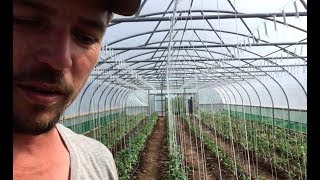
Richard Perkins converts a polytunnel from housing 1,000 laying hens to growing nearly 1,000 tomato plants. He walks through the tunnel prep, irrigation setup during a dry spell, and the staffing shifts needed to run a market garden instead of egg production. The tunnel cost about €5,000.
Chapters
So today's video, we're exchanging a thousand hens for a thousand tomato plants. So you might remember last year, the digger driver we've used to build the ponds here at the farm came and built the pad for the tunnel. And we put the tunnel up and then put down some old cow bedding as a base layer that the chickens help spread out. And then we just started layering on torv, or peat moss. And that's been the bedding throughout the winter, producing 35,000 odd euros worth of eggs over the wintertime. And now we've cleared it out and it's a big old process to prep beds and get it ready for the tomatoes. So we're using these tomahooks, which you find all over Europe, and you can get them from Johnny's in America. So our wonderful neighbor Andersh is helping to clear out the cow bedding. Last year we did it by hand, and it's a lot of work. So really nice to have a small machine that's capable of lifting this much material that's going down onto the back of the polytunnel with the chicken bedding, just to continue the compost windrows. And we'll hopefully be mixing it all up later on in the season. First eggs. So we had one last night. I predicted it come Saturday. First one came Saturday evening. Five under this one this morning. So now we open the nest boxes every morning, and it's a race against time. Got to get up here and open them up. Mr. P's up here inspecting eggs. Good morning, Mr. P. So first egg is on the EggMobile 3. And we had five under EggMobile 2. And we had. Sorry, we had two under EggMobile 2, five under EggMobile 1. So now things start to change. We have to open the nest really early in the morning so we can't be late for chores. And we have to keep. Make sure they keep clean because in the beginning, the birds are learning where this safe space is. They naturally tend to lay eggs in the nest boxes because it's the one constant area in their changing environment. Because they're moving every second day, they don't tend to go and lay out in the pasture. If anything, they will lay under the egg mobile. Especially if we're late for chores, they will lay through the floor. So our role as managers of this is to get up here early enough to open the nest boxes and keep the nest boxes clean so we get clean eggs. And part of that will be determining when approximately half the eggs are laid, because the quad bite we'll be using for collecting the eggs has got enough capacity for about half the eggs. So we want to find out when that time is. That will change throughout the season, but it will be a efficient way to come along, collect half the eggs, do their second feeding. So the birds are fed now and then they'll be fed again. We've been feeding them three times a day now, just as we learn and scale up their feed ratios. But eggs will be coming exponentially now and within a week's time we would expect to be having hundreds of eggs. So big move today. Two eggmobiles coming into top field, jumping ahead of boilers. Some pretty good grass. We want to get the grass shorter for the young chicks to be able to come out and be able to find their way around. Now wouldn't normally put the hen flock in direct contact with the broilers. They'll come out in about a week. But there's such a new flock, I'm not so concerned about any disease issues. And they will pass through quickly and the ground will get a bit of recovery before the boilers come through. And then we just make sure we don't put the broilers directly on a spot where the egg mobile was standing overnight, where you get a high concentration of manure. Obviously beautiful up here. So young chicks have now got full ventilation in both doors front and back. They've screened the doors so no cats or anything could come in. But it's important. Now we're on day 17 so we're aiming to have them at 21 degrees Celsius and it's just been so hot in here. But it's cooled down massively by keeping the doors open. The birds are looking great. We've got mortality one point something percent. So it's. Yeah, it's perfect. It's a really good start for these birds and they're gonna go out in about four days time we'll have them out on the fresh ground. So the ever evolving wash station. We just made a new rack for packing. So vegetables are coming from the field to here for washing or dunking, drying, weighing and then either to the chiller or straight to packing. So we have room here for 11 of the crates and we're typically on the market selling 5 for one price, 10 for another price. And then pre packed boxes will be 10 varieties. So we pack everything into kanga boxes which keep it nice and crisp and cool. And so we built this to be able to store. We have so many of these boxes that we also put chickens in. So we can store six of these under each unit of the shelf here. And then when we come to packing, you have a pack list that will stick up on the wall and take different vegetables and pack them into paper bags in here or into veg boxes for those doing veg boxes. Got some harvest gear here and the chiller down over here. Still got two. Connect up all the plumbing and we're actually going to bring in a digger and put gravel all the way down the driveway here which gets quite wet in the winter. You can't drive a vehicle up there. So we want to put gravel down and also put gravel down here because it gets wet with all the washing, etc. So bit of work to do but just getting things in shape here before it gets super busy. So super dry at the moment and we haven't had rain for a couple of weeks and we don't have rain forecasted for another 10 days or so. We got the sprinklers working overtime and it's a bit of a job just keeping up with getting enough water down on the gardens at the moment. So this is the end result. Lots of work to put these in, but nearly a thousand tomatoes, eight different varieties so far and it's range of cherry tomatoes and some black tomatoes and good sort of main crop tomatoes, really very short season. So it's, you know, we're trying to just get a bulk supply that we can sell to restaurants, but with a bit of variety. And they're getting watered in now and then we put in a drip irrigation system. Pretty simple. This gentleman gave us all this material when we moved to the farm, so we've been just rigging it together to see if we can get that to work how we want. But pretty hot day, so not ideal for transplanting. So we're watering them in as we go and diggers busy cleaning out the cow barn, finishing off the compost windrows at the other end of the tunnel. But I hope you found that interesting process to see how we go using these expensive pieces of infrastructure for multiple uses. You know, producing valuable eggs and compost for the farm during the winter and then a high value crop, quite intense cropping throughout the summer. And for a €5,000 investment for a tunnel like this, with the ability to turn over that much in eggs as well as this scale of tomato production is really worthwhile investment. So I'm very happy with the tunnel. Again, it's from First Tunnels in the UK where we're collaborating to build caterpillar tunnels which I'm hoping to Update you on soon because they're sending me the parts they've been creating, as well as pricing for the different lengths of tunnels. So I'll make a dedicated video when I hear more about that. But excited that some of you will be able to get caterpillars this season if you want them. So that's it for today, folks. It's just a little update to show you the process as we transform the tunnel and a few other things going on at the farm. It's busy times. We're doing some restructuring and putting some more focus on the market gardens. It's a lot of work at this time of year and we've had such a dry spell that just keeping the gardens irrigated has been a big job in itself. The pump and irrigation system are working out really well, but it's, you know, we haven't had a drop of rain for two and a half, three weeks now and it looks like we might not have any more rain for 10 days or so. So busy times. We're putting Carla, who was here last year, as garden manager, back in control of the market gardens with Toby, who's been working with Curtis Stone, the urban farmer also at Roebuck Farm, Jody Roebuck's farm in New Zealand. So their skills are best suited to really managing the garden. We were thinking that we'd rotate people around the garden, but really that's just quite a lot of work to keep people informed and at different working speeds, it's much easier to have dedicated people. So we're going kind of going back to the old system. So thanks as always for watching the videos. Hope you enjoy and learn something from them and I'm enjoying making them. So great to hear your feedback and thanks for your shares and likes, etc. You can find out a lot more in our book, Making Small Farms Work. If you haven't read that, you can check it out in the links below, along with some other links to our trainings and website, etc. See you in the next video.
More from Richard


A review of short and intensive season on a mixed farm and restaurant/event space in Sweden






Alskade Kyckling Exploring complexities of poultry production in Sweden and what we stand for


