S5 ● E37 First broilers going out to pasture...
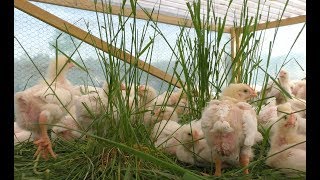
Richard Perkins moves his first batch of broilers to pasture and walks through the operation: 150-160 eggs a day now, ramping to 800 next week. Broilers sell for about €25 each at 2.2 kg. He's got €25,000 worth of three-week-old chicks in the field and plans a smokery to add value.
Chapters
So busy day as always. We got chicks going out on pasture for the first time. 10 tons of gravel arriving on the yard. Something in English then exactly the same back. It's crazy. Time went down. Here we are in Gothenburg and Gracie's been speaking Swedish on the plane. And you got to look in the cockpit too, at all the dials and buttons that make the plane work. And now we're safely here. How are you, Ning? Ning. We're watching the sprinklers border the garden, aren't we? Spin round. Water everywhere. We've been looking at chickens, the layers. And we've been looking at the broilers, haven't we? Chickens everywhere. Yeah. Is there any spider webs? Maybe some. Sleeping in the tree house. Are you excited, Gracie? A bit. Look who's here. It's morning chore time and Gracie's here. We slept in this beautiful tree house where you can see all the way down to the lake. This is the young regenerating woodland where the pigs have been and just got a couple of rams in here. But a lot of forage species coming back and the sheep are taking away the lower leaves of the trees. This is opening up into mixed species agroforestry which was the intention. So the aim is to gravel up the driveway here to make it wind and proof. Now we're using 10 to 12 mil gravel and we put fiber duck down after digging out about 1012 centimeters deep. And that's some work to move it all around. But then we should have year round car access to the workshop and to the egg factory and freezer rooms. So that'll be perfect. Shark boilers on the way out to the field. Most of the chickens coming out. I've got an escaped chicken collecting the eggs. This is half the day's eggs at the moment. So 150, 160 at the moment. Soon ramping up. This one needs to go back in. They say a picture is a thousand words and behind me it really is something. Just got the pasture boilers out today. So there's nearly a thousand birds out on pasture and 1200 birds in the eggmobiles behind them running through keyline plans. Silver arable systems with holistic plan grazing and the improvement of nutrient cycling and soil microbiology. It's a lot going on just in this frame. It's quite an intense part of the farm right now. So the birds have come out on a lovely day. It's been 26 degrees or so, which is perfect weather for them to get acclimatized to being outdoors before Night comes. And something I've said in other videos many times is you need to adapt these pens for your specific time, place and circumstance. In our case, we have predominant winds coming from the south and so we always put wind protection on one edge, one side and one end. And then we put three quarter roof sheeting over the same quadrants that have the side protection. And so because we're always moving in silver arable systems, the pens are always moving with the same wind orientation. So when they get to the end of a tree lane, they go sideways and come back still facing. The pen's still facing the same way. And that's to ensure that they've always got optimal wind protection. It looks like we're not going to have rain for quite a few more days still, so they're probably going to adjust perfectly to the outdoors. It's a very similar temperature to how it was in the brooder. You see the hens are taking shade behind the eggmobiles. We're now up at several hundred eggs a day, and this time next week, I would imagine we'll have probably 800 eggs a day. But it's working well. It's a bit cramped up here because we wanted to bring the hens through because the cows are not coming back onto our land for some time still. And we wanted to flatten the grass out to allow the young broilers to be able to move around easily when they're this young. Ideally you would have grazed with herbivores before they come in. They wouldn't make it through the long grass. It's been a really quick onset of summer. We didn't really have spring here and so in places the pasture is up to my knees already and that's not so comfy for birds coming in at this age. When they get older, then they easily trample that down and then moving the pen itself will initiate the trampling of the grasses. But very nice picture in the afternoon sun. And the guys have done a great job bringing these birds out in a comfortable manner. Felix is just fixing up the last waterers and getting enough water to the birds is important. We use individual buckets that have a gravity fed system and sometimes they leak. You need to monitor the springs. They have a little spring and filter in the unit here and you need to clean that out regularly and you need to really check the birds have enough water. Obviously, on a hot day like this, the shelter that they get for wind and rain, which is what will kill young birds easiest, is windy, rainy weather. It also acts as a Bit of a heat trap, so there's obviously a lot of airflow, but on a very still hot day, it does get quite warm for the birds. Mr. P is inspecting the work. He's very curious if other poor poultry around the farm, but, yeah, we always have a hose and reel at the edge of the field so we can come off the field sidelines and bring water to each pen. Some people like to do batch watering for multiple pens, but because of the logistics of moving these around the silver pasture lanes, we can't have any way of connecting all the pens automatically. But the next batch of birds that arrive tomorrow, they will be going into the new roller pen that we trialled last year, if you remember that from those videos, we put these same pens, but with angled roofing on wheels, and we could pull a thousand birds in four of these shelters with total cover on the roof and electric fencing. So we're going to be trialing again that system this year to see if we really like it, because we tested it with older birds and we tested it with younger birds, but we never tested it the full way through with a whole batch of beds. I wouldn't normally have broilers coming in this close behind layers, as I said in the previous video, due to the risk of passing on parasites and things like that, but because it's such a new flock of hens, I'm not so concerned about that. And they've done a good job trampling the grass. One thing to be aware of is the high nitrogen load that you'll get from young birds and on flattened grass that won't be assimilated into the topsoil so quickly, especially in this really dry weather, as it would do if the grass had been grazed. So, ideally, it would be perfect to come through and graze the land with livestock first and then bring the broilers through and have the layers on a totally separate rotation. But due to logistics and the way we've planned this year, this is the strategy we're going for, and I don't see any reason for concern. I'm not worried about any disease transmission or anything like that. But tomorrow morning we're moving two of the eggmobiles, so these two will be out of here going much further down the field, and that will leave the way a bit cleared for the broilers to start their daily march. And we'll get some good drone footage over the next couple of weeks and see how the ground is responding. Just for reference, this is what the pasture looks like before my birthday this year. If you look back to videos a year ago, it was a very different story and most of the grasses are coming into flower already and it's a job to keep up with it with the lower amount of ruminants that we have. But we've got enough poultry here to take care of things. So we'll keep to our plan for now and adjust it if we see necessary later in the year. You can see previous videos about how we plan grazing and the plan for this year. These birds are going to be sold fresh and some frozen into the winter months and some smoked this year. I'm hoping this weekend I get to finish the smokery. But these birds, we sell them now for 120 crowns a kilo, that's €12 a kilo and they will average out about 2.2. So a bird will be about €25 for a whole broiler. So there's about €25,000 of three week old chicks out on the field right now. And obviously there's going to be a few mortalities throughout the rest of the raising, but it's still at a couple of percent. That shouldn't be anything above expected. But if we are to smoke these birds, we can pretty much double the value of each individual bird. So that's why we've made the investment to build a smokery this year and learn a bit more about that craft for giving customers a more value added product that we can do on site for ourselves and increase the revenue without increasing the number of birds. I've said before we're doing less birds than we've done in previous years. This year aiming to increase the revenue but by smoking the birds instead of doing more. So the birds are going down to three feeds a day now. They've been on five feeds in the beginning, down to four feeds, and this is their last day of that. They'll be going down to three feeds a day. And that encourages them to move around a bit more in between feedings. And we go with a restricted feed program, as opposed to some people who do restricted time. So free access for a restricted time. I prefer to go with a more sort of calculated method, which has always seemed to work well for us. It's a bit more work in weighing out feed and monitoring, but that's what we're working with and I think it pays off to put that intimacy of management into the whole operation. So the brooder is eerily quiet and all the birds are out enjoying the sunshine. So a bit of work to do in here before the new Batch arrive. They come in about 4, 4 o' clock tomorrow the team are off to do a market in Christina Ham. A bit of a drive away and they'll be coming back with the chick. So a bit of coordination there. So the process for turning the brooder over is pretty simple but crucial. First we'll come in with the compressed air and just blow off the dust off the lights just to get them cleaned up so there's no buildup and risk of fire. And then we'll take out the feeders and waterers and we'll sanitize those before the new batch of chicks come in. And then we will pour about. So each of these stalls is about 10 square meters, enough for 250 birds by regulation. So what we'll do is put about one and a half watering cans up to 2 of water evenly across the whole surface and then we'll fork it over. We don't turn it over, we just work it in a bit to make sure the water is absorbed. Then we'll come back with the cleaned waterers and feeders, put them back in, put the lights back on to heat it up again. So it's been a lovely temperature in here and with the cooling down process. Remember, if you look at videos from this time of year ago it was snowing right now and the first birds needed wrapping up in the field at nighttime. But this year it's been the opposite. It's been like summer. We've had several weeks of dry weather up to 26, 28 degrees. And so we've been trying to cool it down. Bedding sitting at 25 degrees in the daytime, so that's not warm enough for the new chicks. I don't want to heat the room up even more, but I do want the lights on to warm up for the day tomorrow before the chicks arrive. So a bit more work in here. But really happy with the setup and the birds gone out look really good. Really happy with the first batch going through. So that's it for today, folks. Just a little update with the birds going out on pasture. And I'll probably do a little market garden update video next because a lot's going on in the gardens with the beautiful weather we've been having. But if you want to find out more, we've got a couple of spots left on our pastured poultry masterclass where we'll be talking through everything to do with spoilers and posted legs. And yeah, you can find out a lot more in our book Making Small Farms Work. It's a manual of how to do this stuff from scratch and adapt it to your time, place and circumstance. So thanks so much for watching, appreciate your views and comments, and share the video. If you enjoy it, don't forget to hit subscribe and you can find out a bunch more in the links below. See you in the next video.
More from Richard


A review of short and intensive season on a mixed farm and restaurant/event space in Sweden






Alskade Kyckling Exploring complexities of poultry production in Sweden and what we stand for


