S5 ● E39 There's no such thing as sustainable...
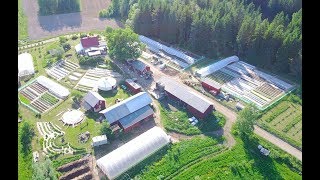
Richard Perkins tours his Swedish farm during a severe drought, moving cattle and chickens for managed grazing while rationing water and implementing emergency irrigation. He explains how planned grazing builds soil carbon and microbiology to create regenerative outcomes.
Questions this video answers
May 30, 2018
6th of June
59 degrees north
Over 90 countries
Chapters
So today we brought the cows back onto our land from changing the grazing plant due to unprecedented growth that we've been having in this extraordinary dry spell. Cows are back in top field. We've moved off our original plan to take some of this grass down. With the rapid growth we've been having, it's pretty difficult to net the chickens in and we don't want them to graze too heavily. We want them to take maybe 40% off the top of this so that there's still enough material to really hold the amount of chickens coming over soon. But we also want that chicken manure to get down onto the ground, get it synthesized in the soil. Still no rain for about seven to 10 days. Probably the driest spring for maybe over a hundred years now. Nothing in there. Busy tales at this time of year. Lots of flies. You're doing a good job. This is Violet, that's Harry. Clover. May understands that buckets can have grain in them, so you shouldn't have a bucket in here. Yeah, I'm getting the hang of it. Yeah. She's very motivated by buckets, even if they're empty. Look, it's a good way to move her if she doesn't want to come. And then. This is Clover, May's daughter, and this is Viola's daughter. We have two bulls here that are castrated, so. Sorry. One here and one here. They're castrated, so we'll take them for beef later in the year. And we just took one for beef, so we have some very nice grass, finished beef in the freezer. So squash going in, making the most of the caterpillar tunnels. Just been going through, looking at Brassica damage and seeing what things we might replace in the market gardens to get them up to speed. But it's looking good and tidy. You see from the drone footage, we've got the main farmyard under control and cut all the grass and done a bit of grounds maintenance just to catch up with the rapid growth we've been having. So it's late afternoon. Cows have done a good job in this first paddock of the day. And I'm moving them on now into this next lane. So this is a lane between a tree lane and the strawberry lanes, because I want to get two eggmobiles in, so we'll need this space as well as this space tomorrow morning. And then we will take them up, let them eat tonight and take them up back over the little track where they were digging in the. And the next day the eggmobile one, the heavy eggmobile, will come back in here. So two eggmobiles to get across here. And because we've had such a dry spell, they shouldn't sink in the mud that they left from digging down the electric line. Happy cows. So I've actually thought we need to start implementing an emergency water rationing because you can see we'll go up to the inflow of the pond, but it's extremely slow filling at this time and the stream is pretty much dried out. And I've got. I've re dammed the sort of entrance to the pipe that comes from the stream. But we're basically getting as much water as we can now from the stream. And you see it's a mere trickle and they're pumping about 30 cubic meters a day. This holds 250 cubic meters in the pond here. But the trouble is with the pond down at the level that it is, there's a lot more sediment coming up into the filter. So the filter is clogging in half an hour, 45 minutes, whereas it normally lasts three, four hours. And what I realized is that whilst it has this volume of water, you can't actually pump all of that out. And when the pond goes down by 40, 50 cm, it's half empty because narrowing down in the bottom, obviously. And so I'm concerned that it looks like on the weather report we're gonna have 30 degrees most of the week, 25 to 30, and no rain forecast for another week. So we haven't had rain for weeks now. So the streams are totally dry. You see the outflow down here. And I'll show you the stream down below which is normally running, you know, with audible sound all year round. But this year it's become just a bare trickle and it's pretty much dried up, you see, down here. And so it's. Yeah, it's really not ideal. And the house, well, has also been drying up. We use that for the field lines, this slaughtery. And that field line runs from the house around all the fields right up into the old forest up there. And at certain times the pressure becomes really low. We're running out the water down there. There's not a lot we can do actually. And what I realized is if we keep using this at the rate we have been every day, we've probably got six, seven days at the most of watering. So what I decided to do is implement a bit more of a strategic plan now with the garden gang and have it that we leave older plants that are better established and can handle a bit more of the high heat and Low watering and selectively water beds using the same pump, but using an irrigation wand and manually watering individual beds. It's a bunch more work, but it will save us a huge amount of water. And I think if we get another couple of weeks without rain, it will allow us to get through that without any serious risk of losing all the crops. It's amazing to see some of the farmers crops in the fields. It's going to have consequences this year. I think this must be the driest year for the last hundred years. It's certainly not usual. It's not usual to have grasses flowering, the sorts of grasses we see at this time of year. And it's. Yes, it's drastic in some way. Like, I feel like it'll be okay. But not having any rain for that long is very unusual here. And yeah, we need to implement something. Grapevines don't mind though. Need to start training these up there. Alder put that one on the string. See one on this one. But yeah, pretty interesting. It just really hit me today, coming to the pond that, yeah, you know, we use quite a lot of water already for it to drop down that far and we're really in trouble if it's, if it doesn't rain for another two weeks. So time to take action, measured action, and, you know, monitor and then return and make a plan and observe how that plan is going. But I think it's the right decision. And I talked to the garden crew and I think it's, it's going to make sense for us. Hey, Rylan. So underneath all this, you've got your berries that have got mulch. These are the gooseberries we just planted recently. You see the mulch mats do a pretty good job. It looks like a bit of a mess, but they're, you know, grass free at the bottom of there. But we like to leave the line so the cows can graze right up to the tree lengths. Hey, Violet. And on this side we have strawberries and the young nut trees. So we want them just to clear the edges of that and see some beautiful growth. These are nuts that I did from seed a couple of years ago. Some really nice specimens along here. One day they will overarch this whole field as a savanna, like planting. They're really nice to have this beautiful grass even, like, it really shows me like, even in this super dry weather, we've got rampant growth. The land where the cows have just been is distinctly different, both in color. Maybe you'll see on the drone footage the difference here because it's you know, we've got much deeper roots and you remember from a video last year, hey Kaz, you remember from the video last year we built about 25cm of topsoil in the time we've been here through, using the keyline plough as a subsoiler, progressively going deeper each year and then planning our grazing. But to have grass like this, of this like quality and may is something else. It's. Yeah, it's beautiful. This stuff works. It's all management based. Anyone can do that. You help. Mr. Bull, you're a beauty. Yeah, but really interesting to see our neighbor's land up here is totally stunted still. And animals have such an important role to play in nutrient cycling and in the micro hydrological cycle. Microbiological cycle, all the things that start to catalyze change. Something I always say when working with students in our trainings is that you can't really be sustainable. There's no such thing. It doesn't exist in nature anyway. We're working with exponential growth or exponential decay. And by that I mean if you put together some of the pieces of the puzzle and orchestrate this sort of movement of herbivores grazing in a planned way, mimicking nature with laying hands or boilers moving behind, paying respect to the natural life cycles of the organisms we're working with, we start building soil exponentially. And it's because each piece of the puzzle has so many connections to all the other functions in the ecosystem. If we start to increase the the nutrient load, then microbiology goes crazy to start synthesizing it. That then in turn feeds the plants. The plants in turn photosynthesize more and put down sugars in the ground, or plants releasing 2 to 50% of their hard earned sugar straight into the soil to feed life. And that life builds soil structure through the aggregates released primarily from bacteria and fungi. And it stores carbon both from root exudates, as short chain carbons, polysaccharides, and as root die back when plants are grazed as long chain carbon. And that carbon acts as a sponge that holds water. And the more water, the more life, the more life, the more sugar, the more carbon, the more carbon, more water can be stored. Every percentage increase in soil organic carbon is 144,000 liters of water per hectare that can be stored in the living topsoil exactly where plants want it. So you see what I mean about exponential. Like if you start to set off life systems, it starts to roll on its own. And likewise and importantly, decay is on the same exponential patterning Here we're going over Strawberry Row and the broilers behind me. But likewise, decay is the same. If we start to damage a landscape, it's an exponential decay because of all the interconnections between this complexity that makes up life. That's what makes farming such an incredibly potent and rewarding livelihood because we study all these different things from biology to chemistry to physics to all the trade skills that you must learn. Plumbing and carpentry and electricity and millions of things that we learned from doing this work. But I feel like as Stan, such a tantalizing thing to engage so wholeheartedly and so observation based into the surroundings and build up these intricate relationships with all these different layers that we're working with. And that's why I advocate mixed farming, you know. And sure, some people don't want to do like this, that's fine. Like it's enough work to run a market garden or to just run pastured layers or whatever it is. But there's something that happens between the different enterprises when they are designed to be synergistic and work together that is just breathtaking. It's something to behold and it's what I love about this place. I haven't been to many farms as intensely productive and diverse as this. And it's really something to behold. It's really something quite special that, yeah, I hope more of you can come and visit us and really feel that and you know, see what that is like in your experience. On another note, that's why we need to study pattern. That's why all of our trainings are based on understanding ecological patterns and functions and then how to design those to work synergistically, to cooperate with how things work in nature. Because ultimately that's where we find energy efficiency. Horse flies are back out now. Energy efficiency and robustness and resilience. And that's, you know, you could sum up. What I do is I observe natural patterns and I understand how to apply them, how to synthesize them for production landscapes. That's what I do. That's my specialism, you could say. And I love that design aspect of the work. How to really observe nature and extract the juice out of that and apply it to all of the different farming methods as far as we can. And that's a lifelong journey. It never ends. And yeah, I'm super excited about really deepening our experience with pattern. That's what we're going to be talking about every single day of our farm scale permaculture design course. Doesn't matter if I want to design tree systems whether I want to do pastured livestock, whether I want to be a market gardener. How does nature build soil? How does nature grow annuals? You know, how does nature plant tree systems? How would nature do tree systems in a pasture? How do animals work with each other, with tree systems in a pasture? And the more we develop this pattern language, the more useful we are as farmers, as human beings, and the more relaxed we can be in our work, knowing that we don't need to know everything. We can study for the rest of our lives. We can learn a lot, but we don't need to know everything. We need to understand basic building blocks and patterns. And from that we can easily set off these chain reactions that are way more complex than anyone could ever tell you or describe to you anyway. So we don't need to know too much. We need to know enough to act confidently and to make a plan that we can then monitor and keep steering the way. We want to end up at the holistic context that we defined for ourselves. And that's why holistic management is such a big part of the trainings we run. I'm just coming over to the neighbor's land to give you the comparison. And I think it will be quite plain to see. The grass is very weak. It's not so rich in nitrogen. You can see that in the color of the grass here. There's a lot more forbs. It's mostly ladies mantles here. This is quite similar to how parts of our land look before we brought the animals in. But we've got grasses that are up to my waist all over now. And this is very low. So it gives you a sense of the power of animals in the last few seasons. And when you manage them well, you set off a chain reaction that is not going to stop again. And it will last and have resilience even if you took those animals back off again for some time. And that's what we plan to do in the forest patch when we take the pigs out this year, just to let the forest recover. But I really hope to keep sharing more observations around the land. It's basically what I spend my day doing. I brought someone to the farm today and was explaining what I do with my day. And I do a lot of hard graph, but I do a lot of observing of details and I observe people because I'm managing a lot of people here and I'm really keen to see how people work and try and understand how they think so that I know where I need to go. Check things and who I could give certain responsibilities to. But I spend my day observing. Basically that's, you know, my brain is always highly active and highly on. And I'm noticing things all over the place. And that's basically all I do in my day. And it allows me to plan effectively and efficiently, to know what to prioritize, to know, you know, when I need to order things, to have everything flow throughout the season. And yeah, it's been one of my strengths is the organizational aspects that have made this project move forward so quickly. And I'd say it's all based on visualization and observations. So I hope that you can get out and spend more time observing the landscape, observing the insect life and spending different times of day in different places, really soaking it in and really learning about the environment around us. Hope in this dry weather doesn't affect the berry production too much. You see, we've got a lot of blackcurrants coming. There's a lot of morello cherries coming on the trees here. But it's, it's so dry. You just never know like if it's gonna affect crops like this. It's been affecting crops in other parts of Sweden, that's for sure. But, you know, fingers crossed, we might get some good rain. I think I've got no worries about the pasture holding up just from the sheer increase in root depth and root mass. It's really, you know, I don't think we've got fear of dry spells here in our pasture, but certainly for some of the crops that are, you know, still establishing, I would hope we will get a good old rain in the next week or two. But it's, yeah, it doesn't look like it in the forecast. So we just have to wait and see. So that's it for me today, folks. Just got the guys putting out pieces for the yurt, getting ready for the first training of the year. We've got an open day coming up on the 6th of June, and then we've got a farm scale permaculture design course, which I'm really looking forward to. So a bit of a rambling video. Just speaking some thoughts, but I hope you enjoy the content and you can find out more from reading our book Making Small Farms Work. It's a manual of how to do these things. It's been read in over 90 countries now, which is amazing to have reached so many amazing people from this small little village in the middle of Sweden right up here at 59 degrees north. So great pleasure to know that that's affecting so many people and, you know, really reaching people who are looking to upgrade their farm, step it up to another level. You can find out a lot more on our website. You can join us on Instagram, started posting pictures on there, and you can find out the whole bunch on our website, including all the trainings. It's all in the links below, so catch you in the next video.
More from Richard


A review of short and intensive season on a mixed farm and restaurant/event space in Sweden






Alskade Kyckling Exploring complexities of poultry production in Sweden and what we stand for


