S5 ● E44 New chicks, New pens, First veg boxes...
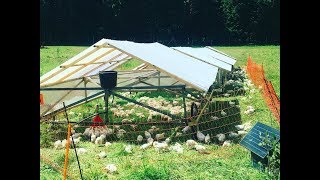
Richard Perkins moves 850 three-week-old birds into a full-scale roller pen trial and launches the farm's first vegetable boxes at €25. A new smokery struggles with temperature control, spiking to 100°C and overcooking meat, while a permaculture design course covers grazing planning and holistic management.
Questions this video answers
850 birds
250 crowns (€25)
Three weeks old
Target ≈72°C; reached in about 3.5 hours after initial burn
Salted for 17 hours
Chapters
So here we have 850 birds that have just come out on pasture in the roller pens that we tested last year and they're out for more field testing this year. Amelanche here with raspberries and squash comfrey. Small tunnel's doing good here. We've got some beautiful crops coming on. The water is still very dry but we did fill back the pond with the rain. We had enough that we feel confident to water. Garden's really starting to look beautiful. Kohlrabi is coming on nicely under here. First, vegetable boxes. What have we got? Carlin spring onion, fresh garlic, 3 microgreens salad mix, kohlrabi, radish, butter crunch, kale mix and peas. Beautiful. So this year's Vegas box is what? 250 crowns, €25 for hand grown vegetables. Beautiful. Shade mobile's working really nicely. Cows are thirsty. Flies are busy. We got them in cycle again with the eggmobiles. So they're back in here. Just need to rework our grazing plan now. I'm actually thinking I would like to take the cows slower through here just to take this down a bit more. We don't have enough ruminants to really deal with the amount of land over at the neighbours behind the hill here. But I'm thinking therefore I want to concentrate on our land and what's best for our land and consider other options because it's, you know, it's going to be like this all season and I think I want to rethink. So I'll make an update about that another time when I've decided. So we are learning about maps and levels and guessing height difference across the landscape, which is much harder than it sounds. Our eyes are bifocal, they're designed to measure distance. But here we're in such a sloping landscape that it throws your eyes off. So we're guessing a point right down here in the field. Up to here we've had guesses from two and a half to 28 meters. I'm guessing myself about seven, but we don't know. So we're using a bunyip and a laser level to measure the actual differences. But it's an interesting thing to never trust your eyes. Here we have a water pipe going up the ridge to the ram pump header. And if you go stand on it, it looks like water goes uphill. So don't believe your eyes. Believe the tools. So this group says 683. I said 713. I think I get 668. I think I win the chocolate. But we're going for the laser level double check. But I'm not sure about this lot's mathematics, to be honest. How much was. So we're at moving eggmobiles and these little honeyberries are waiting for us. Moving eggmobiles is different this time of year. Strawberries, honeyberries, gooseberries, black currants, red currants, white currants. So, for reference, this is the top of the poultry net. That's Philip. But this is how the grass is up here in front field. Now, chickens in the jungle, that's quite exciting. It will come storming out. Yeah, for sure. So this model gives them 20, 30% more space and actually more roof cover to get away from the elements. At this early stage, when the birds have just come out, it's really critical. Now we really watch them closely. We've got waterers. We're going to have an automatic waterer when the birds are bigger, but they're still so young and we want them to have more water evenly distributed across the little paddock. And we just got to get them used to electric fence. They've never seen that before, so we've got to just keep an eye on it. And we've actually got an energizer here that's got variable power, so it's important to just make sure they get used to the fence. But it's not so strong that it's gonna shock them. So this one has a dial that we can turn it up and down. But we like this model because essentially it's much easier to move these. Now, in the first few days, it might become harder to move them because the risk of crushing them under the wheels. So you could put a little baffle on the front of this to sort of shoot them out of the way. But as the birds get bigger, the aim is to feed them down the center of the next line and then we can pull these over the top of them to give them their shelter. But they seem very happy. We delayed putting them out till today because of the weather. Yesterday was the plan, but it was raining. We didn't want to get the birds out in the rain and we kept the nets up close to keep away any aerial predators like a bird of prey. The main risk here, and because it's such a tight, enclosed space, we don't think we're going to have issue with that because it's a bit of a risk to land in an enclosed space for a bird of prey. But we'll see. We've got to observe. I've been explaining to the gang that this is part of our role in our position. We're a demonstration site. It's a space that we can be innovative in a way that some others can't perhaps. And that's part of our role as a demonstration site, is to try and innovate and find better ways to do things. So that's what these pens are about, is trying to save us time whilst giving the birds more space and better welfare and see if we like the model before we really recommend it to people. So this model uses a 50 and a 25 meter net to give us the right sort of shape of pasture and we're keeping it very close. I think as the birds get bigger, we could give them more space if we want to also. But important to keep them well protected from aerial predators at all times. But particularly now when they're so small and these are three week old birds, they're really enjoying pecking through cow manure pats and picking up sticks and learning about eating grass. But nice to see the birds out. It's a very different model to raise them in a big group like this and obviously there's a risk with it, but yeah, I like it. I think it's good to give these models a try and see if there's better ways of doing things. This one bird escaped here. They actually fit through the fence, the smallest ones. So we're gonna have to keep really good eyes on this. We'll be coming up here many times a day as they march along with the layers behind the cows which are over here now. And so we're back on cycle with the cows a few days ahead of the chickens. Something to consider here is the wind netting and wind sheeting that we have on two sides of the pen. So bit breezy today, but you could easily add some drop down curtains if you need that extra protection. Right now we're just observing, seeing how it goes. And our main concern really is in the afternoon, evening when they start to sleep a bit, they will probably group together in dense groups and that could lead to them pushing each other against the fence. So you need to just monitor and observe that. We have had a small group of young birds in at this age in these pens last year, but it was only a quarter of the amount of birds in here is 850 birds in here. And we had a full group of older birds just because of the way logistics worked out last year. So this is our first full test with a full sort of scale batch, as it were, in the pens throughout their whole time outdoors so lots of observation, that's the name of the game. But yeah, I'm thinking that they don't need much attention yet. If it was really windy and rainy, then that's going to cause problems for young birds. That's the easiest way to, you know, cause stress and illness and death to young birds. But they have pretty good shade. The grass is high, so there's plenty of ventilation, but also enough shelter that they can get in under the rain. There's much more roof space because all quadrants are covered and we've just got to observe because these birds are not so good at hiding when it does rain. You know, some of them will just sit out in the rain. So we'll just have to see it might be we move the fences in to sort of push them in, as it were. So lots of observation to do in these next days and weeks. And I'll keep you posted on, you know, how it goes, because I think it's a really interesting experiment to see. So it's day three of farm scale permaculture design course. I get so excited doing these trainings. We're already deep into holistic management, defining context, how we deal with decision making and looking at the scale of permanence, a big part of PA Yeoman's work with keyline design. Today we're getting really deep into keyline design and how we gracefully and geometrically pattern landscapes based on permanence of features within the landscape. Starting with understanding our climate and what it was, how that affects landform and how that bears the relationship with water to our land. So we can energy efficiently plan everything, these layers, according to their permanence and priority. It leads us to roads and access and then to things like trees and then to buildings and fencing and subdivisions, etc. It's an amazing topic. It's one of my great passions, as you're probably aware of, but really nice to have people out on the farm doing farm chores, seeing how the farm runs. We've been eviscerating chicken today just to see how that all works, with the new chicks arriving this afternoon and a new roll of boiler pens going out. So great stuff already. People really understanding maps and how to find levels and we're getting deep into the. To the heart of all the stuff that I'm passionate about. And really nice group of people, lots of people from Germany and Denmark. Most of our team here is German, so it's an interesting year. It's very Danish last year and that seems to be the way it's going. But yeah, having some really nice weather, getting a bit of rain again suddenly now looks like quite a wet week, which is logistical when you have so many people and we're living quite outdoor life. But it's much needed for the land. Trying to revise our holistic grazing plan because we want to actually really focus the cows trampling and grazing onto our land to really run ahead of the poultry enterprises now and maybe not go through our neighbours land. So we are going to see if we can get it cut and bailed for winter and we have an agreement to manage that land. But he's also got subsidies for us grazing. So you need to know if we're allowed to do that. We just got to find out what's going on there. But yeah, really nice days at the farm with inspiring people and inspiring projects and yeah, it's always great to see which characters show up at trainings like this. Chickens everywhere. That's number three. They've had a long day. Batch number three. So batch two out in their normal salads and style pans. And batch number two went out today a day late into their roller pans and we're testing those for the first time through the whole batch of a full scale batch. So this is batch three and it's the last planned batch for this year. And these will go into the saladin style pans again into front fill. So this could be. It's a short boiler season for us this year because of the building of the smokery. We're not doing so many birds this year, which is nice but still aiming to drive the revenue by adding value to the birds. So these have just come back from a long day in the van and this is the second turnover of the bedding. So this is now getting up to about as high as it could be without birds escaping. We might have to come along and put some additional wood or a bit of fabric over here as the birds get bigger and more agile, stop them jumping out. But this could be the last lot. So the turkey poults are coming this week but they will be going into the old barn. So this might be it for the Buddha this year. It can be emptied and composted further down outside. So it's now later in the day and dinner time really. So I'm just coming up to check on the birds and you know, really see if I can observe anything that needs addressing. But they, they seem hungry right now, like they're large and actively hunting around. They've got food so I'm not concerned about that. But they seem to be away from the edges of the fence, so that's good. Like one concern at this time is they get stuck in the electric fence. And I asked them to actually turn the fence up a bit in the afternoon because I saw some young birds running through the actual fence, small birds, so they obviously weren't getting enough of a shock, but it seems to be effective because there's no birds on the fence. See, down there now. And so I'm just going to have a look under here and you see, yeah, they've turned it up to five now. This goes up to five. Well, it goes up to five and then plus five. So this on the lower five, it was on two before, so I think this is better. They're sitting right back from the fence, so they obviously felt some sharks. So I think it's good. I'm curious. I'm going to come back later in the evening and, you know, just really make sure they're okay for the night. But yeah, great to have three batches of birds on the farm again. Now this batch has been a really easeful batch. The weather's been really good. Haven't had much rain in the time they've been out, but they're growing well. It seems like how I'd expect the birds to be. We haven't done so much weighing of birds this year because pretty confident with the feed ratios and yeah, it's less critical for us at this time. We've been eating a whole bunch of strawberries and there's some really nice ripe ones up here at the top of the field. It's an earlier variety than in most of the field, but great to have all three. Oh, that's delicious. There's great to have all three batches of birds now. As I said, it might be the last batch that have just arrived today. Trying to just keep it at a sensible workload and increase the revenue through smoking. I did test the smoker and so I could tell you a little bit about how the first test went with birds inside. But with the help of Jura, we've rewired the sauna heater. This just plugs into 16amp plug there. We've worked out where the thermostat should be for about 72 degrees. It took three and a half hours to get to there. Got a little thermostat coming through the wall and it's interesting, I think that that temperature is okay. However, if there's 50 cold chickens, like a hundred and something kilos of chickens, that's not Going to work out so well. We actually have two elements in here. It can be wired to three phase. So we're thinking we're going to. We basically took out the timer because we don't want that and put the thermostat outside with the light that shows it's working. But we've got it running on single phase right now. I think what we're going to do is rig it onto two phases of the three phases and see how that goes. And we got the thermostat up here at the height the chickens would be hanging. Now I'm going to light it. The concern is in winter, you know, with 100 and something kilos of meat in and winter outside, it won't reach temperature satisfactorily. You want to get it up to temperature within four, five hours. I put a whole bag of this is Alder 02 millimeter sawdust. So I'm going to light a fire in here now and get this smouldering away, see how that affects temperature increase and put the heater on and just do a test run to impregnate all this material with smoke. I'll probably do a few smokes just to get, you know, smoke into the wood so that we have a consistent taste in the product and do some testing with chickens at the same time just for our own consumption, just to get the salt balance sorted and that kind of thing. So just got the little fire going, let that catch the sawdust and then we'll get the heat up before we turn this thing on. Just got a metal sheet that protects the wood of the door and should be fine like this. Obviously need to monitor these things when we're testing out. So just give that a few minutes and then we'll close the door up and start raising the temperature. So I've only Left this for 10 minutes so far and it's already brought it up to 64. It's pretty good. That should help a lot with getting it up to temperature quickly. Just having the initial burn so you can see how smoke is coming out from around the door. That's the technique. Joran said rather than have a venture allow some natural leakage to allow airflow. And that's worked well for him. So we've done the same. So it's reached temperature in less than two hours, which is ideal. Seems to be all functioning really nicely. Should get 24 hours burn out of the alder. So just keep an eye on it now for the rest of the. So first smoking didn't go that well, the birds basically. I went off to Gothenburg to take Grace to the airport. She flew home alone and yeah, it's very successful trip for Grace to travel alone for the first time and had a great stay here and she's coming back in a couple of weeks, which is awesome. But while I was away like he got up to temperature very fast with the initial fire and then they called me in the afternoon. It had gone up to 100 degrees and it sat over 100 degrees for some hours. I asked them to leave it just to, you know, see what actually happens because I didn't want to open the door and lose the smoke density or whatever. So birds got overcooked and they're not dry actually, but they're definitely overcooked. So the texture is not great. They're flaky and fall apart a bit. But the level of salt was really good and I'd salted them for 17 hours this time so that taught me something there. And yeah, I like the color of the birds but just overdone. I think the timings were all good. It's just the temperature is a bit high. So I think we've over insulated the smokeway basically and not sure what to do yet. Haven't decided since it's not the thermostat. Thermostat is working and it's cutting off. It's the heat from the smoke that's creating, you know, too much heat. So it might be we just need a vent. But in a way we need some kind of automated temperature control thing. Otherwise it's going to be very hard to make consistent products. You know, in perspective. We need it really well insulated otherwise we'd never be able to use it in the winter when it's -25 outside. And so yeah, I'm running the farm scale permaculture course that I don't have a minute spare in the day really other than to make this video. So I don't actually have time to think about it right now. But I'll update you when I know we've got to do something and we need to start selling smoked birds. So I've got to get on the case as soon as I can now. So that's it for today folks. Thanks for watching. As always, you can leave comments questions below and I can try and weave them into future videos and yeah, you can find out a whole bunch more in our book. Making Small Farms Work. A lot of people feeding. Back on the training that this just been awesome for them and it's led them to come and get a hands on feel for what's going on here. And yeah, it's a practical manual, how to do this stuff from scratch on low budget and finding solutions that regenerate the earth, produce amazing food for local consumers. So you can check that out in the links below. We'll see you in the next video.
More from Richard


A review of short and intensive season on a mixed farm and restaurant/event space in Sweden






Alskade Kyckling Exploring complexities of poultry production in Sweden and what we stand for


