S5 ● E45 Weathering a storm with 3 week old broilers
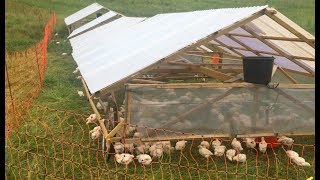
Richard Perkins moves 3-week-old broilers through a storm using roller pens and Salatin-style shelters, rolling them together and adding sawdust to keep birds dry. Mortality stays low despite the weather, and the farm is running 1,100 eggs a day while pursuing organic certification.
Questions this video answers
2%
Three weeks
About 1,100 eggs a day
Ragnar's second birthday (2 years)
Chapters
Today's video is just a really quick update looking at these roller pens and how we weather the pretty intense storm. It's that time of year. Berkeley compost 18 day compost. So this is some of the bedding from the cows, the straw and there's some partially decomposing manure and some of the tomato wastes and grass forbs, etc. Making comp. So a little update. It's very wet weather today, a lot of rain forecast. So we've come along and put the fence in really tight to the pens just to keep the birds encouraged to be under the ground and dry. And we've rolled all the pens together and so today's pens are a lot more watertight and I think that's a good move. The birds are dry inside and we're just going to monitor. If it's really heavy rain and water starts flowing, then we need to give them some bedding, get them up off the ground. But right now birds are dry enough and that's fine by me. It's good. We need some rain, the gardens need rain. It's just always a bit of a cautionary feeling when you've got young birds coming out. So pigs are here last time before these trees are cut this winter. Beautiful old spruce trees up here. And then this land has got to regenerate afterwards and so we're keeping pigs out for some years to allow this to go through. Amazing seeing all the young birds coming back. And I noticed a lot more insect life and bird life last year. But up in the tree house, up in the patch of wood over there, I've got three birds, three nests in my actual tree house in the roof and above the door is a little ledge. Pretty amazing to watch. So just for contrast, we've just had a bit of rain today, so that's why we've been paying attention to broiders. But the difference, this is the paddock they'll come into and you see the regrowth after having pigs in here in the autumn. So it's ready to go again. And so it's a time based thing. But we don't mind keeping these in here for a little longer because this forest is getting cut and their digging action is going to germinate a lot more tree seeds that are going to have many years to recover once this forest is cut. And we'll see a whole flurry of succession of the sort of species we see here. And eventually this will all be turned back to silver pasture for cows for wintering for part of their grazing plan, etc. So here's a few of the older birds. They obviously much more adapted to moving around in these pens. So they kept out of the rain really well. You see them sitting in the sheltered sections only and that's different with young birds. They can get scared by the sound of rain on the roof and it drives them out into the weather ground. But yeah, all these birds are doing fantastic and they've been having nice weather all the way through their early stages, so it's definitely much easier. And they've had 2% mortality across the whole batch, which is fantastic. I would imagine that being higher in the roller pens, just because we're getting them out at three weeks in very challenging conditions. But it went as well as it could go, I think, so pretty successful. So we're about halfway through our farm scale permaculture course. It's a lot of study. We've been doing really intensive sessions on, you know, everything to do with forest ecology, water systems in landscape, keyline design. Today we spent the whole day looking at market gardening, how we plan market gardens, from tools to bedside, to all the different factors that are involved in the planning, through to all the spreadsheets and the detailed planning and quite a lot of information today. So we're having a restful evening tomorrow. Gonna have a barbecue at the lake when the weather seems to be coming back to sun again. We've had a couple of rainy days, but we had a really intense storm last night with the boilers and I had a lot of concern. I was up here. All the breaks I had during the day, just observing the birds because they're so young and they're much more exposed than the Saladin style pens on the ground. And so I had to make some adjustments because of a super heavy downpour we had. So here you can see where we've actually put a bit of sawdust. I'm going to come and clean this up. And we knew it was going to be heavy rain in the evening. So what I came up and did differently from today is I rolled all the pens together so the roofs were all touching and I brought the net in right to the edge. You see the roof overhangs slightly and so I brought the fence in to make sure they have to sit inside under the dry. I made the decision yesterday not to move the birds because the ground's quite high and the grass is wet in the mornings from June. And so coming up here to move them. I made a decision based on the weather forecast not to move them because they were already sat on dry ground. The birds are so young at this time, they're not leaving so much manure. And I'm super glad I made that decision because the birds were really dry. And when the rain came, it was all within like an hour. But we were listening to a movie in the yurt and we had the sound on full volume and you couldn't even hear. So we gave up watching the movie. We were getting into animals and grazing. We were watching. Great Judy, one of his talks. It's really an amazing talk, but we gave that one up and aborted it. And I came straight up here with Niels and we just made sure the birds were fine and then added some bedding because there were a few surface flows coming down here. You can see where there's a bit of a depression and a little hole here. It was such a strong rain and the ground is so very dry from having no rain really for six weeks that there was just sheet runoff under here. And I was very concerned because these birds are super young. We get them out at three weeks, which is younger than most people. You know, some people are getting them out in three weeks in fair conditions, no problem. The boilers that came out first of all have had super ideal conditions. They came out of the brooder to 28 degrees and it was no rain and just nice weather since. And they're growing amazingly. We've lost 2% of those birds, and mostly in the brooder, which you would expect. But these birds, I would imagine are going to have a higher mortality. I can report back on that as we see. But they're much more exposed and there's a bigger weight distribution in this group in general, just coming out, the brooders, a lot more small birds. Some of them are double the size of others and that's often the case with boilers, but not at this time. Often the weight differentiation comes later when the males obviously are growing quicker. It was very interesting. I'm glad we acted in the way we did. But because the birds were bone dry, they were totally comfortable and fine. And I think the decisions and action we took were needed. And then today we knew we were going to get rain again. It's a bit gloomy and gray, but it's just drizzle. And so I immediately wanted to give them a bit more space. And I've come up here several times today and they're all dry and they're doing great. So I'm happy with the way we've managed them. And it's an observational intensive thing. You still need to go check on the salatin style pens anyway. In heavy storm events, if there's groundwater flowing, the birds have got nowhere dry to sit. You've got to get them up off the ground and that's only more critical the smaller the birds are. If they're older birds, they're obviously more resilient. But either way you really want to make sure the birds have got somewhere dry to sleep. And it really does a good job with these roofs and sometimes with the salatin pens, the water can push the of plastic roofing down. You'll get water coming inside, not a huge amount, but certainly dripping. But this has worked great. We've had the fence on at full power and the birds learnt very quickly to stay away from that. And today I've just given them a bit more space. Now we're using a 15 to 25 meter net here and the 50 meter net's going up the hill, you can see the end of it there. And that's to allow us to give them a much bigger run as the birds get bigger. Now they're so young, we don't want to have the fence too far away from the edges of the pen because we don't want predator birds coming in. And so we can give them more space by keeping the pens a bit apart. Like a big bird of prey is not going to want to land inside that. And so I'm happy on the predator front. I'm not too concerned at all. And things like foxes won't come through this net, but it's birds of prey that would be our biggest concern. But seeing the birds now, they're very evenly distributed along this different pens which in the morning they showed a marked difference. So our basic morning routine is set up the next day's fence. So we use a 15 to 25 meter net so that we've always got an opening adjoining the next pan. And then we just take the brakes off, we just have a bolt that goes through each wheel just to lock each wheel. We undo them and we start moving forward. But even today, this morning, on the second move, they're already running along with their pen and give it three or four more days and they will come running along knowing they're going to fresh ground. So it's a lot of birds in a small space. There's nearly a thousand birds in these enclosures, so it's a lot of birds to get moving along when they're really young. And we know it's going to take, you know, a few days until they Start really coming automatically. And then once that happens, it'll be a case of opening the pen to the next day's pen, feeding down the middle and they will come running to the feed and we'll just be able to then pull the pens over the top of them without fear of squashing them because they'll be down the center line. Right now it's a little bit different. We're pulling each pen and trying to encourage the birds under that pen to come forward. But the ones at the back have quite a long distance to travel, so it takes a little bit of time. And what you find ending up happening is there's a majority of birds in the last pen that's moved congregating over there. So you've just got to watch that and you can encourage them along. But we haven't needed to do that. They spread out on their own anyway. But you see it's drizzling now and they're pretty much all under shelter from their own choice. There's a few that range out, but they look really dry and good. I'm very happy. And they're really enjoying grazing and finding insects. This morning we were just watching them running around with huge beetles and earthworms and fighting over slugs and yeah, it's a pleasure to see. So the main reason we're doing this model is because it's a lot more like little details to consider in the beginning, the first few days, getting them out, getting them used to fence and having a bit more vulnerability with the shelters. I've talked before, you could easily add side screens and drop down things for weatherproofing, but we just haven't felt it's necessary with the weather we've got. We did have to make that big adjustment yesterday by putting the sawdust down and just bringing the nets in. But that's no big deal. It doesn't take very long and I like being, you know, very engaged with the processes to make sure the birds are totally fine. But this model will become much quicker when the birds are used to running forward. You'll be able to tie all these pens together and move them in one go. They're very easy to move and you'll be able to move, you know, the equivalent of 10 Salatin pens in one go very quickly whilst giving the birds 25, 30% more space. And that that will transfer to a lot more forage, a lot more insects because they'll just have a lot more ground they can go over. And so I like it. I'm still, you know, I want to see this whole batch through because it's going to be hard to compare to earlier batches just because we know the weather has been so very different with this batch coming out compared to the first batch which came out in 2830 degrees for the first four weeks of it. So, you know, it's hard unless you run a side by side trial. But I'm very happy with the progress and I think it's yeah, I'm glad we've done it like this and I'm glad we've paid such close attention. Even super busy days when we're running our trainings, I'm still able to get up here six more times a day and really have a look what's going on. Observation is key and that's the complexing bit of all these enterprises we run. They're all observational based. You can't automate them or you lose details that inform the management. And so you need to be right in the heart of it, working intimately. It's all about intimate management and based on observation. I've been really going through with the participants on the training here, all the things I'm thinking about and looking at and I'm running a training with them. But I'm, you know, my mind is on all these things all the time because it's important for the welfare and performance of the operations. We're running 1100 eggs a day. It's a lot of eggs. And we're actually considering going for ecological certification for organic standards because one of the big hotel chain spas that's near us, that's a very good customer of ours for microgreens and vegetables throughout the winter as well as turkey and chicken. And they buy a lot of eggs from us. So they're part of a bigger chain that's got requirement to buy organics certified eggs. And we've never been certified and never wanted to really go down that route. And their big boss has been talking with the CEO who we've always interacted with and their chain has this policy that they need to adhere to and they've always just been taking our eggs because we have, you know, we only feed organic feed and so they've been like accepting that. But due to the company's review for their whole company that's operating all over Sweden, they brought that issue up. And so the CEO that we work with has asked if we can just get certified. And we looked into it and I think it's quite easy for us actually. So we signed the forms today and sent that off. And it might be that we become ecologically certified, which is not something I ever thought about or pursued in any way, but I think it would bring some benefits. So why not? And I don't know if we'll get that, but we will find out and I'll let you know how that goes in the coming days. So Ragnar's second birthday today we had a little bit of surprise cakes and gifts for him. And yeah, two years flown by quickly. So Ragnar was born beautiful home birth upstairs during the middle of our internship program, actually. And Johanna did an amazing job. We had amazing support from our interns who had this whole action plan of when she would go into labour to heat up the bathtubs that we use for bucket showers and bring all this hot water. We had a water birth up in our bedroom in the farmhouse. And so we had a midwife who, like here, midwives are quite fun, far spread apart. There aren't many private midwives. Everyone goes to hospital typically. But we wanted a home birth and so we brought up a private midwife who we had been seeing. She was about four hours drive away. So we called her up when Johanna felt the signs and started filling up this birthing pool that we had here. And yeah, it was an amazing labor and process and Johanna gave birth in the early hours and all of the interns did an amazing job cleaning up and just making, you know, such a nice reception for when she came back from checks at hospital and stuff. And yeah, it was really a magical experience. And two years flies by, you know, it's. It's amazing how time flies and, yeah, interesting to reflect on that today. So I'm signing out and gonna spend some time with my son and think about that. And, yeah, looking forward to just finishing this training with some really interesting projects and people and their different experiences. I'm not going to be making videos much because we've got some super intense days coming up now. So we go into the last half of the course, but then we'll be back to regrouping on the farm and really working out the action plan with little trainings peppered in between. In the next couple of months, our pasture poultry training, then our workshops with Curtis Stone, the urban farmer. Really excited for that and all the people coming for that. It's going to be a really busy course and really excited to meet all of those of you who are coming for that. And then a bit of a quieter period at the farm and I'll be making more regular videos and keeping updated on what's going on, etc. So thanks so much for watching. I really appreciate your views and comments and you can find out a lot more in our book Making Small Farms Work. I'll be sending whole load of copies that have backtracked from the last week and a half and I'll be getting them out sometime this week hopefully. So thanks so much for watching and you can find out more information in the links below. We'll see you in the next video.
More from Richard


A review of short and intensive season on a mixed farm and restaurant/event space in Sweden






Alskade Kyckling Exploring complexities of poultry production in Sweden and what we stand for


