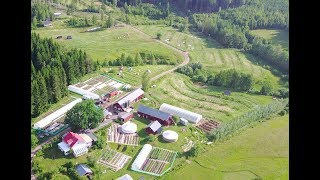
Richard Perkins gives an aerial tour of his regenerating forest and savannah plantings during a farm-scale permaculture course. The video shows grazing rotations, eggmobiles, garden harvests, and the drought challenges affecting the operation.
Questions this video answers
June 20, 2018
Seven hectares
7,200 eggs
About 1,000 and possibly up to 1,100 eggs
Chapters
So today's video is just a little update, a few clips. There's a couple of days left of our farm scale permaculture course. I've gone and lost my voice, which is typical after talking intensively for 10 days and then having a volleyball game and shouting. A lot. A lot of fun at the lake last night. But quick update for today. So we're just taking a little aerial tour. It's early morning, I've just finished chores.
And we're flying out to the left. That is the cut forest that's been regenerating for five years now. Some quite big trees and we're turning it back to agroforestry. You see the grass and forbs are recovering in there now flying over the boilers. They're in a funny configuration because of the way we set up in the beginning. I talked about in other videos. It's worked out fine. And going through Nutfield now with the cows ahead of the laying flock and the broilers in their roller pen there. Interesting to see the land patterns of youth up high because you see it very differently from on the ground. You see the impact there of the birds going through front field and the impact of the broilers and layers from before where we've had no rain since really, but a bit of rain recently so that will pick up. And you can see the strips the cows are taking through the savanna planting is planted on a diamond pattern. So they have about 10 meter wide strips they go through which the eggmobiles follow. And yeah, funny patterns of land use because we've been doing things in a slightly different way this year with the roller pen and taking the eggmobiles right up the top that we've never done before. You can see clearly the impact and pathway of the. And you'll quickly see green spots of fertility where they've been. We've got seven hectares here of the neighbor's land that we need to graze through. But we just can't keep up with the amount of livestock we've got. So we're. We're still in the process of deciding.
What to do there.
I just heard the breakfast bell ring. So everyone is bringing down breakfast here in the earth where we eat.
Garden's looking beautiful.
Books going out too. Spain, Germany, lots of Germany. And also to India today.
That's nice.
And we're also selling T shirts. You can buy our farm T shirts. Like it?
What's this?
Veg box number two?
Yes, number two. Toby.
We've got fresh dill.
Are you happy with It.
Yes. Big bun, big head of lettuce. We have a nice bunch of fresh chard, Swiss chard. We have nice mustard greens, scarlet frills. We have spring onions and fresh garlic. Beautiful, beautiful. We have D', Avignon fresh French breakfast radishes, a big bunch. We have a mixed bunch of turnips, red turnips, white turnips and purple top turnips. We have purple kohlrabi.
It never ends.
White kohlrabi. And we have a big bag of piece.
Beautiful. And stuff's going to restaurants as well. I see the van is full.
The van is full. So we have. We're delivering more microgreens, 10 heads of lettuce and three kilos of radish. And then we also. And then we also have some loose veg going to Rico. More microgreens, more lettuce and radish.
Super nice, super nice. This week's harvest, it's a beauty. So we're in here, just putting some Epsom salts, got a bit of magnesium deficiency, a bit of rock dust for phosphorus. Because we're just using chicken manure, it's a bit too much nitrogen, so we're trying to balance that out. Got some of the little food coming on, the tomatillos.
These are such hardy plants, they don't.
Need pretty much any care, just training them up with lots of beautiful fruits. And these will get to big tomato size by the end of the year, which is super delish.
Last day in front field and this is land that's not been grazed yet, so you see what it looks like. It's up above the Eggmobile. Pretty fun for chickens to be in this. Pretty challenging to put nets up. We've just been driving along to squash the grass down here to make it easier to put the fences up. And birds are eager to get out at about 6 to 6:15. So we need to get everything done by 6:30 and then go off and move the roller boiler pans. But it's working quite well. This is a carbon bank. We're laying down huge amounts of material trampling, leaving a lot of lid on the ground for grasses to then be able to grow up back through it and create a thick biological mulch on the ground. So a lot of trampling this year. Not keeping grass in vegetative state, but letting it express its physiology and then trample it. Amazing to compare this to the neighbours that's never had animals here. You see, the tops of the grass is up to my chest. And when they're allowed to express their Physiology. It's amazing. This is going to get trampled down as a biological covering and armoring to the soil. And some of it will grow back up because it's not had its stems broken. Some of the stems that get broken will kill that plant off and it will start to decay biologically, allowing new shoots to pop up through. That's how grasses are so quick at capturing carbon is the meristems at the bottom. Unlike any other plant, the new shoots.
Like if you look at a fruit.
Tree, you see the new green growth at the ends of the branches. With the grass, those meristems are down at the bottom. So this is a plant that's evolved.
To be eaten so that these new.
Solar panels can see the sun and regenerate themselves.
And the rate of sugar transfer through.
Grass is bit measured at about 25 seconds, 25 centimeters a second in a annual rye grass compared to like a meter a minute in an old tree. So the rate of sugar transfer is huge, which is why grasses are so fundamental to soil building. But it's going to be interesting seeing chickens coming out today into this little jungle. Well, the door doesn't even open today. So last day in this field.
Then the birds are going to be.
Going up to Nutfield to rejoin the others. We're going to open the nest boxes. There's some in the nest box here. They can actually creep in the side here. That's okay. They're not sleeping in there. They're just coming in to lay eggs. They're determined to get get into these spaces to lay eggs because it's the only dark safe space in their constantly changing. Little boilers on their long march. So this kind of movement, because there's so many birds in one pen, it.
Means that they have to travel a.
Lot further, which is really good for their health, obviously. And so we're just practicing now, shuffling along birds with each pen because at this stage they're not so food motivated.
That you can just put the food.
Out and they'll come running. But it really won't be long until they are. Next pen's coming up and these birds are tending to come batch by batch, which is convenient. And it's great for them to have this bit of exercise to encourage their leg development and general health. Happy birds. They're foraging nicely. That's perfect. So still a long way to go for this last group, but we're transitioning to this perpendicular lines in the savannah planting. So we had a funny angle for starting, but we're now going off this way and we'll be jumping down the field like so. I'm just coming, picking up this row cover. It's pretty amazing. We're having very gusty winds today.
But it.
It flew up. We were just having a conversation in the car park after lunch and it flew up in the air. Probably about 40, 50 meters up in the air air and flew all the way here. Strong gust. But the caterpillar tunnel is no problem. And the yurts no problem.
It's just the little fleeces that were.
Lying around the garden. It wasn't pegged in.
It was just sitting underneath the toolboard.
Pretty amazing the winds we get sometimes.
So 10:30 at night. I'm losing my voice. We've been having a day off and playing volleyball in the evenings.
Not a day off.
An evening off in the middle of the course. And now we're just coming back and checking on the animals before bed. But the volleyball was quite boisterous and lots of fun. Lost my voice. There's a bit of a fever going round. Beautiful sky. We had a bit of a break in the weather so we thought we'd take the opportunity to go to the lake and have a barbecue, take some time out and just have a bit of social time. We barbecued some old ewe that we had in the freezer and it was marinated and so tender. And people are really surprised that eating ewe can be so nice. And it's important to consider eating older animals. We're so used to eating lamb, but ewe is very good grass fed. This has been grazed pretty short. Hello, Cass. These girls are ready to move tomorrow and we're trying to graze it down now in here and then move on to the neighbor's land and take a slow, steady run through there unless we can get it cut now because of.
The.
Subsidies, the neighbors not sure if they can do that. But it's been such a problem with the drought that people can't feed their animals.
There's a big bank backlog for cattle.
In the slaughtery houses because people can't feed them. Their pastures are not resilient and there's no grain or alternative food. So they're allowing people to cut even if it's not allowed normally in subsidy wise. So I'm hoping we can get the neighbor's land all cut so that we can really put some time onto our land, which I think will be really beneficial for the birds following in through behind. But beds are all fine. I've been checking everything and yeah, it's late now. It's Time for bed for me and get my voice back for the last remaining five days of the course. Afternoon egg closing. Niels is on changing over nest maps. Everyone's doing their design projects now. Here's one of the chestnuts, peanut, pecan and black walnuts. But, yeah, I've lost my voice. It's good. Everyone's on their design projects now, looking at applying all the things we've been talking about throughout the training and relating it to a real landscape, real marketplace, real context, and it's always an exciting process. See what happens. More chestnuts here in the savannah planting. This is Bittenfeld, the apple grown on its own. Seed can do that with Antonovka or Pittenfelden. Might be one or two more. We're very happy with the roller pens so far. Got a bit more space today, which is nice for the birds, and they're growing steadily. They're definitely moving a little bit easier each time. Soon we'll be getting them onto their automatic waterer and getting them rolling around. You see, the hens are a bit jumpy right now, a behavior we've often observed around midsummer. I don't know if it's lack of sleep because I get a bit jumpy at this time of year from lack of sleep myself, but they have this flightiness that I think. The peacock doesn't help. You see him masquerading over there, but it's always a good practice to walk along the edge of the fence as you come in and just. So if they're gonna leap off, they're gonna go back towards the inside. So these are the rollaways. You can see Neil's just putting back clean nets. So whenever it's needed. Typically once a week in wet weather and less often in dry weather, we'll take them out and shake them off and then go and pressure wash them, keep them sanitary and replace the mats. Nice trampling that the birds are doing. So, yeah, just a couple more days of the training after today and everyone will be heading off. We'll be taking a little bit of a break, but it's been a really great run. I hope we can hear some feedback from folks because it's a different experience for everyone. But I think people have been very happy with the content and the food, and it's been a lovely group of people. It was great to get to the lake last night and have a little break. It was a lot of fun. Hello, Mr. P. So batch three are doing great.
Interesting to see the differences.
Batch two, that went into the roller pan were very different in size when they already left here. Batch one being just such a consistent batch, it's going to be really interesting to reflect on the final weights and all that record keeping will be really interesting to observe. It's looking good in here. Everything's functioning as it should. I'm very happy with some of my espaliers. This is the beauty of bath. It's an apple from where I grew up, but it's already put on 35cm of growth this year, which is great. These were put in as 80 centimeter whips, about the thickness of the branches here. And I've just been going slowly selecting buds that are growing along in the right direction for me. He's putting on his first apples this year, which that's okay. I don't really want it to go fruiting yet. But I'm just continuing the process of thumbing off any branches that keep popping out and see like a new bud here that's growing in the right direction gives me the opportunity to continue it along. But within two or three years it'll be out to the ends and really nice architectural feature. This one's just got the growing tip lent over. You have options there. You can cut it off, but I'm just trying to fill this space up now to complete the sort of architectural feel. But super nice year for tree growth so far. I think we're going to see some really nice development and nut trees. Up in Nutfield, Niels is on eggs and he's been taking apart the shelves I built in the winter to fit more eggs in. How many eggs are we getting in, Niels? Yeah.
So at the moment we can put in 7200 eggs.
Oh, yeah.
Yeah.
We've really increased the space.
That's about a week's worth. So it's perfect now, which is amazing. How are you finding the eggs coming out of the eggnogs and they coming out in good condition?
They're coming out in perfect condition. They're really, really clean now that I've got the routine in taking off the feathers while I'm. While I'm picking them. And so it really saves me a lot of work here. So I'm really appreciating doing a lot of the pre work.
You're doing this flipping just to get. Yeah, I'm doing the flipping work, which.
Means I don't have to turn each egg individually. I'll just do the whole tray and that saves a lot of time.
So how many eggs are we up to today?
I think we'll get definitely to a thousand and I think we might even reach 1,100.
Perfect. Not there yet, but I'll let you know.
Thanks.
So I wanted to ask your opinion. I've got an amazing man on the course, Roger, who's a British farmer, a conventional industrial farmer for 40 odd years who basically quit farming, said I'm never doing that again with his wife and has actually come back to regenerative agriculture through Rebecca Hoskins film Farm for the Future. And I know that impacted a lot of people. And yeah, he's been on a path looking into Joel Sargent and Alan Savory's work and following us since we started and he's ended up here and he's a hilarious guy and it's so honoring to, you know, it's really humbling when someone double my age is coming here to learn from what I'm into. And yeah, I'm humbled by that. And I think Roger's a fantastic guy and I really wanted to interview him for the channel just to hear a bit about his story and past and why what happened for him, why he changed to this. And you know, that's a major shift. Most people coming into regenerative agriculture don't come from farming backgrounds. They're, you know, coming into it from some ideological perspective or from some entrepreneurial perspective. But for someone who's, you know, grown industrial ag for all of their life, that's a major perspective shift and I really, you know, admire that in a very deep way and I'd love to interview him for the channel. So let me know if you would be interested to hear that because I think a lot of you would find that really touching and inspiring. But let me know in the thoughts and if you up for it. I think that will encourage him to sit down with me and have an interview. So that's it for today folks. Really brief video, just updating and super busy days where my attention is going to the participants here and the team as well. I'm looking forward to getting back to getting in touch with the farm again. It's very weird to be not totally focused on the farm in such a busy time, but it's been an amazing group and I'm super happy to get connected back with the team and continue the season. So thanks as always for watching our videos and really appreciate your comments and likes. Let me know if I should interview Roger. I think that'll be a really nice video and yeah, you can find out a lot more in our book Making Small Farms Work that we've been sending out all over and. Yeah. See you in the next video.
More from Richard


A review of short and intensive season on a mixed farm and restaurant/event space in Sweden






Alskade Kyckling Exploring complexities of poultry production in Sweden and what we stand for


