A Richard Perkins farm vlog documenting the arrival and initial handling of a batch of turkeys (about 150 birds). The video covers transport and brooder handling, temperature/smoker testing, weighing birds to set a feed program, protein and feed rates, the mobile turkey shelter (“gobbledygo”), and planned grazing/slaughter logistics. Practical, metric-based targets and routines (weights, feed grams/day, protein levels, movement frequency) are emphasized for small-scale pasture turkey production.
Questions this video answers
150 birds.
Five weeks old (on Monday).
Measured examples: 1.4 kg, 1.55 kg, 1.65 kg; he plans target ~1.5–1.6 kg for current stage.
114 grams per bird per day (≈800 g/week).
129 grams per bird per day.
Chapters
Today I'm on the road. I'm off to pick up the turkeys for the year. They got five weeks old and they'll be in the brooder for two more weeks before going out on pasture.
So farm scale permaculture course is over. And you saw the interview with Roger, which many of you enjoy, so thanks for your comments on that. It brought him to tears, actually, and it was moving to see he's, you know, suddenly exposed to so many people. And I think he was very touched by that and very heartfelt. So, yeah, thanks for that. It was a wonderful course and people had a great time. Some feedback that some people had some of the best weeks of their life here. So that's always pretty moving to hear from this little farm in Vanland. Here's a quick update today. Just a few things going on other than the turkeys arriving.
So I'm moving the roller pan and the strategy is to move the first three fast. And when the birds are so young and they're not moving so readily on their own, we move the first three and then the last pen, we move real slow with these follower boards. And they're pretty much all following through now and just moving it really slow because they like to move with the.
Roof and then all birds come through.
But we've been at it now about 12 minutes and they're nearly all in the New French, so that's the equivalent of 12 charlatan pens moved in 12 minutes. So it's pretty good.
So a decent amount of rain today. It's just dried up now and the sun's coming back out after dinner. But coming up to see the birds, guys said they came up earlier at lunch and while it was raining, the birds were all under cover and fine.
And I think just that couple of.
Days as they've got older and they've, you know, they know that this dry underneath and they can sit under, you see quite large groups. Got to be careful for trampling when, you know, the birds are just tight together. Obviously a lot more can congregate in one space when in one open flock, but you see they're quite evenly distributed amongst the pans and they seem really good. I'm very happy. And we've had a few losses, like higher than the last batch at this age. But then there were so many small birds when they came out that I talked to about in the other videos. This batch coming out has such a wider range of birds in weights, like some double the weight of others, which is more typical as the birds are Older. So the losses from trampling have been limited to, you know, really small birds. And I think that, yeah, the birds are fine. I don't think it's a direct comparison because they're normally quite even coming out of the the brood compared to this batch.
There's one with mustard, one with onion and one that is just the normal one, kind of pickled.
Yeah.
And then of course, eggs. There is for the eggs also, nice blend is the mayonnaise that is here.
So I'm testing with a little S shape wiggle, not using a whole bag.
Just to see what the temperature will.
Be like with that. So 7:30 in the morning, it's been on for five minutes, up at 40. Smaller fire this time, just to get.
It going, not generate too much heat in the beginning. So in 12 minutes it's gone up to 56.
It was at 60 and went down a bit. As the fire was dying down, I.
Closed it up, put the thermostat on. I'm just going to really monitor temperature carefully today.
So a quarter to 12, sitting at 70. So smoker is cooling down. I kind of followed someone's suggestion to put a trail of sawdust in here and that worked really well. The Temperature sat at 73 the entire.
Time and so I'm happy with that.
Not sure the smoke density was high enough like this, but that's something. We're going to test with real birds now and see how it goes. But the wood is starting to really absorb the smell and that's going to be great for getting a consistent product. But yeah, thanks for whoever suggested that.
It'S a good idea to start the.
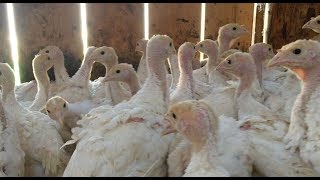
Fire one end, let it burn along, but that's. It was kind of out this morning, still sitting up at 48 degrees just because it's so well insulated, but testing again with real birds soon. So I'm at Turkey Farm and he's bringing out some boxes with poles, trying to get 15 in a crate, a few going off here and then it's a long drive back to the farm. So last box coming. 150 birds. They're looking very nice. They're five weeks old on Monday. So I'll go home, get them in there. Buddha in the old cow barn, work out the feed sheet based on their weight.
So I'll talk more about that.
So it's a really hot day. So what I've actually done is left the back door open and tied up the boots. So the boots are letting some air in. We haven't got any ventilation in this van. There's no problem usually when we pick up boiler chicks, but these birds are bigger, they're consuming a lot more oxygen and it's pretty warm in there. So I've just been checking them again and it seems a lot better, but eager to get home. Get these birds out now.
So birds are in safely. They're a little bit startled because they've just landed in a new home. But still temporary measure to have the birds in here.
I'm just feeding them in old gutter.
Because they'll only be in here until I figure they're ready to go out. But I think they're all.
I mean, I would be happy putting these out already. I'm going to keep them in some.
Days just to observe them, but I.
Think within a week I'll have these out. I mean, six weeks is old enough in the way.
They still need warmth. So we've got lights here at night if we need them. But they're strong birds already settling in to their home. But yeah, I like to keep watch of these just in the beginning now. And then they'll be out on the gobbledygo on the field. So I've got to make a feed sheet. I need to weigh a bunch of these birds and take an average and I will start my feed sheet based on the average weight right now. So we've been adding some Epsom salts, magnesium sulfate to correct a deficiency there.
Here in the tomatoes.
Got some beautiful tomatillos coming up.
It's looking great.
This is just compacted subsoil to make the footing for the new tunnel. So we were expecting to have a little bit of issues, but we've been feeding just chicken manure. So we've been adding some rock dust for phosphorus and some Epsom salt for magnesium just to balance the nutrition, which is something you've got to worry about if you've got just chicken manure, because too much nitrogen and it can cause some issues there. Just observing, seeing what's going on. But the plants are good. I mean, considering how much of a long, leggy start they got in the indoors, they're putting on some impressive growth. Had some deep watering recently. Just see the first tomatoes are popping on now, so it's looking good. And then the routine for pollination is just to walk and hit these wires with a stick to help spread things around. But looks great in here. So I've brought some scales in and I want to just weigh a few birds to get a sense of where they're at weight wise and how that's going to how I'm going to use my feed sheet. So I want to see what a few of them weigh. Now. They've had a bit of a long day. I don't want to do this with.
Too many, but that's weighing 1.4, 1.55, One point five.
Strong birds already. I think I'll get them out quite soon because they seem fine to go out. 1.65.
1.4, 1.5.
I think I'm gonna go with 1.5, 1.6 as a target weight. That's what it looks to me. I don't want to stress them by weighing too many. And I've got flexibility because I'm scaling.
Up the feed week by week in my feed chart.
I had to make up my feed chart because it's quite hard to get information about pasture turkeys as opposed to things like pasture boilers, which are a lot more common. But I've got a good target for what I wanted to achieve. Most of our customers want about a four and a half, five kilo dress bird, because that's as big as they can fit in their oven. We'll do some birds bigger. Obviously there starts to become a big differentiation between the toms and the hens. And we do get some requests for much bigger birds around Christmas, etc. And we might like a big one for ourselves, actually. But we'll do most of them smaller. Probably in six weeks from now they'll be ready.
I'll show you the sheet we use.
And how that works.
So this is where we're at. I'm looking at getting the birds, usually 6 weeks old and raising them till around 13 to get a 7.3 kilo live average, which would be a 5 kg dress bird, approximately. So you can see that the birds are actually 5 weeks, 1.4 is my sheet average.
And that's.
It seems to be 1.5, 1.6 perhaps. So in between week five and six, I'm gonna just go ahead with the week five feed, which is 114 grams a day per bird. So that's 800 grams a week per bird. And use that for the whole week and just observe if they get hungry. Next week it goes up to 129 grams. And you can see it increases like so per bird per day. And so it's important to have some.
Kind of data so you can end.
Up with a target weight and work out how much food this is, the cumulative food. So I can then work out the cost and how much to sell the Birds for this is a very simplified sheet, but you get the picture. So I'll be on this sheet tomorrow with the starting and measured feed program.
So I'm going to leave these be for tonight. They've got enough food and I'll start a more measured program tomorrow. Now, obviously everything's dependent on weather and you've got to decide when you want to get them out for yourself. Like turkeys are pretty hard to keep alive for the first weeks of their life, but then they become pretty hard.
To kill after about six weeks.
So my intention is to leave them in here maybe up to a week and then get them out of here and get them up in the gobbledygo. Now, obviously everything depends on the weather, so you need to really plan to be able to have the birds in longer if the weather is unfavorable. Often with the broilers, we've been working on new batches coming every three weeks. And so you have to be pretty careful to make sure you can accommodate any, you know, unexpected weather events or do the birds in the middle of the summer when the weather tends to be better. Now I'm actually borrowing the scale from the brooder here for the broilers, but I don't want to be coming in here much because of the cross contamination with layers, because I'm on layers in the mornings and it's not ideal to be going to the layers and then coming down here because of potential of transferring mites or something like that. We had an outbreak of mites in the, in the Buddha last year and because it's moist and damp, it spread really fast. We noticed them all over the boards here, but it was no problem. We sprayed them with a mixture of washing up liquid, vegetable oil and water and it kills them straight away by suffocation. And it just, you know, by the next day it was no issue at all. But we're feeding the turkeys boiler food. Because it's the six week mark, they need to go down to about the same percentage of protein as the boilers, 22% or so. And that works fine for us. And they're having two chicken nets, so 100 meters of chicken net around the gobbledygo and moving every day, so they get plenty of forage. Turkeys are foraging a lot more than boilers or layers will. But that works out well for us because it's partly why we don't raise turkeys from chicks, is that in the beginning they need really high protein, maybe 28%, 27%, and we don't have Space for extra feed. We've got two silos, one for boiler food, one for layer food. So it works well for us to work with it in this way. So it's approaching that time. It's gonna be next Monday that we start with the weekly slaughter. But because we're doing less birds this year there's only nine slaughters. Hot day birds are doing okay. Just checking. They've got water here, some nice strawberries. We've been pulling a lot of strawberries out of here. But the first batch of broilers, really good looking and some really nice size of birds in there. So here we are at the gobbledygo and this is what the interns built last year for the turkeys. And it works out really great. Essentially it's a very simple setup. The birds are big enough that they don't need more shelter or protection than this. They got a roof on there. It's just made of landscape fabric. And this can be moved by hand unless you're going up steep hills. And then we'll pull it with the ATV or the quad. It's got some nice heavy duty roosts. I mean a human can sit in the middle of that. It's pretty strong, but you get the idea. It's very simple setup. And they'll have two chicken fences. It's just got a bit of board to cover the axles, stop it rusting out. But that's as simple as it can get, really. Two 50 meter fences. And last year we did less birds. We moved them every second day. This year I'm thinking to move them every day to help cover the neighbour's ground which we're trying to get cut now to make some hay the old fashioned way. Once it's cut and get the grass back into vegetative state so we can concentrate the animals on our land and have some keep the good relation with our neighbour. Basically we. I wanted to graze in a different way this year by doing a lot more trampling on their land because it's.
So poor over there.
But it's. Yeah, we don't have enough animals to keep up with the whole thing. But yeah, looking forward to the turkeys coming out. And it's always a pleasure to raise turkeys. I love turkeys. They're so much more fun than broilers and I like eating them more too. But some of our customers are very satisfied.
They said it's the best turkeys they've ever had. Don't.
More from Richard


A review of short and intensive season on a mixed farm and restaurant/event space in Sweden






Alskade Kyckling Exploring complexities of poultry production in Sweden and what we stand for


