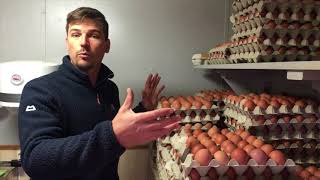
Richard Perkins walks through building an egg packery for 1,200 hens that produce 20 tons of eggs yearly. He covers certification, basic equipment, storage at 8-16°C, and the economics: roughly €450 daily revenue at peak against €90 in feed costs. He sells mixed flats to restaurants and subscription customers.
Questions this video answers
1,200 hens
About 83–84% (83, 84%)
About 1,150 eggs per day (nearly 1,150)
Nearly 8,000 eggs a week
About 430 kilos of eggs per week
Chapters
Right now it's early January and the hens are still laying. 83, 84%. That means for every 100 hens we have, we get 83, 84 eggs a day. And we need to think about some modifications in here. We're going to have 1200 hens this season. That's going to be over a thousand eggs a day for most of the production year. And so we need more storage space for all these eggs. In today's video, I just want to run through some of the considerations for thinking about an egg packery if you're going to have a pastured layer enterprise. First off, before we get into the video, I want to say a big thank you to the patrons who stepped behind us and we're about a fifth of the way to the support that we set out and the goals for Patreon. So thank you so much for that. And I think really, you know, to be able to keep putting out videos at a high rate this season, it's really important we get your support. If you don't know what Patreon is, then click on the link below. You'll find out more there. You get access to the videos earlier and it's where I answer people's questions and I really appreciate the sort of reciprocal support that goes on through that. So thanks so much for everyone that's got behind the campaign so far. So if you want to sell eggs to restaurants or shops, you need to have a certified egg packery. Until you've had an inspector come and certify the packery, you don't get the stamp that we put on the eggs so that eggs can be identified in case anyone got sick. They can trace the eggs back to the farm. We swapped this wagon for four chickens and kicked it out. Very simple. It really doesn't need to be very complicated to have an egg packery, but you do need to have it inspected annually. It's important you look at your local regulations to understand what's needed, but it's pretty simple stuff. I'll show you inside, what we've got in there and how we use the egg packery. So coming in here, you see, basically we have a store of eggs. This is where we pack and grade the eggs. We keep records up here. We have a small supply of nest boxes. We have thermometers to record the temperature. We have hot and cold water available through just a simple connection with a hose pipe that goes to an instant heater here. And that's fine as far as regulations go. And just some simple Shelving for eggs, you have to have a mouse trap and all of the ceiling vents have to be screened. Apart from that, there's nothing else that spectacular about an egg packery. So one thing to think about is how you run your laying flocks. We buy point of lay hens here, so they come to the farm 16 weeks old. And we do that because it's very hard to get. There's only two types of hens you can have here, the Lohman Brown, the Lohmann White, unless you hatch your own hens. But to have your own hatchery is a whole big job in itself. And to be able to plan the business well, we want to know all our hens are coming into lay at the same time, because you've got to think about your replacement of Phlox, too. We keep our hens for one year, so they're four months old when we get them, and we cull them at about 16 months old because their production goes down a bit when you've got high production layers laying at 95% most of the summer through till October time, when it goes down to about 90%. November, December now high 80s now in January we're about 84%, which is really good. But to get that high production rate, you need to feed these birds very carefully. And you'll find you won't get that out of heritage layers and you certainly won't get that production if you've bought your own flock up and had birds coming in to lay at very different time periods. Now, I'm not saying you can't do that, and many people do do that, particularly in the States, where a lot of our viewers are from. It's much more common to do heirloom flocks and there's much more availability of chicks, etc. Here in Sweden, it's very hard to get other birds. You could, of course, breed your own, but we just don't have the time. And we've evaluated the cost and it's cheaper for us to buy point of lay birds than it is to hatch and raise our own. And just due to all the other enterprises we've got going at the farm. And having a young baby, it's much more practical for us. So that's the way we've chosen to do it, certainly for the initial years. Longer term that may change, but we'll see. But I think it's important from a planning perspective also, because when you get the point of lay birds, it takes nearly a month for them to come into form production, because we have like eggs are such a regular product that customers, once you have egg customers, it's an amazing product to add other sales channels to. Once people are buying your eggs, they're coming very regularly to buy your eggs. So it's very easy to sell them some meat or to add a veg box on, etc. Eggs are one of the best stable products for a farm to direct a customer sale and a great enterprise for people to start with. In my mind and to be able to plan, you've got to be able to get rid of your eggs because they build up quickly. Next year we'll have 1200 hens. That's going to be nearly 1150 eggs a day for most of the production season. That's a lot of eggs. That's nearly 8,000 eggs a week. It's a lot of revenue. But you've got to be able to get rid of those eggs on a constant basis or they pile up really quickly. For example, this is a stack of 10 trays. This would be eight trays. We're going to have 266 trays a week. And so you need to think about how you're selling your eggs. We sell on subscriptions, so people sign up for six months at a time and we'll deliver them more often in the summer when we have eggs, sorry, when we have vegetables and other products to sell. So in the winter we do two drop offs a week of half an hour each and so customers know how many trays they're getting for X amount of months, etc. And then we also sell on the Rico ring and we also sell to restaurants and things. But we need to sort of balance our sales with the weekly production of eggs which changes throughout the year. So you need to be able to anticipate that to know when you're going to have larger amounts of eggs or less eggs. So you can warn people up front. And then when you're replacing flocks, you need to try and shuffle that so you have a, you know, to minimize the dips in production or the peaks in production. So what we like to do is keep the old flock, get the new flock on the farm and as the new flock comes in, start culling the old flock. So we get a little week or two with a dip in production and that's it now takes a bit of time to get down with that. And we keep changing the size of our flocks because we're still scaling up production. But I think it's an important thing to think about the sort of Volumes of eggs, the weight of the eggs. You know, it's going to be 430 kilos of eggs a week that we have to store. And you got to keep this in a stable temperature. It's got to be between 8 and 16 degrees. You've got to prove that you're keeping it within that temperature range to have your certified egg. This is what you're after when you've got a certified packery is a production number. And that's what we stamp on the top of the eggs that you see here. So until you've got certification, you can't get this little stamp there. And that's what you need if you want to sell to restaurants or shops. So what I've been doing is thinking about next season and we technically have just enough space to store all the eggs from one week as we scale up to 1200 birds. But it's a little bit cramped. I show you the room on the backside of this wall here. So in the back of the module here, we just have a small space for storing egg boxes. And you see it's about a meter wide, but that will add a huge amount of space for storing eggs. And it's just simply removing this retaining wall, which will be quite an easy job. So you see, it's going to be quite easy just to knock that wall through. And we've got this beautiful stainless steel shelving that our friend took down from a shop. He retired from being a shopkeeper in Stockholm. And when Nicholas and Matt went to sell chickens and pork products in Stockholm back in November, they brought back all this racking. So my intention is put that on the walls, Hicks. It's very strong. It can take the weight. 430 kilos of eggs. That's a lot of weight to stack up on the shelves. It's just going to open up this space, make it much more practical to pack eggs in, but also to take them out, because we take them from here to put in the van for delivery. So having a bit of space between the eggs so you can pick them up easily is obviously very helpful. So this is the racking that the guys came back with that was in our friend's shop in Stockholm. It's all stainless steel, a couple of different types of rack, but it's these flat shelves that I'm interested in. They're not the perfect dimension for keeping eggs, but they're super high quality. And this simple system will be really easy to stack them. What I'll do is I'll build the shelves at the Right height for one day's worth of eggs to tessellate perfectly. And we've got loads of this racking here, so it's going to be a much more heavy duty, much more efficiently built shelving system that's built for, you know, the day's worth of eggs. And if we change our flock size in the future, it's very easy to just change this and it's going to be really strong for all that heavy weight of all those eggs every day. So great way to build up this thing for cheap. Everything we do on the farm, super cheap. Very low cost grain silo that supports those hens. Very low cost racking to go with the infrastructure that cost us just a few chickens in the first place. Eggs keep for up to four weeks from when they're laid, so, so you've got time to sell them, but obviously they keep laying every day, so you've got to be able to get rid of eggs at the speed they're coming in. So it takes time to build that up. I would recommend that you start with a smaller flock and build it up as you build your customer base, but avoid the big mistake that many people make and start with a flock that's big enough to make either the contribution to your economy that you need or a significant amount to towards the economy that you need from your farm. If you're doing a mixed farm, I think one of the big problems I'm writing about this in the new book that I'm writing now is that people start things on too small a scale. You know, having 50 hens is pretty much the same amount of work as having 400 hens, but the economy is very, very different. The thing with livestock is once you commit to livestock, it's a seven day a week, 365 day a year affair. It kind of doesn't matter whether you have a hundred cows or five cows or a thousand chickens or five chickens. Obviously there's a bit more work with more animals, but it's not significantly more. The level of commitment is the same as it were. So make sure you don't start too small because people get really disillusioned when they're putting in that commitment and work every day, but not getting the economy out. You need to start at a scale that is giving you enough. So you need to define what you're trying to earn as profit out of the enterprise and scale the enterprise to that. And that's a big part of the online training and the trainings we do at the farm is helping People get their enterprises scaled to the right size. Just for context, when we have 1200 laying hens at full production, which will be from early June all the way through till November, at their highest rate, like 95% laying this, they're going to be producing about €450 worth of eggs a day. Feed costs per day going to be about €90. So that's an enterprise going to be netting about two and a half thousand euros a week during its high production and still high levels of production in the wintertime. Adding one more eggmobile obviously adds another move every second day and another third of the time per day put into opening up the nests, to collecting eggs, packing eggs, grading eggs, etc. We keep that simple by we always sell mixed flats of 30 eggs. We don't grade them into sizes and when they're small, when the birds are first coming in to lay, they'll characteristically lay much smaller eggs. We just sell them by kilo price to restaurants so everyone feels like they're getting a good deal. But by not grading them, that saves us a huge amount of time. So that works well. And we prioritize selling in trays of three. We don't really sell in any smaller amount and that works really well with our subscription customers and restaurants, etc. So it makes everything uniform, quite easeful and in the volume that's, you know, appropriate to the scale of production that we have. So I'm looking forward to it. It's going to be over 20 tons of eggs that we produce this year. It's going to be the most that we've done and I'm looking forward to it. People love our eggs still. It's one of our benchmark products. If you've been watching the channel for any time, you'll know the hens have been responsible for huge improvements in our grassland, which is driving ecosystem processes forward really rapidly. I really love this enterprise. I think it's a great one and I'm really excited that other people, even locally, are starting this model too. There's several other mobile pastured egg producers locally that I think we've inspired up as well as further afield. So that's it for today. And let us know if you're building an Eggmobile or an Egg packery and how that's going. Thanks for watching our videos. Thanks for all our patrons. You can find out more in our book, Making Small Farms Work. See you in the next video.
More from Richard


A review of short and intensive season on a mixed farm and restaurant/event space in Sweden






Alskade Kyckling Exploring complexities of poultry production in Sweden and what we stand for


