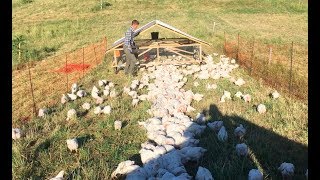
Richard Perkins presents a farm vlog from his Swedish farm during an extreme dry spell (described as the driest period since 1950). He demonstrates on-farm processing (curing pork at 2.25% salt and 2.25% sugar), discusses chicken broiler management and Salatin pen movement, shows turkey behaviour and electric-fence problems on very dry soil, outlines adjusted grazing/rest strategies and hay-buying plans due to drought, mentions plans to introduce a bull for breeding, and reflects on training young farmworkers and the value of a rural upbringing.
Questions this video answers
Salt 2.25% and sugar 2.25% by weight.
He describes it as the driest period since 1950 (worst drought in ~70 years).
About 2.3 kg (average).
Chapters
So today's video is just odds and sods around the farm, super dry weather. Still, it's been the driest period since 1950 and big problems for agriculture here in Sweden. And, yes, just a bit of a glimpse of different things going on. So I hope you enjoyed today's video. So I've been taking three sows that we don't want to breed on, so I've been taking them for eating for ourselves. So I've got all the bacon here and 2.25% by weight of salt and sugar. And then so both salt and sugar at 2.25% and then some black pepper. I'm just gonna coat these and leave them in the fridge for up to a week and then get them ready for the smoker. Put them in the smoker with some chickens next week. So it's been a good move this morning, really fast, because the birds just coming along on their own now as they get bigger. And this is what we observed last year, too. You see, they spread very evenly across all pens. So now as they get, you know, used to the rhythm and get a bit bigger, bit stronger and easy to move, we can start encouraging them just by feeding them down the middle. And they'll come running forward and pull the whole shoulders over the top of them so there's less risk of any squashing them. In the beginning, you've got to be super slow and careful, but they soon learn the rhythms. It's going really nicely. Still not using the full nets. We'll wait till they get a little bit bigger for that. And we've just added an automatic waterer here, but it'll be a while until we just go down to that one. So we're keeping up with the other waters too, just so they get used to the whole setup. Looking good. Big birds, extra rations of water up at 28, 29 degrees in the day. So we're just giving them additional water and coming up still five times a day to check, because it's an awful lot of chickens to have any problems with running out water. This water is a little bit temperamental. You have to be careful. They're thirsty at this time. So it's morning, 72 degrees still. So I'm going to turn this thermostat off and just going to measure inside one of the birds and see how it's gone. Well, hasn't finished smoking. What do you think? So this is the first batch of chickens that went really well, actually had them for breakfast today and ate a chicken for breakfast. It's really nice. Salt levels good. Milder smoke flavor than some of the birds. We've had smoke for us, but we think it's a winner. Pretty good. Turkey's coming out in the gobbledygo. Lucas is here from Canada. 40 hours travel, no sleep, and guess what, he speaks German. Everyone here speaks German except me. So gotta learn how to understand electric fence. Now, these birds are big enough that they can crash the fence and easily come out. So just need to monitor them a bit. Today we haven't put pegs in on the net, but we might come back and do that. So this is how we move. When we get to the end of a row, we actually open the net up sideways and lift the pens up physically. You can see here Toby and Neil's doing this one. It's actually, it's kind of easier than rolling them along because the birds have such a large surface area to move across. The pens are super light. There are light bolted salads and pens with their roof. Watch the nettler. Now, we haven't done this before so just got to learn how to lamb them well. But you get the idea. That's how we, we move across to start a new row because they're going in these 10 meter wide Savannah strips. So we've just come up here and now we're hopping across. But it's very useful actually given the ease of the move today. One thing that you could consider if you're interested in these pens is to actually put wheels on the shorter end. These are 3 by 4 Salatin pens. People have been asking how you build these. Well, I mean you should be able to figure that out from the pictures. It's pretty simple. It's a salatin pen with a little angled roof built up on there. It's pretty easy to see how that's put on. And the wheels are just put on bicycle wheels with a long screw through the actual axle and a little wooden frame to hold it up. They work really well. But the birds have to go a really long way from the very back of the chain into the current one. If you had field access to do it, you could put these wheels on the 3 meter side and move the whole thing sideways. And it's so much quicker and easier because the birds have 20 meters of open space to run out of rather than having to come along through a thin corridor. However, that's something we can't do here because of our trees in most places, because we have silver pasture lanes, we're moving along in a thin snake fashion like all the other animals move too. So in our farm, it doesn't really fit to do that all the time. It just fits occasionally at the end. We have like a chestnut here. We have to hop over things like that. But something to consider and also to weigh up against, you know, it's also really good for the birds to get a bunch of exercise, so it's good for them to make that long move. But, you know, something to consider. Hens are just back into top field now. It's not fully recovered at the stage I would like, but we'll go up and see the turkeys and talk about the grass there. Because we've got the harshest drought for 70 years in Sweden. It's really affecting the resource base that we're managing. So turkeys have come out into their gobbledygo yesterday, which has gone well, except for the fact that they're not used to electric fence right now, so they actually have enough weight that they can easily press through the fence. And so we've had to string up every single pole from the inside on this edge that's along the forest. You'll see as I walk along here. Now, this is the natural hiding space and habitat of turkeys. So they love to come. Like, they feel so naturally inclined to come in there and hide. And so what we've had to do is to brace up the fencing. And we're not getting great shocks at the moment because the ground is just so dry. A, there's no water in the soil, and B, you can't even push the grounding rods very far into the soil because it's just baked dry. We have really expansive clays here that really make it a hard job even with a hammer. But I came up late last night, 11:30, to close up chickens, and I came up here and they were all roosting on their roosts beautifully and seemed really content and happy. We just came up here, brought the boys up to have a look, and that actually scared them. And it turned out that they rushed the fence again, and just because of the sheer number of them, they can actually storm the fence right down. And they don't get. So it's like chickens. They don't get electric shocks unless they're touching in specific places where they're not protected by feathers. So we see. But things are changing up here because it's been the worst drought since the 1950s here in Sweden, and people are selling off their livestock. Like, people are culling their cow herds because they just haven't got enough forage. In the fields and can't anticipate having enough for the winter. There's a guy near us with 400 cows that's selling off half of them. And, yeah, slaughterhouses are fully booked, so it's a pretty challenging time. So it's made us reconsider and it's allowed us to begin a conversation with our neighbour who gives us this 7 hectares of grazing to manage it differently. I've always wanted to move away from the sort of normal keeping things in a vegetative state as long as possible to more trampling and leaving a lot of litter lying on the ground. I really want to improve these pastures, particularly if we work with them longer term, because they're really nothing compared to ours. But because of this drought, I want to actually keep the animals off our farm for quite a while now to allow them to recover fully. They'll have the layers going round and round. We can't bring layers over here, just logistically. And so we're going to actually start taking it very slow through here. The cows have got a strip across the field, you can see, and we're giving them a couple of meters extra this way, and then we'll come back at lunch, do a couple more meters and really try and maximize animal impact. So when we're grazing, we have the. Well, we have three tools we're working with. We have grazing, so the consumption of the actual grass and the impact that has on long chain carbon being released as roots die back. And we also affect the photosynthetic rate and growth of the plant. But we also have animal impact, which is the stamping and trampling of grasses and leaving of shit and urine everywhere. And then we also have. The third tool is rest or time, like giving the grass time to recover. So what we're doing now is actually totally losing our grazing plan and we're going to go as slow as we can. This is the plan right now, is going as slow as we can through this land, knowing that it probably won't recover well, or if it does, we'll get a quick graze through at the end of the year and keep moving the chickens around our land with the broilers. And that will allow a nice period of rest on our land and allow us to really utilize this forage. So it's time to buy hay here. Like if, you know, we're not cutting our own hay, we decided it's not worth cutting hay here, it's just too poor to forage. But it's time to buy in hay because there Won't be a major shortage this winter. So happy for the cows. Trying to get our hands on a bull now to enable us to start breeding beef breed like Hereford onto the Fial Ku, our local native heirloom cows. But it's been really interesting process. Like it's, it just shows, you know, every year we've been here it's been one extreme or another. Wetter spring, coldest spring, dry spring, hotter spring. And yeah, it's really affecting a lot of agricultural production up here. I know it's really nothing for some of you that come from super dry places, but it's all relative. You know the effect of the prolonged dry spells here, I mean it's gone into another two weeks of dry forecast. But the effect of that is massive on agriculture here. If you come from a really hot dry place, you also have the infrastructure and systems in place. Maybe not, but you are more likely to have those systems in place to deal with those things. Whereas our production is just built around having moisture and some regular rainfall throughout the year. So this has really affected grain productions in Sweden as well as pasture. And many people just have no resiliency in their pasture. You saw just even a week ago we were grazing grass chest tight in our land. But the grass that we're on now is it can't grow anymore. It's totally stunted at the point it's at, it's really nothing compared to our land. So we want to treat our land careful now and go through here. So a little update. I just wanted to show you the turkeys out in the gobbledygos and yeah, just update you on how it's going with things up here. It's weekend now and we're going off to pick up a puppy. My daughter Grace is here. So we've got a nice relaxing weekend and try and get some respite with the crew. Gonna have a beautiful barbecue, some spare ribs and tenderloins from the pigs I've been processing recently. So happy days. Today's barbecue day. Picking up puppy. This is tenderloins from the pigs I took last week. And it's very mustard based and thyme. Mustard, thyme, honey from our bees, some soy sauce, salt and pepper and then we got spare ribs. Whoa, look at that. Feast for young men and women. But this is a sweeter mix with like sweet tomatoes and there's sugar in there and all the good stuff. Lots of pepper, lots of chili. Hello cows. Yeah, so we're grazing through here now and this is just to give you a comparison to Our land. It's hard to make these things out on the camera but this is what the ground is looking like. This is its full expression. There's a lot of gaps between the plants. When you actually get down in here it's very sparse. That's why we didn't want to take hay here. It just shrivel up to nothing. Very stemmy. Everything's gone to seed formation but it's very low, it's, you know, knee height all across the fields. Very different to our land and same ground. It's different soil types throughout the neighbour's land here, just like our farm. But you know, it's really startling and it's something to behold when you've been at our farm a bit and seen it in rampant growth. It's dramatically different to this sort of stuff. Now I've said before, but just to reiterate, like for those of you from really dry climates, this might seem lush but it's, it's nothing compared to what our land has become. It's very poor pasture. Now. We've had eight, nine weeks with very little rain but this grass can't get any further than this. Basically this is why we're worried about recovery time now. So we, we're thinking to take as much forage as we can off here to utilize the resourcefully because I don't think it's going to recover well if we get continuation of this drought. So we, yeah, we see it's an interesting year and every year is a bit of a test in that way living up here at this latitude. But yeah, it's fun. It keeps it interesting and dynamic and you know, you can't get into automated ways of doing things. You've got to base everything on observation and careful, timely interactions and that's what farming is, you know. And I really resonated with me what Roger said in an interview a few videos ago about him just being a technician before when he was farming industrially. And I think there's a lot of truth in that. It was very insightful. It's, it's true like everything we do here is so observational base that it makes it hard to, to manage. That's why a lot of people don't want to do it. They're lazy maybe or you know, or it's quite risky because you've got to have people who are able to pick up on that and you know, to have someone here to manage any of these enterprises requires, you know, a built in sense of being able to observe and read what they're seeing around them. And it's one of the great challenges running a place like this is training people up who don't necessarily have those skills naturally brought in. It's something I've really noticed. You know, the difference between farm kids and city kids is it's amazing to see. I'm not saying that to be insulting in any way. It's a really clear thing to me, like to anyone used to working on farms or whatever, you can really spot someone who's grown up, you know, removed from nature, certainly in an urban environment. Their level of understanding of what they're looking at and their level of practical skills is very low usually. And it's great. We just welcomed Lucas here. He's 16 years old and I reckon he'll run rings around most of the people that come here because he's grown up since a very young age at his larger farm in Canada, you know, and some people here in their mid-20s learning to ride a quad bike, whereas he's been riding one since he's five or six years old. So it's a different thing and I like it. It's a bit of a risk for us taking Lucas because he's not technically an adult yet. So that brings some concerns and insurance things, whatever, but I just felt like, yeah, I really want to support someone that's that young going into a more regenerative style of farming is, is amazing. Yeah, it's a new, new journey for us to have a family here with a young child, but also to have a. A minor. And I'm really happy for that. I think it's a really nice change and change of feeling here at the farm. It's. Yeah, it's, it's a funny thing, you know, and it's a big part of what I do, training people up is, is looking at key elements we need to be observing, things we need to be watching for. You know, modern industrial farming is very much based on technician skills and servicing machines or whatever it is, but we're working with little minor details and low budget infrastructure that's, you know, it comes with its problems. So you've got to be hyper aware and yeah, I think it's really been a big thing on my mind this year. You know, the benefits of growing up in the countryside, the benefits of growing up in a farm setting. It's what I'm excited for my kids to do is to learn, you know, by a very young age what all the ecosystem processes they're managing are and how to slaughter a hen and how to take care of a sick animal and how to put up fencing good and all these other life skills. It's also why I wanted to take them sailing at a young age, to really understand how to look after themselves. Practical, usable skills that I feel like schools just invariably don't teach anymore. But, yeah, big thing on my mind. It's a topic I could do a whole video about, I think about, yeah, the benefits of growing up in the countryside as opposed to towns and cities. But, you know, most people live in the city and that's the way it is. But I'm very glad I was raised in the countryside and my learning process has been incredibly enriched from that foundation. And there's just like an implicit knowing of certain rhythms and cycles and that you just can't have if you grow up in the concrete jungle, as it were. So feeling grateful for that today. So we're driving to Oderbridge to pick up Saku with some Thai gifts. Hi, Gracie. It. So I'm just opening the fence. So the next move, which is a straight move, look what happens. So the fence has been open 30 seconds. This is where these pens and this model come into play because the whole process is much more graceful when the birds go off themselves. So today's the first day we put feed down the middle and hopefully we'll be able to just roll over the top of them. So you really see here how they focus in on the feed. It makes it much easier to come along over the top of them if you can. So last few birds, essentially it takes seven, eight minutes to move nearly a thousand birds in a less stressful way. That gives them more exercise and they get more ground to forage. But it's starting to become automatic as you see with them running through. And that will become rampant as they get really bigger and stronger and hungrier. They will come charging through in the mornings. There's always one. I'm up at a treehouse. You might remember that I have a little nest right up here above the door. Happy birdies. Pretty amazing. There's another nest just up in the eave. I can hear Mama calling. She's over here. And there's another one on the backside. So there's three nests of birds. Anyway, that's it for today, folks. I'm just coming to take a snooze. Enjoy this restful period on Sunday. And we've got our first chicken slaughter tomorrow of boilers. They're looking great. I think it's going to be 2.3 average. I'll let you know how that goes, but always nice to get the team introduced to that process and do a job really well. So thanks as always for watching the videos. Hope you enjoyed. Just a little update of random things going on around the place and you can find out a lot more about the technical aspects and how we design and go about making profitable small farms. In our book Making Small Farms Work, it's only available from the farm. You can see it in the links below. We ship them out all over the world once or twice a week. So thanks for your interest in that. And you can see a bunch more about educational offerings and things going on in the links below. So see you in the next video. It.
More from Richard


A review of short and intensive season on a mixed farm and restaurant/event space in Sweden






Alskade Kyckling Exploring complexities of poultry production in Sweden and what we stand for


