S5 ● E52 How we operate Europe's cheapest certified poultry processing facility
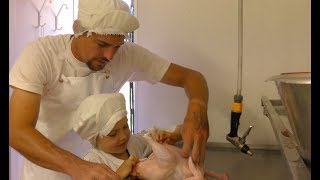
Richard Perkins (video creator) narrates the first slaughter session of the season at his on-site poultry processing facility. He describes processing 300 broilers (≈€9,000 sales; 1/9 of season's broiler production) and demonstrates the facility setup (inexpensive wagon-based licensed poultry slaughter facility), equipment (electric stunner, kill cones, scalder, plucker, powerful chiller), step-by-step slaughter and evisceration procedures, hygiene/record-keeping requirements, temperature targets (birds must reach internal 4°C within 8 hours), scalding settings (63°C for 1 minute 15 seconds), organ handling (hearts/livers iced every ~50 birds), cleaning procedures, wastewater rules (disperse to non-edible trees; no pasture contact for 12 months), and pricing (they sell at 120 SEK/kg ≈ €12/kg; a local certified organic brand sells at €14.50/kg).
Questions this video answers
300 birds
About €9,000
1/9 of the broiler production this season
€200
About 0.4 (amps/voltage reading)
Chapters
So today is the first slaughter session of the season and we're doing 300 birds this morning. That's about €9,000 of sales and that represents 1/9 of the boiler production this season. Now, viewer discretion is recommended. This video includes the killing of birds and the evisceration of them. And that, you know, involves a bit of blood and guts and things like this. So if you're not into that kind of thing, then don't watch. And we share this information very freely to enable other people to get started with the regeneration of their soils and habitats and profitable enterprises that feed people locally with high quality food. Please don't watch if you're not interested in that and if you're curious, then you're welcome to watch. And I hope you find it useful, inspiring, interesting to see what goes into these productions. But please don't leave any comments about vegan or vegetarian propaganda. We're not interested here. We don't invite it here. You're welcome to eat whatever diet you want, but we don't believe that's a responsible way to farm. And so please don't leave negative comments here. They'll be deleted. Thanks for your understanding. I hope everyone continues as always to show up and share in a respectful manner. That's what we appreciate about the followers that keep in touch with our channel. So thank you so much for that. So first broiler session of the year and we've got a few people that haven't been in before. So today's video, I'm going to show you around how we process our birds on site. So this facility is one of Europe's cheapest approved slaughter facilities. It's licensed for poultry. But this is a wagon that cost us €200. And we've put our own gear inside, lined it all with pvc, used the existing drainages. And the basic setup is Kill Station, a dirty room and a clean room. We have the smokery for smoking chicken behind and wastewater drains down and is collected on the outside down here and we're allowed to put that onto our non edible trees. So you see wastewater collects by gravity out of here. So this is Kill Station. Toby's stunning the birds with electricity. You see the stunner on the left there by law and your. You have to stand the beds before cutting the carotid arteries. You can also read on the machine here the amps and voltage. And you see as it gets connected it goes up to about 0.4, is showing optimal stunning there. This is from Sedge Beer in the uk. It's also where we get the kill cones from. Good quality stainless steel stuff. Any initial resistance I had to using an electric stunner has passed because it's actually a lot more peaceful. The birds don't get distressed and so it's nice to bring them down in small batches and not have them sitting in crates for long. That's how we prefer to do. We always have someone on the outside who's on chores. Today it's Niels. He's off doing feeding broilers, feeding layers, collecting eggs, etc. This is the last batch that still got their lights off. They're bled for two minutes and then we're taking the heads off at the top of the neck and they come in in a tray into what's called the derby side here to be scolded and then plucked. And most about this lottery is about work. They come over here to be eviscerated. Any birds that are sick must be immediately removed. So that's my legal responsibility, is checking the health of each bird. Then it gets washed out, inspected and given a grade and passed through here to the clean room where all the data collection happens. And that's recording how long it takes from a bird being killed to get through this process all the way. And then to reach internal temperature, which is it's got to reach 4 degrees internal temperature within 8 hours. So we have test birds at the start, middle and end of each batch and that's how we prove that we are meeting standards. We have a very powerful chiller, so it's no problem at all. Those are records that we must give to the authorities. So this is first birds inner 300. Today birds in. So birds are scolded 63 Celsius for 1 minute 15. And then we remove feet before plucking to make sure that the birds aren't scratching each other as they move around in the plucker. Feet can be sold as dog treats and things like that, but we don't have much of a marketplace. So birds go into the plucker six at a time. We first take off all gland. You do that by putting your finger very flat that you can't possibly cut it and you are looking at the line between the rump and just a little nick that goes down to the spine without actually cutting into the bone. Then you can turn your knife under and you see, you get underneath these little glands and we're just removing them. They go in the bin and we're trying to just keep the knife sharp. So once you get under Them and you can sort of scoop under. Then we flip the bird. You pinch the skin up here. So you're just cutting through. Like there's no risk of cutting the breast meat. You're just cutting through there. And then knife down. And I put my finger in the thoracic cavity there to hold the bird. And then I pick this skin, just rip it down to expose the crop. And then I have a weird tip. I just roll the crop onto my finger and secure it with my thumb to get a grip. And then you tear it off the breast this way. Yeah, not too hard when you're gripping. And then you switch hands. I get it in this finger and grab it here and hold the neck skin and pull it up off the neck skin to separate it for me. Yeah, but in the other hand. And then now in the other hand, because then you can get your finger under the esophagus and windpipe and poke through the memory. I use the same hand. I use your right hand and poke under. So I'm holding the neck with my left hand. Yeah, this is just the windpipe. And then we'll tear this out of the neck this way. Do the same with the neck. Tear it up. And then fold the neck skin back the right way up. Right way up means where, like if it goes in so that just make sure it's the right way up. And then palm on the keel and squeeze here to get a bit of tension. And then there's one slice, but the guts are just underneath there that you don't want to go through it. So you get through that fat there. And then you can get your fingers in. But you should use your knife flat like this. Yeah. And then two fingers each side rip. And any shifts coming up the side now, so you work sideways. Then you got to separate the fat from the gizzards here. So I run my finger around to the right and slide it up and try and keep all this flat. See how I've separate. I'm not actually pulling it up and just going. Then you go. Try and just reach everything you can. Ideally, you can reach all this. Put it all over one. If your hands are too big and you can't. And then you pull it off the table. So then this off the table in your right hand, switch it to your left hand. And we take the hearts in the liver. But you've got to be super careful of the bowl. So you tease it away. Like if it splits, just drop all the gaps. That's true, but just teasing. You leave a bag of the liver on? No, not normally. It just happens. You can pinch it at the top, like up here. And then you get all the liver and then we check the liver. If there's any white or red spots. I want you to show me liver in this side. Hearts. Yeah, that's nice. I've got to start moving so I'm just going to show you the rest of it here. Then I want to keep this fat on the pubic bone. So I go really tight. But I'm not cutting into the spine. You'll blunt your knife in a couple of birds. And then I cut under it. That's gone. Birds in. Birds in. You've got to cut the hole. Can I let that hanging? No. See that? You're leaving a bit of that hole. You've got a. It's a tension thing. You want your guts to be giving you attention, allows you to control it. Because you have to hold up. You'll have to hold up a little. So you've got to get the whole asshole off. Yeah. So try and just break symptoms. So but that's actually for now already here is still the. I think the lungs are still inside, right? Yeah, lungs are there. But if you sometimes the wind pipe for itself. So then. Yeah, lungs you dig out like highest three fingers and you can feel like when you've got the whole thing. And then I squish the other way to get lungs. But we have to check that we actually get all the lungs out. And then if you can check your front end again. And then I just fold it up and take the neck off there. Okay. And next I think we want some. Not even today. So then I. I can see like I've got rid of the asshole, got rid of the lungs. There's no esophagus. That bird just needs rinsing and it's neighbor. And then we just rinse down. And then our job is to keep up flow, no? Yes, but to keep these birds in order. So they're passing through heat wise. So just take it real slow. Yes, but you put it before, you put it after. So we're keeping this order the whole time. And Carla will get on top of it. But just take it slow and see if you can copy all them steps. And if you get confused, just let me know. Okay, so bird start. Finished. Take the oil gland off by cutting down and under without turning to the spine. Flip the bird, lift the neck skin cut through, rip down. And then I'm pulling the crop against my thumb to get it off the breast and off the Neck skin reaching under the esophagus and windpipe. Separate them, pull out the neck, slip with a bit of pressure here between the vent and the keel. Rip open off the table in case anything splits. Separate the fat from the gizzard. Reach around, try and pull out everything that I can. And then I'm separating today. Livers and hearts, checking them for the health of the bird. Any red spots, any white spots? Not good, they're fine. Blackbird's healthy. Cutting straight down beside the anus to make sure I don't remove the fat from the pubic bone here. Take the lungs out and take the neck off at the body there. Bird's done, next one. So our organs are going through now. Hearts and livers, they're full of blood obviously, so they must be cooled a lot quicker. So every 50 birds, at the pace we go, we can put them through and they go into ice water to make sure they chill down. So they have a separate regulation temperature wise, they've got to get to temperature much quicker than the actual meat in the chicken. So here's all the record keeping and this is where birds are timed when they come in and the grades, which Lucas is doing a great job with. And birds get stacked up in here so we can identify each bird and organs you see go into the cold ice water down here. But then that's how we keep records so that we know when we come back which birds from where and when we pack them. We, we read the grade. A is for perfect for customers. B is okay for customers that don't mind like a tiny rip in the skin or whatever. Sea birds are birds that have a broken wing or something that will eat ourselves. But then we check the grade because sometimes the bird's skin will look like not premium to us. But then after being in the chiller, it looks perfect. So we'll come back and regrade it again. And we check the temperatures in the chiller and just monitor everything here. So it's just me eviscerating now and we're going quite fast pace with both coming in. So it's pushing me to my limit. But we're not taking organs now. Like we don't take all the organs because we have so many birds. We don't actually. We're not able to sell all those organs, but that means evisceration is slightly quicker. I can get down to about 25 seconds of birds safely. And so we're just trying to keep up with the pace now to be finished at a good time today. Okay. So paint your hands. Same with milky. Yeah, that's good. Don't touch your face or anything now so you can do all the pulling bits. Okay, I'll do the cutting. So this is the oil gland. That's how it oils the feathers. We cut that away. You see the yellow sacks there? So you want to get me there because it tastes a bit funny in the meat. You want me to wait with the plucker? Yeah. She can't hear maybe. Alright, so then we cut here. Now you have to put your fingers here and rip this skin down. So you put one finger in there to hold the chicken. Yep. Hold it with your hand. And now you rip down with the two fingers in there. And rip it. Yes. And then we've got to get this bit. Here is the crop. That's its food sack and it's stuck to the breast meat. We need to try and grip this white sack and pull it this way. Pull, pull, pull. Yeah, it's a bit slippy, isn't it? You see, you can pull it down, let that and it separates separated. It's cool. No, and then you can take it in your other hand and you've got to separate it from the neck up this way. It's a bit sticky. Now the next bit's tricky. I'll help with that. You have to dig under. This is the food pipe from its mouth and this is its air pipe to its lungs. So I'm putting my finger under them and I have to pull them out. You can pull like that. And then you got to pull the neck out too. This is the neck my grandma loves. Yeah. So it's quite tough. You have to yank it. So then it's all released. That's the next thing. I can see the bow. You can see the spine on the bone. Now this is big cuts to try and not hit the guts. See the guts just in there. So now you need to get two fingers each side up and rip it. You have to pull quite hard. Harder, harder. You can rip all this. Harder, harder, harder. Good. A little bit more. Now if it has a little bit of poo, we have to wash it up. So we'll wash your hands. That's good. Now you have to run your hand over here. This is the gizzard, the food sack. And it's stuck with fat to the skin. So we need to like scoop over it to separate it with the finger. Yeah, See, now this is the funny bit. You got to put your hand in all the way around and pull all the insides out. It's warm and it's all the organs. So you just scoop them out and pull. Go further. You see there's a heart little bit. That's the fascia that holds it together, keeps it all in shape. And then we have to cut it off. So that's his bum hole. And we have to make sure we don't get any. I don't have to get any. We'll wash them in a second. Look, I'm cutting down, down, across, underneath. And there was a bit of wind left. Do you want to see if you can pull that out? Sleepy. Yeah. Cool, cool, cool. Yes. I want to see if they're interesting how I feel. Yes, they're solid. It's so that they can't. Can't get stopped to breathe very easily because otherwise if you lay down and went to sleep, you might not be able to breathe. So it helps it stay open. Now the lungs are right up here and they're very hard to get. So I'm going to show you. I'm to going. Gonna scoop them like this. It's gonna be hard for you to reach them. You see how they're up in the rib cage there. Oh, that's cool how they're so tiny. They are tiny. Now I'm gonna chop this off here. It's a bit hard for you. Maybe just big hands there. That's Gracie's chicken. We like it. Good job. Pretty. How did it feel? Warm. Warm and squidgy. But not too lucky, was it? You didn't mind? We've only got a few hundred more to do. To be honest, I've always been interested in the lungs. In the lungs and the anatomy. I mean, in the. Yeah. In a bigger animal, like a pig, it's much stronger. It's like the heavier the animal, the stronger the windpipe has to be, otherwise it will collapse. So clean down begins. We're basically going to get this place back to zero feathers. And there's obviously a lot of bits of chatter and dirt and bits even on the ceiling up here. So long process now is to get everything clean. Toby's finished upper tuber for us, so he's washing down out there. And we'll be getting out in order each station because Lucas will be still here till we're done. So obviously things are a bit of a mess. So pressure washing, hot soapy water and wash it down. This gets left out in the elevator. Obviously blood and heads gets taken away. So we get the eviscera collected. The same with the feet, etc. So first job in here is just basically spraying everything down to get all the feathers and bits onto the floor off the surfaces. And then we have someone on laundry and this gear is all washed in our house which is bagged and taken separately on their. Fine with that we take apart all the sink drainage and just make sure that's cleaned with hot soapy water. Then sterilized and take all the erysser out. That gets taken away buckets and then deep cleaned after that's been taken. But it can take two or three days for it to be picked up. So it's got to be fly proof. And basically we've got to get it back to zero colors. And then I'll come in with a spray. This is the spray nozzle. So I'll come back in and spray it. We have a whole cleaning procedure laid out here but this place will become spotless again. And then all of the apple haters put back together. But it's lunchtime and we've got a very full freezer fridge. Can we just have a quick look in the fridge? Fridge just to show the capacity. We've got room for one or two more racks at the minute. So this is the other end of the wastewater and this is the water produced from today's session. So this is allowed by our regulators to be put onto non edible tree lanes. We put it in the windbreak and just disperse it through there. And it's very simple but happy with that as long as it's not in contact with land that's being used as pasture for 12 months which is not in our case. So that's the way we do with wastewater. So I hope you found that interesting. It's you know, integral part of the season here and we've got eight more slaughters to go and then turkeys at the end of the year. But I hope you found it interesting to see see into the process a bit and how it looks and it gives you some insight. It's never the same as being here and like actually getting your hands on. We've got a pastured poultry master class this weekend looking at pastured layers, pastured boilers and we're hoping to get the people coming to that training in this slaughtery too and get some hands on feeling for it because it's very different when you actually, you know, you're in control of putting the birds through. But yeah, it's an interesting process that we take a lot of pride in by, you know, producing much better quality chicken than you can buy elsewhere in Sweden. Some people, I know people from the States. Canada have often commented about the price of chickens, but our birds sell for 120 crowns a kilo, which is €12 a kilo essentially. And that's actually cheaper than organic certified chicken in our store, like whole chicken. So this is one of Sweden's two organic brands. This is a Rico chicken, nothing to do with the Rico ring that we sell at. You can see here, it's in our local supermarket. It's 14 and a half euros a kilo. It's certified organic, whereas ours isn't, although ours are only fair organic feed. But it's also been squashed and flat packed, which is probably great for bulk delivery, but it doesn't look good. So I think, yeah, that's a very good value for money. I think we do a very good value for money, especially as they are hand slaughtered at the farm and moved every day onto fresh ground. Move twice a day as they get older. I don't think you can really go to a store and buy chicken like that. So we're very happy with that price as offering a really good deal for people. So just wanted to clarify that because I occasionally get comments to that tune. So this stuff is all sprayed down clean, drains unblocked and back to normal again. And we leave the inside with the fans on, keep it cooling down and you see everything is clean, good to go. Birds are still chilling, still coming in here once now, keeping the records of the temperature of the birds to see how quickly they go down. But it's no problem ever because it's such a powerful unit. It's. It's always capable of dealing with the amount of birds that physically fit in it. So the next thing is to come in here and set this scalder off for packing tomorrow. So we use heat shrink bags. We need them at 90 degrees sea water. We'll have one in taking the birds out, checking the grading, passing it to someone, putting it in the bag, shrinking it, passing it through here. It'll be weighed up here and records kept here and packed into chill boxes to take. Thanks so much for watching. I really appreciate the likes and views and I really hope you get something from following us throughout the season. I try and just post a bit of everything going on, really. You can leave suggestions for video topics and other things you might like to hear me talk about and I'll keep an eye on those as time goes by. You can find out a bunch more in our book Making Small Farms Work as well as our on farm trainings which you see in the links below. And look forward to seeing you in the next video.
More from Richard


A review of short and intensive season on a mixed farm and restaurant/event space in Sweden






Alskade Kyckling Exploring complexities of poultry production in Sweden and what we stand for


