S5 ● E53 Packing €10,000 of pastured poultry
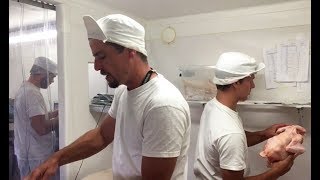
Richard Perkins (farm in Sweden) demonstrates the poultry packing workflow: scalding, defeathering, chilling, bagging, heat-shrinking and labeling, with roles for assistants and data recording (weights/spreadsheets). He explains a three/four-grade quality system (A/B/C/D), equipment and cost choices (scalder, plucker, blast chiller), logistics for freezing/refrigeration, and operational scale and rationale for measured feeding and data collection. He closes with notes on customer preferences, regulatory constraints (packaging), and upcoming educational offerings.
Questions this video answers
90 degrees Celsius.
-18°C.
One year (best before marked on package).
About €6,000–€7,000 (quoted as six or seven thousand euros).
Around 330 birds per slaughter (versus about 270 last year).
Chapters
So some people asked about the packing procedure for chickens. We're busy in here and I've got Lucas with me in the clean room. We're packing and passing through to Nicholas, who's stacking them up into our kanger boxes ready to take to the freezer room or for delivery. Okay. Good morning. Move now. I haven't even put food out, so we'll see how this goes, I think. There you go. The camp. Look at that. Off we go. Toby's got to get that fence up quick. Straight onto fresh ground. Birds moving themselves. Anything that's got feet or wings is designed to move itself. Right. Saves a lot of work and all the while giving them more space, more forage. No predator losses. I wasn't anticipating any. Those of you in countries with other potential predators, and you need to observe this one closely. I know people have had some failures with open nets, but one critical part of this is the fence is very tight up against the roof that no eagle or hawk wants to go in there. We do have eagles and hawks here. We also have wolves. We have lynx. We have pine martens, potentially even wolverines that exist in this part of farmland in Sweden. But I think that would be very rare. They wouldn't come on the farm. Pretty amazing. So this is. With no feed put down at all. It might mean they come running back when they realize. So Grace and I decided we'll make some bacon. Oish looks beautiful. It's been in salt and sugar with black pepper for five days. And, yeah, it looks really good. I really want to eat bacon from our beautiful pigs. So this is all the notes from yesterday with the grades. Obviously we're working backwards. And Lucas has kept a really good record of which birds are wet. The body started packing and put 100 birds in. And so we have a scalder set up here at 90 degrees Celsius. And this is the basic station, so I'm not allowed to. I'm in charge of packing into bags, cable ties, heat shrink. Lucas is passing me the birds and then helping turn them upside down so I don't need to touch the birds or have them touch the outside of the plastic to keep everything super clean. This is what a bird looks like once it's been packed. And then it goes up on the scales there. Having trimmed off and shrunk both ends of the bag, Nicholas is then taking them here, drying them. Fresh tea towels, have a big supply of them laundered so that we can just dry them to put the labels on. Then he records the weights and Spreadsheets. So we have lots of data. We collect about all the birds. Then you see he's stacking them 12 or 14 to a kangar box. And these are good to keep them refrigerated for many hours basically. But we'll be taking them away pretty quickly. So this lot's mainly going to our freezer space in Karlstadt as well as any fresh deliveries. And we'll be filling this up and working out what to do with the last sort of 50 birds it might be. We do a big smokery test with a full batch of birds. We haven't decided yet. So what we're doing is tucking the neck skin so that it's folded nicely at the bottom of the bag. Lukas can re degrade on the wall. And then we're just double checking. Sometimes the birds look a bit funny on the skin. And so we want to check them before we pack them. But then after timing the chiller, they look fine again. And then I just twist the end, squeezing out as much air as I can. And I hold it at this end, get it in some 90 degree water and snip this off, snip off the cable and I shrink the other end again to seal that up nicely. And then if anything's other than an A grade bird, a grade being prime bird, ready to self estimate, I'll let Nicholas know and he'll assume they're all A grade unless I say otherwise. And this allows us to have like a double kind of quality control. We have quality control in the slaughter process, like you saw in the video from yesterday, but that we double check that. So we don't want any feathers or bits on the birds. We've noticed a few with feathers on them, but we like our birds to be spotless. This one is not written. Okay, so here's a dislocated shoulder on the next bird that isn't noted in the quality control for whatever reason. And so that one will go as a V bird. So we have three grades of bird. A is perfect for sale to customers directly or restaurants or whatever. B birds have a slight mark on them. It could be a tiny tear in the skin or it might be a dislocated wing where the skin isn't broken. And some of our customers are fine. We just let them know that. And so we have a code on the label that we can read any bee birds and what the problem is. And then we can talk directly to the customers. Bee dislocated shoulder. And then we have seabirds that are not for sale. They're for us to consume. That might be a big whip or a broken wing that's bruised and no good or any bruising. They're the typical things that show up and then we'll eat them ourselves. D Birds are birds that don't make it into the slaughtery on the day or birds that have some kind of problem when we're eviscerating. They don't make it past the evisceration table and they get recorded in the data too because every bird needs to be tapped. That's. So these are high quality shrink bags that we buy in bulk and you've got to be careful. We use this supplier here in Sweden. They're probably all coming from China but you certainly get some that are made with noxious chemicals and you need to buy high quality ones that don't have certain chemicals in. You can read about that on the web. I really like them. A couple of people have commented is there any alternatives to plastic packaging? But I think realistically I've never heard of anything that will be effective and safe and meets the stringent health and safety regulations that we have to abide to to have a certified slaughtery. I mean plastic is pretty important in terms of how we manage the actual birds and the transportation and storage. Unless they're being born in bulk and then they can be stored in gray food, grapes or whatever. But for freez quality or refrigeration you need to have something practical and hygienic. So if anyone's got any better suggestions I'll be interested to hear. But I haven't heard of a better one myself. So I'm happy to use a little bit of plastic to keep the high quality birds in great condition. So this is the finished product and you see the weights recorded on there and these are being frozen at -18. It tells you the date frozen and best before. You've got a one year shelf life with these frozen birds which is fantastic but very nice Here you see that, you know this is. It's a really nice process to do the whole cycle from Buddha to finished packaged product. So these will be going off to Karlstadt. The ones are getting frozen later in the day. So this powerful fans are on all night because we're heating up the scalder the night before and it gets pretty steamy in here. So we leave the fans on both to dry the slaughtering out after the clean down. But then to keep it the bits of a nice condition in here when we come back in for the packing day. So three People takes most of the morning to do all the packing nicely and organize it all in kangas and get them out of here. And yeah, I quite enjoy the process. It's lots of repetitive motions, like processing the birds in the first place, but once you get a nice workflow going, it's pretty good. So basically the slaughtery got totally cleaned down yesterday, all the laundry done, and we make sure we dry that during the night. And if it's a wet day or whatever, we'll put it in the sauna at night after everyone's had a sauna, just to finish drying it off so it's ready for packaging day. And then basically, once we've done the packing, there's another clean down in here. Obviously the chiller here needs a thorough clean down. The birds have been dripping in there since they went in. So I will foam in there and let that sit for 15 minutes to do its work as I clean down in here. And I'll basically clean down the whole floor again and rinse it, dry it and then it's left ready for the next use next week. So this really makes up the Monday and Tuesday at the farm every week during the production season. Although this year we're doing half the slaughters of last year and we're doing a thousand less birds isn't. But we're doing many less slaughters by doing more birds each time. So we're doing 330 maybe. It depends. It'll be slightly different each week, but around that. Whereas last year we were doing something like 270. It's definitely maxing out the fridge, as you saw yesterday. Lucas was telling me he was doing monitoring the cooling down and Bert got to temperature within four hours. Now there were 700 kilos of meat going down to four degrees in four hours. So it's pretty impressive. It's an overpowered chiller. And really the chiller is the most expensive part of a slaughtery. I mean, this is all built, you know, super homemade and cheap. Except the chiller is probably the single largest investment. And it's about €7,000 in this case, is that correct? Six or seven. It's from Spain. And we phoned the company up and had them, you know, look at our specific case. We told them what we wanted to do with poultry and how many and what we might scale up to in the future. But everything else in here is either salvaged except for the pluckers and scalder. Everything else is salvaged here. The evisceration table was an old mechanics table. I Picked up on eBay for €20 in the UK on the trip I was over there, the sink is was already in the wagon. When we bought this wagon for €200, it came with all the gear for a worker's wagon. So it's the water heater and stainless steel sinks and lockers that are used in this laundry now. We had to buy the PVC that stuck all over and we found old stainless steel tables. I think the scalders we use are a couple of hundred euros each from Germany. From seitman.net I think it is. And the plucker is a German model that's a couple of thousand euros. Very powerful model that's suitable for turkeys, although you can still only get one turkey at a time in that. And up to six boilers is ideal. Everything else is super cheap, simple stuff, so you can definitely do it. You could make something like this cheaper than we have if you found all the right bits. But it's worth investing in a chiller. That's going to be the important bit for meeting regulations and, you know, thinking about how you might scale the enterprise in the future to make sure you're not making double or whatever. So when the birds come out the chiller, their skin is quite dry. It's a blast chiller, which is important to get the birds down in temperature. Right. The birds aren't dry inside at all, it's just the skin. But that makes it hard to get into the bags when they're big birds. And that's why it's really good to have two people. Because in this way Lukas is really helping me direct the bird in and I'm just ensuring that they're not touching the outside of the plastic. So everything is clean and hygienic and yeah, it's good to watch working a little team like this. It's much more efficient and effective than trying to do it alone and having to wash hands all the time. We do have basic hand washing gear right next to us here and also alcohol, so we regularly clean our hands throughout the process. Obviously working with chicken is quite greasy, but definitely good to select the bag that's the right size for the birds. Poultry bags are often available in many sizes, but to get a really good finished product, you want fairly tight fitting bag. It just fits much better when it shrinks down, so you kind of want to go as tight as you can and you can still comfortably get them in without it being too much of a hassle, which is pretty good. I don't remember the size of the bag we're using right now, but there's many available and if you look online it talks about the suggested size of different weights. So you can work out from what aim, target weight you have, what size bag you actually want. We're typically aiming for 2.2.2 kilos for our dressed birds. Lucas was just telling me at home they do things quite differently because they're raising just for themselves and friends and they raise these Cornish Cross. These are actually Ross308. They're very similar to the Cornish Cross, just a slight difference in the parent breed. But they do grow really big. But Nicholas was saying they grow them up to four or five kilos and partly because they're such big families. You're one of seven kids. So to make a chicken dinner you needed four kilos. How many chickens would you eat? Two chickens. That makes up one family dinner. But that's. Yeah, then you need very different sized bags. People, we've been talking about the difference between raising birds with free access to food and with measured rations. We always measure the rations because ultimately these birds are kind of bred to just keep eating and they will eat themselves into problems health wise. And so we like to do things a bit more scientifically and limit the feed. I know a lot of people do unlimited feed for limited amount of time, but I think it's a lot more interesting to actually really measure it out and really be precise so that you can collect a lot of data and really know what little changes do to affect things. For example, if we added 10% more grain for 40% of their life, what would that do to the feed cost and what would it do to the size and health of the birds? And that's always been of interest to me is collecting a lot of data that we can then adjust the enterprise but also share with other people. So that's quite an important part of what we do. But just for interest sake, I've told before, but I'll tell again. We kept some of these birds for over a year and we kept them with the laying hens and they got over eight, eight and a half kilos. And it a very interesting process because they lived with the laying hens, they slept up on high perches, they laid goose sized double yolk eggs every day and they tried to act like laying hens. Now these are obviously being slaughtered at seven, eight, nine weeks or eight, nine, 10 weeks. And so they're still growing young birds. They haven't learned all their chicken like behavior. But what we found with the large broilers that were kept for a year is that they tried learn off the layers how to act. So we have this rotation with the cows followed by the layers four days later for the fly larvae. And what I noticed was that the broilers would enthusiastically waddle after the hens to go get the cow pats, but they would actually just eat the cow paths. So they never quite worked it out how to be a full chicken. They're a very different bird in terms of their foraging capacity and their alertness to predators and those kind of things. But the main reason we go for science we do is that that's the feedback from our customers of what they can eat. We have a lot of elderly customers and a lot of single family people who just can't eat a bigger chicken. And sadly, as is true all over the world today, most people don't actually know how to butcher a chicken anymore. And that's something that every housewife or husband would have known, you know, just 50, 60 years ago. But now that's sadly quite rare. And most kids in Sweden up to the age of 18, 20 have only ever eaten this kind of chicken and its breast meat in cubes. So we sold to a school last year, 16 to 18 year olds and the school were really excited to buy a bunch of our chickens that came and toured the farm. And the feedback was that these 18 year olds didn't like the chickens because they had bones in them. So go figure, this is a country where the kids at school, five or six, six years old, think the milk tanker comes to the farm to fill the cows up with milk. So that's the, that's the world we live in today. So that's it today, folks. Just wanted to respond to the request to see what it's like to pack the chickens. It is a very important part of the process too, and easy to overlook. Once you've finished a big day with slaughtering birds, there's, you know, a whole bunch more work once the birds are chilled down. The birds chilled down quick enough that we could do this in the evening. The slaughter is already clean and we could come back in and do it then. But it's already been a long day because we got up extra early to do chores before breakfast to get everything fit in in a day. So, you know, we often just do the next day because it just makes more sense to us. But yeah. Thanks for watching the channel. I just want to say thanks so much everyone. I've had some really touching comments, people saying this is their favorite farm channel and really appreciate the, you know, just no nonsense approach and I really appreciate those kind of comments because my, my intention from the start has just been to share information the best way I can and try and keep you up to date with what's going on and why we do things the way we do and, you know, a bit of what's going well, bit of what's not going well, and just trying to keep it real. And I know a lot of you really appreciate that element of the channel. And for me, I've always said I'm never gonna play YouTube, you know, I'm not interested in clickbaity titles and I know our channel would be much bigger if I did all that, but I'm not aiming to do that. Something that really moves me is that I see the analytics at the other end and I see most of you that really enjoy our channel are really watching the videos and really taking it in. And I can see that in the quality of the commentary. Like, we don't have any, like, horrible people following us. It seems like there's often one person that doesn't like the videos. I kind of wonder if it's the same person all the time and say, well, why do you watch our channel? But just a thought that goes through my head. But yeah, I don't ever want to do it as a clickbaity thing and play YouTube. I'm just trying to give information out for those who are genuinely interested. So one way you can support us is buying our book Making Small Farms Work in the links below, which is great value for money in that way. You're getting a technical manual about how to do these things and it's the only place you can buy the book. But another way is to reach out on Patreon, which is where you can support us with a monthly donation. And I got some exciting things coming up on that. I'm thinking to do monthly questions and answers to people that support at a certain level. And I'm also thinking of taking our farm scale permaculture design training and putting 50 hours of video footage on all our business spreadsheets and everything, like guided tours around the farm, like all the resources that we would use in our farm scale permaculture course and making that available on a subscription basis so you can access €1,700 training for €50amonth or something. And if you're diligent, you can work through that in a couple of months. It might take a year to go through it, but I the way it's really good access to information and a huge amount of information in a way that you can take your time going through it and coming back to it. And I wanted to do that because I felt like then it's accessible to all. I often have people riding that can't afford to make it to our trainings that would love to. And it's like, well, we live in Sweden, we pay taxes in Sweden. I can't afford to make it cheaper. But the way I could make it more accessible is by volume in that way. And so the aim would be to see like, hey, I make this available for everyone. If it's €50amonth and that's all you can afford, then you've got the 1700 Euro training for one month and you can just really spend a month full time on it. And if you want to take your time, then you can, you know, be there for a few months or a year or two years or whatever, you know, whatever you need. So I haven't worked out the final details, but I will make a video when I do know that. And let me know if you're excited about that, because you can already see the kind of content that's in there on our online training page, which is in the links below. So you get a really good idea of the layout of the course and the content within it. But it's the most comprehensive, rounded, mixed, diverse farm training out there, actually. And so I'm pretty excited, excited to be able to offer that in the. In the coming weeks, hopefully. But I'll keep you posted on that, but let me know if you're interested. Thanks so much for watching. Hope you enjoyed the video. See you in the next one. Neil's got any eggs? No, nothing at, at the moment. I'm sorry.
More from Richard


A review of short and intensive season on a mixed farm and restaurant/event space in Sweden






Alskade Kyckling Exploring complexities of poultry production in Sweden and what we stand for


