S5 ● E56 Birds, Grass, Vegetables and REKO
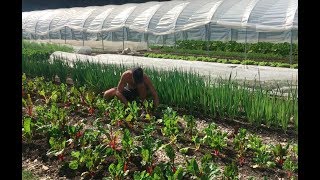
Video vlog-style farm update by Richard Perkins covering preparations for a one-day Stockholm event and a Reko market, detailed poultry management (extended netting, eggmobile redistribution, brooder mortality), a first large-scale smoking test of ~48–50 birds (10% brine, ~2.2 kg live average, temperature tracking), and drought-driven impacts on vegetable production and pasture management. The video also includes community interaction at a REKO pickup and brief notes on other farm elements (walnuts, apples, sauna).
Chapters
Today's video, just a little farm update as we get ready to go off to Stockholm for our one day event with Curtis Stoney, urban farmer. I imagine he's on a plane with his family right now and we just had a RICO delivery. And we've got birds smoking. The first test batch of 50 birds smoking and life is going on despite the dry, hot, relentless drought we're facing here. So this is the right way to do it. We had a bit of a trouble with the pasta podge course putting two lines of food out, but you see what happens when you put one out. You can just gracefully come over the top of them and they're not in the way of the wheels. Much nicer. Here's the farm mascot. This bird just does not grow, but it's healthy. A little slower than the rest. Just for context. That's my hand. He's smaller than the birds in the brood. So the birds are getting their full 75 meters of net. First time. Quite a bit more exposed land, so potentially risky for predators. We are underneath trees where buzzards like to hang out. So we see this is the first time we've ever extended the net this far on any of the pens any of the seasons. We tried last year, different aged birds, but this is the full test with a whole batch from the beginning to the end. And the first time we give them such a wide open space. Now it is definitely a risk, but we see. I want to know for sure what I think of this before I really recommend people start out with this. I was saying on the poultry course, I recommend people start with the selling pens and really master what they're doing before trying anything too different. Because definitely some people in nets have lost a lot of birds to predators suddenly. So you've got to know your surroundings and know your limits really well. First big smoking batch. I've got two kilos of salt, three liters of boiling water in each of these and I'm going to make it up to 20 liters, see if I can get all these birds in here and just work out the logistics for the first big smoke of 40 birds. So moving all three eggmobiles today. And we're going to be moving all three again on Friday. So when Toby and I go off to Stockholm, we don't have to leave them with many chores to do. But we realized we had a bit of an escape yesterday and we realized quite a lot. Too many hens are in this egg mobile. So we need to do some counting. Maybe tomorrow when we're not Moving them. We're going to let them out the back door ten at a time and just count them all and redistribute the hens because it becomes a bit of a problem with the feed regime. Obviously they're getting rations, but also with egg collection. When you get 50 more eggs than you have trays, doesn't work very well, but nice to get them on fresh ground. The grass is growing again, but it's not recovered. They're going up to Nutfield again next, but it's not recovered up there. But as I've said before, we don't have many options really. We've got to keep them moving, but we've been really slowing down the moves here to impact it more heavily and allow more rest. So if you're not, you know, if the grass is not recovering, then you got to slow down and impact certain bits of land heavier. But ultimately that gives everywhere more rest and that's what you got to do. If in doubt, slow down. Some good growth on these walnuts with the cars. I showed you the pig first and then I'll come to the cave. Good morning, turkeys. So the dry spell continues and all promise of rain got kicked back again. It's relentless, totally relentless. At this point. We're all just getting used to it, really. There's nothing we can do. There is some nice dew in the morning. That helps because it wasn't even due recently. The turkey's getting bigger, getting hungry. They've started talking with the cows. Whenever the cows are talking to each other, they're going. To. All right, reaching capacity. So first big test of smoking birds today. I've just put a table in above the fire. I'm just putting these checkered plates on to catch fat. I'm not sure this is going to be an ideal setup or not, but I've got a lot to do today and no time to mess around, so I'm just going to see how that goes. I'll show you from over here. So, you see, I've got the sawdust here. I've got 48 birds in brine, so I'm going to put them all up and then light the fire, see how it goes. It's a bit of a test and experiment still, but we can't sell those birds anyway, so that's what they're for and hope it goes well. It's been going really well on the small batches so far. So this isn't a regulation, as I've explained. I've actually got the birds chilling here and just got plates to help submerge them in the brine. So I've got 48 birds, eight in each of these crates. They're at 10% solution and they've been there for about 16 hours now. So that's how I like it. I'm going to drain these off and then go take one at a time, string them up, get them up hanging in the smokery. And now this will normally be done inside. I'm just doing it out here because these are a test bed, but basically I'm just skewering them with this needle to then put them on a hook and get them up hanging above the fire. So I'm putting this as the halfway mark and I've put them quite close, so they're not even filling a third of it yet. So I might give them a bit more space just to check they're not touching. So gonna start the fire soon. To give you a sense, I've got all the birds in and for reference, this is 50 birds and that pretty much fills this space. I wouldn't try and put any more in. 50 birds, 2.2 kilo average. That's about 110 kilos. So these birds are worth 13, 20 odd euros, I guess. Now, smoke, they're worth double that. So that would be about two and a half thousand euros. However, they lose some weight in the smoking and the amount of weight they will lose dep on the heat, the time, all kinds of different factors. So I can't tell you the precise thing. That's something you would have to check for yourself. And I don't actually know it precisely for myself yet. And this is the first big test with a full smoker. So that's all data I need to collect and get my head around myself because it might act very differently today when it's got this many cold birds in it. We'll see. We'll be checking temperature regularly, but it looks good. I'm concerned there might be the odd drip coming through here that might go onto the fire, but not too much. So I think I'll roll with that and hope it goes all good and keep you posted on the results. So we're gonna light a little bit bigger fire this time because it's obviously a lot of mass to heat up those chickens, but I don't want to get it too hot. Just trying to get everything up to temperature fairly swiftly today and we'll see how it goes. So we're going to leave the door open to get a little bit of oxygen to the fire. Gracie, show us up the. Up to where the chickens are. They look good, don't they? So first observations only gone up to 40 degrees with the initial 5. Just closed it up now, whereas it normally go up to 60, 65. So it just goes to show the mass inside is really affecting that. I'm gonna actually plug this in now, get the thermostat on and see if it's heating. Yep. I started to go, so 12 o' clock now, 40 degrees. We'll see how the temperature changes throughout the day now. So you might just hear the pumps running right now, but we are lower than we've ever been. Pretty hard times. But despite this weather, the veg crew have been whacking out some amazing boxes and we're a bit behind on the veg sales, which is presenting a cash flow problem. But it's not just about veg sales and there's nothing we can do. You know, we're pumping what we can and minimizing water use, but we're just hoping for rain now and it's, you know, we're all getting used to the fact that there's very little water and we just got to use it really sparingly and really prioritize watering the things that really need it. Now. A lot of the trees in the landscape are yellowing off. It's, you know, it's really dry and, yeah, that's the way it is this year. Hi, puppy. Vegetables. Vegetables from KO Yeah, he's just starting to take loose fetch and we just finished taking. Beautiful. This is rico ring. Look who we found. So we're leaving Nicholas to Rico. He's forgotten his printouts, so he doesn't know what he's got to get people. But it's a bit late for us to go and get them. He left them in the freezer room. But it looks like there's a lovely long queue there. And I just met a couple of other folks here, including another veg grower who has eggmobiles that I want to do a little farm swap with later in the year. So we go and see them and invite them to come and see us sometime. Just show around and see how each other do. Because there's lots of amazing little producers in the Ricoh group and be nice to get to know people a little bit better. So night arrives. Doesn't look like night here, but that's. We're in the middle of the summer in Sweden. Birds look great. I don't think there's been any problems with predators. And yeah, it's beautiful to see. I think they're really enjoying having the extra space. You see, they're mostly clustered around their shelters, but they obviously enjoy having a bit more space and they haven't impacted the ground so heavily. I'm quite happy about this. We've got all of this top part of nutfield which is good for them. So we'll zigzag our way around and down and possibly back up again. They're looking really good. So last birds out in the field. These were brought out during the password poultry course. Can just make out the last pens behind the hedgerow here, but they're doing super nice and high mortality in the brooder in this batch and we don't know why exactly but it was a bunch of birds that had funny legs and I don't think it was anything from our managing. I think it was just a dodgy batch of birds which happens sometimes. I just see there, there's a whole load of cherries to go and check out while we move them tomorrow. So smoking away. And it's set at 72. You maybe can't make that out there, but it took three or four hours to come up to temperature but it's been sitting there ever since. So I think should be a good old batch of birds. But we won't be seeing that in this video. I'll open that up tomorrow morning and post the results in a future video. Despite the drought, it looks like a bountiful apple year. We're not going to thin these out, we're just going to let them run their course. Sauna's on. Just show you how it is in here. You'll have seen this in other videos, but we are blessed to have this beautiful sauna which can keep temperature even in minus 20 or 30. I built this couple of winters ago in a wagon that we swapped for four chickens. Heats up pretty fast and it's a lot of people have passed through this sauna telling wonderful tales. So that's it for today's video. Just a few clips of what's going on at the farm. And make sure you stay subscribed to the channel and you can hit the notifications button if you want to get regular updates from us. And thanks for all the shares and comments and likes. We appreciate that. You can find out a whole bunch more in our book, Making Small Farms Work. Make sure you read that. It's only available from the farm and I look forward to seeing you in the next video. Sam.
More from Richard


A review of short and intensive season on a mixed farm and restaurant/event space in Sweden






Alskade Kyckling Exploring complexities of poultry production in Sweden and what we stand for


