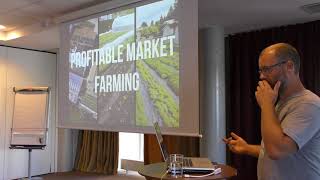
Richard Perkins and Curtis Stone tour a regenerative farm and discuss scaling up food production. Stone started his urban farm on $7,000 and now sells directly to restaurants and customers through a platform called RICO. Both focus on efficiency, water management, and building abundance mindset over scarcity.
Chapters
So we're on the train off to Stockholm. Come and see, people. Where Toby. Look, Toby's sleeping. This is what the stream looks like for two months now.
Frogs.
Wow. Look at them. Look a bit sleepy. We're redistributing 40 hands who have made their way to another eggmobile. And so we're evening out to make sure they all get this right amount of food and get access to oyster shell for making eggs, etc. So those two eggmobiles are spending the day there. And the newest eggmobile, the really light one, is going up to Nutfield. But we're actually going to the bottom of Nutfield into the riparian. You see, this is the winders. We have to keep the legs up and down, but the ground's pretty dry still and pretty affected. Looks like a thunderstorm tonight. Toby and I are off to Stockholm to meet up with Cur for our event tomorrow. So we're just moving all the eggmobiles to allow them to have minimal chores while we're away. A little bit tight getting through our gates. Here. We are into Nutfield. Just take it nice and easy when we move the eggmobiles. Obviously a lot of birds in there, but we're heading down to the corner of the field up above the vineyard here because we've got BO right up at the top. It's not recovered really, so we're taking that time. But down here, we haven't actually been with an eggmobile, so we thought we'll just net them into the riparian here, see how that goes. So there's a couple of nut trees that will get a bit of an impact as we do this, but somewhere it is. We're up above the orchard here and look at the dry pond. But thunderstorm tonight, so with a bit of luck, we'll get some water coming back in here. This is what the ground looks like after the birds have been through high manure coverage and they've been foraging, but squashing down the ground a lot. And then the ground outside the pen is a lot less impacted. So they're curving back down now on their way down here. And they've got 1, 2, 3, and then some three thin moves up here and then we'll have to cut across. So early in the morning. Internal smoker. I'm just going to open the door up to let it cool down a bit. It's been set at 72 the whole time. Let's have a look first. Look. Wow. Looks good. Now. It still didn't burn all the way through the Pile. It's like last time. But the fat plates look like they did their job. There's no dripping into the fire, which is good. Birds look smart, Unconventional. Breakfast. So we're on the train off to Stockholm. Come and see people. Where? Toby. Look, Toby's sleeping. No, this is €11 for a loaf of bread. We should do the baking business. Stockholm prices. Look. This is 45 crowns. Four and a half euros for 150 grams of peas. What do we sell on the market? Are we on weekend? 300 grams for 350 or 35. 35 brands. 350. So we are nearly three times cheaper than Stockholm prices. 69 pounds a kilo for leeks, 39 pounds for one little romaine salad. Reselling heads like this. We sell heads four times the size for 35 pounds. Pretty amazing when you have a fruit bush. You wouldn't think that people are willing to pay four and a half euros for this liver pinet. I think we should move the farm to Stockholm. That's the beauty of modular infrastructure. We can actually just move our farm. We're gonna consider it after this weekend. We got jazz. Jazz on the waterfront. Look, this is Marina Tower, Lee Hotel. This is where we're coming tomorrow and we come down to meet Curtis and have dinner. That reminds me of Thailand. This is the same boats that they use for river ferries in Bangkok. But let's go follow the jazz, shall we? Very nice. So we're here at downtown Stockholm on the waterfront and our event's on. We're listening to Curtis.
It's cool to do this with Richard because I think both him and I have a synergistic way of presenting this information. I'm going to talk about something that's a lot more micro, where Richard might have applied to the macro, though. I'm going to actually look at some macro principles of thinking and the way we run our business and what's made it successful. One thing I just want to show this. To start, I'm going to kind of show you my farm, talk about some of the things that I've learned. But I have a lot of videos on YouTube. Like I have almost 600 videos on YouTube now and I tag everything. So a lot of times when people ask me questions, I'll be like, I have a video on that. You put it into the search on my YouTube channel. You'll find it. I have a ton of content on YouTube and so that is a huge resource, actually. And I also list a lot of equipment that I use on my website. If you Go onto the resource page and go under Curtis gear list. You'll see all these different tools and stuff that I have in there. So I have no background in agriculture whatsoever. I started as a rock and roll musician. I pretty much spent 15 years of my life doing that. I never imagined I wanted to get into farming. I'd been a performing musician since the time I was 12 years old. I was a gigging musician by the time I was 16, touring across the US and I did that until I was about 28 years old and I lived in Montreal, was a total hipster. And that's all I really did.
I actually.
This is actually two years ago, I had a reunion with my band in Montreal, which is kind of fun, but that's pretty much how I spent my life until I experienced this in Montreal and I realized how fragile everything is when shit happens with the weather. And this is a freezing rainstorm. I don't know, do you get freezing rainstorms here? So this is an anomaly in Canada, which is insane. When you get these warmers, warm Atlantic fronts that come up, you get tropical fronts that come up, and it rains warm air or warm water when it's minus 30. And so the water rains and it freezes on contact. And so the electrical wires get 4 inches of water on them and they collapse on their own weight. And the first time I saw this, I was locked in my house for almost an entire day because my door was frozen shut. Couldn't get out of the house. And so I was like booting at my door for hours to loosen the ice to get out. And I walk out my door and I immediately fall down the stairs. And I walk outside and it's absolute pandemonium outside. There is barely any food in the grocery stores. The city is completely gridlocked. The trucks can't come in. When I first experienced that, it made me realize, like, holy crap, I'm living in this city. And there's. In Canada, there's only three days of food on the shelves. And so that's kind of what attracted me to agriculture, was sort of fear of collapse. It's just like, what the hell happens if everybody's starving? And here I am this, like, you know, progressive rock musician. And that's really cool. You know, I had a degree in music composition. It's just like, I was just thinking, if shit happens, I'm food.
That's it.
Like, I had no skills, no skills that had intrinsic value to anybody. So I got on my bike and I rode to Mexico from Canada, and I Visited off grid homesteads, eco villages, organic farms. I saw a lot of cool stuff. I kind of wanted to just see what was out there, what people were doing. The reason I became an urban farmer is because I had no other options. Basically I wanted to do what Richard was doing. But buying land where I was from was next to impossible without taking on insane amounts of debt, which I couldn't even get approved for because I had no credit, I had student loans, you know, I had debt. Like it just wasn't an option for me. Just, you know, being down there, traveling and seeing farms and seeing what people were doing not only inspired me to see possibilities, but it inspired me in the human spirit. And I really learned quickly that you can accomplish so much by just having the correct mindset. And that's been the biggest thing for me, was understanding that what you envision and what you imagine can happen really quickly if you approach it with an abundant mentality. And so the thing that's. There's sort of this dichotomy of thought that I become that I face every day when I wake up in the morning as I think, okay, today I can choose to live in scarcity, which is believing that there's never enough and that everything is a zero sum game, meaning that in order for you to succeed, somebody else must lose. That way of thinking will lead you in this fear based mindset that will never really get you ahead. Whereas if you think about things abundantly, it's the opposite, is that there is a lot in the world, there's a lot to go around. Your success doesn't equal somebody else's failure. Your success can actually equal somebody else's success. It's a win win thing. And when I switched my mind over to that way of thinking, everything in my world changed. Because I'd always thought negatively about everything in the world. I'd always been, even as a musician, I was always interested in politics and geopolitical issues and I always would have opinions about how the world is and how it ought to be. But when I changed my perception, all of a sudden the world didn't seem so bad. All of a sudden, instead of focusing on the negative things that were happening, I was just seeing positive things. And that happened for me in my journey of doing this because I get to travel around the world and hang out with people like Richard and yourselves that are interested in solutions and doing things. And that's what I see. I started on $7,000, which is like €45,000, basically. I started my farm on that much Money. And I basically worked with what I had available to me, which was mostly my own aptitude and spirit. But I didn't have any. A lot. I didn't have a lot of resources, but I had some yards that I could use to start farming. Because I had to spend so much time riding a bike back and forth between my plots, it really forced me to think about what can I do on these farms to make them as lean and efficient as possible so that I'm spending the least amount of time doing that. I even carried our BCS rototiller by bike. You know, it was crazy. In a sense, I was a lot skinnier back then, too. But I mean, I burned so many calories back then that I often didn't have energy to make myself dinner. Like, I worked so hard back then that I have a hard time understanding it now. I mean, maybe as a parent, if many of you have children, you understand too that the work just goes into something else. You know, sleepless nights and all that. I didn't understand that back then, but we were working really hard. But we did a lot of things inefficiently, too. I mean, this is like my first couple years at the farmers market. We grew so many different types of crops. We spent so much time on things that just didn't deliver that value. And we weren't really looking at that 80, 20 back then. It was like, well, let's just grow a bunch of stuff and see what works. But I mean, I used spreadsheets a lot in the beginning of my farming career where I was looking at how much crop, how much each crop was making. And if I put the 90 different vegetables that I grew into a spreadsheet, and then I sorted that spreadsheet by profitability, there was like five. Five things that really made the bulk of the money of the operation. And so it was easy to kind of make decisions on what to cut and what not to cut. You know, look at our faces. 12 hours of doing this, you know, washing things inefficiently, cranking salad with our giant orange salad spinner. My right arm became, you know, almost twice the size of my left arm, because I'd be on the phone talking to chefs, taking orders, spinning salad greens. Whereas we found better ways to do things by modifying washing machines. I'm going to show you a lot more of the infrastructure that we use on the farm. But this is where I started. This is the first farm plot that I ever developed. It was a double lot. So the whole lot was a half acre There was a house on one quarter of it and then the other three quarters were farmable land that I could use. It's where I got my start. It was the first place that I started farming. Made a ton of mistakes on this site. I had to fully remediate the soil. This is a real lesson in urban agriculture. Though the things that I teach people aren't specific to urban agriculture. They can be applied to any type of agriculture in market gardening. But this was a real lesson in urban agriculture because we had to completely remediate soil. So in the top left it was all contaminated soil because the house had burned down. There was drug needles everywhere. There was 300 hypodermic needles that I found on this site when I first developed developing it because it was. The local junkies were shooting up in the garage and in the property. It was crazy. But that's what it looked like a year later. And you know what I think? I still think to this day one of the most exciting aspects of urban agriculture isn't necessarily even the food production though the food production is important. It's the social aspect in that, like Richard expressed this morning, is that most people don't know where their food comes from. Like most people have no idea where their food comes from. And I think this is the biggest role that urban farms have to play is that they're mostly a demonstration to introduce food production to people. Because I think if we have more consumers that are educated about where their food comes from, they'll make better decisions for the whole food system in general.
I want to share a bit about how we've taken this dilapidated old typical portioned off bit of Swedish farm and turned it into one of Europe's most productive per square meter, diverse organic farms. Doesn't always look, this is two years ago at this time of year, but this year it looks like this. So for those that aren't aware of the longest drought since 1950, I'm sure most of you are well aware this is a very hard year for production. Our vegetable crops are way behind what they should be. This year we have run out of water. Now we are living in a very rural environment and we have a shallow well and we have a stream fed pond that we can pump out of and we have exhausted that supply. So we literally have no water supply. So we laid out a design. Having seen a farm under snow, I was living in Ganesta at the time and we laid a long term design based around perennial crops, things that grow themselves, grasses, trees, bushes. That's our Long term plan, Energy resilient plan. And we spent the last five years just basically 3D printing this onto the landscape and we've pretty much set it up. Now. This is a super low cost setup. We've spent less buying and doing up this farm than most people have spent on a house in this country. And it's running a business kicking over pretty good money for a farm, let alone a tiny farm where all the production is actually concentrated in 3 hectares of land. So I want to take you through all the different approaches to the enterprises we run, but also in the framework of how we've laid it out and why it's what this plow looks like going through the ground. And it's a very well designed subsoiler and you can barely see I've done it right and within a couple of months, you really don't know I've done it, other than my grass is a bit nicer than the neighbours. And this is the result of that. This is the plough pan. When we started and bought the farm, it's just 95% of all roots sitting at this depth now, after two years. So the first year we pull it through a little bit deeper. We don't pull it through really deep because the plants won't catch up in, you know, it's a waste of diesel. And then the next year we pull it a bit deeper and then we plan our grazing to really maximize the physiology of grass plants. Because if we have livestock, we're not managing animals, we're managing ultimately microbes, but specifically grass plants. Because we only have a shallow well that's feeding a slaughtery, it's feeding our animal systems and it's feeding people. We've built a pond for watering and irrigating vegetables. This is using a product that I really like called GCL liner. It's a geosynthetic clay liner. It's two layers of geotextiles sandwiching a layer of bentonite clay. Because we're underwater 10,000 years ago, we have sandy soil, we have clay soil, we have rocks and sand. It's not waterproof. You can't make it down in our farm. And so we've lined this pond. This is about €5 a square meter delivered. And it's an incredible material that you can stick an iron bar through and it will seal itself up again. But it only works if it's covered in topsoil again. So this pond, four weeks later, is healed up and a functioning ecosystem already, or a young one. And so we used this to irrigate our market gardens just through risers that split up from the pond. This is the first two days after we moved into the farm. We bought our key lime plow, this time as a ripper. So you imagine planting a tree, how big a hole do you. Here's a tree in a pot. How big a hole do you dig? Well, when I used to work on organic farms as a teenager, we were planting little blueberry plants and I would dig a meter deep hole 2 meters wide. Now when you're 18 year old kid, you're like, ah, do I have to dig it that deep? You know. But the results are self evident, right? Trees are meant to grow on uncompacted dead forests that is carbon rich decompacted grounds. They're not meant to grow. Well, the types of fruit and production trees we grow aren't evolved to grow in grass fields. They come from a different habitat. So we need to study those habitats to understand how to treat them and implement them. Well, all of our production trees come from decompacted soil. And so we use this instead of digging holes. This is digging us an 85 centimeter deep hole. And all this machine work is taking a couple of hours, right? So here we're making a vegetable bed on top of the trees on this funny key line pattern which sets the pattern of land use for all of time. And a couple of hours later we've laid the bones of this farm that will be there for generations. And you'll need a bulldozer to take them out even if we're not there. I'm also doing experiments with nut trees. I've got a passion for trying to find chestnuts that will fruit here. People all say, no, no, no, can't do that here. But someone's got to do it. Someone weird like me is up for doing it. So I'm taking the hardiest genetics from around the world and just mass planting them. And if they die, I don't want to look after them. I don't want to look after things that want to die. That's a great principle for farming. Stop growing things that want to die and stop killing things that want to live. This is the way we've been breeding animals and plants in agro terms for decades. But it's the wrong way to go. A child with its logic can understand that this leads to collapse. We need to be breeding resilient things. Have you tried walnuts or hazelnuts? Yes, I've got a whole load of different walnuts and hazelnuts. And I actually just found someone nearby. This is Nutfield. So it's a savanna planting that's up to 30% canopy cover, means you don't get any loss of grass. Now, the reason I'm particularly interested in chestnut is because it's a grain crop, not a nut crop. So it's low in oil and fat and it's high in starch, so you can store it, make flour with it. And something I always like to remind people of is we've spent 10,000 years breeding crappy grass plants into wheat that we're all addicted to. Now, if we'd spent 10,000 years breeding chestnuts, we would have nine chestnuts per cluster this big, and we'd have forests over us, we wouldn't have fear of droughts and we'd have our staple carbohydrate dropping down on us with little work to do. And if you couldn't be bothered to be pick up your staple grain, you just send the piggies in, you eat the piggies. This is just to show how the key lime plough goes through. You see, it leaves these little marks and then a few months later you can't see it's gone through. But this is something that's really applicable to our climates. I've been to all the best agroforestry stations in Europe, but this is a really cute one. Dennis Flores place in Versanobles in the south of France. And this is higher than average organic wheat in very intensive tree plantings in high shade. Now they are in the south of France. It's more sun, but they crop vegetables on same sort of cropping systems that Curtis and I will talk about. After that grain crop, they'll be going north to south or east to west, depending on the sun and the season, and growing really beautiful veg crops in high shade. Now they're growing poplar as a timber, which is something only the French would do. But you see, we're utilizing multiple layers of cropping. This is something that most farmers can get into because it's not too weird. And Joel Salatin says that nice thing of, like, you can be nudist or you can be Buddhist, but a nudist Buddhist, that's too weird. And that's it. Like, our farm would always be considered weird to Swedish farmers, right? And we're pretty straight cut and keep our lawn clean and we keep ourselves, you know, tidy appearance, but we're still weird. But even this is very, very weird for most farmers.
Restaurants are incredibly nuanced because there's sort of A whole field of different types of restaurants. And there's small restaurants that are owner, operator, like this one, where it's the chef owns the restaurant, he signs the checks, he writes the menu each week. There's like two or three staff, small orders, but relatively easy to deal with. And then there's larger restaurants like high end luxury hotels, resorts, wineries, Michelin star restaurants. There's a whole spectrum of people in there. And I find generally with the smaller restaurants, they're a little bit easier to deal with, but the orders are smaller. The bigger restaurants are harder to deal with, but the orders can be huge. Like at the peak of our restaurant career, when we were selling to big restaurants, one order was a thousand. Like we get thousand dollar orders in one place. You drop off $1,000 of product. And it's easy because it doesn't take that much longer to pack 10 pounds of salad mix into a box as it does to pack a couple ounce bags of salad mix. It's fast, so there's an advantage there. But like I said earlier, it's more about the management of the customer. There's high maintenance and there's low maintenance, there's high volume and there's low volume. So a high maintenance customer, big restaurant, if they buy a lot of stuff and they have a big ego and they're kind of hard to deal with, I'll tolerate it because they're buying a lot of product. But you might get a high maintenance, big ego customer that doesn't buy a lot of stuff, well then what the hell, why would you sell to them? It's just an absolute waste of time. Whereas a low maintenance customer that doesn't buy a lot of stuff, they're easy to sell to. They might only buy $100 a product a week, but they're easy to deal with. They always pay their bills. So I kind of have this. I kind of play favorites that way. It's like if you're high maintenance, you better be buying a lot of stuff. And I'll only tolerate it to a certain degree. Some of the things that I've seen in kitchens will, I'd never seen anything like it. You know, like chefs screaming at the top of their lungs at people, people crying in the kitchen, like absolute abuse. And it's a stressful environment too. So it's, you know, it's not easy to get into it. Especially like I said, the higher end the restaurants, the more stressful it is in the kitchen, generally speaking. There's obviously some exceptions, but you know, there's A whole sort of hierarchy of people to know in a restaurant. And at the top, you've got your executive chef. So in the kitchen, there's this hierarchy in the restaurant, there's accounts payable, there's managers, there's serving staff, there's all that. But in the kitchen itself, you've got your executive chef at the top. That's like the person that makes all the key decisions, writes the primary menu, hires and fires people. They're the celebrity chef, if there is one. And then you've got executive sous chefs and executive chef de cuisines in there. And underneath that, you'll have chef de cuisines and sous chefs. And then you've got line cooks, and then you've got, like, general kitchen staff. And so when you're selling to restaurants, you really want to know who's in that hierarchy, and you want to know who to talk to. Usually if you're approaching restaurants, you want to talk to the executive chef at first, because that's the key relationship. That's the main person you want to talk to. But sometimes they're so busy that you're just going to end up talking to other people. But I found, because restaurants have such high turnover, when you go to sell to a restaurant, like when you're delivering product, you want to know at least three people in that kitchen. You want to know who the executive chef is, you want to know who the sous chef is, you want to know who the chef de cuisine is, because some of them will leave. Fresh sheets are super, super important if you're going to sell the restaurants. Basically, what this is is a weekly publication of what you have for sale. It's all your weekly offerings. And so you're listing all the product, the types of products. I always categorize it so greens, roots, microgreens, summer crops, herbs, information on the bottom. You can download this on my website. By the way, if you're going to order for Friday, you got to have your order in by 9am Things like that. Minimum delivery, you know, $75 for downtown or $100 for outside, you kind of set that whatever is realistic for you. A friend of mine has the same. The more ways you have to get paid, the more you get paid. So if you've got the square card reader or you've got. Or you can take debit cards, cash, checks, whatever. The more ways that you can get paid, the more likely you are to get paid. And so our policy became in the later years, any new restaurant that we've never sold to before, that hasn't been open for a lot of years, has to pay COD for the first full year. Then they can go on terms because we've just been burned. I'd been burned by one customer for $10,000.
So Rico is. I'll show you the page now. The orders just went out yesterday. So this is Rico Karlstadt. Well, look, this is a. So this is our biggest selling place. There's 80,000 people live there. So that's an hour and a bit away. So we are in the middle of nowhere. We're not near a big city. But suddenly we have seven and a half thousand people looking every single week at what we have for sale. And we didn't have to do anything. It's very effective. It's becoming one of the bigger ricos in Sweden. It's not the biggest by far, but this is all just flashed up since, you know, that's you. So we are one of the administrators. Johannes put a lot of time into this. But before all this came about we developed the exact same concept on our own. But I like working with others more. There's more benefits even though there's competition now.
Why is that, Richard? Just because there's more people there.
I'll get into it. Because it's complex. There's layers to it. We're doing exactly what we did before. We pre sold things on subscription basis. We turned up in random car parks. We used just simple polystyrene called Kanger Box. It's a brand from Germany. It's insulated box. We can keep 12 chickens frozen for 10 hours. So we don't need a fancy refrigerated van. Everything gets piled in and we're dropping off €3, 4, €5,000 of products on cultivating the customers who will come and meet us at some random ass car park at 7 o' clock at night because that's time that suits us. So we're cultivating the customers we want. If they're late, we're like, that's your last warning. Please don't be late. We got to get back and feed chickens because we're busier than they are. That's for sure. With farming. No, I know we're busier than they are. We're running around farming in all of our production in six months, pretty much. So we're busy and so we don't have much tolerance. You've got to set your boundaries. If you're late twice, then I can scrub you, cull you off my customer list and get someone who's going to be a better customer. And that's the beauty of growing and scaling at the right rate. So you're under producing all the time because then you have choice of who your customers are. That really annoying person who's always late or doesn't remember to pay on time, you can just scrub them and it's nice to be able to do that so you can select the customer quality you actually want. Customers who will go out of their way, who will understand if something is wrong in the order, or they'll understand if something happens and they'll support you in it. Kind of like csa. We used to do csa, but I think the trouble with CSA Community Supported Agriculture is that the whole idea in the beginning was that, you know, if the farmer loses a crop, then you all take a little hit, rather than the first farmer a big hit. And if there's abundance, you all get to share that abundance. But in reality, I don't think it works like that. I think people expect what they pay for all the time. So it's not a csa, it's just a cash flow model. Now, like our model when we did CSA was that you always get at least the value plus a couple of euros more. Now we set the price so the value is according to what we set. But we're aiming to give people what they pay for all the time and not give them this big peak in the middle of the year when you have loads of everything, because then they get this false sense of like, oh, next month it's going to be like this too. It's much better to manage it even so that their expectations are managed. So this model, we always did this from the beginning. And Johanna put a lot of time into customer relations and she's a sort of lovely person who she won't say go away to someone who wants to speak for half an hour about their cats and just pick up six eggs. Whereas I'm very good at cutting that off because I don't have time in my day, I'm very busy. So it's a good balance because that was very important in the beginning. You often need to identify who's got what skills, because we need all these different schools and none of us have all these skills. We need to collaborate, whether we're working with colleagues or partners or whatever. But that really built up some great relationships and that relationship marketing is what brings security, because you can start to talk to people about feedback and get genuine feedback. It's very hard to get real feedback. When Ricoh came along, we were already set up where we did all our deliveries. We had everything set to drop off in this town on certain day, then this town and this town on another day, and here on another day. So we already had this regular thing. So when RICO started coming along and gathering, we got behind it and connected with the main organic and good local producers in our area and said, come on, let's make rico. And then because we were part of the administration, we could steer it. So we ended up setting all of them on our existing drop off points same time, same day. So it was absolutely smooth transition for us because we were willing to initiate something. And what it meant is that we immediately had all of our existing customers doing just coming to the same place. Nothing changed for them. But we already look like the main thing going on because we got this massive queue and everyone else is sitting there like, what are they doing over there? This is how it works. Now. This has just gone out and this is for a RICO next Wednesday in Karlstadt. And so there's not many orders yet. They tend to come last minute, especially up to the day. You have to order a certain amount of hours before closes, as it were, so that people have time to harvest. But something to do is to, like, we harvest all the veg that day. We never harvest. And like some things like peas that are harvesting all the time, we'll put in the fridge. But we pretty much harvest and pack everything right there. And that's a leverage point that we always, if we sell to grocery shops or to chefs, we make sure they know that too. We just went to a little organic shop that opened in our local town and they've got our biggest community competitors vegetables. And they look manky, They're a week old. And every time I see this big vegetable farm's vegetables, they always look manky and old. So I'm like, hey, did you know these are the vegetables we bring and we harvest them that day and this is how long they last in the fridge. And I'm guessing these are this many days old because of how they look. And they're like, yeah, it's like, hey, well, we come here twice a week and we can bring like this and give them very generous samples. That abundance thinking that Curtis mentioned is like, you've got to give people really, you know, they're used to dealing with massive packs of this, so you've got to give them a decent sample. You know, if you give them four smoked chickens, then they can actually make a meal for their family. Their wife might be influencing their decision making at home. Do you Know what I mean? She might be running the thought process of that chef or whatever it is. So what we do is we write down everything that we've got for stuff that week and this changes week to week. So you have, like, right Before Thursday at 8 o', clock, you have to put your ad out and then after a certain time, you have to clear your ad. So each producer needs to do that. And so the whole Facebook feed gets scrubbed and then it starts again for the next week. Now, you see, we have, like different vegetables. Oh, no, sorry, that's not. What is that? Chicken. Fresh chicken eggs. We have roast chicken, smoked chicken. We have bits of pig here. Our forest raised pig. We have different vegetables. And what we do with our vegetables is quite different to what we used to. We steer our customers. Like, if you buy 10 items, you pay the actual value that we've set for that crop. So it's 250 crowns to buy 10 things. If you want to buy five things, you pay 30 crowns a bunch, but they're actually 25 crowns of value in each bunch. If you want just one thing, you pay real premium for it. So we're happy selling you that one thing. If you're willing to pay a silly amount of money for it, that's fine with us. But no one does. They're steered towards these. What's really cool about Rico is you can see everyone's orders and that's cool. I can see how am I doing against Mrs. Jones Vegetables? Are some of my customers now buying hers? But what's she doing differently? Can I go and look at that? And that's the same for everyone. So it's like encouraging the lifting of everyone to do a better job. And they're all people we get to know. So we're trying to organize farm swaps. We've done farm swaps with a couple of them where we go to their place and see what they're doing and get some ideas and see what we like and what we don't like. And that's really nice. So it's a lot more community feel. And whilst that's got some competition, it's healthy competition because it drives everyone to, like, do a better job. Here we just talk a bit about how we produce stuff. We also have a static website here, so this is just where people can find out more info about production models when we have open days and da, da, da. But basically this model is really working well because it allows us to direct people to different places at different times. Like everyone's on Facebook all the time. Right. So it's very convenient for them to shop in this way. I like this model more than any other model we've sold at. And I like more that there are other producers there than just when we did it ourselves, because basically they bring all their customers. That's why there's seven and a half thousand people there right now. They're not all coming each week to rico, but they're all exposed to our products all the time. So there's no fees. It's just a bit of administration work. But it's kind of a collaboration between people who become friends. It's not much work in that way. And so it works really good.
It's really important just to get started.
Yeah, definitely. And it's a learning thing, right? Like, part of the reason I do what I do is I learn more than any university could ever teach me about every field. And because I'm studying ecosystems, essentially, I learn holistically. So I study agroforestry systems and I learn some abstract way about financial things, how to use money like an ecosystem. It sounds abstract, but this is the nature of holistic education. We're all brought up compartmentalized linear thinking that, you know, at 21, you know about chemistry, you don't have any relationship to the biologist down the corridor or whatever. And this is a great flaw of our society is siloed information when everything in nature functions in whole systems. And, yeah, I think a big part of this kind of lifestyle is the learning involved. You never stop learning about these things and you can always refine. So it's about getting started and refining it over time. So none of our things are perfect. You come to our farm and it's not perfect. Someone said the nice thing in the poltergeist. They're like, oh, now we're here. It's like, this isn't perfect, because I had the impression from watching YouTube, everything's perfect. And I try and keep it very real and down to earth. I'm just showing you what some random bits of my day look like. Of course it's not. It's just a random farm where we do random stuff with no budget and, you know, just the way it is. But it's very easy. Certainly through Instagram, around these things, you get a very polished image of things that, you know, have a pile of crap over there. Yeah.
Because we all. We all filter ourselves to some degree.
Yeah. I might do a month of just showing you all the crap around the farm. Plastic bags with blood and guts. And then like we're going home. It's hot. Crazy, isn't it? We are just crossing the water. We've had a lot of train rides. Taxi. Your eyes zooming around, eating, feeding, kids. But we had a good day, didn't we? You were very patient, Mel. But people seem to really enjoy it from the feedback we got. So we're very happy. And we're nearly home and we're going to have a second dinner and go to sleep, I think, and get a lion for the first time this year. A lion? You up for a lion, Don't.
More from Richard


A review of short and intensive season on a mixed farm and restaurant/event space in Sweden






Alskade Kyckling Exploring complexities of poultry production in Sweden and what we stand for


