Richard Perkins prepares his farm for a four-day workshop with Curtis Stone hosting 55-60 people while managing a hot, dry spell. He's rotating grazing, irrigating 250 new beds with movable risers, and smoking three turkeys with a 10% brine for the course meals.
Questions this video answers
About 55–60 people ("nearly 60"; "55 odd people here for four days").
About 250 beds ("we've just done another 250 beds").
10% brine: 1 kilogram salt per 10 litres of water.
Brined about 15 hours; smoked approximately 20–22 hours.
About 50 eggs total—described as ~eight eggs per person for farm-worker breakfast portions.
Chapters
So today's video is a little quick update as we get ready to bring a whole bunch of people here for the course with Curtis Stone. All about urban and small scale profitable regenerative agriculture. It's going to be nearly 60 people here tomorrow evening, so lots to do.
Sam.
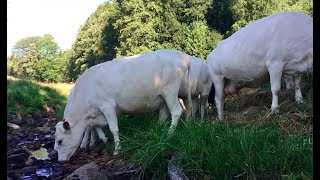
So we're taking this little triangle that splits the fields that are hopefully getting cut today. They were going to be cut at the weekend but we'll take this field today and if the machine can get across the bridge, we'll take the several hectares here. It's very poor over here. That's what we got. And it's time we get our winter feed sorted. Today we're just giving them this little patch. We're in the slaughtery today so we're just wanting to make sure we don't have to do too many chores. So we've actually given them river access. We never normally do that. To bring animals onto a water body you need to really manage time very carefully. It's better to bring water to livestock even if it's a bit more work because you can create a lot of damage on a fragile riparian. But that's not to say you can't bring animals too. But we've just fenced in a little bit of water here so they can drink for themselves and we don't have to worry about coming to fill up water. They look happy exploring. We've included some trees for shelter in the fence today and so depending on where the machine can get, these fields might be bare at the end of the day. And so we'll take next a little. We're going to be grazing a bit all over the place. There's a field of about half a hectare behind here and then it's back into our riparians and forest paddocks and just little corners around the place until the grass recovers, which at this time is really not recovering quickly. It started to recover up in Nutfield where we've taken the eggmobiles, but we just need a bit of rain now or we're not going to get enough recovery to see us through. In that case we might just have to keep them stationary and feed them in winter feed until the grass is fully recovered. We having to bring chickens onto ground that's not recovered. But we would like to ensure we're not overgrazing with the herbivores. So it's Monday slowly day. We've just done another 250 beds. Chill is coming back on. It's a bit cold in there. I've Just been cleaning down so everything's just been foamed and getting put back where it was and just drying the floor up now. Long day today. We had a couple of new people on evisceration. I was on clean tea most of the day and then just went on evisceration. Speed things up at the end. But it's dinner time. We just finished cleaning down. So big old day today and we've been moving all the eggmobiles up into Nutfield and yeah, it's hot and dry still and we're just getting ready now for the course with Curtis. They're going to come up to the farm tomorrow, I think and then we've got going to have 55 odd people here for four days. Going to be amazing. It's quite logistical. It's a bit stretching at the seams really. But Johannes bravely taking on the catering and planned some epic farm to fork meals. So really looking forward to that. But good sessions today. Really enjoying the team we've got here. Just really hard working and focused people that are pulling off a great effort in the challenging year that we're having this year. So I'm super proud of everyone and really grateful for all the input and collaboration that's going on here.
How can you see that they're dying? I can't see anything.
Some of the old trees are yellow. They just don't have enough water so they're dying.
Will they come back to life if there's more water?
Hopefully big old trees and maybe stronger. But the young trees might die. Some of our trees we planted. These look good though.
There is tour boy cat.
Ready for the morning. It. All the birds ups are going to move turkeys now and apparently they're coming cutting today instead the hay. So we've got the cows on the little triangle waiting to see what's left and where we graze next. But we can't fully plan until they actually come do the job. So turkey's just moved. We've really taken this field down as the neighbour wanted. Bit of advice, never buy fences with single spikes. They are rubbish. We use double spikes that you can put in with your feet in all conditions on all our fences. This is just one we had lying around left over as an emergency net that we got in a pinch one time. But they are really not worth the money. You need double pegs. So this turned up. We're going to be feeding people. It's going to be 55, 60 people here at the farm. So we're going to be grilling A lot and don't like the look of galvanized plate. One, it's not very strong and two, it's pretty toxic when you burn it. So I think we'll put a different mesh in there and get it all set. That's going to be nice for cooking up big meals to the last drop. It really nearly is the last drop. Now some people asking why we're using risers with evaporation being so high, but the reason we do that is drip is extremely inefficient in the type of cropping system we have where we're changing beds over a bunch. And you would need to have a lot of infrastructure in place for that. And you would have. We have, you know, everything from one line of crop to six lines of crop and then 12 lines of crop that you would need to have different attachments on each header pipe that you didn't then need to close up again. And it's true. If I was in a really dry climate, you know, dry all the time, then I would definitely want to use drip to save water. It's one of the biggest single water saving features you can have in a dry landscape. And when you drip water onto the soil, it plumes in like a big V shape like this underground. So it waters much more intensively. It's really good, but it's just very inefficient in this type of setup. We'd have to move it a lot. And where we have a lot of small beds, if you have big long runs of the same crop, it would be quite efficient. But because we're changing over the beds all the time with different crops at different spacings, it would be very time consuming. Now we do lose water to evaporation when you're spraying onto hot ground, but it's very, it's much less significant than in many countries. And typically we have rain every week and it's, you know, irrigation is not a major issue. That's why we haven't put so much emphasis on that investment. For some of you in different climates, it would be a very good idea. But just bear in mind there's pros and cons. The good thing about the risers is we can just move them anywhere really quickly and irrigate and we don't normally have a water issue like we have this year. And so, yeah, you know, it's all contextual and you've got to work out what is best for you. So everyone's back late, so I jumped in to make lunch with It's Going to be a quiche with pastured eggs, zucchini, sour smoked chicken, smoked oats. Motto's from the garden, eggs from the field. Yeah, that was delicious. Look at this. Then we're putting bacon on top of this.
One more thing if you want. It looks really nice. It could be onion.
There is a bit of onion would go good, wouldn't it?
Red onion and yellow one.
This is a quiche. Look at that, Gracie. And then we've got about 50 eggs to put on it. That's about eight eggs per person. That's a breakfast for farm workers. Wow. That's the quiche.
It looks good. Aren't you gonna put some there?
It's all flowing in. That's a good lunch, Gracie girl.
That's all we're having for lunch, pretty much.
Look at that, A mother of a quiche. Now, you may not make it out very well, but the trees up on the hill, you see some of the birches yellowing out. It's actually. Trees are dying now, even big trees because of the prolonged spell without rain. It's really full on. And we're just welcoming Curtis and his family today. They're coming to the farm, getting ready for the workshop and we'll have all the people arriving tomorrow. But it's. It's a really intense time now at the farm where we're even considering whether we should continue gardening if it carries on. The forecast shows no rain for bunch more time and it's. It's just rough now. There's not really any options for us, but really gonna have to wait and see what happens because all of our orchard trees are looking really dry, the ones we planted in spring, and trees are definitely suffering. And it's not just young trees that are newly planted, it's some of the old forestries. Now, obviously the soil up on the ridge there is very shallow and poor by nature. That's why it's suited to forestry. But to see big old trees going orange at this time of year, it's heartbreaking really. Chickens getting packed. So got the yachts together, showing people rounds ready to go. Hey, folks. So while chickens get packed, I am smoking three turkeys for Thursday night's dinner. Same brine ratio, 10%. So one kilo of salt to 10 litres of water and 15 hours or so smoking. Fifteen hours in the brine. So hot I can't even think straight. 15 hours in the brine. Take them out, dry them off and then we'll be smoking for about 20, 22 hours, ready for Thursday night's feast when there's 50 odd people at the farm. Who's that, Ragnarok?
Clover May.
Clover me. Hey, Clover May. Oh, they're having fun, aren't they? Do you like seeing the cows? You look like you want to have a little nap. Okay, Just feeding turkeys. And that's going to be the end of the video because we're off to the lake to have a barbecue. Some lovely forest and pasture raised lambs and some of our chicken on the barbecue. And just welcome Curtis and Katie and Violet to the farm. It's been a busy day, just prepping stuff to get ready. So we're ready to go and relax now, aren't we, Ragnar? He's ready to sleep. Yeah. Thanks so much for watching our videos. Just a little random update of snippets today just to show you how things are at the farm right now. And we're getting ready now for the course with Curtis, so it's going to be busy days. I'm not sure how many films I'll be making in the coming days, but you can find out a whole bunch more in our book. Making Small Farms Work, online trainings in the links below, as well as events, open days, all that kind of stuff. You can find out a whole bunch in the links below. So thanks for watching and we'll see you next time.
More from Richard


A review of short and intensive season on a mixed farm and restaurant/event space in Sweden






Alskade Kyckling Exploring complexities of poultry production in Sweden and what we stand for


