S5 ● E59 This could save the Market Gardens
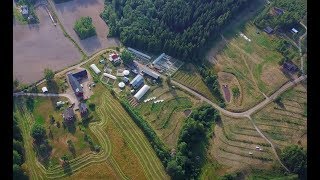
Richard Perkins repairs a ram pump and rigs a gravity-fed water line to refill a drought-stressed irrigation pond. The temporary setup delivers 600 liters per hour, enough to fill the 250,000-liter pond in about 17 days from empty, though it falls short of the garden's normal 28,000-liter daily demand.
Questions this video answers
10 litres
600 litres per hour; approximately 14,500 litres per day (24‑hour)
28,000 litres per day
4 cubic metres per hour (4,000 litres/hour)
Approximately 250,000 litres (quarter of a million litres)
Chapters
Today's video is about desperate measures in desperate times. Good night, turkeys. So going up the riparian now and that will lead us towards the paddock behind the trees that we can use. So they've got a nice long strip here. They cut the grass yesterday in this field, which is very nice, but we want to get this cut too if we can. A nice paddock they have today. So they've been cutting the hay yesterday just in the first of our neighbour's fields. But that's fantastic. It's a little bit late for cutting and the grass has definitely gone through its peak of vegetative growth and it will be losing nut. But the cows we have are bred for poor pasture. So it's always been a thought in my mind of what to do as we improve our pasture. It may become unsuited to these cows, which are hardy mountain cattle that are bred for poor forage in the past. But it's great to have some of that cut. We're hoping the other piece gets cut too. And you can see from the aerials just not recovering. But I was really happy to see they've cut it about 4 or 5 inches from the ground so it's going to recover quickly when we finally do get some water. Although we're not holding our fingers crossed.
It's that time of morning.
Chicken guts. Now, depending on the time of day.
And the weather, you never know what.
You'Ll find in here. Maybe a horse, maybe four cows, maybe a whale. So this is where our journey begins. We are up at the back of the puff. Do you see the tree house there? And the stream still here has a little bit of flow. Now what I did at 11 o' clock last night, I had a bright idea to come along and refit all the ram pump header pipe. Now this has been here for a while. We haven't had the ram pump running and so some of the pipes had worked loose. I just came up here, reconnected it and re leveled it. So the water flows down. You can see we're just damming it with rocks and moss. And the reason for that is we want a good flow of water down the pipe. But we don't want to totally block the stream because there's fish and other creatures trying to eek out living here too. So there's still a flow coming down and so we're not going to dry up the stream. That's important. Now today's video is going to be pretty much a one take roll as I walk down the line to show you how we're trying to fill the pond in this emergency situation. Something interesting about levels here. The only reason this pipe exists and the ram pump header exists is that I looked at a map one day and saw that the ridge where the IBC tank we'll see in a moment is, is actually lower down than the point in the stream there. So this pipe falls at 1 in 100 downhill. Now it might look like it actually runs uphill, certainly when the vegetation is clear. If you stand here, it looks like water is just going straight up a hill, which obviously it can't. This is where maps and laser levels, tools like this can really help us because I would never have intuited that you could lead water out. We're going up to that ridge below that tree you see sticking up. The water's right up there, 8 meters above the river there. So it's pretty intense and you couldn't work that out by eye typically. So we need to understand maps, we need to understand tools like laser levels. I actually came up here and laid the provisional points in the wintertime. So we're going along this pipe and yesterday in the night time, I came up with a head torch. It was getting quite dusky in the forest here and just reconnected anywhere that the joins had moved and re leveled it to make sure water is flowing in the right direction. It's a little bit precarious walking through here, so the filming won't be great. But I want to just show you what we're up to because it's basically come to the crunch point where if we don't get water in the pond, we're going to have to stop growing vegetables. I'm going to go down through here. I might fall at some point because this is a very steep part of the terrain. Yeah, yeah. It came to that crunch point where if we don't sort it out, we really will have to stop growing veg. And you know, it'll be big consequences financially and morale based too. So you see, this is very simple. We've just laid it up on rocks secured into the banks. We've cut through a channel here to keep the gradient falling 1 to 100. Water sits level anywhere on the planet, so as soon as there's a little slope, it's off. And to make something like this work in undulating terrain requires the use of a laser level being really precise. And here we get through to the end of the pipe and just around the corner here. It's quite hard doing this, holding something. Here's the Header pipe for the ram pump, which you can hear is filling away. It is blistering hot today. There's a level two warning on the weather for elderly people and children to, you know, stay in the shade, drink lots of water. It's very muggy and hard to keep hydrated. I've been drinking so much water and adding salt and things, it's just really hard to stay hydrated. So you see this is filling up. It's actually filling up faster than it's flowing out. So let's go down. I'm just going to take a couple of pieces with me now. I've just repaired a split in the header. You see the yellow tape there? So next problem to deal with, this pipe is corroded where it's sat on the ground.
So the actual header pipe from the.
IBC down to the ram pump. So this orange one is an overflow, and basically water is coming down where it shouldn't. So I'm going to do a tie.
Star of a patch with a bit.
Of inner tube, String it on, tape it up, see if I can get that to be going down the tube.
Now, because it's a gravity flow system, you can get away with repairs like this in some degree because it's not a pressurized system. Now, I'm okay if it leaks a little bit. As long as the majority of the water is going the right way, we'll be able to get a good flow to the pond. So pretty tired today. I went to bed after midnight and Woke up at 4 with some big crashing in the yard.
I think it was the peacock knocking.
Over some of the slaughtery gear. So I just went off and did chores then. Oh, so pretty tied up.
People started to arrive already, but most people come in later.
And then I'm just now gonna tape over this and hopefully that'll stay put. It's not a perfect finish, but it'll do for now. I've got water coming in.
It was actually corroded from the pipe sitting on the ground, But I just patched that up. And that's mostly fixed. It doesn't need to be totally sealed in my case, because this isn't a pressurized system, Although the water is falling in gravity. So here we go. We're down at the bottom, and what I've done is taken off the ram pump. This is a Charles carter ram pump. They're the original ram pump builders. They had the patent in 1800 and something off the montgolfier brothers, chaps that invented the hot air balloon. And the design has not changed in hundred and something years. They have a lifetime warranty on this. And I say anything with a lifetime warranty is worth buying and stockpiling, even if you don't want it, because you don't get that very often. Today, it's basically two, two rubber seals and that's the only perishable bit. There's one in the lost gardens of Heligon in Cornwall that's been running uninterrupted for like 70, 80 years. So this is a pump that works by falling water pressure and most of it going through the bottom of the pump here. As water comes in, it closes a valve, it compresses the air in here. Another valve then opens, water is released and a little bit of water is pumped really high up in the air up to 30 times the height it fell. Now, some of you are immediately going to say, why aren't you using the ram pump to fill the pond? Well, the main reason is the stream is super dry and a ram pump loses 90% of the water. It's using the energy of 90% of the water passing through it to push 10% up and along. And so with so little water in the stream, it's just not efficient. We need as much water as we can down this pipe. So I've basically split this off and now it's running to a 50 mil pipe that crosses the stream up here and we've just basically hacked it through. It's going back uphill here to top field. So let's go have a look at that. Just crossing a 5000 volt fence. So, been a bit of an adventure tour today, but this is what my night and morning look like. Sometimes we get creative late at night. It's a good time to get into things. Not so hot, but basically, you see the pipe up here? We'll go and see what it looks like on the other side of the fence. So that 100 meters of pipe comes up through the fence here and we've stepped it down here to a 25 mil pipe. So we're basically using old pipe lying around the farm. I had to buy two fittings in town this morning, so pretty low cost solution. A couple of hours work to get water flowing into the the pond here. So I've just run this pipe over the road, I'll bury it and I'm going to take a bucket down and just measure the flow rate so then we can start making calculations about how much water we can get and how much we can pump out of there and maybe this could save the market gardens. Okay, so the last bit of the run is just yellow pipe coming down here. The duck's still enjoying herself and here finally the sound of water entering the pond. So what I want to do is actually time the water coming into the bucket. It's not a strong flow, but it's 24 7. So let's do some mathematics. Okay, so it took exactly one minute.
To fill this bucket, 10 liters of.
Water and so that's 600 liters an hour, not a huge flow, but that is 14,500 odd litres a day in 24 hour period. So what does that mean? Well, they were pumping out 28,000 liters a day to really irrigate everything around the gardens and we don't really do that generally anyway. We do, you know, half the gardens and then half the gardens the next day, typically trying to do a heavy watering less regularly than a little watering all the time. So that means basically as we're putting down 4 cubic meters an hour from our sprinklers, so we should be able to do three and a half hours of pumping every day, which is amazing. I mean we have pumped so little in the last three months that that's going to be luxurious and it will certainly save us still. This is quarter of a million litre pond so it would take 17 odd days to fill it from scratch. Now obviously it's, it's half full so I would anticip, anticipate it taking a week and a bit to fill it back up at this rate if it stays consistent. Now obviously it's forecast couple of weeks without rain still, so in that case it would, it might dry up anyway. But having said that, we're going to be pumping in the meantime. So all in all, I think it was well worth two connectors and a little bit of work to do that job. And yeah, I'm going to let the gang know and I'm sure they'll be happy about it and we just see how it goes. I'll keep you updated in future videos. We're turning our attention to the course with Curtis now. People are arriving and yeah, busy days ahead. I'm very excited. It's been great to welcome Curtis and Katie and Violet here and they're a lovely family and I'm super excited to just continue the dynastism and synergy between us in teaching the information we're passionate about to help more people get started profitably, smartly with regenerative Ag. So thanks as always for watching. Hope you enjoyed that. Video and I'll post some videos in the coming time with a bit of info from the courses and all the amazing people gathering here. So thanks so much for watching and click like share the video if you enjoyed it and you can find out a whole bunch in our book Making Small Farms Work or on our online training. It's the most complete, rounded, diverse farm planning and business training out there and so you find all that in the links below. Thanks for watching. See you next time. Sam.
More from Richard


A review of short and intensive season on a mixed farm and restaurant/event space in Sweden






Alskade Kyckling Exploring complexities of poultry production in Sweden and what we stand for


