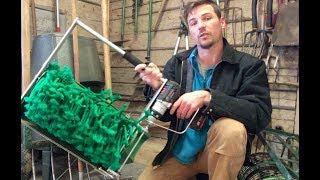
Richard Perkins explains why no-dig market gardening needs fewer tools. Tillage destroys soil biology and causes carbon loss, compaction, and more weeds. He builds beds with compost layers and cardboard, then works with a broad fork, bed roller, precision seeder, and a few hoes instead of expensive machines.
Questions this video answers
January 17, 2018.
Less than €1500.
About €180 (75 cm model).
About €150 (Johnny's roller, bought from the U.S.).
About €500 plus shipping (around €50–€60).
Chapters
It's really exciting to think about growing things again for the next season. And we've just been reviewing things we want to invest in this season, which is very little this year. It's going to be a much cheaper year than most years. We've done most of our long term investments and we've decided not to invest in a couple of tools. So today's video, I just want to talk about the basic essential tools and all the tools you don't need to buy if you choose an appropriate method for growing vegetables. Something I've been thinking a lot about lately is how people create their own problems. And we all do it. But I think in terms of vegetable production, you know, tillage is creating all the problems. Tillage creates carbon loss up into the atmosphere where the carbon in the soil bonds with oxygen in the atmosphere, flies off as CO2. That leads to lower water holding capacity. It leads to compaction. Also, when you oxidize the soil, when you aerate the soil, you're not adding oxygen in a healthy way necessarily. You can oxidize the soil in the same way that adding chemical nitrates will do. And that changes a little soil chemistry balance. That locks up nutrients to do with iron and the clay particles in soil chemistry and how they have a ability to lock down particles in soil interactions. But we also wake up plant pathogens which are in the soil all the time, but they're pretty much asleep the whole time, waiting until the system becomes oxidized. Also, weeding. And weeding is a big one because so many people get into all the latest fads and tools, especially in market gardening. But I feel like so many of the tools are to then counteract a problem that the farmer created in the first place. And if we're smart and managing holistically, we're trying to always address the core of the problem. And for me, one of the biggest core problems with vegetable production is bare soil. It's the corporate core problem of most of agriculture on the planet. So just by adding compost to our beds, we eliminate nearly all the weeding. And so you'll see the very few tools we actually need for our market garden don't really involve weeding. And I think you've got to decide you've got two roots, you either till or you don't till. This is as far as weeding goes for us. We have a little accurate hoe, some Korean hand hoes and a couple of oscillating hoes that don't get much action. Now, weeds will always germinate on the compost that we put on the beds. But we don't really get much weeds coming through. If you put the material down thick enough in the beginning and if you've got access to cheap material or free material, then really go to town with it. Particularly if you build those beds in the autumn. So here you see beds that we built on the lawn that had been lawn for generations. Just putting 10, 15 centimeters of rotten manures of different ages. All horse manure from the village. We just laid that out and put cardboard under the pathways and put wood chip on there to suppress all those grasses. There's couch grass, horsetail, all of that. We've also made beds in this other way. We've tilled with bed former and then stomped down the paths by foot and then put down some cardboard on the beds. This time just rolls of packaging cardboard. And then laid down compost and filled up the pathways. Both methods work. It's up to you. You know, it doesn't really matter, but if you're going to till then, make sure you cover up the damage. And something I like to say to people is like, hey, you know, there's nothing wrong with the tilling if you're understanding what it's doing to the soil and you're making the effort to repair that. And especially things like double digging. If you're starting on pasture like we are, it can be a great way to start to really put some organic matter in the ground, decompact the ground and then just look after it as a no dig bed. After that, it's up to you whether you decide to go no dig or not. You know, there's definitely some workflow things that can work well with tillage. But ultimately I've chosen no dig as a strategy. After studying veg production all over the world half my life, I don't find a better way to look after soil, capture carbon, put it in the ground as we grow annual vegetables. Now that's a decision you got to come to. I just think it's the smartest way forward in my mind. And I think a lot of market gardening really doesn't improve on, you know, basic agriculture, organic agriculture from the last 30, 40 years. There's not a lot new going on in a way. And I feel like there's a lot of emphasis on nifty new tools and things that just aren't necessary if you choose to go a no dig approach. And so that's what I've done. And the tools we need, I can show you here less than €1500. All the tools you need to get going really efficiently. Now that doesn't include things like row covers and the trays you need to start your seedlings, etc. It's just like basic daily tools, things that we're using on a day to day basis. So one thing we use is a broad fork. And now does that fit in no dig. Well, I've talked about that in other videos. I think it does for building topsoil in the first years, particularly if you're starting from compacted meadow like we were or you know, damaged ground, which is likely. You know, this is a great tool as a kickstart in the first few years and you'll know when you don't need to use it anymore. On some of our beds it's just not beneficial to use it so we won't bother. They're about €180 in BlackBerry Lane in the UK and it's built for 75 centimeter beds. I recommend them, I think they're great. I keep them in the no dig tool kit because we're not breaking the soil surface or turning the soil over. And then we use a bed roller. This one's from Johnny's and this is what we use to get some compaction for the seed bed for better germination. But also you see we can mark out rows for transplanting. Do you need it? Well, you can make your own like Anders here, our friend in Denmark made his own out of just scrap lying around for free. Or you can people use concrete screen. I think it's useful to get a nice flat bed for seeding in. But I also think it's great for marking out helps with transplants so you can just quickly move along transplanting without measuring anything out. Then we. So that's about €150. We bought that in America. We also bought this six row precision seeder from Johnny's in America. This is really nice. It's for things like turnips and radish and mesclan mix and arugula rocket. Any baby salads, things like that. I think that's an excellent tool. That's about €500 plus shipping, maybe another €50, €60. Some people like cheaper models that you can get in Europe. This is a single pinpoint seeder. Some people have four row ones. They're not as good quality. I don't think they're much cheaper, but I don't think they're as good as. We grow a lot of salad mix for restaurants. So for us the six row seeder Was great. And that allows us to grow 12 rows in one bed. So if you're growing lots of salad crops and radish, etc. I think it's a great investment. Then we have a rake. This is a 75 centimeter rake. Again, we bought it in America just because it's a 75 centimeter rake and you can't get them here. Most of the good tools coming from America are 30 inch tools. Not very expensive, and you can always get the head and put a handle on on your own. Or you might find a hardware rake in your country that fits the size beds you use. Very inexpensive. And then we have our quick greens harvester. It's the only other big investment. This is from farmer's friends in America for harvesting. You see, it's got very sharp serrated blade. You put your cordless drill on and you can cut salad really quickly like that. So for baby salad, arugula, that sort of stuff, it's a must. You know, you can't harvest efficiently without it. About €500 investment. Maybe another hundred euros for the spares kit. To get spares of everything while you're shipping it from America. It's the only place you get it and use your battery drill, which you'll have in your workshop anyway, for me, fantastic investment, really worthwhile. And the only other things we have for weeding are a simple oscillating hoe, precision hoe and a Korean hoe for sort of light work or for transplanting. To be honest, they don't see that much action. We're not weeding much. And I think that's something I really wanted to point out is, you know, all this stuff with flame weeders and tarps and all these fancy finger weeders, these are things that you need if you till and leave soil bare, if you cover the soil using compost as mulch. And a lot of people on a recent video said, hey, you know, is that sustainable using that much compost? What you got to remember is we're using no more compost than a lot of market gardeners would use in a tillage system. We're just laying it on top and never tilling. Plus we're leaving all roots in the ground. And so it's a very different soil biota going on. The soil food web is left intact and is pumping as long as possible throughout the year. And that's the goal of building healthy soil. So the tools I've shown you here, I mean that's €1500 of tools. And that's all you need to get things rolling and to do it successfully if you choose a no dig approach. We did talk about getting a paper pot transplanter but we decided not to because we don't think the time it will save is that great because we're working with 10 meter beds. I think it's a great tool for much longer beds. You know, 20, 30 meters is of course going to save you a lot of time. One other thing that put me off is it's full of fungicides. Currently the papers to stop it breaking down and to be honest, we're looking at what's going beyond organic. And a product that's full of fungicides isn't even organic. So, you know, I think until they've made advances there, it's not something that I want to put in my system really. It's not something that I'm happy to sell to my clients. It's something that's got fungicides around it. And also the main problem for us too is the size of those paper pot holes. It doesn't allow us to grow on transplants. And in a three month frost free growing season, that's your biggest advantage is being able to grow transplants on bigger both to stack the amount of crops you're growing in the season, but also to get over things like flea beetle damage in Brassicas. You know, bigger plants just get off quicker and also don't get the pest damage. So for me that's a big one. And also I don't like being tied into a company in Japan. Obviously there'll be other makers making those paper pots at other times, but I don't want to have to go back and just keep buying those materials. I want to just use good quality local materials that I've already got. So for me, transplanting, you know, if you're fast at transplanting doesn't take so long anyway. I mean we even transplant spinach and all things like that just because it's not that big a deal, like transplanting does not take up a huge amount of our time in the summer. So no issue for me. The only things we're going to invest in now is some nice pruning scissors for working in the greenhouses. Now we've got a much bigger greenhouse for tomatoes this year and a couple more nice harvesting knives like forward facing harvesting knives for salads, etc. Just to make that a bit quicker. But other than that, we're not really going to invest in any other tools this year. Ultimately, you know, you've got to decide which way you're going with that. And there's no right or wrong. I'm just making this video to show that you really don't need to spend huge amounts of money. And it's very easy to get caught up with what's the latest gadgets, what's the latest stuff. But really good veg growing is a lot to do with planning and working efficiently. And I think that's gonna look different in all of our time, place and circumstances. It's different for all of our setups. You've got to really discern what's working well. Layout of your place with your refrigeration, your wash station, and how you're gonna get it into a vehicle to move things is also gonna be important and save you a bunch of time. So tools is definitely an important one. But I wouldn't go out and spend more money than you have. Plan really carefully. Really, in my opinion, you wanna start by cost for everything. It's so easy to overspend and not recoup that money. You really don't need a lot. You can save a fortune if you think about buying a tiller and all those fancy tools that are coming on the market for weeding, etc. That's like an annual income you can see from the setup we've done here. We're putting in our investment into the soil, which pays off in dividends and we don't need to put so much into tools. And I think it's a good strategy and putting that money into protected growing space like a tunnel, a polytunnel, which can be done low cost wherever you you are, and season extension like row covers, insect netting is a great investment. So put your money there and try and keep your startup costs really low. I hope you found that useful in some way and look forward to seeing more people starting up veg productions this year. And yeah, especially locally, I know it's a booming thing right now. Thanks as always for watching. You can find out more in our book Making Small Farms Work and let us know in the comments below what tools you found super useful in your operations. See you in the next video.
More from Richard


A review of short and intensive season on a mixed farm and restaurant/event space in Sweden






Alskade Kyckling Exploring complexities of poultry production in Sweden and what we stand for


