S5 ● E60 Urban and Rural entrepreneurship
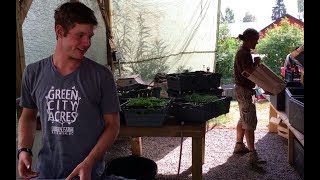
This is a video-recorded update from Richard Perkins (July 21, 2018) reporting on a short, intensive farm training combining regenerative/ecological design principles and hands-on market-gardening practice. Perkins summarizes two days he led (covering Yeoman's Scale of Permanence, keyline water design, tree systems, soil and no-dig vegetable production) and introduces Curtis Stone, who will teach two days focused on market gardening techniques and business/marketing. The recording includes practical farm life details (food, livestock, produce), participant reactions, and an emphasis on scaling production sustainably and teaching long-form apprenticeships.
Questions this video answers
Almost 20 years
Probably 160–180 properties
July 21, 2018
About 34 degrees Celsius
Chapters
So just finished two days with the crew here for the course and Curtis taking over tomorrow to do two days focus on market gardening, business entrepreneurialism. Super excited and amazing group we got here and quick video update from the farm and a few thoughts and ideas as we go through this epic hot summer days with an amazing group of people at the farm. So we just finished two days that I've been leading on the training and Curtis is taking over for the next two days. Really excited for these next two days and I've been focused on really the bigger picture of ecological processes and patterns and design, how we approach the design of regenerating soils and habitats and all the steps we go through following the yeoman scale of permanence. So we did a big farm tour that took a whole day going into all of these principles and approaches that we have at this farm. And it's such a joy to bring a large amount of really focused, enthusiastic people to a place like this where there's so much going on in a small space. And it's been one of the intentions of this farm is to really expose people to the whole gamut of regenerative agriculture as far as we can and expose them to the practicalities of it, you know, how much time these enterprises take and what's the revenue and all the back end business stuff look like and you know, what does it look like day to day and how does it look like throughout the season so you can get a feel for. Yeah, I like this bit and I could scale that up and see I could make my income with that and oh, I haven't considered that thing before and I can see how I can bring that into my landscape. So trying to really open doors and that's my job, is to act as a nutrient and a stimulant for people to really consider like a broader array of things. Because I like to say, you know, however complex we think it is, it's way more complex than that. And I, you know, bringing together almost 20 years of study in this field, very intensive study and experience with all these things from different parts of the world as well as on our farm here, and bringing my extensive design experience, we've designed probably 160, 180 properties ranging from small holdings to industrial scale production. And it's a lot to share in a short time and I've given people a lot of resources and things to go and explore those things further. It's always an interesting thing doing a short training and I valued it this year because a lot of people Say that they can only come because it's over a weekend or whatever. And we're typically running between two week and three months trainings because I think that just scratches the surface of the things we're, you know, passionate about and trying to get through to people. And really, as I always say, it's the core team that are here for six months that get the biggest learning because they see everything throughout the season. They don't see the winter season, which is a whole nother thing. And we've been considering in the past how to expose people to that part of things because that's half the year here, but they get the full. If we look back at the start of the season, there's no veg in the ground, the birds haven't arrived yet. And look at the fields changing over time and how things run on the farm and the workload over time. I mean, they get, you know, insight enough to go and start their own thing if they're confident and able to do so. So it's been really hot and just I'm down at the river now just checking the inflow to the pipes. And we considered actually moving the entire classroom on long extension leads, bringing the big flat screen and the whiteboard down to the forest because it's just so hot. But people's attention was really high and no one was getting drowsy despite the hot weather. So they said they're fine staying put in the yurt. So we did that. We've been eating epic food. We've had smoked chicken, smoked turkeys, pastured eggs and all the vegetables from the farm. We had some beautiful forest raised pig that soaked in sugar and salt brine and then cooked and put on the barbecue to finish it last night. I think it's a real treat for people to eat farm fresh food and we make a whole human diet here and I think that's something unusual for people. You know, we're supplying quality food that you can't go out and buy, not even in some of the finest restaurants in the world. Everything's come from our doorstep in our backyard and cooked to perfection by Hannah. And she's got two helpers which are doing an amazing job and people are super happy with the food and there's a lot of excitement and a lot of chatter in between class and you know, people have all different experiences and walks in life and looking to do different things. And some really nice feedback yesterday that to see things here, to be here and just things like seeing me go through keyline design on random Landscapes on the board or on the computer is very different to reading about it in a book. And it's nice to hear because I thought I was quite thorough and clear with my book, but I understand it's totally different when you get to sense things and ask questions and, you know, be in real time. So I really valued that feedback because it's an interesting dynamic. Like, Curtis's farm is very different to ours, but we saw in the event in Stockholm, like, we have a dynastism in the approach we take. We're both entrepreneurial and want to support people getting started. And so I think it's a really good matchup, actually. And I'm really excited for these next two days where Curtis is going to be really sort of honed in on market gardening and the strategies they employ there and sharing some techniques from some of the best farms he's been to, as well as looking at business and entrepreneurialism because he runs several businesses trying to get people started and facilitate, you know, good practice. And so we're both committed to excellence in our field and really trying to get more people going with the right information. So it's been a really epic two days and I'm really grateful for all the support the core team have been putting in. They've been working super hard to facilitate such a large group here, as well as Johanna and the chefs just making epic food. Amazing. I really wish there was some way to capture, like, the quality of food that we eat here and like, ah, it's just a sensual pleasure and really nourishing to have such a wonderful rounded diet straight from the farm. It's easy to forget this is the busiest time of year for us. So it's kind of a bit crazy to have such a large group here for a few days because it distracts the attention from things that are going on at the farm. But it's working really well. The group have been really responsive and are really looking after spaces and they're super respectful of everything going on. And yeah, it's been a real pleasure so far. It's great to have Curtis and his family here. They're such a sweet family and just really responsive and flexible to what's going on. So excited to follow these next couple of days and I'll make a video with Curtis and share a bit more as we go. Here's Rico. Beautiful vegetables. Despite the drought, they're kind of immense. This. You've never seen fruit set like this on tomatoes. They're small tomatoes, they're cherries, but they have incredibly dense blooms and I've forgotten the variety. I'm going to find it out for you. So what's going on?
Six today. Squash, big bags here still. Abundance of sugar, peas, purple top turnips, French breakfast, radish, really nice cucumbers. So we have two different varieties and everyone gets two cucumbers. We have red onions, nice bunches carrots, mix of orange and yellow. We have fennel, we have kale bunches and we have herbs. We have coriander, so lots of coriander.
So what do you think? After our trip to Stockholm, seeing the.
Prices there, should we move the flight to Stockholm? I think so. I think we should just. It's because it's a good thing. Mobile infrastructure. We just pack everything up. Yeah. A couple of days and we'll be sweet.
Turkeys first. Turkeys for dinner. They look fantastic. Okay, watch this, Violet. Watch him go, watch him go. So I'm out moving my turkeys. Here they come. I'm just carrying a food bucket, but that's enough to bring them all without fencing where I want them. Hungry birds have started doing their gobble. And it was too fast in the.
Morning to try to navigate cleaning that cart off.
Sure. Monkey, you did a good job. Monkey is the sweetest Norwegian fish. Forest cat. And she caught a nice vole. These are the things that are eating all our trees and they sexually mature in a month and breed like crazy. Look at these little gnashers that can take out an entire apple tree's roots. Boink like that. Then in the spring when the ground thaws, all your trees go thunk and fall over. But even 20 year old Apple tree, they can take out the entire root system off. Amazing. Tea.
Yeah.
Look at that. Good morning, Maggie. You hungry?
Thank you.
Breakfast time. Okay. Lots of lovely people. Thank you. Power straight figgy. Here we are. Curtis is here. It's your two days. How are you feeling? A man stoked.
Stoked.
Gonna.
I'm gonna kind of check in with everybody today and see where everybody's at with market gardening. Because I can, I can go in any direction if they. If everybody is sort of like up the snuff. I can kind of go really into details. I think I'm gonna start with just like concepts of market gardens. And I'm. This is the first time I'm gonna just talk about market gardens and not just my farm.
Yeah.
So I'm gonna show three farms. I'm gonna show a bit of my farm. I'm gonna show steadfast farm. And I'm Gonna show Jean Martin's new farm the front Descartes. Mainly because it's like tiny, medium and large scale.
Yeah.
Yeah.
So showing some different contexts. And then kind of like I'm gonna break down, like, the basics of soil production and economics to just kind of COVID the bases. And then I'll decide where and how detailed we want to go from there.
Super awesome. Yeah. And you're gonna share a bit about business marketing. Full on. Full on.
Like, tomorrow we'll probably delve more into that, but we'll see. Because, like, I think I'm just trying to be cognizant of keeping people in here too long. And I've got about six different sessions I can do in the field. Kind of just kind of threw this together last night. Especially just being here over the week, kind of observing where I can do this stuff.
Yeah.
So anytime I see people start dozing off, like, kit, let's get up and go outside.
They were really great. I'm so surprised people didn't get sleepy in here. We've lifted up the entire walls all the way around.
That's helped.
And taken off the roof. So that acts like a bit of a chimney. Yeah. And it really helps get a breeze through. But it's gonna be 34 degrees today, which might not be hot for some of you, but it's super hot for us.
Yeah, it's gonna be.
And the ground is reflecting heat and it's just quite stifling. Very excited. Big screen.
Big screen is awesome.
Big whiteboard.
Love it.
So we really got into the nuts and bolts going through the scale of permanence yesterday. So Yeoman's scale of permanence is the ordering framework that we use in all our design work over the last decade. And it was the first integrated land planning design framework. So it gives us an ordering pattern for permaculture design, which has never really had a clear ordering structure. Larger landscapes. And so Yeoman's scale of permanence you see pictured here, it goes through the layers of design according to how permanent and malleable things that we are going to work within. Our systems are starting with climate, which is fixed and determines the species and the plants and the animals we are going to be using, and also tells us a bit about what the landscape used to be like. We need to be able to read landscapes to understand what was the potential of this place. What are the natural biomes here? What does the land want to do so that we're not imposing our design onto the landscape. We're weeding the land. And you can always see well designed places because they're graceful and they fit the landscape. They don't look imposed onto the landscape. That leads us to landform and mapping. We get good mapping together so that we can design water to be most effective on our land. And that leads us to the water layer of design. That's where we always start in our tangible design, as it were, in our case with keyline cultivation patterning. So I've been teaching people how you go about doing that on classical keyline landscapes, as well as the random sort of fields that most of us have. 95% of the design work I've done with keyline design has been just random fields that don't have the primary landscape components typical of the illustrations of keyline that you see with main ridges, primary ridges, primary valleys and key points, etc. But the point is it's all pattern based. So I've been talking a lot about pattern and trying to really open up people's eyes to understand that we can access huge amounts of information all around us if we start looking at the world in their pattern goggles. With pattern goggles you could say so, really coming back to core ecological principles all the time. How does nature run herbivores? How does nature do tree systems? How does nature build soil? How can we apply that in a market garden and do really good soil care, etc. So the water layer we've got deep into keyline design, looking at reticulating water around so we can move animals like nature. And then we got into tree systems and roads and thinking about how their placement in the landscape should look and how trees function and what forest ecology is about and how to apply that to a production landscape. And that leads us to buildings and fences and then finally soil. Soil is the most malleable of all things. It's easy to build, it's also easy to destroy. And humans are pretty good at that. We destroy more soil each year than the last ice age did. And it takes 10 tons of topsoil to feed each person. We're only eating 400 kilos of food a year, so a disastrous state of affairs. We looked at big examples of design, we looked at amazing projects around the world, and we looked at some interesting scenarios where humans are trying to use technology to fix what are essentially biological problems. And it's amazing to see that we actually have solutions to all the problems we face. It's just not many people know about them. And we need people powered up in whatever part of society they're Working in to get clear and empowered and go out and put in tangible solutions and start integrating their work with all the people they're connected to. And so we've had a really intensive knowledge based couple of days. And that's how I like to do. I like to give people a download and then give them the links and resources to go off and find out more. Because this, this is a lifelong study. It's not something you can just pick up in a short course. That's why I've always been hesitant with short courses. But I have enjoyed the fact that different sort of people turn up and that's been really great. So now we're keeping on with the schedule and I'll get a bit of downtime looking after the kids, but I'm going to try and participate and hear what Curtis is going to share. So lots of great market gardening strategies, tools, techniques and we'll do some practical out in the garden too. And then really focusing in on business and entrepreneurialism, which I think is decision making and financial planning that really makes this stuff work. So it's really an important part of the background. It's not usually what attracts people into this field, but it's the only thing that makes it work. So that's a really important part of it. And really nice to hear that some people that came here just to hear about market gardening actually got very inspired and engaged with the bigger picture stuff. And I think it's important to hold some of that true. You know, market gardening is the least sustainable of all the different farm productions. And quite contrary to modern Facebook memes where meat production bad, vegetable production good, but actually it's the complete opposite in regenerative agriculture. It might be true of industrial productions, but if you farm properly, then you see quickly that turning sunlight to grass, to flesh is the most sustainable thing you can do. And actually all of the massive inputs and time inputs needed to market garden make it very unsustainable. And so we need to work biologically, intensively and limit the size of those productions to make them efficient and effective, which is what both of us share in the approach we take. But yeah, I think it's important to bring some of the ecological principles and thinking to market gardening because typically market gardening is often the soil depleting, resource intensive affair. And I think there's smarter ways to do it. It's why we've chosen to go no dig. I think it's the optimal soil care method for growing vegetables after, you know, I got into all this stuff when I was 18 as a vegetable producer. I went to ag school for organic crop production and managed CSAs and grew vegetables since I was 18. So I'm well aware of all the different approaches and strategies and it's led me to what I think is the best approach for small scale, biologically intensive production. So we'll hear some differences in production in the next couple of days and I think I'll sit down with Curtis and talk shop at some point and we'll discuss some of these points and share our perspectives. So I'd really appreciate it if you guys want to leave any questions for Curtis in the comments below. And I think he's got a bunch from his subscribers to ask me. So I think it could be a really nice dialogue and exchange of ideas that connects our viewer base because there's probably people watching both of our channels that don't know of each other's work yet. So I think that could be really nice. And we're both pretty open and funny people that we can talk about a whole bunch of stuff and just share perspectives which I think people will find interesting. So don't forget to leave some comments and questions for Curtis below. And I hope you enjoyed just a little quick update from the farm. We'll see you in the next video. Thanks for watching Forest Raised Pork on the barbecue. How's it looking? Toby?
Awesome. And it's.
It's good. Wow. That's been in salty and sweet brine for 24 hours and then glazed, I think with honey. It's epic. We like it. Sam.
More from Richard


A review of short and intensive season on a mixed farm and restaurant/event space in Sweden






Alskade Kyckling Exploring complexities of poultry production in Sweden and what we stand for


