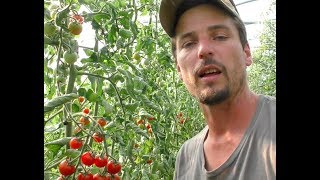
Richard Perkins walks through managing severe drought on his farm, from rescuing fish in drying streams to nightly irrigation schedules. He shows his intensive tomato tunnel where close spacing and the ILDI variety, which produces exceptionally high fruit counts, yield far more than conventional growing.
Questions this video answers
9 by 27 meters
22 centimetres
800 hens
5,000 litres per hour
About 14 cubic metres a day
Chapters
So in today's video, I want to just give you an update about the water situation and how the tomatoes are doing in here as we have a lazy couple of days after the busy course with Curtis Stone here. Can I help you? So we have yogurt and raisin. Look at that. And banana. That's good. Now. Everyone's gone, haven't they? Wagner, Gracie. So we're all going out for fika. Yeah, we're taking the seat on the road. It might not make it. So we're going in two cars. There's too many of us. But we're going to one of the restaurants that we deliver to higher end dining. But apparently they have a really fancy Fika restaurant in the afternoon. Gracie, you like Fika, don't you? What is fika? For someone that doesn't speak Swedish, Fika is like afternoon tea or coffee or morning tea or coffee, isn't it? So we're going for Fika. I wouldn't mind a waffle with cream and strawberries. I'm going to see the town. I'm having a lazy day. We've had some extremely hard work in the last days in the hot spring, Son Ragnar, you've been working hard, haven't you? But now we're having a relaxed day. So this is one of another impacts of this hot dry spell. A riverbed is just bone dry. We've just got two more trout out of a little pool. Don't touch them, my love. It damages their skin. They're so pretty. They are very pretty. But they are going to die if they don't get relocated because this puddle has just not got enough oxyge. They're just sitting still, trying to conserve energy. But we're going to put them in the pond and give them a better chance. Here's the first victim. I'm going to take a walk up the stream and see what's going on in different pools. Okay. Good job, kids. With the rescue. There's three brown trout coming out now. So as ad wildfires rage across Sweden, we're really seeing the trees drying out in the landscape here. And I said in a previous video, dying out. But some of these young trees may suffer and die. The older trees that are yellowing off some of these birch behind me here will recover with a bit of rain. They're just dropping their leaves to allow for the lack of rainfall. But it's a harsh year for water systems. The lake is about a meter below its normal level and it's not a deep lake. The one we swim in meters at the deepest, but it's a significant amount of water to be a meter low. But yeah, challenges. This is life with farming. You know, it's always a challenge. It's too wet, it's too dry, it's too windy, whatever it is. And we've just got to keep responding to whatever it is and make skillful adjustments or timely interactions to make sure we're putting investments in the right place and not making, you know, overspending where we don't need to. Like in our example, it's a drought this year, but it's typically too wet, you know, and we have an issue of too much water in the garden. So you've got to take things into a longer term perspective too. So some sleepyhead didn't close up hens last night. It's 5:30. I came up to do chores early and I was gonna move this eggmobile. We're actually slowing the movement of them down to increase recovery elsewhere. But I'm gonna take the heavy eggmobile and bring it down this marsh patch where we never graze anything. Typically it's so dry now that I think I'm going to really impact this land heavily. And I'm just trying to slow the movement down to increase the recovery elsewhere. Look here, I'm zooming in. There's mama elk and her baby. She's got two babies and the other baby is somewhere near us because she's not running the other way. But I saw them the other night coming home and I got within two meters of them. But other baby is somewhere here. Where's other baby? He's somewhere in these trees. She's wondering what we're doing. She's got a hurt leg. You see her right back leg is scammy. She looks engine but also healthy. Ready? Three, two, one. Check the wind. Yeah. All right. Ready? Go. Good job going in. Your turn. Yeah, That's a good jump off point. Ready? No. Yeah, that's the one. No. Come on in. Yes. Good night, birds. So I actually put off slaughter this week and delayed it for a whole week because I've been looking at the birds closely and there are some bigger birds in here, but I think they would dress out lower than the average target weight. And I think for smoking birds, I want them bigger, if anything. And I think that, yeah, we just take a week off now and see what size we get up to on average. You see, there are some big birds, particularly the males here, but I think they're slightly smaller than our typical average at this age. So I'm not sure if that's an impact of having so many birds in the same spot. It didn't appear like that last year, but we just take a quiet week now after busy training and delay the week, which might mean we have two slaughters in one week later down the line. We see. But I think it's good decision because the average looks smaller to me than it would be. So we'll just watch their feed rations for the next week and put them on a higher percentage of grain if they appear to be getting too big or just a slaughter day. It depends on, you know, we're micromanaging what's optimal in terms of output there. We've made a paddock all the way down to the stream, all the way up to the end of the neighbour's land. And we're actually grazing tree forage now because they cut this field, there's a few marginal areas left with sedges and things that the cows are not wanting to eat. So it looks pretty green, but it's actually mainly tree forage we're going for in here. But this is ideal landscape for these Fiauku, their native heirloom Swedish hardy mountain cow. Pretty neat. I'm just gonna hop this fence so they have a thin strip down to the water. Lots of shade, lots of protection. This is an ideal place for these cows. And so we're down to now just grazing through all of the marginal areas around the farm to tide us over now until we get to to recovery time on the grasses up where we've just been moving the chickens. It's definitely starting to grow again. Bit more rain forecast in a week's time, so hoping to get some rampant regrowth. And as I said in previous videos, they cut the field quite long, not that long, but a few inches that it should recover up quick. But great for the cows to come in here and be able to take leaves off the trees. Lots more nutrition in perennial forage. So looking forward to seeing what sort of impact they have in here. We asked the neighbor if it was okay to graze into here and he's fine with that. And just down with Niels. Moving turkeys, they're doing great. They're very hungry and kind of wanting more food than is on their feed sheet, which has worked out really well for us in previous years. But they. Yeah, they're growing well and seeming very hungry. Nice to see the cows in the forest. So we had a fantastic course with Curtis. I really enjoyed the time. And still super dry. It's Actually even hotter these last couple of days. But really happy to have done that training and I think everyone really enjoyed themselves and got a lot from it. Some people have been asking about water updates and I'll show you down at the pond how that's going. You can see it's bone dry. We've been actually watering systematically through the garden, putting 4 or 5 centimeters down. And whilst it's crusted on top, it's holding a lot of moisture down below. Now, I want to just clarify something about this compost because people have been getting the wrong end of the stick. I think we were saying it's from the paper industry. It's probably largely spruce, but it's not made of toilet rolls. It's. It's, I think by waste from the paper making industry before it gets made into paper. So it's essentially just carbon material from the paper making. But what it is allowing us to do is just hold moisture on the ground and keep it there a little bit longer, make it do a bit more work on the ground. So we're actually ordering some more just because it's so cheap. It's about an eighth of the price of our normal compost. That's balanced cow and chicken manure with peat moss and bedding. Someone asked also why we water sometimes while the covers are down and that's because they just do it very good job of holding in moisture. Now these are young germinating carrots and whilst it looks bone dry on the surface, it is holding a good amount of moisture for these young plants. It's quite moist under there, so it's kind of saved us this year. Now it's not something I want to do longer term. I'm kind of happy it's there, but I'm going to go back to putting down all the animal bedding thick at the end of this year and then letting that rot down further over the year. But there are some great crops coming out still and the garden crew are doing a great job. They're still able just to pull carrots out the ground. Now, they're young and not well formed yet, but despite the heat, I think no dig is a good approach for this kind of challenging weather condition. Despite it being super dry and really hard, you can still pull carrots out of the ground, which is really nice. They come out so clean in a no dig setup. And yeah, I think I'm happy that we've chosen the go no dig. It brings so many more benefits and tillage and it's really showing in this Dry conditions that this is a good strategy for managing soil fertility and health generally. It's very challenging times in the market garden and almost been feeling like giving up the gardens this year just to concentrate on other more reliable things when we've got so little water, but really happy to see so many vibrant crops. Now we've managed to get a bit of water down and the pond's refilling, that's allowing us to put down about 12 cubic meters around the gardens every day and keeping the pond at the same level. So that's working out well. We're just turning our attention to watering late at night or in the early morning. So we've had to have some early mornings just to get the garden watering done because it's pointless to do that in the blazing sun in the middle of the day. But just got these caterpillar tunnels really high up and aired to allow them not to trap too much heat. Some really nice fennel coming in at the back down there. That's looking good. It's been so hot today, it's been over 30 degrees again and still not strong likelihood of rain. But it looks like a couple of days next week we might get some heavy downpours and yeah, when it comes, it might really come. Now, some people have commented about evaporation loss from the ponds, but I think it's, you know, it's hard to relate to if you're not from this climate. But evaporation accounts for very little. The pond over here behind me, which I'm not using for irrigation, has got about 8 inches of evaporation and that's been in now three months without rain. So it's really not a significant loss compared to, you know, we're using between 10 and 25,000 liters a day on the gardens for the dry part of the year. So it's really insignificant compared to those viewing dry landscapes where evapotranspiration exceeds precipitation. But we're here down at the pond again and it's filling up. It's still low, but we've pumped for many, many hours out of it now. So we're keeping it kind of level and filling slowly. It's definitely up since the lowest point it's been in, but this solution has been working well. So this is water coming out from up in the forest a long way away. And whilst it's a small flow, it is flowing at about 14 cubic meters a day. So it's allowing us to put down 10 cubic meters a day and start replacing the water. That's gone from here, but it's really hard times. There's a total fire ban on any kind of, you know, kind of have a barbecue. Can't light a sauna or anything like that here at this time. And there's so much forest fire going on, devastating large amounts of capital locked up in monocultural forestry up in the north. And streams are dying out. I mean, the streams, the seasonal streams, are drying down to a trickle and fish are dying. Lack of oxygen in the ponds. We've been rescuing a few brown trout to put in the pond to keep them alive. Yeah, it's really hard here. And now we've cut all the grass. We've actually started grazing into the neighbour's land, into his riparians to get a bit of tree forage, to really try and allow the grass to recover before we bring the herbivores back in. So we've got some amazing tomatoes coming along now. Some really nice beefsteak tomatoes on the emerald. We're growing five or six varieties here. This one that everyone's been asking about is called ILDI. It's got about 80 to 100 fruits per cluster and it can have up to 5, 6 clusters per plant. It's still early in the stages yet, but you see it's starting to develop. It's a small plum, like cherry tomato, but I've never seen tomatoes anything like this. It's just insane. Insane amounts of fruit on each cluster and they will start to yellow off. You see some developing here. Really nice. But we're going to have an abundance of tomatoes. Despite the problems we had with the plants getting super leggy early on in the year. We made some calfos using eggshell, which you saw in the last video, and we've applied that. I think it's going to do the trick to some degree. Now. It could be blossom end rot related to water, but because everything's on drip irrigation and getting the same amount of water, I think it's probably actually more to do with, you know, just random lack of nutrients in some parts of the soil, because this was just a compacted sub base to put the tunnel up on. Just crouching down to show you some of the cherries coming on now. So we're doing really close spacings. We're at 22 centimeter spacings and we have eight of these beds in the tunnel. Our tunnel is 9 by 27 meters and it holds 800 hens during the winter months. So it's turning over about €40,000 of eggs in the winter. And then in the summer, this abundance of amazing tomatoes. We have a couple of cherry tomato varieties. We always save a row for tomatillo that you might just make out in the background here. And I love tomatillo. We put that in mixed in with tomatoes in the bags and loose sails that we do. And I think it's a delicious addition. We have a black cherry. This is black opal. It's very nice cherry tomato. Really delicious one. We're growing all indeterminates and this year we haven't grafted tomatoes because were growing for the first time in this place. And so next year we'll be grafting again onto probably estimo rootstock. So to graft tomatoes, you need to seed. Wow, I still can't get over these Ildi. They're just insane amounts of fruit gonna come off here. And someone was suggesting to just roast whole trusses of the fruit. And I think that's a very good idea. So a bit of maintenance to do. We typically, you know, this is a low cost, low maintenance way of growing tomatoes. It's very intensive, but we're basically spending an hour or two a week at the most just coming through, pruning suckers. And we need to come along and clear the bottom branches now around the fruit sets. So you see, we need to probably take off the bottom branches up to about here now. And that's the job to do now. It's no urgency really, but it'll help to get more ventilation through here as all these fruits start developing and allow us to observe more easily. But a little bit of work coming through just taking out suckers. And we use little Japanese pruning scissors to do that. And we're watering every couple of days. This watering System puts out 5,000 liters an hour, which is at risk of running our well out. We've had a government warning to check your wells and be very careful. These are the Japanese pruning scissors we use. We really like these because these are a fingerless scissor that you wear on the back of your hand like so. So you can work with both hands and then clip on the back. But I'm actually really impressed with how the tomatoes are turning out because they had a bad start and they're not in good soil. They've had compost put down and chicken manure as a fertilizer. See, this is a nice example with a couple of fruit trusses that's pruned up to the right height. So we're going to come through here soon and just clear out all the bottoms and you'll really get a sense of just how many tomatoes there are in here. But nearly a thousand tomatoes starting to look really impressive. So it's hot, but it's evening time now and I'm going to start working my way through, just cutting off all these branches carefully below the first fruits. And I'm just going to drop them to the side as I go to make a nice neat pile. I can pick them up as I go. On my way back, I'm basically taking everything off up to the height of about 80cm or so. I like squatting in this position. I spend a lot of time in Southeast Asia where people naturally sit like this and I'm pretty flexible. So I actually designed my garden around this posture. I can sit like this all day. I'll actually sit like this when I'm at the bus stop waiting for a bus or a train, which people find a bit odd. But it's very natural position and good for the body. One of the jobs in a tunnel like this is to keep the plants well tied up so they don't spread into each other. And then they get all tangled up. It gets a bit of a jumble. It's regular once a week. Taking off suckers, etcetera Is usually enough to just come through, tighten them up and you don't get into any major problems. Let's have fun running in the jungle. Cherry tomatoes coming well. One thing that doesn't mind all this extreme heat is my cancon. Ipanema aquatica. This is Chinese water spinach. It's the fastest growing plant on earth. It can go from seed to seed in 21 days in the right conditions. But that's in the tropics. But here you see it's a nice stir fry green that's coming up really well. And I reckon it'll take a bit longer than it would in the tropics, but I reckon that's going to make some beautiful stir fried breakfasts with pasteurized eggs soon. So I want to ask you guys something because I'm thinking now to possibly pursue the idea that I've had for a couple of years now of opening up a European tool and farm supply shop, an online shop with really good logistics based somewhere in central Europe to supply people with all the sort of amazing tools that make market gardening effective. All the things that we use in chicken operations and different fencing, energizers, the knives, the stunners, pluckers. Like a place where you can just buy anything you need to get a farm started. Cool bots, all the stuff that people need to import from abroad, the good cedars and market garden tools as well as caterpillar tunnels, all this sort of stuff and I think it'll be really cool. There's not a single place like that in Europe currently and people are always emailing me asking me where to get stuff and I thought, well, at some point I just gotta make the store and make it awesome. So what I want to know from you folks is what would you call a one stop tool shop for farmers and market gardeners? Give me some name suggestions because I'm in that creative process right now. So that's it for today folks. Just a quick update. We're taking a few restful days after a really busy course. Amazing time we've had on the farm. Super hot days and just getting on top of the tomatoes now. Thanks so much for watching and don't forget to click subscribe. Share the video with your friends if you enjoy them. You can find out a whole bunch more in the links below, including our book Making Small Farms Work, our online trainings and other offerings that we have educationally and open days at the farm, etc. See you in the next video. It.
More from Richard


A review of short and intensive season on a mixed farm and restaurant/event space in Sweden






Alskade Kyckling Exploring complexities of poultry production in Sweden and what we stand for


