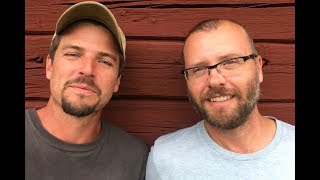
Richard Perkins and Curtis Stone discuss scaling from urban to rural farming, the role of animals in organic fertility, and resource constraints like phosphorus and seed supply. Stone explains why compost could be an overlooked enterprise for market gardeners, and how small operations differ from larger organic farms.
Chapters
So I'm here with Curtis Stone. We've had an amazing workshop, and this is the second part of a video. The first part of the video is up here. Maybe it's up here. I don't know how these cards work, but you can see some questions from Curtis's viewers that he wanted to pose to us. And we're just discussing a few things about the farm here. But I actually got a few questions from our subscribers that I asked people for questions that they could put to Curtis while he's here. And so there's a few of those here. Someone is asking here. Silver Maples is asking. Like, in the past you've talked about buying a bigger farm and. And doing the rural thing, which is what you were interested in originally when you started being an urban farmer. And what are you thinking about that now? Like, do you.
It's funny. Well, it's. I mean, it's a complicated answer. I mean, I would say coming here, I mean, there's parts of the lifestyle that are really attractive to me. I love living in the country. I love the community in the country. Like even just talking to some people who are your neighbors here in the course. I mean, I love country people because they have skills, they're really resilient, they're really resourceful, and I like that aspect of the lifestyle of the country. But the challenge for me is that I'm involved in so many other enterprises outside of specific farming. I run a company in California with Diego Futer. I'm a regular content creator. I write every week. I do all these other things. And I have a young baby that I go. In a way, I'm kind of happy I didn't do it, you know, if I didn't have those other things happening. And this all comes down to context. If I didn't have those other things happening, I think I would be wanting to do this. But at the same time, I've already. I've put in seven years. I mean, I've been. This is my ninth year of doing this. I've put in seven years where I had huge days. And I look at your day to day and, you know, no offense, but I'm just kind of like, I don't know if I want to do that. I don't know if. I don't know if I could handle that right now because I have too many other things on the go that I. It just. It just wouldn't be practical in my context at this moment. Could it happen again later in my life? Probably, yeah, most likely. I think eventually I do want to be in this kind of situation.
That's the thing. Context change over time. And something I've been talking with Curtis about is my context is also changing. We have a young baby and the desire to spend more time with family and time out. And I kind of took on a couple of full time roles here. One is educating and mentoring people and one is running a farm. And actually I really zooming down to wanting to just farm and have less people around. And so context change and that's the way it is. And all we need to do is keep responding and managing to them.
That's it. It's cool. I mean, I think like once you get into that line of thinking and you know, we, you and I have had some different conversations about permaculture and what it means and all that. But I think one of the greatest things that I've taken from permaculture because I got into it quite a long time ago, was observational thinking.
Yeah.
And that's actually helped me not only in my farming but really it's helped me in my other business enterprises because I've learned to take live feedback, feedback loops, observe and interact and then change things as I go. So what I started with and where I thought I would be is totally different than where I am now. And so I think as long as like I've been open to these things and I'm open to have my mind changed because it has been changed many times and that's kind of helped me continually redefine my context.
I've got a question here from Aruba and we're obviously a meat producing farm and I think everyone that follows our channel is well aware of that, even if they, they're not people that eat meat themselves. But it's a big part of what we do here and obviously we're exposing people to the entire process of raising and slaughtering animals. I've talked a lot about the unsustainability of a vegan approach to farming. Now I have no bones with whatever diet people want to eat. But from a farming perspective it's really important to understand that animal inputs are vital for driving fertility loops. And the question from Aruba was to. Yeah, to hear Curtis touch on that as a vegetable producer. And I think probably a lot of people that are vegan, vegetarian are following your channel and maybe not even aware that how much animal input there is in vegetable production.
Yeah, well, it's interesting. This has actually come up at the workshop a lot because we kind of talk about Commercial farming versus being an agrarian. And those two things are very different. You know, people like John Jevons in the bio intensive movement have done this for a long time. They can produce vegetables on a vegan diet with vegan inputs. And that's all fine and dandy, but it is agrarianism in the sense that you can't scale the production and a lot of labor and inputs go into producing your fertility. This is the advantage of animals, that the gut of an animal is an instant way of creating compost. And it's just the reality of it. I, I was a vegetarian for 16 years. I was even a raw vegan for I was raw vegan for one year. I was a vegan for a couple other years. Out of that whole 16 years and two years into me being into farming, I was still vegetarian. I learned really quickly that a vegan diet just wasn't practical in organic agriculture. And it was just, it was one of these things where I sort of experienced a cognitive dissonance where it was just like, well, this goes against everything that I've thought was correct for many years, but it's just the reality. And I think, you know, if you want to talk about the sustainability of meat, because obviously when meat is criticized, it's the vegans are always criticizing industrial agriculture.
We do too.
And we do too. Exactly. Because it isn't sustainable and rightfully so, it should be criticized. But when you really, when it really comes down to it, animals are required in agriculture. And just as in the natural world, animals eat each other and kill each other. And nature, I would argue that in nature it's a lot nastier for some of the way animals are killed than they are here on this farm. It's quite fast. And these animals on this operation have an incredible life up until the last seconds that they're killed that one bad day.
As Joel Saladin says, it's really important to understand that there are no vegetarian ecosystems and it's really fine whatever people want to eat. But I think it's an irresponsible way to farm myself. Animal inputs dry fertility in all ecosystems and they integrate so well together. And that's what we need more in our farming systems is integration. Okay, taste is asking. So both of you have market gardens with wide range of products. And looking at the decline of resources in the world, what would be the hardest resource to self supply in the future to keep a small micro or small vegetable garden running? Thinking about things like water, seed, grain, compost, etc.
Well, I think you and I probably agree on this one. It's probably phosphorous as far as an input that's brought in, but that also is very dependent on where you are. I've done market gardens. I help people set up market gardens all over North America, some in Australia and New Zealand. And in some places phosphorus isn't an issue in the soil, it's overly abundant, but in some places it's not. So I would say as an input that is needed in agriculture, phosphorus is one. And as far as I know, we're at sort of a peak in what is. What is possible to produce in the world is phosphorus. So it's probably that because you can produce nitrogen. You know, if we just talk about.
Npk, compost can always be done locally.
That's right. So we can produce nitrogen relatively easily.
And I think seed is one. But I just was thinking about. Curtis made a video recently looking at a seed saver who's running a commercial, you know, profitable commercial enterprise, saving seed. And I think you should check that video out.
Yeah. Maybe put a card up to it or something.
And yeah, because you know, seed saving, like seed is a global distribution market. So if you buy seed from a local Swedish company, they're buying from Johnny's in America, who are buying from possibly Syngenta or, you know, nobody knows. It's a massive global distribution network. But actually what we need is people running market gardens a bit like this specifically for seed supplying their local. I would always buy a local person's seed because it will be adapted really well to this specific circumstance as long.
As they can do it at a price that's reasonable. Because sometimes, like in Dan Brisbois is the video. This is Ternay Sol Farm in Quebec. It's an incredible large scale organic farm and I would urge people to check it out because sometimes we talk about scalability in market gardening and I honestly think is my opinion now, and this has changed over the years, just in my experience and my travels, is that if we're going to scale market gardening, it does get to a point where the 30 inch bed system just doesn't make much sense. Because let's be honest, 30 inch bed market gardens are not going to feed the world because if you want them to feed the world, you're expecting more people to get into agriculture than are now. And people in agriculture has been declining ever since the Industrial Revolution exponentially because technology allows farmers to do more with less. And so unless we expect that that trend is all of a sudden going to change. And there's also Suddenly going to be a revolution of billions, literally of billions of farmers getting into market gardening. I think that's unlikely. I would love to think that that would be the case. My idealistic mind would say, yeah, wouldn't that be lovely? But it's not. So I think it's worth looking at operations like Tournai Sole and say, here's an organic farm that builds soil. They're using active cover cropping and some tillage to build soil on scale. And so I'm not saying that has to be done through tillage, but I think there's a lot to look at these types of farms and see. How do you do this on scale? Because 30 inch bed, where it's really human powered is a great system. I would say up until 6, maybe 10 acres. Once you get beyond that and you're talking about tens of thousands of customers every day, it's a different operation. And I think we need to look at larger scale systems and learn from them. And I think that's probably what's realistic if we want to scale this. Because we can't expect billions of people to get into market gardening. I just think it's an unrealistic expectation.
It's an interesting thing. I think Kurtis will say the same. But because we are, we're just engaged in this field every day of our lives, that you kind of forget that not everyone's thinking about this stuff. And actually hardly anyone's thinking about this stuff. You guys all are following these channels, but most people on this planet aren't. And so the global trend is this decline of people in ag and farms are getting bigger and more industrial and robotic, etc. And there is a big rise, contrary to that, there's a big rise in people getting into particularly market gardening. But it's at such a small scale that it's insignificant.
It is in the global food supply. And that's, I mean, it sounds depressing to talk about because I mean, we have certainly seen. I don't know if this has been your experience, but it's been mine. I'm sure it has been your experience, but I have noticed a lot of people getting into this. And so in our little microcosm of our ecosystem that we live in, it seems like this is this huge phenomenon. But if you look at the hard numbers of global food production and you talk about regenerative ag and market gardening, we're not even a sliver of, of a percentage of global output. And I know the UN published this, I don't know if it was the un but it turned out to be not quite true. There was this study that went around and said, you know, small farmers are producing the lion's share of the global food production. It's just. It wasn't true. It was. They exaggerated a couple things, but it's like, you know, and it was. At times, it's funny and it's ironic. I was having a laugh with your wife when we didn't have some stuff on the farm and she was like, thank God for the global food system that we were able to get some of this stuff brought in to use at our event here. We need to feed 45 people a day. So it's like we should criticize industrial agriculture, we should criticize conventional large scale, but at the same time should be.
Humble enough to learn from it.
We should be humble enough to learn from it and also be grateful that it is there in that we have been able to do things that human beings have never been able to do as a result of it. So again, doesn't justify the things that are wrong about it. But it's. It's important to put it into context.
Yes, complex questions, but I think, yeah, the seed one is an important one for me because that's going to be a limiting factor for people as time goes on. But there's a big need and demand for good seed. There is, and it's a skill. I don't think each market gardener should be saving their own seed. You want to be turning your beds over making a viable living, but that viable living can be made by someone exclusively growing seed. But that's. It's another skill level and you need.
To know it's a very other skill level. It also requires a certain amount of land that you can do it. The thing that's interesting about seed saving operations is that they always have a market garden, but it's not necessarily. It doesn't really work the other way. And if you're going to be a market gardener, to have a seed saving operation doesn't really make sense unless it's really your context. But Dan Briswe's operation is there are seed savers and they have this fairly big market garden. I know a couple other people on the west coast of Canada that save seed and seed saving is their thing, but then they have a small market garden as cash flow. And so it's actually one thing I wanted to touch on because we mentioned compost and seeds is. I think compost is actually an enterprise that is really overlooked and it's not as sexy as bringing up animals and having a market garden. But I think that's a serious need that's not being met in this space. Because you and I both bring in compost.
We had a problem getting good compost here.
Yeah. And I talk to people around Europe here. This is a major issue. I see it from my YouTube subscribers all the time. They say, curtis, I know you use a lot of compost. Sometimes we use 20 yards cubic yards a year on our tiny 46, 50 foot bed farm. And people go, I can't get good compost. You can actually make money in compost. The guy that I was buying compost from for years died last year, unfortunately, but he was making money at this. And it's actually not that complicated of an operation. It doesn't require a ton of infrastructure. You definitely need a tractor and you need a way to turn that compost. But you can scale into it. You can start simple and then you can upgrade to implements. I think this is an enterprise that a lot of people should be looking at.
Yeah. We need people getting powered up and operating all parts of the system. So there's many ways into, you know, the field of regenerative ag or whatever you want to call it. But Karl Hammer in America, Vermont compost, that's a really great operation.
Very great operation.
They make super good compost and they're passionate about the art and science of compost. Whereas most compost you can find, it's more of a municipal compost, or it's turning a waste into another resource. But the passion and the part that makes it so useful for a market gardener is missing. It's just a substrate with nutrients, balance, but missing life or whatever. So I agree. I think that's a really good enterprise that people could be starting up as well.
Yeah.
Cool. I think that's gonna be enough for now. We're going for breakfast. It's our last day today. Curtis is leading the day. And then people are zooming back off to wherever they live to carry on with their projects and farms and digest all the information they've been exposed to. But thanks so much for coming. Yeah, I've really enjoyed this day. These guys are awesome. And we've had a really nice, smooth, easy time, really.
It's been surprisingly easy.
In the drought.
Yeah. In a drought. And that. It was funny because it rained the day after we got here. It's like we brought the rain. So it helped a lot.
Yeah. But thanks so much and I've really enjoyed the time and I look forward to collaborating in the future.
Absolutely.
It's awesome.
Cool. Thanks.
Thanks so much for watching, folks. See you in the next video.
More from Richard


A review of short and intensive season on a mixed farm and restaurant/event space in Sweden






Alskade Kyckling Exploring complexities of poultry production in Sweden and what we stand for


