S5 ● E64 We're going certified Organic (partly)
Richard Perkins walks through his farm with an EU organic certifier to see what it takes to get certified. He's going for vegetables, microgreens, and eggs, but skipping the broilers because EU rules require 84 days on pasture. Most of his operation already fits the standards.
Chapters
So we're here with Ulf, who is a Ura certifier for the EU organic standards and crab and craft. But there's craft is a separate thing here in Sweden. But we're actually looking to have the hens and eggs certified organic under EU standards. So we've just been looking up here at the eggbo meals behind us and just talking about how we run the hens and other things. And Ulf seems to think that it's. It fits the baseline for organic standards. And you thought the birds look healthy and good and that's our primary intention too. These are some of the things that we're talking about. They want to see the winter structures and the size and how we give water and where the silos are on the farm and then the internal measurements of the eggmobiles to make sure that they all meet standards. So we just give some simple drawings to show that the roosts are enough for the birds and the nests have enough space and then where we buy birds from and all of the record keeping of food to show that we're feeding organic. And yeah, it's quite an interesting process because it's always a bit overwhelming if you haven't done this before. Ulf didn't want to speak too much on camera because he's not sure if he's allowed to say certain things or not as a representative of the company. But you know, he's used to certifying big industrial units as well as some small scale farmers. So this is obviously a bit different to what they're used to. We're just showing around the farm and all the different things that we do and explaining the approach and what we're up to. And it's good to know that this is, you know, can be a fairly useful process. We talked about the broilers, but for us we don't want to get organic certification for these because we want to slaughter at the weight that's best for the birds. And under EU directives, organic meat birds must be 84 days old. And that's just an arbitrary number in my mind. It pays no respect to the welfare of the bird, the breed of the bird, etc. And so I want to slaughter the weight that's right for the customer and the health of the bird, etc. But we're just showing around now, showing a few models.
Is it the same? That's what the. I've just read briefly about it. But it has to do with quality standards.
It is, it is end product.
More.
No, yeah. If you have a slaughterhouse, if you make marmalade or something, it's very normal.
That.
The buyers ask, they demand that you have an EP certification to be able to sell your products.
Yeah.
I came in contact with it when I contacted Coke Barum Land. And to sell in the grocery stores they often have certification requirements and that's.
Of course it's hard for a small producer. It's easy if to you want produce X amount of tons.
Yeah. On your backs.
Turn the earth. But we just put new layers of.
It'S straight on the ground. Yeah.
And we just deep.
Yeah.
And these tunnels, I didn't put them in as greenhouse tunnels because they are very mobile.
Yeah.
So they are more like a feature.
No, no, but the greenhouse is.
Yeah.
If it's solid on the ground. Yeah, absolutely. And that's the ground as well. In the regulation that you have to grow your stuff in, in the soil you're not allowed to put. And also the amount of dirt if you. I don't know if you grow anything in pots.
No, no. Like it goes in pots as a seedling.
Yeah, of course you have. You have the minimum of 30 liters otherwise.
Is that for plant welfare? Yeah, it's like six chickens a mina square. We just got some more of this wood based compost. I just want to show you it's bone dry in here. Just talking about becoming organic certified for the gardens too. But despite it being bone dry, this stuff is really helping us hold moisture. You see the worms down here. This has been the saving grace this year to have really cheap organic material to put on top that just acts like a sponge. We've just been talking about seed supplies and compost and using our own animal manures. So I think basically our vegetable production and our hens are going to be meeting organic standards right away. And yeah, it's interesting. It's not something I ever considered before. It's something that Johanna initiated because one of our big customers needs it in their chain. They've been buying eggs as a really good customer as well as chickens, 10 turkeys, vegetables, microgreens. It's a very big customer near here. And they have. They're part of a bigger chain that needs things actually certified organics. So this is how this all came about. But it seems like no problem. And obviously talking with the inspector, it's clear that we are starting from the point of trying to do things organic or better than organic as opposed to a big industrial farm that's switching to organic. So. So in these kind of cases, he's saying it's much easier to see that, you know, we have all the foundation in place for the certification. So it's really awesome. So you're not actually concerned with the packing and this side of it or you are a bit. Yeah.
For example, the plastic and the boxes we check. So everything has to be the knife and the falcon. Is it all right to use in grocery. No, like I said, it's a production control and we check the balance with what you grow and what you sell. Yeah, so the balance.
Yeah.
So if, if you've sold 200 kilos and you let only produce it produced 100 kilos. So it's.
So it's like. Okay, so you know that it comes from your.
That's hard. Yeah.
You have to, you have to show that, that, that. Nor normally if you come to produce it, that, that you have some kind of journal system in your computer on paper, whatever. But, but it has to be the, the, the basic on it that we check the fertilizer, the dirt, when you, when you harvest how much.
Yeah, because it's, because otherwise it could be that you show one part, but then you use something else in the other part or something like this.
Or you buy in cheap spinach from China and sell it as your spinach.
I mean, it's.
We should hide all them in Chinese spinach bags.
Yeah, I saw them.
But. Well, no, but I bet you're in.
The wrong country to, to.
To do that.
I think.
I bet you get all sorts there, don't you?
It's. If you come to, to ground farming, that's not a big problem. I mean, you're, you're, you're in international level and, and olive oil and you start to talk about fraud. I mean, fraud, fraud against. To, to. To the. Through the buyer, to the customer, but also towards another producer to make him go out of the market, for example. So it's a big. Normally you grow this in the greenhouse.
In the wind outside.
All right, so pretty interesting morning. I think we're going to have organic certification for vegetables and for microgreens and for eggs, which is awesome. I don't really want it for the boilers. As I said, it's not in our advantage to take organic certification. We want to be able to slaughter when it's best for the birds and respecting their physiology, etc. Not some arbitrary number as I've talked about in other videos and earlier. But yeah, pretty interesting. It's not so overwhelming. I think it's. You know, I wanted to include this segment. I don't know how useful it is, but I think it's good for people to just see. It's like the slawry. It's like, how do I build one of them? But once you do it, it's like, oh, that was kind of easy, you know, and it's the same with this. People were getting a little bit worried about them coming to inspect today and I just thought, I bet this is going to be really smooth and easy. It's like we're obviously trying to do good here and, you know, that shows in the way we care about things and the way we run the operation. So I thought it would kind of be smooth like this and wanted to just share that with you.
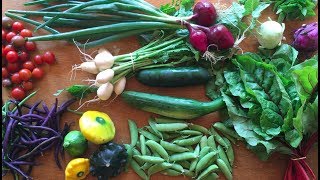
So packing organic veg, actually number seven, eight. So we have beans, mix of green.
Bees and purple beans.
We have still our patty pan squash, still the abundance of sugar peas and rice. Not stopping kohlrabi, green and purple hakurai turnip.
Very nice. These are actually transplanted.
They're transplanted.
So it's slightly elongated and done very nicely with good success.
Our cucumbers are pumping, so we have English ones and English, the big ones and the longer ones.
And, oh, it smells like super strong at the end.
We have red onion. We have beautiful chard. Best chard so far, that's for sure. Nice big bunches. We have beautiful tomatoes, tomatoes, cherry tomatoes.
And a lot of them coming on.
And with the tomatoes, really nice, small bunch, but beautiful basil and lemon basil.
Look at these hunky gardeners. Hunky gardeners.
This is nice.
Beets.
Yeah. Yellow beets and some more micros.
Yeah, nice. Can you pop the lid off? I can. This is how we do micros with. We just put three varieties in one little pack. Very nice, Very nice.
Contacted some hands.
Yep.
So that's what you get in the box this week. This is veg box number seven. Beautiful. There's Reuben now, Reuben is. He's five years old now and we're actually passing him along with one of the big sows because we're clearing out with pigs for the winter to let this all recover. Rest of the pigs are in here. Niels is just actually trimming the fence because it's quite overgrown. But we've got a good old 5000 volts coming through here. It's pretty good. But the pigs are in here now, so they've got a lot of vegetation they can eat from and I think they're going to enjoy it. They'll probably be here now till the autumn when they go for Their one bad day as it were. So the irrigation supply has finally arrived. We've got a misting downer. This is just to go off soft thin walled piping. And I'll punch that with this little tool here and pop in these. Now we've got these brown nozzles. These are releasing about 20 liters a minute. No, 16 liters a minute and the mist is 20 liters a minute. We know that these spread about 4 meters over which is good enough for the caterpillar tunnels. But I'm going to come and install these, the piping up in the top here along the central beam. And I'll put a irrigation nozzle under each post as we go down. So the process I'm going through is to take down the old thing. I'm gonna. It's too thick the pipe up there to pierce holes properly. So I'm gonna snip all the connections and redo it because I don't want to damage the crops underneath we've got fennels and bush beans as well as carrots and things germinating. So I'm going to whip that off with the new one up, put it, put the gear in, connected up to the yellow pipes that we use from the. Basically the big pipe coming up. 50 mil pipe splits to gekka fittings. Standard industry brass fittings to 1 inch yellow pipe. So I'm going to connect that up to this so we can rig up both the 30 and 40 meter tunnels whenever we want. So I'm going to get on that.
She put the lime in the cooking now she drank and pull up she put the line in the cooking now she drank and drank and p. She put the lime in the cooking now she drank and pulled up she.
Sweaty even after dinner. I'm actually skipping dinner to do this but looks good. So now I've just got to hook up the main supply line and I can bodge that on because this black tube fits inside the yellow header pipe. What I've done at the end here is just put the yellow pipe we use from the main header pipe here, you see and I've just connected that over with a little clip to hold that on. And the end of this goes to just a standard gekka fitting and that means we can connect it up to. We have multiple 10 meter hoses so we can water anywhere in the garden. So I just got to connect this end up to where it comes out from under the ground from the pond. We can test if the system is working. There's two outlets on here. So I'm unblocking this one, I've blocked the other one, then I reconnect and Toby's down to the pump. So I'm going to shout to him. Well, I can visibly see the rain arc coming right to the edge of the tunnel. That's perfect. I think it'll be a little bit heavy as you go inside, but it does reach to the edges. And I can see on the other side, it's reaching nicely over there too. So success. Pretty easy. And that's the way we irrigate the caterpillar tunnels. Pretty straightforward and I'm glad we got them now. We've been waiting a long time for the right part so we can get this going.
Sam.
More from Richard


A review of short and intensive season on a mixed farm and restaurant/event space in Sweden






Alskade Kyckling Exploring complexities of poultry production in Sweden and what we stand for


