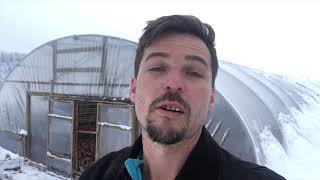
Richard Perkins walks through polytunnel snow management: invest in strong steel frames with diagonal bracing, or use livestock inside on deep litter to generate heat that melts snow naturally. Plastic degrades every four years, but frame failure is rare; plastic stretch is the real problem.
Chapters
I just love looking at the structural integrity of these spruce trees. The branch is perfectly evolved to take that load and falling down as you see here, like 40 degrees or something, with no damage to the tree whatsoever. Thinking about structural integrity and snow loads. Today's video I wanted to make about polytunnels. I often get asked, yeah, but what do you do in the winter when there's so much snow? So I wanted to make a video about that today. So yesterday I did something I haven't had to do for four years, which is clear the snow off the top of our polytunnel, only one of our polytunnels. So I want to talk about some of the considerations for polytunnels in a deep snow winter. Now, if you follow some of the market gardening groups, like Market Gardening Jealousy Support Group on Facebook, you'll see all these photos at this time of year of collapsed high tunnels and polytunnels. And I want to talk about structural integrity because essentially when you're buying a tunnel, you're buying steel, so you better buy good steel. So this is our small tunnel and we've had it up here for four years now and I haven't had to clear snow from it and I've had animals in it for two years and I think that's a critical piece. You can see I haven't been able to clear the snow full fully from the sides here, and that's because I've got a disc problem in my back. So I haven't wanted to dig away that volume of snow. Now this snow has been built up over three days and so it's been super heavy and that's no good for my back right now. I've been going to the Cairo. I'm going again today, so I've got to look after myself. But what concerned me mostly was the stretching of the plastic, not the rigidity of the frame. I really think these frames from the company we buy from can handle any amount of weight. Now, buildings in Sweden here obviously have to be built to take huge amounts of snow. And this snow had built up over three days. So the bottom sort of 15cm was highly compact to heavy ice and it was really stretching the plastic out. So polytunnels in winter, you've got a few options, really. A lot of people in this country put the plastic on each spring. Now that's a very wise way to do it. It does mean that you end up with a lower quality sort of fitted plastic covering. But the reason I don't do that is because any Expensive or, you know, relatively expensive space like a polytunnel should have multiple functions on a farm, and we use ours for livestock. So therefore we've invested in higher quality frames that don't really have any issue with snow loading. And plus, if you keep livestock inside your tunnel, you don't need to clear them ever. Now, you might be using it for storage of machines or other goods, and in that case you might need to. So there's two main ways that you can clear snow from your tunnel. First is a really simple method, but you need two people. It's to take a rope and have one person on each side and sort of zigzag it backwards and forwards as you walk along. And for initial snowfall, that works perfectly fine. Now, when you have a high build up of snow, particularly when it starts to get a bit icy underneath, that method doesn't work very well. And that's where we've got to. Now, because of my back problem, I hadn't taken off snow from the previous days because often, you know, as the weather changes and it gets warmer and cold, it will just fall off on its own. And so what I did this time was use a different tool. This is a roof cleaning tool that's very common here. And it's just a head here with a telescopic handle and that reaches well over halfway over the tunnel. And that allows me to catch the snow and pull it off. And so even when it's quite icy and compacted in the middle of the tunnel, I can sort of dig into it and yank it all off and it will pull everything off. So it only took me about 45 minutes to clear the snow off both sides. Obviously I didn't clear the sides very well, but I'm leaving that because of the state of my back. But I have no concern about it pushing in on the frame and no structural concerns about this tunnel at all. So I buy this tunnel from First Tunnels in the uk and I do that because I really like this service and I like the cost. This was about €2,800 delivered from the UK to Sweden with side ventilation and all the crop rails and extra supports that you see. Now, just to make it really clear, I don't get any commission from First Tunnels, but I've probably helped sell them over 100,000 units, euros worth of tunnels. Our friends from Norway, Sweden, Denmark, Germany, down to Spain and Portugal have all used their service on my recommendation. And I really like them. I think they're a cool company. Their website's easy to use, easy to add on additional features. And so I just want to point out the additional features I think are important, which is in a high snow loading country, to make sure you get these additional crop rails. Not only do they allow you to put on wires for stringing your tomatoes or cucumbers, whatever it is, but they really increase the structural integrity of the frame. Likewise, any diagonal bracing that's offered for the ends of the tunnels definitely worth buying. And on that note, I would buy the side ventilation that you see here because that's a great way to manage the polytunnel during the growing season to keep the temperature and humidity how you want it. When you think about it, a polytunnel, you know, you're not paying much for the plastic. You're essentially only paying for the quality of the steel. And the frames that you see buckling out is cheap steel. Basically. You know, if you buy cheap steel, you're not going to have a strong frame. These frames are pretty good price, but they're very strong steel. And I have no doubt that this frame can hold up to, you know, any amount of snow load. The only thing that's going to happen is the plastic bows, and that can stretch the plastic. Typically in a commercial setting, you want to change the plastic every four years because it's, you know, anything plastic or glass is reducing the transmission of sunlight. Even greenhouse glass, like 2 millimeters thick can cut 20% of the light. Now, that sounds surprising to some people. You don't notice it with your eyes because your eyes aren't really built for that. But a plant who's, you know, think of like a photon meter that photographers in the old days used to have, you know, a plant who's dependent on light for food can really measure the differences. And if you've ever seen, for example, a dandelion growing in an open field compared to under a tree, you know, it's a very different plant. It's almost unrecognizable to each other. So light really affects things. And polytunnel plastic cuts out a bunch of light, and as it degrades over time, it cuts out a lot more light. So you want to change that at certain intervals, but you can get away with it for many years. I know people have kept the same polytunnel skins on for many years, you know, 10 years or so now, you know, it's humidity that we want as growers, as well as the sort of increased temperatures. But yeah, it could essentially stretch out the fabric, which you don't want. So it's good to remove when it gets to that point. But let's go and take a look at the other greenhouse because that's a lot bigger. This is I think 20 by 7 meters. The other tunnel is 30 by 10 meters. And clearing the snow off that one would have been a nightmare. But I've never ever had to clear that one and I don't think I ever will have to. One thing I've done on this is just taped up the leading edge. This is built for taking snow off roofs of houses. But because we're on the polytunnel and it's plastic film, I've just put some additional tape around here to stop it having a sharp edge so it doesn't damage the plastic. Some people have asked me why we didn't buy a gothic arch, you know, sort of more V shaped arch for a high tunnel, which is a lot more common in the States. It's hard to get them here, to be honest. And the manufacturers that I've seen here in Europe, they're often a lot more expensive. And as I said, I think, you know, and it's interesting that a lot of the collapsed tunnels you see on Facebook posts, etc. They're often that shape too. So ultimately, personally, in my opinion, I think the quality of the steel that you're buying is more important than the actual profile. You know, obviously a steeper pitch roof will shed snow a lot quicker and easier. But I think ultimately you haven't got much of a risk. I mean, the fact that this is the first time I've cleared that tunnel in four years, you know, I really don't have concerns about it. Another thing you could do if you're really concerned, just to put some wooden posts up for the winter season, you know, three or four posts along the length of that tunnel and you know, you really have no concern with your frame. And like I said, I'm not concerned about the frame strength at all. I'm concerned that the plastic will stretch out and not be such a good fit. But that's, you know, it's not happened and I've got no concerns really at all. But I think it's something to consider. You know, ultimately you're investing in something hopefully very long term, but it's got to also be cost effective. And I think that I'm very happy with these tunnels that I bought, you know, the same version but much bigger and I would buy them continually. I don't think I see huge advantages in, you know, a much steeper slope, high tunnel. If you can get them, of course. That would be a great deal. And if it was the same price, then, yeah, I would choose that. But, you know, for paying an extra few thousand euros for the same thing but slightly different shape, personally, I wouldn't have bothered doing that. So this tunnel's never been cleared and I don't think I ever will have to clear it because it's used for livestock. Now, in this case, it's only poultry and they don't exactly kick off a lot of heat. But there's also a deep litter system inside that's generating its own heat and that helps in the overall ambient temperature within there. It's obviously cold in there, there's no heating, but we'll see the temperature in the bedding and the small amount of heat that chickens give off definitely, you know, helps in creating a thin warm layer that allows a little bit of moisture to melt, that allows the snow to just fall off. So this is just all fallen off on its own. I've never considered to clear it and I don't think I'd ever have to. And then with a tunnel this size, that's very fortunate. I also think it could be easily done by the rope method, if necessary. But livestock is really the key. And as I said, we want to have multifunctional spaces that are expensive. This tunnel was very good value in my mind. Less than €5,000 delivered 30 meters by 10 meters. A couple of thousand kilos of material delivered from the UK to here. I just like the quality of the design. I like the quality of the steel. It's not cheap steel. You know, if you buy cheap steel, you're going to have a weak tunnel. But these things have got to put up with a lot of snow in the winter. They got to put up with high winds. Really important you concrete. The foot is in properly and don't skimp there. Just like when you're building a house. It's the roof and it's the foundations that are the most important bit. So just for reference, let's just see, the temperature here says minus three and a half. Outside, it's quite warm now, but let's go and look at the temperature in the bedding.
So it's exactly the same tunnel structure.
As the other one. You see, these rails are what give.
The frame so much integr. You see, there's a lot less snow.
Even on the very top of the roof here. And that's really thanks to having the birds and the bedding in here. And what I notice is wherever birds Roost.
Sometimes they're roosting on these poles.
Even if there's one or two birds.
You'Ll see a slight degree of melting.
Where they've sat just above them. And you see like it's a clear line here above where they roost there.
So a little difference, but it makes.
A big difference because it just melts.
A little bit underneath the snow and.
It will slide off on its own. Now, I don't know if it's going to be hard to do this with.
Chickens in tow, but let's have a look. The temperature here is 3.4, so it's already 6,7 degrees warming outside. Excuse me guys, if we just start digging in here. Okay, so look here, we're at 12 degrees, so that's a good 16 degrees warmer than outside. All that's happened here. 12.8. I'm just adding peat moss and it's got a bit of wood shavings mixed in with it and I just keep adding layers as we go. Chickens are trying to bite the camera here, but you see, that's helped creating an ambient temperature in here that just keeps things from getting too cold up on the roof. Bear in mind these are just chickens and chickens don't put out much heat.
You might remember from past videos, just.
Having the cows in our barn guarantees.
Water from freezing even down to minus 30 degrees. And you know, cows are like big radiators.
So if you have sheep or other.
Animals like that inside a tunnel like this, which we've done before, we used to have the sheep in with the chickens in the other tunnel, no problem at all.
But even a flock of chickens with.
Deep litter, particularly because of their high nitrogen manure, works no problem. And next year, as we scale up.
The layer flock again, we're going to.
Have a lot more chickens. So we'll be using the other tunnel too. So no risk of snow load for me.
It'S quite a big change from.
What we see out here. It makes a huge difference. And you know, it's a great use of space for us to have the animals with natural light in here keeps egg production up. Birds are still over 82% in their production. I think it's about 84, 85% in their production right now without any artificial light. I do. That's not true. I use a light that comes on at I think 6 o' clock in the morning and I've started doing chores a bit later. Now I don't get up till 7. I come out here at 7:30 now just to try and Catch up on sleep a bit over the winter in these dark months. So I have the light come on just so they will go to the nest box because if it's totally pitch black some of them will lay on the floor which is not ideal but pretty amazing difference. Now just to see just that simple process of composting and that's capturing all of that highly. It's capturing all of that high nitrogen manure and trying to lock it down to in this case peat moss mainly as the carbon source. And that's going to make fantastic mulch for the tree systems out in the fields here. We'll be putting that on as mulch in the spring and then we'll basically bring in, you know, bobcat or a tractor with a front loader, clear that out and we'll have a beautiful weed free growing season for this is going to all go down to tomatoes this year. It's going to be, you know, over a thousand tomato plants in there. It's going to be awesome. But yeah, like I said, very happy with these tunnels and I think, you know, as long as you choose from a good brand. I really do like this company. I will keep buying from them whenever I buy tunnels. As I said, I've helped 20, 30 clients and friends buy from them too and I just think they're really good quality. So you know, don't be afraid of snow load and you can, you've got options for clearing it easily and simply. You've got options to just put in posts there to support the frame if you are concerned. And I personally, I wouldn't bother taking the skin off. I would put livestock in there and keep some income coming in over the winter.
So that's all for me today folks.
I've got to get on with chores.
Now but I hope some of you find that interesting.
I've had a lot of questions around that certainly when people come visit the farm and from people online.
So just thought I'd put that out today just for those of you that.
Are worried about tunnels or gonna buy a tunnel. And yeah, I'd recommend this one.
Thanks as always for watching. Don't forget you can find out a lot more in our book Making Small Farms Work.
See you in the next video.
More from Richard


A review of short and intensive season on a mixed farm and restaurant/event space in Sweden






Alskade Kyckling Exploring complexities of poultry production in Sweden and what we stand for


