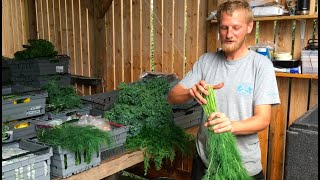
Richard Perkins tours his farm in early August, describing abundant harvests across the market garden, poultry, orchards and nearby forest. He highlights current crops (tomatoes, lettuces, beans, chard, onions, beets, cucumbers, berries), seasonal workload (harvesting/post-harvest dominates), poultry production practices (brooders at 31°C, ~1,000 birds slaughtered over three weeks), and tools/ideas for scaling (berry harvesters, potential additional eggmobile). The video also covers team dynamics, forage mushrooms/berries, and reflections on autumn coming.
Questions this video answers
August 8, 2019
31°C
About 1,000 birds, slaughtered over three weeks
Approximately €1,500 to build; estimated about €130,000 of eggs
Over 50,000 subscribers
Chapters
Well, things are abundant and this really is the season of the harvest. It's time to be harvesting off the farm and from the forest, the berries and the berry bushes in the field. So let's have a look at how the farm's looking at this time in early August. So Joachim and Joe are rocking out the market garden, doing the extra busy week this week. We have some incredible veg. Got tomatoes coming out the tunnel, beautiful head lettuces, spring onions, herbs, different coriander and organas. We got salad mix completely coming up. Had a shortage of that for a week or two, which is unusual here. Dill and parsley. We've got courgette flowers for the restaurants. Beautiful kale, beautiful colorful beets, patty pan courgettes. Mixes of carrots looking fantastic. Beautiful chard bunches coming out now. Rainbow chard, very nice. More onions, more carrots, loads more spring onions. Beautiful radishes, peas, beans, massive cucumbers coming out of the tunnels, lots coming out there. Flower boxes, more herbs, more beans, romaine lettuce. Salads up here too. So we're just packing now for the second Rico day. You guys, you've only been here how long? Two weeks, Three weeks. This is the third week. Third week. And you guys are smashing it. How do you like working in the market garden here? I like working in the market garden here because there is no weeding to do. All produce is great, top quality. Do you second that? Yeah, second that. I'd also say I really like the kind of environment of working, living, eating together. You really get a chance to gain a skill set quite quickly in a short amount of time. So not to disturb you too much, but we talked about, like, how little time goes into, you know, lack of weeding, that sort of stuff. But what would you estimate the time input is for harvesting and post harvest? It's like 70% of the time it's harvesting, post harvest. At this time in the season? Yes, at this time of the season. And so the other 30% is seeding, planting, and then doing little projects here and there, learning how to do handstands and stuff. Well, it's thunderstorms. Today. Nice to hear some thunder and lightning. Quite refreshing as well. Temperature going down. We can. You can see things are looking grand. And it's really down to just harvesting and post harvest. Now, earlier in the season, maybe 40% of the time is on post harvest routines and a lot of crops going in and bed maintenance going on. But this time of year, it's pretty much all about harvesting and then occasionally turning beds Over. I think the peas are going to have to come out soon. We've been cropping them for many weeks now and we've actually left some on the vines because we have, you know, significant overproduction. Beautiful autumnal feeling coming now and turning some of these beds over to make room for the last crops of the year. It's going good in the caterpillar tunnels. Someone posted a comment about these sticky traps for insects catching bees. To be honest, I've not actually seen bee in any of them, but you do get a wide variety of insects and the aim of these is to be able to identify what sort of things are coming into the garden so that you can act accordingly. You know, for biological pest control. We've been taking an abundance of courgettes out of here and chard, lots of beans. Just got a cacophony of beans that we haven't been able to keep up with hardly. Well behind the dill flowers still got a lot of beautiful parsley, kales under insect net, all the carrots and a few beds turning over now. Got lots of beets and longer term crops like that in here. Peas at the back will be going out soon. We've been cropping peas for so many weeks now. Sheer abundance of it and amazing spring onions that have held all the way through. We stopped growing normal onions this year and we started just growing spring onion multi sown in the paper pot. You can see this bed harvested today, but it allows us to get a couple of thousand onions in the bed. You can see just harvesting whole rows at once. Just incredible, amazing onions. We've been having those purple varieties but no hindrance to growth grown like this. It's what the paper pot was designed for. And the radish. Yeah, the radish I think is a problem. So is there a possibility to grow? So see what's growing in the tunnel in the lean to. Sorry. Got bunches of kales. We're growing Nebraska's on in our old 64 cell trays. They do a lot better. Pak Choi got some beets. These are in 144s, the smaller little cells and more kales. We've got some turnips in the paper chains because they do really well. Multi sown in there. More lettuces, more turnips down the bottom here. More Hakari and we've got Mitsuna and Rocket going out. So we've got beds of these that don't have any flea beetle damage finally, which is great. More lettuces, more herbs. Looking nice. Well Here are the grapes in our handmade root trainers. No problem with drying out? No problems at all other than a lot of fat hen growing out the sides of the pots. But I don't really mind that. I'll pull them out in the winter time, I think. But the grapevine's doing fantastic and they seem to be working really well. Very happy with that. Some of these have even got grapes on them. Would you look at that? No flea beetle. No flea beetle there either. So eggs and chickens and things getting packed. Where are you off to today, Gustavo? Going for the Rico in Torsby and Sune, which is like a lot of stuff and a lot of stops on the way. It's a lot of restaurant customers too. Yeah. It's gonna be a full van. Yep. How do you like doing the drop offs? It's quite fun, especially the Rico because you talk with people, these women coming over and yeah, it's fun. Quite stressful, but it's really fun. You've been doing that with James this week and got it down. That's also quite fun. Here's James. Just had a shower for you. Oh, nice. James is going on rico. How do you enjoy going on the Rico's with Gustavo? It's a beautiful moment. An extended moment every week. Two times a week, in fact. There's no one I'd rather spend Rico with than Gustavo. You two have quite a time, don't you? James came here for. You came here for the market garden post and for the. And the poultry course. Yes. And he's still here. He's just hanging on. Can't get rid of me that easily. So the chirping sound of happy chicks for the second round of parsley boilers. Very nice and warm in here. So they're up at 31 degrees under the light. Not hard to heat. The building up at this time of year can be a struggle at the start of the season, especially if we're really pushing six batches, which is as much as we can do in a season here because we're slaughtering over three weeks. Typically we'll do a thousand birds and slaughter them over three weeks to average out the weights and the differentiation between males and females. But they're looking very nice. Gonna raise these in both the roller pens and the salads and style pens right from the beginning to give the next group of interns a chance to see that. But always nice to have a happy, calm brooder. Well, the turkeys are certainly growing up large now. Some of the toms here looking pretty big. We decided to Save these guys on until they're pretty big because we're going to spread smoke the birds and separate the breast meat and do some different style products with these. Sweden's not a country where people eat so much turkey. You can see the toms really get the blue in their heads and develop their little shaggy chins and they start to make their gobbly sound. But they don't really do it on command. No, they won't do it for me. Look at the pears on this young tree. Tree is getting weighted down with fruit now. Looks fantastic. This is hinamaki red gooseberries. We've got a bunch up in the other fields. So behind these hydra honeyberry bushes we've got red currants. These are ready to harvest now. Just an abundance of these will be coming through here in the next days. Just thousands of these bushes. Black currants, red currants. The red currants actually end about here and turn into these beautiful black currants. Really nice variety. Spen Lomond does really well here. Quite big, luscious berries. Gonna have to get in here and start picking. Down at the bottom of the tree lane here in Thumpfield we've got these chokeberries. They're still small. They will swell out over the next period and they become sweeter after the frost. But I'm considering. I said in a previous video that I might start replacing hazels that we lost through drought up in top field. They're on the back of the row facing. There's berries on the front and taller trees like fruit and berry and hazel on the back of the row because it's kind of east and west facing. I'm thinking of replacing those hazels with aronia because they do so well. These are from seed a few years ago and they're prolific now. They're not the nicest berry, but they make excellent jams and things. And that's a much better way for us to sell berry fruit because we can store it over time, ease the sort of workload and storage of that product. Hens are doing fantastic. They're at the bottom in nutfield here now you can see all the nut trees clearly sticking out of the flattened grass. Different chestnuts, walnuts, pecans. Hens think it's feeding time. So they're coming towards me now. But they've been laying really well and good eggs. And Gustavo has mainly been in charge of them this year, which is unusual for me. It's typically been my role. Healthy ends, healthy eggs could easily sell double the amount of eggs you'll remember. We Scaled down poultry this year just because we had such a bad drought last year that you see in videos from a year ago. We had about 115, 120 days without regrowth of grass. But you can see the grass has picked up great. We've grazed several times over it this year and save a few odd patches. You wouldn't know that we'd got hammered last year with such a drought, but yeah, happy with the hens. It's. It's interesting because now we have access to the neighbor's land. We could easily double the eggmobiles. We already have three eggmobiles, but we could build another one for about €1500 and we'd be doing about €130,000 of eggs. And that's something to consider. It's an easeful enterprise and it does wonders for the grass as long as you're not overstocked on your grass. Cows and sheep up here, they're on quite short grass. It's only just recovering, but it fits the time plan and they're very happy to be on this after they've been on the roughage over at the neighbours. Lots of these hinamakers, gooseberries on the edge of this row. Strawberries are just nestled in for the winter now they've finished their production and so they will just sit until they get weeded next spring. And then hazels and more berries on the rows. We've got hazels on the bushes for the first time this year now. It's barely a crop, but it's nice because the wild hazels here haven't been fruiting for about a decade, according to the neighbour. Lots more currents, but so many bushes in this field. We need to be running through here right now in the next days and harvesting these while they're in perfect condition. Well, it's super nice and really relaxing and reassuring that we. Feels like we finally have a really nice team flow for the first time this year. Things were a little hectic at the start of the year with some people issues, but also having the internship was pretty hectic and it makes things a lot more work. Having too many people for a job is so much more work, especially for me as an organiser. It's, you know, I much prefer working efficiently with a skilled person in the right frame than lots of people. It really slows things down. Of course, that's part of the educational offerings that we're creating here. But it's. It feels really different now. We have a really cohesive team. Everyone's relaxed, engaged, knows what their roles and responsibilities are. And we just seem to have like an effortless flow for the first time in months, which is really nice for me because I was getting pretty exhausted. So looking forward to rolling through into this second half of the year. I really love autumn time. The heat's going now. It's going back down to between 12 and 18 degrees. So it's going to be know pretty autumnal soon. Cooling off dramatically and quite wet. It typically gets really wet in September and that's often the wettest year. But you never know, things change year to year. These beautiful cows. So nice spending time with cows. I can sit with them for a long time. Sheep are still a little bit sheepish, as it were. They tend to keep their space, but they are definitely up on the morning moves. I'm just moving on my own and often moving big distances between paddocks without any fencing. And you know, they always end up in the right place pretty easily. This is the inheritance plantings. I like to call them chestnut and oak. Chestnut oak. That's a red oak or chestnut Oak. Chestnut. These are from seed. And there are a few hundred wonderful hardwood trees up the outside of our fence just utilizing this unused space on the side of the road. Talking of abundance, there's time of year now where we can come out here, a few of us for the morning chore time, 6:30 till 8 in the morning and we can come back with 50 kilos of mushrooms that we can then eat fresh, dry down and store over the next year as well as all the berries. We'll have a look at the tools we use to collect berries. We're not going to pick them right now, but very efficient tools for making hand harvesting really quick and efficient. And we always put forward a few hundred kilos of berries to eat through the next year to replace what's been feeding us for the last year. So I'm just up in the forest just behind the house and this is other end of Nutfield. But this is the time of year for the abundance of the forests still summer chanterelles. These sell for about €35 a kilo here. Now this isn't the best picking spot, but you can see there's a bunch of them. We get a lot of what's called Karl Johan in Swedish is the porcini mushroom. This in a cream sauce with fresh elk as a stake, braised lightly on each side. That's the ticket. So this is your typical berry harvester that I'm sure many of you are familiar with. I use these double Handed. For picking blueberries, you can sort of comb under the branches and they collect inside here. Picked them up second hand for like €1 or €2 here I've got a whole load of them. But the thing that's really epic is this little vacuum Ventura. And so this, you basically stick a vacuum cleaner on here, pour in berries with leaves or whatever in them. Berries fall down, leaves are sucked out. That thing cost about €25. I think it's from Finland, game changer for harvesting wild berries. Someone asked about the mushrooms and I didn't really get to respond earlier, but these have basically been soaked after the first harvest. This is Indian mushroom behind me and they've just been left outside kind of neglected. But you can see there's a really nice second crop on these. Well, with all the blueberries as well. I remember a couple of years ago they were saying There was estimated 50 million tons of blueberries that wouldn't get harvested in Sweden. All the forests here are just abundant with blueberries. And also cloudberries we get in our local peat swamp, which is almost like a raspberry, but orange coloured and pretty unusual. And we also have lingonberry or cowberry, which is used to make like jams for meats particularly. But it really is the season of the harvest. It's an abundant time of year. Personally, I think it's actually my favorite time of year. This cusp of turning into autumn and the mist on the meadow and just the sheer abundance. I've said that many times before, but it's a season where you feel kind of stupid for farming just because the sheer amount of fish in the lakes, the sea, the food in the forest running around or lying around under your feet, there's just sheer abundance. And it's a time for rejoicing. And that's why harvest festivals always came, I guess. It's such an abundant time to give thanks and, you know, really cherish the beautiful systems we've created and also the world we inhabit. So I hope you found that interesting to get a glimpse of the farm. I'll be doing some more detailed updates as we get back into the swing of things after a little break in the middle of the season. But thanks so much for watching, folks. I appreciate getting us over 50,000 subscribers. That's a milestone and thanks to you all. And I appreciate the measured and controlled and calm way that people engage with the channel and, you know, the respect that's fostered here. I really appreciate and value that deeply. So thanks so much. Keep on keeping on. See you in a video soon. Bye for now.
More from Richard


A review of short and intensive season on a mixed farm and restaurant/event space in Sweden






Alskade Kyckling Exploring complexities of poultry production in Sweden and what we stand for


