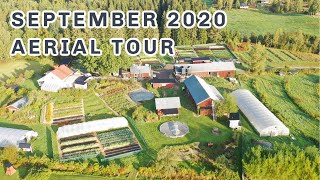
Richard Perkins presents an aerial flyover of his farm in mid-September, reflecting on seasonal change, farm management choices, and future plans. He discusses bed-closure practices (composted chicken bedding, geotextile covers), selling/retiring equipment (caterpillar tunnels, Yeoman's plough), grazing rotations across paddocks (K1–K3), nut and market garden recovery, ideas for translating his regenerative agriculture book (Polish, Spanish, German), experimentation plans (poultry breed/feeder trials, eggmobile design), and personal notes including passing the Swedish class-one weapons/hunting test and recommending drone use (Mavic 2 with Hasselblad camera).
Questions this video answers
September 21, 2020
DJI Mavic 2 with Hasselblad camera
Swedish weapons license, class one (rifle and shotgun)
Yeoman's plough (sold to a farmer in Norway) and caterpillar tunnels (being sold off)
Chapters
So it's early morning in mid September, thought we'll do an aerial flyby and show you what the farm looks like right now. First off, I want to say folks, thank you so much for the support and words for the last video we put out, including a lot of private emails and a lot of thoughtful response and thank you so much for that.
It's been emotional whirlwind recently and really.
Trying to dig deep into our changing contexts and things that need addressing here for the longer term sustainability. And yeah, I think I could write a whole book on the thoughts that have been going through my head. But yeah, I won't say so much more about it. I think a lot will change in coming times and I will let you know and I know a lot of you are interested in the processes and I will talk about them as and when I feel moved to. But yeah, I'm not sure what what's going on yet, but some interesting things.
Going on in the background and I'm.
Excited about a few avenues that I haven't been talking about recently that I'll share with you in coming time. It's been amazing to just be going through the farm like a hero experience. I've been really enjoying just seeing so many perspectives and that's been so stimulating to reflect on our context and our function here and moving forward different pathways that could be open to us that I guess I'll share more about over the wintertime and really excited to be exploring the possibility of the first translation of regenerative agriculture. I want to work with Pavel, our friend in Poland who helped with getting the printing of both my books sorted and he's an amazing young man and the perfect person to work with with his collective quick thinking mindset. So we're thinking to translate the book to Polish and I just had an interview yesterday with Thomas from Labruski Angus, who was here on the four day course that we ran recently and he's very excited for it to be translated to Polish too. He's actually working on translating you Can Farm by Joel Salatin and there's just not any literature in Poland so I can't think of a better team to work with for that process. And we've already got people that want to translate it into Spanish, etc. So hopefully this will create a framework that allows us to start translating it into other languages. I think German is a next favorite after Spanish perhaps.
But anyway, thank you folks so much sincerely.
And yeah, we are okay and we will be learning letting you know more what's going on in coming weeks. But let's get on with the aerial tour.
So the landscape is really turning into its autumn colors now.
Trees are turning to yellows and reds.
Around the village and things are slowing down. It's been a while now since we slaughtered the last broilers. So the farm is really quietening down and a lot of the beds are being covered up now you'll make out in the market garden. We're putting the geotextile down this year and that's really critical because we had a lot of young spruce trees come up in the beds this year. And we think that the spruce trees had an abundance of seed because of the drought year two years ago. And because we failed to cover the beds last winter, the spruce can be releasing their seed really early in the season. And so we think that it's wise to have those covers on. But the gardens have been doing great. We've had great sales this year and interesting to be covering the beds up now with the compost from the chickens. So just to the right of the big tunnel here, you can see the winter bedding just between the windbreak there and the winter tunnel. And that's been what we're putting on the beds. So the bed closure is basically cutting out crops, leaving roots in the ground, putting on a layer, a few wheelbarrows of the composted chicken bedding that you see in the frame there. And then that's been broad forked. We haven't broad forked all season, but we've board forked that in. And then we've covered up with the geotextile. So we're still selling veg till the end of October. But this is an incremental process putting beds to sleep. You'll notice the biggest change here is that I've taken the caterpillar frames down and I'm selling off the caterpillar tunnels because we have two big tunnels for spring and autumn season extension. And I think we can fully utilize them in a better way that we don't actually need those caterpillar tunnels. So I decided not to use them next year and therefore pass them on. And if we need them again, we can always get them back. And as with primary seller of them, it's not an issue to get replacements again if we want to. But I would like to focus on outdoor growing and optimizing that. You can see as we spin around here, the cows are actually now up on the neighbor's land. This is what we call K3. And they've worked up all of this patch, the first sort of block that you see in the middle of the frame. And now they're heading across the neighbour's land and they'll be on their way back down again. Now this field is getting ploughed up to reseed with grass, which is a strange consideration. It's kind of what people have been taught to do here is every few years you plow up your land and reseed it with grass to have better pasture and probably typically put MPK fertilizer down. Now, we've obviously demonstrated that that is not necessary and there are much more effective and profitable ways to improve the ground. But, you know, this is the cultural constraint. And if someone has done that for 50 years, it's very hard to convince them otherwise. And we're not in the business of convincing them. You know, we've got the benefit of all our winter feed off this land. So this is K3 and then in the background there, K2. And then in the middle of the trees, coming into the center now is K1. So we grazed that more recently. So our plan right now is to graze down this field. And then we were supposed to be going back to nut field, which is nicely recovered if we swing around over here. But perhaps we will leave that till last. There's no harm in leaving that. So the natural order now would be to graze back through all of this land, but we'll see how we go with that. We've got so much winter feed, more than we will need, and the sales prices on that won't be very good this year because it's been an abundant grass year. Maybe we'll buzz down and see the cows, don't want to disturb them too much. But you see, this pasture is totally fine, actually. And it's not a decision I would have made, but it's also not a decision I would try and influence. It's just the cultural conditions we're working within. Beautiful sunrise. We've been getting frosts. Now just zoom up that you get a look down towards the lake. You can see the birch trees are turning yellow. And this year has really flown by really fast. It's been a strange year in many ways, and I guess it's been a strange year for everyone, but things have gone remarkably well considering all circumstances. Interesting. As we fly back over, you see that section of the windbreak that I'm moving towards is so much more abundant growth than the rest of the windbreak. And that's because there's water coming out the ground there. And Front field can be particularly wet because it gets all the runoff off the roofs of the barns. And because of the shape of the land, it sort of flows down the field towards that second pond that we have there. So another cultural thing is the neighbors have been hinting that they would like this cut down because there's something about keeping land open and obscured views. And it's an old cultural thing of, you know, recognizing how hard ancestors worked to clear the land from forest. But we've, you know, expressed that this is a functional windbreak that protects, protects the tree crops inside. And we're not actually willing to cut that down because we put it there for a very good reason. And it's doing a very good job at that. And my intention is to keep blocking the land up in smaller and smaller blocks to improve our season. So this is the composted winter bedding and that's just been sat in this windrow all season now. And it's quite nice stuff. It's a bit lumpy looking there, but once it's out on the bed and raked out, it's very granular and will make a really nice top dressing that will sit down over the winter time. I'll just zoom over the gardens now. Yurts have been down for a long time. As we go over south, you see some of these blocks going closed off and protected for the winter. We're talking about putting all of the east and west into perennials. So we've got asparagus and flowers on the right hand side of the picture. But we're thinking to put these beds, which we call the west beds, into perennials as well. Things like chives, etc. That will give us some early morning crops. And that's because those beds get very dry and very hot and we don't need the space. You might hear the drone whirring in the background, but as we fly over the old and new north, you see how many of the beds are now covered up and we've started to use the compost. If I just spin round here, hope it's not too dizzying for you, but these compost bays have been a really great addition. So we've been actually using the compost out of the middle bay to put on beds. And you can see the left and right bays are quite full now and they will be totally full by the time we've put all the garden waste in. It's been a shame not having pigs this year because they are by far the best way to turn veg scraps into Something useful, something else we've observed if you watch closely as we fly along the forest edge here, see the leaks here in the far left there near the trees. We've noticed that although we cut along the edge of the beds with a spade, the roots of the trees are obviously deeper than the spades depth and they're affecting growth. So we need to find a way to really cut down, you know, probably 60 centimeters along the edge of these beds to eliminate tree roots because they're really sucking water out of these beds. You can see the same going on here. So that's a little task to do. Still a lot of beautiful veg going out weekly. Very tranquil morning. We've done our hunting tests. Alex and I went off to meet our friend Joe near Stockholm and did intensive English language hunting test over two weekends. And we passed that. So I'm now certified to shoot class one rifles and shotguns. My intention is not to join the hunt so much as to take a deer off the back of our land. Probably in the section in view up in the forest paddocks. Just to have some wild game in the in the freezer for the family.
I'll roll on a few clips from that now. Chickens in the freezer. We're off to hunting test and just taking some smoked chicken and pulled chicken with us. Smoked chickens.
I got.
Okay, we're at another range for test theory test today. Everyone's still going to. I finished mine. I got four questions wrong. You allowed 10 questions wrong. I think the translation into English is not particularly good. But I passed. So ready for shooting tests. So this is one precision test with small rifle. 50 meters. Got to hit them all in a tight grouping. Standing and sitting. Okay, I'm number one in this group. So I'm starting by sitting, shooting. Not sure if it's going to allow us to focus in on the range 50 meters away. I'm shooting number one on the downstairs target. As Joe's goes. He can do standing, kneeling or sitting. One, two, three.
Oh, nice tight grouping there.
4.1234. Okay. And it's up one. Okay. Long day. I have passed my Swedish weapons license, class one weapons. So I can now shoot class one rifle which is good for moose or elk we say here. And deer, wild boar, etc. As well as shotgun for things like roe deer and smaller game. So long, long day.
Lots of waiting between shots.
There's all different gun ranges in the forest here. Alex was a supersarp shooter and I guess he grew up playing a lot more computer games. And Joe and I had a harder time certainly with the shotgun but with rifle I'm pretty confident. Long time in waiting around and lots of shooting practice but quite fun and yeah really enjoyed doing that course and met a bunch of great people doing it. So that was awesome. So yeoman's plough is off today. I've sold this to a farmer that was here on a training in Norway and I'm a bit attached to it emotionally because of my work with keyline planning. But we will never use this again at this farm. It's absolutely unnecessary. Typically only use this two or three times and because of our grazing and intensive poultry just we're away, we don't have any need for this. So it's better it goes off. I originally bought this because I was doing regular work in south of Europe and thinking to go and do design installs using this bed former as a tree planting rig. But Jesus is down there, he's a topographer and has a keyline plough down there. So there's no point in me going with my higher day rate from up here in northern Europe. So a big momentous day. It's see this move on. But I hope it will do some great work in Norway and hopefully will be available to others to rent out and to keep this work going. It's an incredible tool if used correctly. And that's the thing is there aren't so many people around that know A how to pattern landscapes and B how to check the soil is in the right condition to use it. Okay, off to Norway with the roller. Also Bjorn, what are you going to be doing with it?
Going to be doing some plowing for the benefit of the soil and the animals.
You're building a slaughtery over there, building a slobbery.
Going to do the controlled grazing with the hens, chickens and the cows.
Nice.
Yeah.
A beef.
Yeah, more like your. I have this novation extinct, threatened like dual purpose breed. Yeah, yeah. So been out conquered by the Norwegian standard cow. Yeah it's now the six breeds in Norway. That's like your like the.
So hopefully this is going to get some awesome use and Bjorn's going to do university conducted tests with soil building with egg nutrient content and all the likes which sounds awesome.
The hens are still on their way down top field and you see Eggmobile 1 there has been getting repaired up. Just making sure the wheels are good. Some great growth on the walnuts there. Something that's excited me is I was talking to cattle who you'll remember from the farm like A hero experience who automated the Ridgedale style eggmobile. Something we talked about while he was here on the training recently, was getting a few people that are into pastured poultry together over the wintertime and designing an eggmobile that really responds to the difficulties some people have had. Taking this model in different parts of the eu, where scratching space underneath the wagon is important to make these structures bird proof, sorry, bird flu proof, where you'd have to keep the birds indoors because that's a problem that's likely to become increasingly apparent. And what we thought about doing is taking the 40,000 Euro German models and putting better nest boxes in, but making them homemade and seeing if we can't make something for about four or €5,000 and then blueprint the plans so that people can have fully automated, optimized, really time efficient eggmobiles that they can build themselves without investing so much money. That sort of project really excites me as we pan over nutfield now. See the great growth of some of the nut trees here. So this is walnuts of different kinds, sweet chestnut, pecans, hickories. And the field has recovered very nicely. As we fly over to the far top corner of the farm here you see where the boilers were last and there's some incredible regrowth there. And I spoke to some of our former interns and core team in good.
Heidelhof on the farm, like a hero experience.
And they are raising breast chickens as broilers and seemed very confident about the numbers, although they're able to sell to chefs in Hamburg at €18 a kilo, which makes it seem far more realistic. I don't think we could possibly sell birds for that much, but that's interesting to me. So another thing that got me excited was doing a lot of experimentation again next year and getting excited again because part of my issue has been repetition. I'm an innovator and needs constant creative stimulation. And whilst a farm can do that in many ways, I feel like I want to have time and space to get engaged with things that new for me, for my learning. And yeah, it's been a big thing because I feel like I know how.
To run all the things that we.
Run and spend my time teaching others to do it. But it would be nice for my own process to do new things. So I thought about doing some comparative trials with brass with the standard boilers and red ranges and doing really extensive detailed feeder trials and yeah, just putting that information out to the world to see what options are there and really put the numbers together because I think that would be super beneficial and interesting for us. Something we've talked about is exploring different breeds of laying hens to more robust traditional breeds and just hovering over the turning circle here you can see this on the right is our land where the rams were recently and on the left you see the neighbor's land still with brash. I've brought this into frame so many times, but it's always a pleasure to see. We actually got the sheep up in the forest patch here just for a short time. I've been seeing elk up here every day, but not so much to do up there other than get pigs engaged. And I've been curious. I've seen Kunikuni is for sale in Sweden now, so I'm curious to try a mini pig like a Kunikuni and certainly missing having pigs this year. And I really enjoy to eat bacon. So not just bacon but pork in general. So considering having small amount of pigs. But yeah, pretty interesting having lots of different ideas all over the place and considering different ways that could support us to move towards our changing context. Which I can talk about another time. Plenty of water recently. It's been a very wet end to the year. Pond is totally full. It could do with a clean out at this point and take out some of the pond plants. Okay folks, that's it for the flyover. Hope you enjoyed seeing the farm from an aerial view throughout the year and seeing some of the clips from the air. It's always great to have that perspective.
And just see things from above sometimes.
I've thoroughly enjoyed having a drone and I really recommend if you have the opportunity. In the cache I use the Mavic 2 with the Hasselblad camera. It's an exceptionally good quality camera and the things that you can see from above that you can't see on the land have been. It's hard to explain how but they've been very critical for management decisions and it's also a fantastic way to share your land and farm with your customers, etc. It's a really important tool and can also obviously be used for intensive mapping through drone deploy and other online technologies like that.
But yeah, thanks so much folks for.
Watching and don't forget you can find out a whole bunch more in the links below. We have Start the Right Farm our short online training out and we are organizing and reorganizing our full signature online.
Training that will be running as a.
Live event over the winter.
Details will come out when we know.
More about that and you can find out a whole lot in regenerative Agriculture, our book, which is available from the Farm in the links below.
See you in a video soon.
More from Richard


A review of short and intensive season on a mixed farm and restaurant/event space in Sweden






Alskade Kyckling Exploring complexities of poultry production in Sweden and what we stand for


