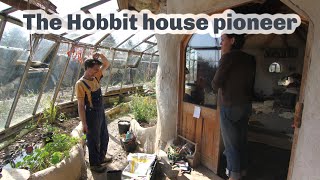
Simon Dale (speaking about the Lammas Project) describes building his third family home using locally sourced materials (stone and clay from the site, trees from nearby woodland, straw-bale insulation, and reclaimed glazing/greenhouse). He explains the brief timeline (built over a few months, with finishing later), gives specific modest cost figures for components, and situates the design within permaculture principles (multi-functional elements, integrating house and land). He contrasts this DIY, low-tech approach with the mainstream construction industry and argues that regulatory and planning systems (even where sympathetic, e.g., one-planet/low-impact policies) impose heavy paperwork burdens that impede alternative, sustainable building.
Questions this video answers
£1,200
£600
About £800
About 50%
Chapters
This is. This is the first building that we built here at the Lammas Project. It's the third home that we've made for our family over the last 10 years. Moved here in the summer, built the house through the autumn, which is now two years ago. Took us about two months before we moved in, with a fair bit of finishing off afterwards and put the greenhouse on the front afterwards, the following spring. We've built using stone that we've excavated from the land here. When we levelled out the site for the house. We're also using clay that came from the same place, using trees which come from the woodland. One field away from here, we used quite a lot of scrap for wiring and for plumbing and so on. Scrap glazing all round. We've got an old greenhouse on the front here, which we dismantled from old botanical gardens who were moving, which gives us growing space which is attached to the house, which is also living space and gives passive solar heating to heat the house whilst the house keeps the greenhouse warm. Our design is very much informed by permaculture principles. So we're. There's an example of one element serving many functions. And we tried to incorporate all those sorts of principles throughout our design of the house and the land and to try and integrate those two together as much as possible. So the boundaries there are a bit blurred, like growing some of our food inside the. You know, inside the house and bringing some of our living outside the house. Ended up spending 1200 pound on the roof liner there, about 600 pound on. On straw bales which we use for insulation in the walls and roof, little bits on things like lime and sand for rendering and odd plumbing fittings and things to make things join up. And a landscaping bill of about 800 pounds, I think it was. So all around the world, people are now, and have been for most of history, building their own homes. And they've been doing it not entirely on their own, they've been doing it with help from their communities. They've been doing it informed by local vernaculars and traditions of building and using those patterns encoded in the way they build, to ensure that they do it well and make buildings which serve them well. Our modern construction industry in this country is something quite different to that now. And I feel I'm really fortunate to have come to building not as a builder, not as a carpenter, but just as a layman, if you like, who is looking to provide shelter for his family. You know, it leads us to that short route between what's our needs and what are our resources. How do we match those? That's not what drives the construction industry. That's driven by. It's an industry, it's there to make money. In some ways, the more convoluted the process can become and the more complicated, the more opportunities there are for process profit along the way. And so that's the natural direction in which it travels. Building industry accounts for massive amounts of our energy usage, both in the operation of buildings and really importantly and often overlooked in the construction of buildings as well. Something of the magnitude of about 40% of our energy use is going into buildings. If we are going to make some kind of transition to a low carbon future, if you like, ways of doing things which are not more positive for the planet as well as socially, we need to look amongst everything, we need to look at the way we build, the way we live. So I feel there is a real value in not just what we've been doing, but all those people out there, you know, people in Britain who making themselves little shacks and satisfying their needs without making a big impact. And we need to look and learn to the rest of the world and to those traditional vernacular building methods which go on around the world. The obstacle for us now with this is that we're meeting the system, if you like, we're meeting regulation. And I think in my mind now, it is really a key issue for anybody who's looking to live in an unusual way, in an alternative way in order to sustainable goals, is that our society is governed by regulations and the function of those is to stop bad things from happening. You know, as such they do, but by their nature they support the status quo. And as well as stopping bad things from happening, they stop good things from happening, you know, depending on what you perceive as good and bad, obviously. So when we come along and we make a building like this, which doesn't use masses of plastic, doesn't have high tech extractor fans and heat exchange systems, it's running contrary to the conventional building industry and also the direction of green building or sustainable building, which in the mainstream is one of really focusing on the operational elements of the building only. So you can invest a lot of energy into the construction of the building, put in sophisticated heat exchange systems which are going to save you fuel use in the longer term. But there's very little acknowledgement of what goes into creating all those systems there. Since its inception, Lammas has been really involved in talking to the regulatory authorities, particularly, you know, in our case to the Welsh assembly, particularly. And there has been this development of planning Policies for this type of development, which is great, you know, low impact planning policy, that one planet planning policy, in many ways that's a massive step forward. It's giving somewhere within the system a legitimized place for people who otherwise were marginalised by their want to live a sustainable life. Despite having these policies, there is still an immensely onerous amount of paperwork associated with them, which is proving to be a restriction on the people who are actually going to take it up. And I've got friends who started to operate under these policies and who've got given up because they just can't take the fact that they have to put, you know, interpretive signs around their site and they have to run the drafts of the text for those explaining what kind of trees are growing here to pass the council before they're allowed to make the signs and put them up. You know, they can't cope with measuring how many kilograms of carrots they harvested off that bed and how many kilograms of Swedes they harvested off that bed. Putting that all in for their annual monitoring report along with how many miles they travelled on trains that year. You know, there's a burden of paperwork there which for us has occupied maybe 50% of the time that we've been working on this land, has just been about reporting it and monitoring it and making sure that we are doing what it was that we set out to do. You know, like a lot of the issues of our modern society, there's a big element of the what is not quantified? What do you not measure? When you measure things, what is it that you're not measuring? That's the important thing. And I think that that also plays out saying this building regulations thing that we just talked about a little bit, the building regulation system there is addressing certain areas of concern quite reasonably. So really it's addressing is this building safe enough that it's not going to fall on your head, that you're not going to get killed in the fire inside it? And that's fine. But by virtue of identifying, if you like, a sphere of concern, there's also things which lie outside that sphere of concern. And the more we focus on those things inside the sphere, the more we load impacts outside. So the need for ventilation in the building goes as far as especially assessing how much air changes is required to move body odour of people so that I can protect me against the hazard of smelling my wife's body odour or something. You know, the cost of that is possibly in some cases the installation of ducting and fans and so on which are coming. They're produced with fossil fuel energy. They're using minerals from other countries. The consequences of those things are not considered. You know, there are externalized and safety risks and consequences there which are not considered. So I think what we're trying to do with this is not that we're trying to ignore our own health and safety concerns, you know, because of course, you know, I don't want to, don't want to kill my children. I want to make a good healthy living environment, but also I want to acknowledge all of those externalities and to do that in a quantifiable way would be non impossible. For starters, I can't compare carbon to toxic pollution because they're not equitable things. At some point there I've just got to make a gut decision, a qualitative decision, if you like. This material doesn't feel good to me. You know, I don't need to maybe sit down and spend two weeks doing full life cycle analysis and assessing where it came from and every stage of it, putting carbon outputs on each one of those. You know, I can, I know that, you know, I've got my own knowing and I'm going to believe in that and operate on the basis of that. There's all these inspiring examples of people, people who inspired us to come this way, who have just set up and started doing their thing without asking for permission to do it. And they've been, I think, hugely successful. I mean, they're marginal projects and they're not going to change the kind of ecological impact of our whole species. But they have been really inspiring. They've developed and are continued to develop ways of being which are intelligently designed to work in harmony with nature without putting so much load onto our resources. There's a freedom there. There's a really big freedom there. We, that's how we've lived before we came here, you know, and there's some element of insecurity in it, but there's also a lot more freedom. It took us nearly five years to get the planning for this okay, which was, you know, which was hard work and it was a large amount of paperwork which not everybody could cope with doing. In fact, I think it take really exceptional people like we have here in this project to take on that sort of challenge. So as I understand it, the planning system in this country operates that you are allowed to do whatever you like. If there is a problem, if some of your neighbours or anybody thinks that you're doing something which is unjustifiable, then they can go to the local authority, they can make a complaint, and the local authority, through the planning system, will effectively come in and arbitrate whether that's a reasonable thing to be doing. That becomes a retrospective application rather than a prospective one. Whether it's retrospective or prospective is not meant to influence the judgment. It should be impartial. I think the reality for projects of this sort of type is that what we're actually talking about doing is so foreign to the majority of people who are making those decisions that they don't understand, possibly the need for it, and even more likely the actual form that that solution is taking. So I think for all the people who have been doing this sort of thing, there's been a massive advantage in getting on with it, because then when it does come to the stage of planning, they've at least got something to point to. You know, look, this is what. What it is that we're doing, and they can overcome lack of understanding and lack of trust by doing that. And for a lot of people, it never even comes comes to that. And where we lived previously, we were on good terms with all our neighbours and people knew what we were up to, but nobody had any problems with it, so we were allowed to continue, which is a great thing. You know, maybe that's a prestige of common law. I think that does remain a really important route for a lot of people.
More from Richard


A review of short and intensive season on a mixed farm and restaurant/event space in Sweden






Alskade Kyckling Exploring complexities of poultry production in Sweden and what we stand for


