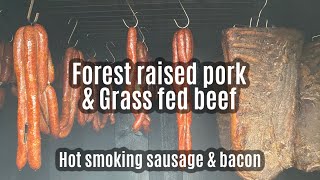
Richard Perkins (Ridgedale Farm) presents a YouTube video showing him smoking sausages and bacon while updating viewers about a large cookbook project (a third manual in a trilogy). He explains the smoker setup (a low-cost smoker with an electric sauna heater, built to handle ~50 pastured chickens), describes multiple sausage recipes and curing/smoking parameters, demonstrates monitoring with a digital remote thermometer, and outlines the cookbook's planned contents (700-page farm-to-fork cookbook covering recipes, preservation, catering, sourdough, wild foods, and no-vegetable-oil approach). He also shows fruit dehydration and on-farm daily life.
Questions this video answers
About 6–7 days.
About 2–3 days.
Salt 2.5% and sugar 1.5% (brown sugar).
Sausages: about 68°C (he also references 62°C as a target in places); Bacon: about 62°C (mentions cooking bacon to 62 and later measured bacon at various stages).
Built for 50 pastured boilers/chickens.
Chapters
Welcome back to another video, folks. It's been a while, hasn't it? Let me tell you what I'm up to. Hey, turkeys. Okay. Look at that. So those of you that follow along with the farm will know it's been a lot of changes in my life and I've been learning to take it a little bit easier. Although I'm in the middle of writing a very big cookbook which is turning out to be a mammoth project. It's involving four other people coordinating all of that and putting together a comprehensive third book in the trilogy coming from Ridgedale Farm. So that's taking up a lot of my time and I'm just spending a lot more time with my kids and really enjoying getting in touch with the food that we've been creating here over the years. Some of you will know I've wanted to make a cookbook for five or six years now and it's just never worked out. I've tried to sort of open that possibility up for some of the people coming here. So I decided last summer just that this is only going to happen if I kickstart it and lead it. And so that's exactly what I've been doing. And it's been an incredibly rewarding process. We're hoping that will be out this spring. Certainly the crowdsource campaign to help create the printing costs will be there. And our favorite printer over in Poland that run Coppice Agroforestry to heat their printing space. And they're an ethical printing company as far as that can be. So with printing they're up for printing our third large manual. It's going to be another big book. So it's going to be really like wrapping up a lot of the great learning of this farm, how to run all this stuff, all the numbers, the data, the design approach for regenerative agriculture, then the builds book on how to build all the different infrastructure you've seen in videos over the years. And now lastly a large comprehensive animal based farm to fork forest lake to fork cookbook using no vegetable oils, no weird stuff, seasonal recipes based on real food, whole foods. And so that feels like wrapping up this chapter for me. So if you've been following on Instagram, you'll see I've been posting a lot more there recently and I've been making sausages. So I'll tell you about these. But first let's get the smoker lit. I'm just using birch bark which is full of flammable oils. Makes a fantastic fire lighter. And some of you will be familiar with the smoker from running pastured chickens over the years. This smoker is built for 50 pastured boilers. That's a very nice product, the smoked chicken. It's like a ham almost. And I'm doing things a little differently with the sausages and bacon. I'll run you through some of the details and steps, but I'm actually using a different wood chip this time. It's actually from the pet industry. Let me show you out here. This is actually just alder, 2 to 4 millimeters. But I checked this out because when you buy chips for smoking, it's important they're dry to the right amount so that they will smoulder for a long time. And I read through on the pet. This is used for like bedding for reptiles. It's exactly the same humidity and it's just a lot cheaper. It's bigger chips than I'm used to. So I did a test run just to see how the smoker is working and check whether the sauna heater is still working. And it works perfectly. So I thought, great, that's what I'm going to use. So those of you familiar with the farm and the builds book, you'll know this is our very low cost poultry processing unit. And then right outside is this very cheap smoker we built for a couple of hundred euros. Our neighbour gave us an old sauna heater that's running off electricity on the back with a thermostat. We've got a temperature gauge here that's hanging at the height of the chickens when they hang. Now I've also got a digital thermometer. This is really useful if you're cooking a lot of meat. This is just one brand. I'm not promoting them necessarily, it's just the one I've got. But this is inserted into the meat and then it runs on my phone and I can set up whatever I'm cooking and it will alert me and give me an estimated cooking time as well. So it's very handy when you're cooking meat a lot and you really want to cook things in particular ways. And in this case, where I don't want to be opening the smoker once it's heated up. This is really handy to be able to monitor the temperature. So these are Polish style sausages. The ones to the left here are basically pure pork with salt, black pepper, garlic, marjoram, sugar, tiny little bit of sugar and a bit of cure number one. And then the ones in the middle here, they're pork with a Little bit of beef and then cure number one. That's got nitrates and salt and pepper, garlic and juniper berries. And then I've got four pieces of bacon. I've got about 20 in the freezer, so I'm doing just a bit of it, do it in batches. And I've actually timed this quite nicely because the snow is all melting now. It's about 5 degrees outside, and that's perfect for smoking because I need to get the temperature up in here. Sausages, I'm going to cook to about 68 or so. And the bacon I want to get to 62. So I'm going to put that thermometer into the sausages because they're going to cook quicker because they're thinner. But what we do is just light this fire, get the door sitting ajar like so, so it's oxygen to that fire. And that will bring the temperature up to around 45, 50 degrees. And then we'll turn the fire off by closing the door. And then I go around the back and I plug in the power. So it just minimizes the use of electricity. It's quite a low power unit considering it can do 50 chickens. And that's pretty sweet. So I'm gonna have to just monitor this. And that's why this remote thermometer is so handy. I can watch it from the office while I'm doing other things, working on the book project. And I don't go to bed until this is done. I'm expecting it to be done tonight sometime, but basically when it's cooked, so that's very dependent on the external temperature. So I kind of timed that while I was putting the bacon down. So the bacon is in 2 1/2% salt, 1 1/2% sugar. I've used brown sugar and then a bunch of black pepper. I put recipes in other videos and I'm going to be putting like 10 or 15 of my favorite sausage recipes into the cookbook, both raw sausages as well as cooked sausages. And it takes about 6, 7 days for the bacon to cure. The sausages just take two or three days to cure. And so I've timed that with a gap in the weather because we've had quite a mild winter and I wanted to put the smoke on when it's not totally freezing outside. Now I'm afraid I haven't got so much footage from making these other sausages. These are uncooked, so they're just uncured and raw ready for cooking. So I've frozen most of them down. Now this is a traditional British pork breakfast sausage with lots of mostly pork with a bit of pork belly, ground in black pepper, sage, nutmeg, ginger, thyme, cayenne pepper. And then we've got this incredible Argentinian chorizo, which is pork mixed with about a quart of beef. So salt, pepper, paprika, garlic and then a bunch of red wine. And then my favourite has been the Chiang Mai sausage and I'm totally in love with Kaffir lime leaves. And this is a beautiful blend of sausage that's traditionally cooked as a big round on the barbecue like this. It's mainly pork with salt, galangal, fresh coriander and fish sauce, shallots, lemongrass, Kaffir lime leaves, garlic and chilli minced in and it unbelievable flavour. I've been really in love with Kaffir lime leaf. Alright, back to the smoker. So it's important you hang things at a sort of equal height. Now, Obviously there's a 35, 40 centimeter difference there, but that's okay. We're just going to measure the temperature near the base of these to ensure they're fully cooked and that's going to work out just fine. But this is the way we do. We have a rack on the ceiling and then we're just hanging chickens, essentially, normally always at the same height by using a same length string through the breast meat. But you can see with bacon hooks, obviously with larger pieces, they're going to hang like this, but there's going to be some temperature differential based on the height. But it's going to get pretty toasty in here. It's pretty small. You see, we've got fat trays here and that's just to collect fat from dripping onto the smouldering embers so they don't create acrid smoke. And with always with a smoker, you want to get it smoked in, as it were, you run it quite a few times before you use it, because it's the impregnation of the smoke into the wood that really holds a lot of flavour. And likewise, it's good to cool down the finished product in smoke. So when we do chickens, you can see videos on the channel of how we do that. We let them cool down in the smoke for up to 12 hours after they've finished cooking. So cold temperature, but still plenty of smoke coming. And we achieve that just by opening the door again. 10, 15 centimeters. So that's going good. I'm going to be back and forth checking this out now and then we'll shut it up to cook. I'm going to put this thermometer into the sausage and I'm putting it vertically upwards so it doesn't fall out in the process. And that's going to allow me to track progress from up in the office as I keep working on incredible recipes for you. While that's all going on, we're dehydrating fruit leather. Ragnar's been in the wars. He's had chickenpox, which is a good thing when you're a kid. He's also got a little bit too close to a frying pan at precisely the wrong moment at his mum's, so he's looking worse for wear, but he's fine. But check out what we've been making. We get so many berries on this farm in our agroforestry planties. So one way we're using them. This is flatcurrant. Then we've got. What was this? Red currants. We've got. This is using bananas and things and we've got blueberries and we've got. That's apples and pears and banana. So we're dehydrating those at about 50 degrees, 57 degrees for four to six hours. And then that's a nice natural, sugar free sweets for kids. One thing for sure, making a cookbook in a household kitchen challenging. I've just taken the surface off this table and retreated it with an OSMO top oil. It's an oil and wax blend that's really nice, but you can see this is the sort of thing that happens when you're trying to cook five dinners in a daytime. So things are getting some wear and tear. So I'm going to complete the job by sanding down this board as well. It's going to be good. So a lot of time being spent in here. And just as with the process of making the builds book and regenerative agriculture, I'm working on indesign and I'm getting sent images and text documents and then I've got to edit that down to make a cohesive language but then also fit it together. This is the catering section, working in multiples of 10. So how to cater for groups, if you want to host things at your farm, etc. That was a really important section for me, like how to learn the science of catering for larger groups. But the book's progressing well. It's going to be 700 pages, just like the other two manuals and it goes through the different animals and I really wanted to bring the sort of farm to fork fear. Like, hey, here's this creature in the field. This is what it looks like as a product. And then we've got nose to tail recipes, how to actually do things with each of these creatures. Going through to lamb and mutton, grass fed beef. Then we go to, through all the bits, using the organs, using unusual cuts in a sort of anatomically appropriate section. Some beautiful raw meat dishes, forest raised pork. And then we get through to tallows and we're doing a section on all of the no dig vegetables that we grow at the farm. How to like really accentuate each of the vegetables, fish and stuff that we harvest from the oceans, lobsters, etc. A lot of wild foods, completely wild based meals that Ben's working on. Some beautiful imagery. Look at this. This is a raw mackerel dish. Everything harvested from the sea. Just amazing. No vegetable oils, no weird foreign ingredients. Replacements for any ingredients that you don't find in our sort of cool, cold temperate climates. So it's a lot of work. And there's hunted dishes, there's a whole section on preserving and wild foods. Different methods of preservation, from sugars to salts to smoking to fermenting, drying, etc. Different recipes for all kinds of things that you're likely to have on a small holding or farm. Wild preserves and other preserves. Then we get down to the baking section. Smoked fish, etc. And then sourdough baking is the focus of this. Different traditional breads from around the world and how to use all the discard. And then we get to the big section on catering for large groups and the sort of things, thinking behind all that. It's a mammoth project like every book, but I'm super happy to be able to bring that to you. It's. It's really a joy and as I said at the beginning, it's to have the how to Farm book, the how to build all these things book and then how to cook and eat and cater for groups is. Yeah, it's really special and I'm really excited to be able to bring that to you. Okay, just switching over to the GoPro to show you what it's like on the phone here. So I've come down a couple of hours later and you can see I've got different measurements here. If I look on the wall of the Slaughtery, it's about 62, 63 degrees on the height. The thermometer is there, but you can see it's reading 72 as an ambient temperature. And I've got my target set for the sausages at 62 and you can see I've got internal temperature of 50 right now. That's great because I could have a lead sticking out with an analog thermometer or a digital analog thermometer, as it were. But with this app, it can't reach all the way up to the house. But as soon as I come out the door, it connects back in. But what's really nice is it's got an algorithm. So it's telling me at this current rate of heating, it's got two and a half hours left. And that's really cool because it allows me to plan ahead, go off and do some other jobs and not be worrying and running down. And often smoking goes through the night. So having this kind of app can alert you and send little warnings when it's nearly at temperature or whatever you want to set up. Essentially it's super cool and I've really enjoyed it. As I said, I'm not affiliated with the company in any way. I just bought this one because it seemed useful and it's proved very useful for me so far. I'm going to start taking out the sausages now and stick the thermometer probe into the bacon. Now how to get into here to get the sausages out? Well, turns out I've got some Swedish military grade gas masks with filters, so I'm going to use that so I can actually get in here. Ragnar's being the cameraman. Can we see? Wow, look at this. Let me just hold the camera up for people to see. Beautiful. Alright, so we reached temperature here. Pulling that out, I'm gonna stick that into a thick piece of bacon. Pretty smoky. I'm gonna get my gloves on. How is it doing the camera work? Ragnarok, you like doing that. So I'm going to put the thermometer into the bacon now and we can get a reading on that. That's much lower temperature. I'm going to put this on, test out Swedish military wear. Maybe this is a little bit overkill. It does mean I can stand in here and breathe normally, which is very nice. So the result looks pretty sweet. When you have the sausages bunched like this, it is pale in the middle. The smoke hasn't penetrated fully. I'm just trying to keep these together in the right order because I got two different recipes. Not sure you're gonna hear a word that I'm saying, but that is surprisingly effective. It's incredibly acrid in there. Obviously I'm letting a lot of the smoke out, which is not ideal, but I wanted to get the sausage out. This is an incredibly effective tool. I feel like I can just breathe totally normally in there. It's actually a chemical weapons thing. Someone left a whole bunch of them here at the farm. So I'm just going to check the temperature now in the bacon. So you can see bacon is at 49 degrees. Got to get up to 68, so it's going to take a while. I'm going to shut that door now. Okay. Beautiful. So this is the pork and beef and that's just plain pork. You can see where it's bunched together. They don't take on the beautiful color. Could have separated them more, but it's also a bit impractical. So go and taste them. See how we think. Okay. Dark has befallen us. Smoking is done. So you can see it's only actually burnt half the chips. But if we can see through the smoke here, this is looking really beautiful and quite hot. Look at that. Retrieve my temperature probe. Wow, that's looking great. Now, I could let it cool down in smoke, but I think I'm going to take it and chill it quite fast now and slice it early in the morning and pack it like that. I'd say that's a wrap, actually. It's not fair to call it a wrap without showing you the goods. I'm just going to cut this so you can see, but I'm actually going to let this cool and cut it when the meat is cold because it's going to be much easier to slice. This is actually done with the skin on. It's much easier to remove the skin when it's cold. Look at that. Forest raised pork for the wind. Sam.
More from Richard


A review of short and intensive season on a mixed farm and restaurant/event space in Sweden






Alskade Kyckling Exploring complexities of poultry production in Sweden and what we stand for


