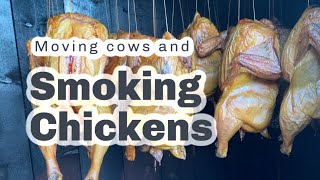
Richard Perkins walks through smoking 50 large chickens at once. He brines them for 24 hours in 30-liter tubs, then hangs them in a 50-bird smoker with birch and alder shavings for 24 hours total, cooking to 72°C internal temperature.
Questions this video answers
50 birds
2.4 to 2.8 kg each
1 kg fine sea salt per 10 liters of water (3 kg salt for a 30 L tub)
24 hours
72°C (deepest tissues), smoker may reach ~81°C
Chapters
Hello, bird. Hello, bird. You should learn the fly, mate. Okay, ready for the morning move back to our farm, Sam. Setting up the first smoking of chickens. So we've freshly sterilized all the containers after winter rest. And we've got 50 birds of quite a big size, 2.4 to 2.8 because we went over the normal slaughter date with our inspections. So sterilize the containers. We've marked all these containers with 20 and 30 liters. We're using one kilo of fine sea salt to 10 liters of water. So we'll be doing 30 liters in each of these. Aiming for three kilos of salt. I like to mix that in with the hand motion. I found that's the most efficient way to dissolve the salt quickly. These birds will sit in here for 24 hours precisely. And it's quite a precise art to salt and then smoke birds. You have to work out the particulars of your setup. But just got the chiller off to give my ear a rest because it's blowing in your ear here to get these filled up. Then we'll get the salt weighed out, get the birds in and submerged, and tomorrow we'll set up the smoker. So going for 3 kilos salt, we use a high quality sea salt. Getting 25 kilo bags like this. Okay, that's all the salt. So best technique for mixing salts is freshly cleaned alcohol arm. And I put my hand in like this. And I found that to be quicker than using a whisk. Done. That's dissolved so I can feel there's no particles at the bottom. The only downside is it's very, very cold. This is how we go. We put the birds in with the bigger opening and their tail upwards so that they really fill with water. And with 30 liters of water and eight birds, you can see they just about align so that just the tips of their bones on their legs are sticking out. The water when we put the lid on, it squishes them down. And that's totally adequate. And so 24 hours like that. Got one ready here. So I'm just going to fill all these the same and leave them until tomorrow morning to get them in the smoker. Okay, so birds have had 24 hours in brine. We've just lifted them up onto the racks to drain. Beautiful big birds, ideal for smoking. Now you do lose a bit of weight, maybe 15% weight when you smoke. And so it's good with bigger birds and they remain juicy and really good. But the bigger ones are even better in that perspective. So that's 50 birds ready for smoking. So we'll let them drain a bit, empty the salt water, brine out, clean the chiller down, and after lunch, we'll skewer the birds with cotton meat string and hang them up in the smoker and show you how that process works. Beautiful birds. So we're using a homemade needle to thread the birds. Just use a roll of string. And I like to have the birds set at a height like this from the roof of the smoker. And it's important they're all equal height, so we do that. This would be 1, 2, 3, and I'll just keep working like this to create 50 strands. Fabian's home forest morels from Sweden with pasta chicken. Look at that. So birds are skewered and it's important to go through the breast out to the side of the spine, so you get a really good solid purchase on the bird, as you can see here. So that can support the weight of it as it cooks and softens. Obviously you don't want that dropping down into the fire. So we string up all the birds and when that's done, it goes into the smoker. 24 hours in the smoker, but only 12 of those are cooking up to 72 degrees internal temperature. Often that needs the smoker to be up to about 81 degrees and it needs to sit there for a while, obviously. So then we do a temperature test in the birds. And that's why you want the birds to have even length strings, so they're hanging at the same height. So A, they cook evenly and B, they smoke evenly. And on that note, you want birds of a similar weight category within a couple of hundred grams of each other to ensure that they are cooking through evenly. So you can see your hand is just going slightly to the side of the keel, the breastbone, and it's a little bit hard. You've got to get to the side of the bone, but you want it through the cartilage, etc. So that the bird isn't going to pull through. Okay, so next step is hanging the birds up. We use this mesh grid, same as in our chicken mobiles, to hang these now with 50 birds, which is what this smoker is built for. Just got a wider view so you can see better inside. We designed this around 50 bird capacity because that's what we wanted to be smoking on a weekly basis. You can see you have the smoke channel at the bottom, metal piece of loose metal there, that just protects the wooden door from the fire. And then you've got about 9cm of insulation. And we use this metal mesh just because it really allows a lot of options for hanging in different places. Because what you want is to have the birds equal height and you want them not touching. A little bit of skin contact like that is okay, but they shouldn't be pressed up against each other and you don't want them touching the walls, obviously. Then we have this metal sheet. There's a drip tray for the fat. There's a lot of fat in chickens, obviously that will melt down. You don't want that dripping on the fire because that will make the smoke very acrid and taint the flavor of the meat. What you do want with a smoker is for the walls to be made of natural wood so they really soak up the smoke aroma. It smells beautiful in here, and that's what you want. So smokers get better over time as the wood gets impregnated. So very good insulation. And then we have a simple system. We've just got a thermometer that goes through the wall to the inside. We have a sauna heater with a little flap to protect that. And if we go around the back, you can see this is just the control here. And all we do is plug this one in. Now, we haven't tested this since the winter, but in theory that's on. And I've got the temperature dialed in to where it should be. Now I need to update that with a little mark just so we know it's in the right place. We'll just turn that off for now. We're using older, not to 2.02 millimeter, very dry wood shavings. You can see what that looks like here. Now you can make your own, obviously, and the people often favor some of the hardwoods or softwood fruits like oak or Apple, etc. People here tend to use birch or alder because that's what's commonly available. Alder is a lot cheaper. And so we use this one. We'll use about half of this bag, which is perhaps 50 liters or so. So we use 25 liters. And we tend to put it in this little fire pit. So we've got a little bit of kindling just to get the initial temperature up, to save on the electricity and to get this smouldering and then this smoulders slowly along. So we'll put a little pile with a little hole in that we make the fire in, and then a little S shaped snake that smoulders until this is Taken out. Okay, birds are in. Now they are closely put together. They could have been further apart, but that's okay. They're minimally touching. They're not really pushed up against each other as you see in the rows, so they should be fine. So beautiful birds. So the older wood spawn and wood dust is down here. We light a little fire and we're using this to ignite the wood for smoking, but also to bring the temperature up in here. So it's sitting at 12 degrees right now. What we tend to do is close this door up. So obviously we need oxygen to get to the fire, but I like to close it up about an inch open and that fire will get going. So in about 20 minutes or so, probably the temperature will be up at 40, 45 degrees. At that point we can close this down and the embers will be smoulding. We can turn the heat on at the. It. We have reached temperature. We've been probing a bird in here. It's got to 72 in the deepest tissues. So now I want to start cooling this down. Now. These birds want to cool down in smoke and just opening it fully so you can get a good view. That's beautiful. Now you can see all the fat dripping. That's why we have this plate here. That's a wonderful sight. So we're gonna have one for lunch to test that out. And we'll let these cool down a bit now so that we can then pack them tonight and they'll go off to customers. Okay. Chickens have been cooling in the smoke, so it's quite cool in there now it's 30 degrees. We are going to put some gloves on, put them into crates with plastic bags, get them in the chiller now and then they will be packed tomorrow. Okay. Smoke birds back in the chiller, cool down overnight and then they'll be packed tomorrow morning. We're just going to wrap these with bags on the top so they don't dry out in the chiller. It.
More from Richard


A review of short and intensive season on a mixed farm and restaurant/event space in Sweden






Alskade Kyckling Exploring complexities of poultry production in Sweden and what we stand for


