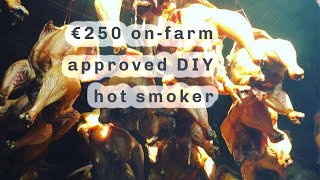
Richard and Johan smoke broiler chickens for the first time, testing brine concentrations from 8-10% and 12-hour brining times. They smoke at 70°C for about 24 hours, then cool in the smoker another 24 hours, finishing in an oven at 175°C. A local smoking service charges around 70 crowns per kilogram.
Chapters
So busy weekend for me. We're smoking the first of our test batch of broiler chickens and tomorrow I'm going off to pick up the first 1000 broiler chicks. A long drive tomorrow for me as well, but let's have a look and see how that process goes.
So this is the first experiment with smoking chickens. We have some fine sea salt and I'm gonna try six chickens in an 8% salt solution and six chickens in a 10% salt solution for 12 hours. And then on Saturday, tomorrow I'm gonna go off to the local smokery and try smoking them. I'm doing two not so different salt concentrations because we want to get the salt balance down first and then we can play with whether we want to add sugar or spices or anything different. It's very easy to over salt chicken. I've got a feeling this is going to be on the heavier side. Right now it's just a test and we're not doing this to regulation because we're not selling these birds, we're going to eat them ourselves. And so normally this would be happening in the clean down slaughtery. We'll be packing birds, cleaning the chiller out, putting birds in brine, putting them back in a clean chiller. And we'll have to have a whole HSCC plan around that process. But we've got to go ahead to test batch with the smoking and then we'll make a plan of how we're going to do this in the routine week to week with the slaughter process. I'm going to use hot water to dissolve the salt quicker and then fill it up with cold water. And the birds have been defrosting. They're birds from the freezer. You ideally want birds of the same size so they smoke evenly. And this is birds that are 2.2 to 2.4 kilos. So these birds are 10% brine, using some plates just to hold them underwater. A bit like. Hang on, that is a really sharp knife, dude. A bit like these little pushers on the feta cheese. No.
Yeah.
So we need to keep it underwater. We're gonna help him cook today. Oh my gosh. We gotta roast with chicken.
And look what we have here.
What's this?
We're gonna fill it with the goose mince.
Goose mince?
Yeah.
Wow. Canada goose. Canada goose meat. Wild Canada goose. Don't know if they're protected in Canada, but they aren't here. So we got, we swapped with the neighbour actually. So some very nice roast chicken in the oven. Whoa. Can't See Very well. Smells awesome. The day's brushing ration some nice vegetables roasting as the feast. So for smoking we're using fine sea salt, which is. We buy bulk organic food for feeding people at the farm, supplementing what we produce at the farm. The salt dissolves protein in the muscles of the birds. And it's the salt and protein that reduce moisture during cooking, which makes the meat juicier, improves the flavor, makes it more tender and enhances all the natural flavorings. But it's easy to get too much salt and it's easy to get the birds to dry. So it's critical all the different times and combinations is what we're working on to come up with the sort of signature product that we want to produce.
It's.
Hey, cows, coming into the old pig paddock. A little bit of grass with. Toby's busy, busy. What are you making, Toby? Making a tool board. A toolboard? A tool temple. The tool temple. Wow. The roof is built perfect.
Yes.
So this is a tool board for the market gardens for tools on the front. And we're thinking some row covers and fleeces on the back too. Have them for easy access. And we're having one of these here in the north bed. So easy access to the majority of our beds, which are over here. And then we'll have one in the south beds too. That gives access to the greenhouses and the south beds. So here we are at Euron's little place. And here's a little farm shop here and several little smokery facilities. Very simple but very effective. So we'll have a look around, get to meet Euron. So Johan's been smoking meat for several decades, no?
Yeah, about 50 years.
50 years, wow.
I was eight and now I'm 65.
Since eight years old.
And you've been mostly focused on fish? No, no, no, no. Okay.
I start with meat when I come here. That was 1989.
Okay.
I come from Skonna Lunde, down south Sweden, so. But today is only salmon.
Only salmon. And you have clients coming, people coming on holidays from Germany. It ends up all over the place, doesn't it? Today we're testing two batches of chickens at 10% salt solution and 7%. But Yuran already said that's maybe not salty enough to withstand summer.
No, it's too low.
Too low.
Never below 8.
So I messed up already.
It's better with little higher tip 10% and have it little less of time.
Yeah.
So you can start with 12 hour, 10% salt. And this is not good. You Rise it to a 15 hour, even 20 hour.
So then once we have the basic salt concentration, how we want it, we then can test with different spices, see how we make a little signature blend for the.
So when you have right. Salt, you are satisfied with the salt and the smoke is good. Then you can start experimenting with other things. Yeah. Like maybe curry. Curry.
You had the idea to stuff pork mince. Yeah, that sounds really good.
You can make. Yeah, chicken is a. It's good thing to. To make. Experiment with. You can make several things with the chicken.
Yeah.
And stuff them with maybe plums, apple, parsley and some spices inside and smoke them.
Yeah.
And you can have them with a lot of butter and in the oven, 175 degrees, maybe for one hour after smoking. And then in a frying. What's the name? A frying bag, like plastic.
Yeah. To keep the moisture in. Yeah.
And then you pour in that moisture with cream. One liter of cream, half kilo of butter, and then you get real good.
What sort of temperature and time do you think we'll be going for?
70 degrees and 24 hours.
Okay.
Because of chicken and salmonella problems, you must be very careful to heat up the meat to 70 degrees.
And then you said it's also important to let it cool down in the smoke.
And that's because of the aroma in meat from the smoke. If you take it out directly after 24 hour or you have it cooling down in the smoke for 24 hour more. It's different in taste in meat. You can do exactly as you wish. I will show you my way. First, I put the big needle here in the chest.
So you're essentially stringing them all so you can hang the whole string or individually.
And now this is 10%. Yeah. I. I have a suggest for you.
Make 10 knots.
Yeah. Now we'll make one on this and two. Yeah. So and this is because I want the. The juice to drip. Yeah, yeah.
Do you have to open. Are you letting any air out of the smoker? In the beginning, is there like a lot of humidity coming out?
When you have a closed door, every motor will stay in the smoke.
So you actually want it to.
I have built the smoke very bad, so I have big. It's not tight and all the smoke coming out everywhere.
Yeah.
And when the smoke comes, the moisture.
Yeah.
So I don't want to wet inside.
Yeah, but that's sufficient if you have little air spaces further.
Yeah. I make a little. In the roof, a little chimney with.
Like a little tractor. Yeah.
But I never used it smoke comes everywhere you can.
So if it was airtight, you would need to manually control that.
Yeah, that's. That's not good because with the moisture and smoke come also heat.
Yeah.
So you have to put in more electricity and it's more expensive to drive the smoke. So it's better when you build the smoke not be so careful. It will not be so. Exactly.
Not totally at all. No.
Several millimeters. So on the hang, if you can sew.
Perfect.
So this is a sort of smokery.
That you can build for a few thousand crowns. Few hundred euros.
Yeah. I have a concrete floor. Yeah. And above it I have old bricks. Yeah. About one meter high.
And then it's wood on the wall.
You won't be able to see maybe.
On the film, but it's mean high brick and then wood that.
An insulated wood. And it's very important you have insulation in the scope around the outside. So not the wind can move the heat or the smoke inside, especially in winter. So you have minus 5 degrees and a heavy wind on this side. Side. This side will be maybe 60 degrees and this side will be 70, 75 degrees.
And then some fat trays for.
Yeah, yeah. Catching fat dripping from the meat will not come in the glove because there's.
Going to be a pile of the. This is the aldershot and that's smoldering down at the front here. Yeah.
Turn off then burning and I will not burn. Burning like a cigarette.
Yeah.
Lying smoke.
Yeah.
And when you not catch the fat dropping from the meat, it will come down and burn. And it smells like hell.
Yeah.
And that smoke coming to the meat.
Yeah.
So after 24 hour in that smoke, you will not eat it. Not the dog either.
So as close as they're not touching, basically.
Yeah. One or two centimeter between them. It's good. When they are turning, they cannot come together. So you must. Must have a good space. That's too close.
Oh, I like the smell.
Gonna be good.
Yeah.
It's really exciting for me to take on a new process because it like I do a lot of work to raise them and slaughter them. But it's nice to do something with the actual chicken.
Will you earn money on this stuff? You must do it yourself. You cannot leave it the way and pay a lot of money for. For doing it.
Right now we've been paying a local farm to smoke chickens for us. And they're charging with VAT, about 70 crowns a kilo. And these birds are 2.2, 2.4 kilos. So you see it's quite a big difference that we should be making ourselves. So that's why we're taking this enterprise on and building a smokery. And I really love Euron's little setup here. You can see it's very easy to make this so of thing with bits that are lying around. And you've got a double door down here. So this is very similar to something that we'll be putting up next to the slaughtery at the farm in the next couple of weeks. I hope so. 12 beds in. We're gonna start the fire. We need to put the alder in. And these will be in for about 22, 24 hours. About. So a whole bag in there. And that would be enough for if this was.
Yeah, exactly. 24 hour. It's finished.
So you. But it's enough to smoke a full cabinet of meat. Awesome. So we're using more than you need to per bird. So you can see how that's just piled in in the doorway. And the bottom of the bottom door flap is metal so that's not burning up. So a little depression there with birch bark which is full of oil. So it's what we use to light fires here in Sweden.
It's burned like dark dynamite. And then we put some foil so.
A few bits of wood on top.
It's common.
More.
Coming back after 24 hours. Everything is perfect.
Perfect there.
We can leave the metal door open for a little while.
So you let it get going and then you come and close this one down. Yeah.
And I look at the thermometer here coming up to around 70. I start the electric. And how long to. To let the electric rise the temperature. It's better with the wood. Yeah, it's cheaper. Yeah.
So this is Juan's little self service shop.
Yeah.
And beautiful smoked trout, different flavors.
This is just with salt and hot smoked. And this is fillet with a lot of herbs. There is sun dried tomatoes, there is paprika, there is garlic, onion. Three kinds of pepper. Basilica. Yeah, about.
It's really nice and people will come. You get a lot of visitors here. So it's in English and German also. But people come and write down what they've taken and pay for themselves. So it's open 24 7, 365. This one's watching. Make sure you pay honestly. So that's good. There's basically a heating element on this is going through the wall of the shop, through the smokery there. And so there's a heating element on the other side.
Inside.
On the inside.
And that Is also important to make metal. The dripping from the meat coming in that one.
Yeah.
70 degrees here and main switch for the electric here. So we put it so. And now we have a control lamp for the thermostat is working. So when we are starting now we have about 40 degrees there it come yellow. And when the thermostat is rising the 70 degrees, it will switch off the electric and the lamp will also switch off.
Yeah.
So that's a control amp that the thermostat is working perfect and always home improved.
Yeah. Homemade, low cost. Perfection. So you can see that's caught now inside and that will just smoulder away for the next 22 hours or so. So Ewan, you built this whole homestead, essentially. Homestead, you built the home and everything? Yeah.
When we come 1999, it was just that building.
There was one house out on the road here. Yeah. But you built. You're just going to turn the camera so you can see earth.
Stella and I have.
These are the other smoking units we can have a look in.
I have some electricity for light out here in this area. And here is my battery for 12 volt system.
Nice. So semi off grid and then a beautiful studio which you're finishing up now, are you?
I have a few months left, still.
Some work to do and a beautiful little cottage like in kind of old fashioned style. It's a very nice little spot. But these are the other smoking units. Can you tell us a little about how they operate?
Yeah. This here is just for fish smoking. The big red one is for warm smoking up to 70 degrees.
Yeah.
And this is for coal smoking, maximum 25 degrees.
Yeah.
And here I use the smoking from the hot smoke in the pipe and through a fan here, dragging out the smoke.
Yeah.
So I used the smoke twice here. First for warm smoking and around and coming up here for cough smoking and out.
It's something, it's really nice to see. Like it's. I think it will inspire a lot of our viewers, like the simplicity of the setup. Because it's like I've said in videos about poultry slaughtery that it can be so overwhelming for people before they've done it for themselves. Like how can you get approved? How can you do this? But it can be quite simple.
You must be a very practic human and you must be willing to experiment and be a friend with time. You cannot have a Harry in your body. It must take time. And then you start experimenting with all things. And when you are satisfied, then good, then you have learned yourself. And here I have A freezing room.
Here'S a big freezer. But the. It's important part of the controls then is about protocols and how you keep things clean. So this is a clean space for all the prep, the packaging as well. You see the vacuum packer there. So this is going to be important for us when we working out the HACC plan with the regulators is how to get birds from the slaughtery. They need to then go in brine. So we need to clean the chiller down and put back birds in containers in the clean chiller. Then we have to show how we're getting them outside to the smokery. And it's all this protocol stuff that is what the regulations are about. The actual setup can be quite simple.
You must read a lot about the meats. The meats, bacteriology.
Really understand the science.
Yeah, yeah. Exactly as you have about Earth with nematodes and all that what is in meat. And it's very important that you get that knowledge because if you're not, you don't understand in what way you could be a tenure for your customer.
Yeah. What we found with building up the relationship with the regulators is like if you really like they're looking to see if you're confident that you know what's going on and if you know the science and can speak clearly about it, then they relax and they can see. Yeah. Okay. They. They know what they're up to.
Yeah.
Have you ever had problems with the regulators, with. With your business here?
No. No problem at all. Because I have been. I have been hobby smoking since 50 years ago. So I have a very good experience of how to smoke. When I started this app, it was for making my living and money on it. That I have not been before. It's just for ourselves. But when you are starting to selling your products you must study all this kind of meat structure and bacteriology and all that because if not the government people will not give you your permission. They ask something and they understand that you are not the right guy. So you must all the time be the guy who have the command of.
Those people and like one step ahead in a way. Yeah.
Every. When they're coming. But this is not a good way to treat it. Okay. I hear what you say war in the paper. Are you reading the things you are saying in Swedish? A lot of. A lot of thinking their own thoughts not fetched from the paper. It's my own private interpretation.
Yeah.
And that's not good. That's not good. And you must be a little tough against them.
Yeah.
And you can't be that when you have knowledge. Do you not have knowledge? Then you must fall on your knee. Please be good to me. So the knowledge is the key to have a good connection with those people.
Yeah.
When I getting filets. This is from the main bone, the whole spine with meat on. Now it comes three pieces from one fish and you fry this in butter and put your fork on to hold it and your knife to scratch all the meat. And then you have a creamy sauce and potato. Potato rice.
Awesome.
This here is a lot of work to fry them, but you have your hungry yeomans. They will fry it outside.
Lovely you. Awesome. Thank you so much. Dinner for the gang. Wow. Oh, thank you so much. And we're going to be giving you some eggs and chicken once the chicken's finished. Good.
I take 200 crowns for. For the wood and electric. So I. I took very. I want a hick for it.
Sure.
You can change. Yeah, yeah. Very specific. I make for ourselves. This is cold smoked pieces of salmon here. This is the film speciality. Yeah, very good. And there is a little garlic on and cold smoked. And you put it on a good toast.
Yeah.
With a cold beer with butter as well. You have this to try.
Thank you so much. Thank you for showing us around you. That's going to be really interesting for people to see. So I'm off back to the farm and we'll be back early Monday morning. We're going to leave it cooling down in the smoker for 24 hours or so, but thanks so much.
What time in mundo shall I call you? Yeah, not before 7.
No, no, no, not good.
So that's it for today, folks. It's really awesome to have a little look around Euron's place and it's so nice to be able to take some time out from the farm to learn from someone that's just been doing it for five decades. I mean it's amazing to have that knowledge passed down and to create a new line of products. I'm really excited to do something with the chickens. I'm so familiar with raising them and slaughter the process, etc. But it's nice to do something to add value and there's lots of room for trying out different products and finding.
Like a little niche in there.
So thanks so much, Jerome for showing us around. I hope you enjoyed the video. You can find out more in our book, Making Small Farms Work. Our open days are up on the website if you want to come and see the farm in the height of the season and you can see our trainings up there too. Thanks so much for watching. Share the video if you enjoyed it and we'll see you next time.
Sa.
More from Richard


A review of short and intensive season on a mixed farm and restaurant/event space in Sweden






Alskade Kyckling Exploring complexities of poultry production in Sweden and what we stand for


