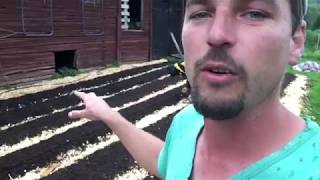
Richard Perkins runs six soil-prep experiments on his farm: compost, compost tea, biofertilizer, mycorrhizal fungi, biochar, and a combined bed. He shows how he makes each one, what he's measuring (germination, growth, sugar content, yields), and what else is happening around the farm.
Questions this video answers
Six
7 kg compost in 180 L water, bubbled for 24 hours
20 L cow manure with 60 L water; 1.2 kg rock dust; 100 g bone meal; milk, sugarcane molasses, dried yeast; worm castings (and an airlock for anaerobic fermentation)
60 g mycorrhizal fungi in 10 L water
About 500 broilers; day 21 on pasture
Chapters
So in today's video we are making trial beds to test different soil preparations that we make here on the farm and do a comparative study as scientifically as is possible when there's so many variables out of our control to see what those soil preps do for different vegetables that we'll put into those plots. Big day for boilers. So it's day 21. Birds are coming out into the field. It's a nice sunny day. Birds have grown really well and are how we want them. And the weather was pretty wet yesterday, but today is perfect. So you always got to watch the weather. When you bring them out, they're obviously very vulnerable and whilst they have a lot of their adult predators, there's palm patches of down you can see. So they're extremely vulnerable to Indian rain. Right now we have the back screen up. So if we get storms, you see the wind coming from this direction. So we need to monitor the weather very carefully this next week. Okay. So on double counting, there are six more birds than we realized. So the, the hatchery has given us more birds than we bought, which they often do, but that's no problem. So we've got our feed sheets for the field which are a little bit different from the brooder. We've gone down to three feedings a day now. So today it's just really important to check the waters are working fine and none over spilling. And we'll do some extra monitoring today. It's only three feeds which corresponds well with eggmobiles so that the machine can bring up feed and everyone's got it when they need it. But we'll come up a couple of times extra in the gaps today to just see how they're doing. Check the water. It's a big day for them obviously, so careful monitoring is critical at this time in their lives and things like this. See this water is not set up totally properly and it's got a very slim leak. So what we do to fix that up is just tighten up the hanging valve which you do by spinning this anti clockwise, I believe. So it's just little tweaks to get it all set up good. And we've got to make sure that all birds have access to water all the time. Happy birds. Really nice to have broilers back in the field. They're finding worms. I've been seeing a few catching insects already and they're eating a few forks. So small batch for us. Just 500 birds in this batch time controlled feeding. So they're on three feeds a day. They've Gone down from five to four in the brooder and three when they're out in the field and just been up checking the waters. Everything's fine. And not concerned about a little breeze through the back today because it's going to be a hot day today. So birds doing good. I've seen them all fighting over insects and eating forage already, so we'll see. And tomorrow train them up in moving the birds with the new wheels on the dolly. Great to have birds out on the field again. Farm is rolling again. Cows are doing fine. The bull seems to be very relaxed, very content. This is a bull you can walk straight up to and he's no stress at all. He's not an aggressive bull. He's used to people, so you can come right in. And he likes a little bit of penning. That's really nice. He's just a very gentle, big old bull. He's getting some, which is nice with all these people around and people learning about animals sometimes for the first time. Definitely important to have a bull who is not going to present any problem. Lots of strawberry flowers. Strawberries are doing good. These are not fertilized. We come through and just weed them once and then graze up to the edges. You can see they're doing pretty good. There's going to be a lot of the boilers will come in and come right up to the edge here where the cows haven't taken it. But doing very well, considering. In any gaps we have, there's a couple of spotty plants that we'll probably pick up. But we have a thousand young plants to go in to complete these fields. But pretty good, pretty low maintenance and we'll get a good amount of strawberry off them. Team are on the last day of holistic management. They're looking at grazing more and then we're going to have a big barbecue, restaurant, half a pig and celebrate and get back into the flow of internship again. Hi, Clover May. This is the forestry mess that's starting to green up, but it's going to be a while till this becomes rambunctious pasture again. You can get a good sense here, have a comparison. This is how it's coming up and this is what it was. So we've got grass as high as. I'm gonna flip the camera over, but we've got timothy up to my waist here, so it'll be a while until we get back to that. But progress is happening. Turkeys are settling in. Still too young to make the most of this forage and not trampling all of it. But we're doing slow moves every second day as we try and keep them only in front field here. We don't really want them going into a different field. Well, it's Monday morning and everyone's in holistic management class, but Bobby and I are going to catch a fish. We need fish for compost tea and we're going to make some fish hydrolysate so that we can make fungal compost teas. You need those complex proteins to grow fungi. We can use raw fish in bacterial compost tea, but someone's got to do it. So we thought we'll take one for the team. So we're not going sailing today. It's a beautiful day, but we're not going to sail without Dominique because she's the master sailor and she's been rigging all this up. So we want to wait for her for the maiden voyage. But we thought we'll take a quick fishing trip and try and get some fish for the soil preparations week next week. We're going through how to make compost teas of different kinds, biofurts, biochar, all the different farm ready soil preps that we can do, biofertilizers. And then we're going to be using a bunch in the garden this year to correct the deficiencies. And so we'll be making some little documentaries about how we're making each of those recipes are in our book. Those of you that have got that and we'll make some little fun videos next week. Okay, Compost. This is biochar laden compost. Ah, it's not a snake. This is slow. So yesterday we came and opened it and there was a big grass snake wanting to come and lay eggs in here. This has had biochar that's been soaking weeks in water just to hydrate it because biochar is hydrophobic. And we've been turning this pile with biochar to inoculate that coral reef, as it were with life. And so one of our trial beds is going to have this on it minus the slow worm, but the grass snake is gone. So slowly. Inspection this week we've connected up water to the new frostbite tap we put in in the video this spring. Just having a quick clean down in here and I'll be inspecting for water quality and hygiene procedures like before every year. We're not slaughtering till July this year, but I thought I'd get in here and just inspect things and give it a good thorough clean while we've got trial beds being made. And a shade mobile for the cows going up. And we'll go and have a look at the trial beds shortly. So, in the name of science, Malta's putting in the last seeds. Radish seeds. Can't hear a word. It's radish seeds. Radish. Okay, so this is our trial. We've got six beds, all treated the same. This is an old pig pen where we kept a sow. And we've put down some compost made from last year's bedding with cow and chicken manure and tilthed it. And then we're gonna have compost tea on one bed, biofertilizers on one bed, mycorrhizal fungi for vegetables on one bed, a control bed, which is just as it was, and then a biochar bed, and then we've called this one a mutant bed. So what we're going to do is explain what each of these are and why we're doing that. Each bed is being planted the same with kale, French beans, lettuce and radish. Only the kale is being transplanted. The rest are being direct seeded. Compost tea is coming out the bubbler. So it's an aerobic compost tea made with seven kilos of our compost with 180 liters of water. It's got molasses in there for sugars, humic acids for feed and rock dust. Well, no, it's actually got bone meal for minerals, and that's been bubbled for 24 hours. That's going to be put on in two watering cans tomorrow. And so we'll water each bed with two watering cans to make sure to get the same amount of water also. Okay, this is our compost tea setup. So this is 180 liters of water, which is determined by the amount of dissolved oxygen we can get. And it's seven kilos of compost. It's got fish in there. We typically would use fish hydrolysate, which is a ferment I wrote about in our book, but we just use raw, minced fish with all the guts, all the bits in there for protein sources. A bacterial tea. So that's fine for bacterial tea. For fungal tea, you typically want to have fish hydrolysate. And the ferment produces more complex proteins. We've got humic acids from worms in there, and worms obviously use bacteria for their digestion. And we've got sugar cane molasses, and we've also got a little bit of bone meal, phosphorus source. And so also, at this under microscope today we looked at the compost sample looks how it typically should. Lots of bacteria, lots of ciliates and flagellates and we'll look at this sample tomorrow. It should be absolutely filled with life. And if the compost tea has gone well, this foam will be thick and dense and white. That's a sign of proteins and good activity that we're happy with. So this has just been going some hours now, but we'll be using this 24 hours later, early in the morning before it gets sunny and hopefully will see the marked response. So this is going into our trial beds and the rest of it will be going into the tomato tunnel and then we'll be making another batch to put on the gardens to help with the remedying lack of fertility situation with our wood based compost that I mentioned in last video. Bioferts is an MPK replacement. So it's, it's a homeopathic level of mpk, but it's got by, you know, stimulants, growth stimulants and hormones. And it's being used on mega scale industrial farming in the same sort of recipe. This is 20 liters of cow manure and 60 liters of water. It's got milk and sugarcane molasses as sugars and feed for bacteria. It's got dried yeast which is used to just expel oxygen in the very beginning of the fermentation. You see, this has got an airlock. So, so all anaerobic digestions produce methane, carbon dioxide, so that allows that to bubble out and no oxygen to come in 60 liters of water. It's got 1.2 kilos of rock dust for phosphorus and 100 grams of bone meal that's also phosphorus and calcium. And it's got worm castings for humic acid. So this has got N, P and K plus all the trace minerals, plus lots of growth hormones. And because it's an anaerobic digestion, all anaerobic digestions tend to produce alcohols, alkaloids, turpines, things that are toxic to plants. But because this is put on as a foliar feed all over the plant, below the plant, so it goes up in the stomata on the plants, leaves and stems and on the ground. All of those toxins are air soluble. So that's no problem to us. Then the mycorrhizal fungi, it's fun. From fungi.com from Paul Stamets. That's a mycorrhizal fungi. We're putting 60 grams in 10 liters of water. So we're going to water this weekly and biofurts weekly and compost tea weekly. In fact, mycorrhizae, we're not doing weekly, we're just putting it in in the beginning. So this is the mycorrhizal fungi from fourth. So it's for vegetable, flowers and fruit trees. You can read about it on the back here. We're applying it as a liquid drench and we'll apply it tomorrow as we apply the compost teas. Interestingly, the brassicas are not associating with mycorrhizal fungi. So the kale won't be maybe affected by it, but the other crops should be. Control bed has just got the standard bedding. The biochar bed is our 18 day Berkeley compost and we have powdered up. So biochar is essentially charcoal that's been powdered to micronize it, give it a massive surface area and it's like a little coral reef. And it's also hydrophobic. So we've soaked it for weeks so that it's not hydrophobic and then we have turned it into finished 18 day Berkeley compost and had it sitting through the last few turns of the pile. So it's now full of microbiology. And then we've applied maybe a hundred liters to this bed and tilthed it and then the mutant bed is getting a bit of everything. So the mutant bed has got bioferts, biochar, it's got mycorrhiza fungi, it's got compost cheese going on it. And we're just gonna see as a control what's going on now some interesting things that we'll see out playing out over time. This mutant bed gets a lot more water off the roof structure. So we're going to pay that a little bit of attention and decide how we do deal with that. We've got three different types of kale and then we've got regular spacings with all the other crops. So we will be able to see how germination is affected. We'll be able to see how general growth and health looks. We'll be able to measure plant sugars with a spectrometer, we're going to be able to measure yields, etc. So we're going to try and treat this very carefully. We're seeding by hand. Malta is just finishing off here so that we've got the same amount of seed at the same spacing in every bed. It's a bit too small for our main seeders that we use. But we're just doing it this way to make sure everything is comparative and what you'll see. Also, these beds will perform differently in that there's a strip of sand where we had tree beds here in the past, but it passes through all of the beds, so that shouldn't affect things too much. So it's going to be an interesting experiment over the next few weeks, and we'll be able to see what difference all these different applications make, if any. So we'll probably cover these up soon with an insect net to make sure nothing gets on the kale. And it's going to be really interesting to watch this. So we'll be making videos, checking back in with this in the weeks and months to come, including harvests, and just thinking what's happened and what we see and reporting that back to you. So we've made videos on how to make birkling compost. It's a very raw, rough compost, and this is a pile that's just two or three days old. It's up at 55 to 65 degrees C. So we keep it in that range to kill pathogens and keep it aerobic. And you can see other videos we've made of exactly how we build this. It's one of the most easy and diverse compost you can make in terms of life. Half the mass of the finished pile made up of organisms, billions and billions of creatures, and there'll be up to 5,000 species of bacteria and all kinds of protozoas and flagellates in there. It's a wonderful, simple compost to make. So that's the pile that's going on, similar to the pile that's up now in the experimental beds. So we've had structural meetings in the garden to get clear about what we need to do to remedy the situation I outlined in the last video. And we've been applying manure slurries with chicken manure, both at root zone as well as on the surface. Okay, Operation Onion is underway. We are soaking chicken manure pellets, get them hydrated, splitting one bucket of soap pellets into three, filling it with water, and then we're going to water them into trenches we've made along the root zone. And nice thing with the paper pot is they're all coming in really straight in their paper chain. So we're just kind of making a insertion next to the roots, and then hopefully we'll get the right consistency to really water it in well. And that will give them a pretty instant feed and rather than one option would be to bury the manure pellets down at root zone. But I think to put liquid feed on is quicker, obviously. But to put liquid feed on at the root zone seems like the quickest return we could get, so we'll see how that goes. We're making compost tea today, so we're going to be able to start drenching everything in compost teas. We basically do whatever we can to steer things back in the way it should be going. But you can see we've got beautiful crops, lots of beautiful lettuce here that we'll be selling out schools and restaurants soon as well as to our standard customers. But that's all we got to do. Keep responding and we're doing the best we can and applying lots of little solutions here and there. So we'll keep you updated on what we've been doing and how that's working for us over time. Okay, that's it for today, folks. Quick update on the trial that's going on. Lots of busy stuff going on, birds out on pasture, everything's getting into full swing and things going smooth and feels good. But I wanted to just give you the initial brief for the experiment so we can see the updates over time. With that, I think it's going to be super interesting. I'm excited to see the results and just share what we learned from doing this experiment. It's a really nice thing to be able to do. Thanks so much for watching, folks. Don't forget to click subscribe if you haven't already and share the video if you enjoy it with your friends, family, etc. And we look forward to seeing you in the next video. Bye for now. Sam.
More from Richard


A review of short and intensive season on a mixed farm and restaurant/event space in Sweden






Alskade Kyckling Exploring complexities of poultry production in Sweden and what we stand for


