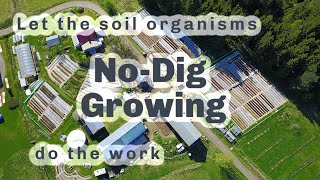
Richard Perkins shows how no-dig beds work at Ridgedale in Sweden: layering compost on the surface builds soil structure and feeds earthworms, bacteria, and fungi. Three-year-old beds hold moisture better and crumb together, but surface mulch attracts invasive Spanish slugs. Root vegetables grow fine without digging.
Questions this video answers
About 25 cm
About 30 cm (over pure sand)
Nearly 400 litres
75 cm width by 10 m length
Spanish slugs
Chapters
So we're here in the north beds as part of the market gardens here at Ridgedale. And we're working with a no dig approach to market gardening, which means we form our beds by layering compost straight onto the ground. Now this is the first season that we've been doing this here. We have some beds on the south side where we've been doing no dig for three years, so we can go and have a look under the ground there and see what's happening underground. So we're here now on the east and west beds, which are on the slope in front of our house facing south. And these were the original no dig beds. And so the soil here has not never been dug. It's just had three seasons of laying down organic matter. Let's dig a little hole in the spare bed and see what we find down there. We'll see a cut through of the soil up near the house to see what we're working on. We had about 25cm of very light topsoil and then just pure yellow sand underneath that we'll see in a cut. But by adding so much organic matter, what we've essentially done is form formulated a lot of helping hands through earthworms, etcetera, who carry this matter down into the ground. For us, the worm count in here has increased dramatically and the ground remains very soft. So we're really using this organic matter as mulch, but also nutrient. And you have to be careful with mulch because whilst minimizing water loss and keeping soil covered is important and vital, in fact, it's really important that you consider the pest and disease pressures here. We have big problems in Sweden with invasive Spanish slugs. And if you cover your beds with straw, you create a breeding ground for those slugs. So we absolutely don't bring any composts, we don't make compost near the garden and we don't put straw on the ground. We use the compost as feed to drive the soil food web as well as leaving roots in the ground to decompose. But what we find is that organisms are bringing that nutrient down into the ground. It's totally changed the profile of the soil. It remains permanently moist, permanently protected. And we're developing this crumb like structure that we're looking for in a healthy soil. And all these particles are glued together by the exudates of primarily bacteria and fungi. It's a really healthy, thriving soil that's being created just by laying matter on the surface in the way that nature generally builds soil too. Let's go up and take a look at what we were working with when we started by cutting through some soil somewhere else. So here's a cross section of what the soil is like where these beds are formed. You see it has about 30 cm, perhaps of topsoil on top of pure sand. This area of land used to be underwater and have glaciers, etc. So it's very different in its composition. But in this part of the land it's very heavy. I mean, this is just sand and gravel up here is very low in organic matter, but it's also lots of stone and gravel. So you see the rich difference from adding organic matter and having life bring it down into the soil. Earthworms are doing the work of digging and that board forking action just loosens and aerates the soil to this kind of depth. It's been a very quick transformation to have our beds go from this to this thick, dark, rich organic matter filled beds that we have today. By layering compost on the surface, we're using compost as mulch. Essentially. It's quite compost intensive. We're putting about nearly 400 litres on one of these beds as the initial bed preparation. And you'll notice all our beds are standardized in their size. We work to 75 cm at 10 meters of length because that fits the overall layout of the garden spaces here at the farm. So here's an old Brassica crop that's been taken out and you can see it's been cut at the level it's harvested. You'll also notice here how most of the weed pressure comes from the edge of the bed, which we could help by filling up the path more with wood chip. But you see the surface of the bed has just a few light weeds that are easily taken out by just scratching the surface with the hose that we use. But to prepare this for seeding, we will come along and carefully cut out this crop right down to ground level. That is a bit of extra work, but that allows us to then just give this a once over with the rake and then we can even use the direct seeder straight back on top of this. And so it's a very nice way of feeding the soil. If we take the roots out here, all of this matter would be breaking down and feeding the soil food web. So we want that kept in place. It's a really important part of the nutrient cycling here. So a lot of people think that growing root crops will be a problem in a no dig set up. But here we're in front of a carrot bed. And the carrots have done really well this year. And I can just pull the carrot out of the ground. Here we are in quite a heavy clay, whereas on the other side, in the south beds, we are in sand. That would come out very clean, but that is a perfectly formed carrot. And we will serve carrots with their leaves to indicate the freshness of the carrot. But it is no problem growing root vegetables in a no dig set up. They do very well. Something.