SUPER LOW TECH OYSTER MUSHROOMS (and market garden update)
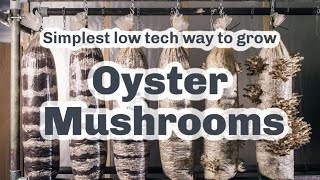
Richard Perkins explains a practical, "super low tech" method for producing oyster mushrooms using hydrated straw/horse bedding pellets and bought grain spawn, giving a specific recipe (2.4 kg pellets : 3.6 kg water : 0.5 kg grain spawn per ~6 kg bag), recommended inoculation rates (start ~10%, test down toward 6%; commercial ~3%), and incubation/fruiting guidance (incubate 10–14 days around 20°C; fruit in partial light and slightly cooler in ~7–10 days). He contrasts this with lime pasteurization and describes a small-scale business model and simple containerized rooms for scaling. The video also includes an extensive market-garden update (crop progress: radishes, beets, chard, carrots, peas, cucumbers, beans, squash; pest notes like flea beetle; irrigation and bed management), a shiitake log inoculation demo (using millet spawn, wax sealing, plug tools), and notes on agroforestry, root trainers and internship enterprise planning.
Chapters
So garden's really coming into their own and we've got some great harvests and new crops coming out into the box this week. And today we're putting in low tech oyster mushrooms with the interns. So super low tech, low sterile oyster mushroom production. We've been looking at oyster production on the board with spreadsheets and talking about critical factors, how to propagate spawn and ways of dealing with different growing mediums. Typically, you know, in the past, small growers using hydrated lime stratification. We are using horse bedding, which is these horse pellets made of straws, barley straw. And the beauty of these pellets is that they're already sticking. There are. And so we're hydrating them. We've got 2.4 kilos of horse pellets, 3.6 kilos of water to hydrate that we're aiming for like 65% humidity is ideal. You've got quite a big range with oyster mushrooms. It can be between 50 and 80 or something like this. But getting the moisture right is important. And then we're taking the spot brain spawn. This is actually grown on millet and we're putting 500 grams per bag. So we're going to end up with six kilo bags. This is lay flat tubing that we can use, cable tie on the end and we'll end up with a bag that looks a bit like this with layers of brain spawn. And then we cut holes and that allows air transfer. And eventually once the mycelium has spread, it's the oxygen at these points that will trigger fruit production. So There's a recipe 2.4 kilos of straw pellets, 3.6 of water to 500 grams of grain spawn. We've been talking about how in commercial business they would put about 3% grain spawn to keep the cost down. And for starting, you know, in a low tech way, I Recommend Starting at 10% inoculation rate and then, you know, find testing where the sweet spot is going down to 6% to minimize the input cost would be ideal. So this is a revolutionary way to do things because it's so low tech. You can see with we're alcoholing our hands and cleaning our hands, but we're not in any kind of clean room. We're just in our yurt and we're relying on the pre sterilized condition of the pellets and putting in a relatively high amount of grain spawn. So about 7.5% spawn in this case. And we've been testing this previously with the four types of mushroom we're growing, which is Indian oyster, blue, grey oyster, pink and yellow oyster. And that tends to work fine. So whilst in some ways the job of a mushroom producer is taking pure spawn, building it up in petri dishes, into grain bags, into whatever they're inoculating, it's cheaper and more time effective to buy good spawn off a reputable producer and buy these pellets and avoid the whole sterilization process. And so we're just testing it out in a super low sterile way. Like normally I want to do this in a clean room, but I think we will get some pretty good results doing it like this. What variety are you guys doing? It's blue and grey oyster, blue gray oyster. So different inoculation, different to the level of colonization, but there's, they've all colonized enough that this is fine. You see this variety has got a lot more developed mycelium, but these will go fine. And so we're looking for about six or seven layers across the six kilo bay, Same energy. So we are going for inoculation in the bottom of the lean to greenhouse, under the bench, will darken off with a sheet and it'll be there for 10 to 14 days. Basically we're aiming for a median temperature of 20 degrees for all these varieties. They all have their own specific ranges of temperature, humidity, etc. But we want to find a medium that's good for all of them. Just because we're growing them out for, you know, we're not doing this as an enterprise, more just for our own consumption. And then fooding, we will put them in partial light in slightly cooler conditions and they will be fruiting in 7 to 10 days average across all of them. So we'll follow these and see their progress over time. Nice sterile hands there. So if you wanted to inoculate. Sorry. If you want to sterilize a growing medium like straw yourself, you would need to use lime. Now that's not calcium carbonate like you might put in the garden. That's calcium carbonate that's been burnt to make calcium oxide and then hydrated to make calcium hydroxide. And we're basically killing any pathogens with ph using really high PH to sterilize straw. So you can put about 5 liters of calcium hydroxide in a thousand litre IBC and that will treat 100, 120 kilos of straw in 12 to 20, 24 hours. Then you have to neutralize that liquid. It's very high ph and you can't just put that out on the landscape, you would need to neutralize it with something like citric acid, bring the ph back to neutral and it's fine to put that out on pasture or something. But basically this method eradicates the need for any of that. And if you do the mathematics, it's cheaper to buy pellets and eliminate the step of building up your own spawn even. And you can get this down. You know, we've been looking at a model of 80 kilos of oyster mushroom a week to provide a net income of about 45 grand a year with a normal 40 hour work week for one person. Now, obviously selling would depend on how you go about sales. But this is 40% private sales to something like Rico and 60% wholesale to chefs. But this methodology is by far the easiest way to get around some of the sterility issues. Now obviously if you're running it as a scaled up enterprise, you would want dedicated spaces. And this is a model that we've been developing to put in our new book, which is based on the wagons. Like we build the slaughtery and egg packery from here, which is a really neat way to go because you have vinyl floors, heating already well insulated and that's what you need. So it's basically a three shipping container model where you have an inoculation room and an incubation room and then a fruiting room. And pretty easy to set up. Maybe €15,000 startup for a business that does sales of 6,700,000 crowns a year, 60 or €70,000. Okay, so off to incubate. It's 20 degrees in here in the grow room. Does get hotter in here, so we've put them under the table in dappled light. So no direct light. A little bit of lights. Okay. And we can always add a bit more of this shade cloth. We're just using a garden shade cloth and seven to 14, well, 10 to 14 days in here. The bags should get really hot. They'll get up to like 26, 28 degrees internally. Start sweating a bit as the mycelium really starts ripping through. So we'll come back and check in on these and see how progression goes. So a lot of covers off now in the market gardens. We've got a lot of flea beetle, but some beautiful hakaris. We're doing four per cell. We've been selling a lot of these, so we're letting the smaller ones grow up on and we'll be harvesting a lot of them this week. Lots of radishes, both davignon and the These are nice for the chefs that we sell to, but we've got lots of big red relish first. Fennel's coming up. They're a bit behind. Put beets and chard in now and lots of beans. More turnips. Carrots coming along. Bit low seeding density, but they're not looking so bad now. You see them flesh out a bit. Got these beautiful purplehead turnips, lots of them. Multi sound beets are coming along. We've got beets in this week's box and kale and first courgettes. We've been through harvesting the first of these, trying to get them to put in an extra water on these. We've got some signs of lower water and squash yield is particularly important to get good amount of water down. Just hear the thunder in the background. So beets coming along nicely. We're going to have really nice crop of them for this week's box. So things are picking up a lot. We've got some salads coming out of rotation now for new plantings. Lots of lettuce developing outdoors. Chard is coming into the boxes this week. There'll be carrots in the box next week, so things are getting back on schedule. Huge amount of peasants. So we've got a lot of peabeds this year and they're doing really well. So here in the new north, lots of squash coming in here also, and carrots and salad. More kale. Sorry, more chard coming in. And then we've come to the point where we're scrapping some of the onions. So the beds that haven't responded, these were the beds that got slurry at the root base and they didn't respond in any way at all. So basically we're harvesting the bigger onions from these beds this week and then pulling these beds to turn them over to something else. And that's been happening with the first salads. Some more nice beets and some good rows of carrots here. The carrots were not seeded as densely as typically, but we've got some good development that soon we'll have carrots in the boxes, which is nice. And so we decided to leave some of the lowest dense seedings in place to ensure that we have carrots and not be too far behind. And we've got much better beds germinating. Got lovely radish that we've been through harvesting the bigger ones, but we've got lots of beautiful radish ready to go out this week and Gordon's busy transplanting. Got lots of kales and chards coming out. Lots more turnips, lots more hackeris here. Really nice hackerai growth in here. So when we've got big flea beetle like this, we're just basically taking the leaves off and to restaurants. We're selling by weight anyway. You can see much better germination of these later seedings with carrots. We went off the pelleted carrots and to be honest, I think I wouldn't grow pelleted carrots again. It's just been too finicky and we've never had problems with our carrots. Peas ready to come through and harvest again. We're harvesting every couple of days to keep them at a really ideal age. So these are paper pots, you see. They're doing really nice. So a little rainstorm coming. We've had thunder and lightning. Got some nice herbs growing. Ah, according to rain now, look, trial beds going on. Still way too early to say much. So we're going to go have a look in the tunnel because bit of a freak rainstorm hitting us now. It might be a little bit noisy in here. So things growing well in here, lots of fruit developing and it'll be a while till we have tomatoes. But you can see things going good in here. We need to start coming in and pruning out. We're clearing out the last of the old lake and we've already replaced lettuces on each side of this one and cucumbers are coming in. It's going to be cucumbers in the box next week. We've decided to leave the lowest cucumbers on the plant. Something we'd normally do is take the first five out to have more cucumbers over a longer time. But we actually want the cucumbers now early in the season when we're lower on other crops. And so we've decided to sacrifice the long haul to get more fruit that's usable now. Got some nice basil. Coming up with some newer plantings of cucumber here. It goes along this whole row. We've had a few summery days, so much appreciated. Rain gardeners will be very happy. So over in the south, we've got nice beans and squash coming up in here. Growth is good. Broccoli haven't really responded to slurry beans coming in. Starting to get the first beans. Very small still, but we'll have an abundance of beans. And then as we come out into the south, got all our leeks, onions, lots more pea. So some harvesting to do today. First kale's under here. We'll be doing kale and chard bunches in next week's, this week's and next week's box. So the mestonada here has been pulled out now, getting charred in here, and we've got lots of chestnut coming up, which is very nice. And something we're doing in agroforestry week. We've got strong strawberries we can eat in here. These are all the suckers going on. Well, something we're going to do is build our own root trainers to pod on these cuttings of grapes. And so they're just in smallish pots at the moment that we want to root these on and make our own root trainers to see how that goes. So some nice carrots germinating here in the west beds. Things looking good. So garden's really coming back in. Whilst we've had a shaky start to the season, I think we're going to have a pretty abundant midsection and a really abundant end section that's kind of back to normal. Every time we're turning a bed now, we're basically putting in chicken pellets, tilling it in. And so we'll hopefully, by the end of the season, have the beds back to normal where they should be, which will be, you know, great for starting next season. So despite being bone dry and on a gravel drive, we've got kingswith area. Round two popping up. A lot of little heads popping up here. A few more over here as we get back into the wood chip. Very nice. Okay, next up is shiitake onto Aldo. We just did in there of the forest and we're going to do an experiment to put some on alder spawn in bags as well as with the straw pellets, just because that's fun. Here is shiitake spawn. It's gone a bit over. You see it's starting to pin in the bag. That's okay. We're using the thumb inoculator from Field and Forest in America. So this is to be used combined with an angle grinder attachment. They sell, sadly, it's only in America, but it's a very simple bit of engineering. This is way more efficient than using a drill. It's very fast. Obviously, it's very dangerous with an angle grinder. You've got to be careful just lighting up the Biolite stove to melt some wax to seal the holes, keep moisture in as the mycelium rips. But this is designed to create the exact size spawn plug to fill that hole. And the reason we want to use grain spawn this is on millet. Again, it's cheaper, more efficient. You can get more logs out of this than you would get in, like a domestic serving of plugs, which are usually really overpriced. This bag of three kilos would do, you know, 40, 50 logs a meter long. And it runs better in the wood. It's quicker to run through the wood and it's quite quicker to apply it and cheaper. Using a drill bit in fresh timber is challenging, whereas using the angle grinder is very fast. Now we use these little biolites, just burning twigs. It's a rocket stove. It's got a fan here. It's a thermocoupling, so it's using heat to make electricity. I can turn the fan up, you see, that goes fast now. So it's a smokeless fire. It's very efficient. And I can charge the phone to make you a video. This is the wax that will seal in the mycelium. And as you see as Malta comes through here, it leaves a little bit of a gap so we can fill with wax. And that's specifically to seal in moisture as we go along. And much quicker to do the holes. So wax to cover the holes keep the moisture in as the mycelium rips. We have had issues in the past with birds eating the wax to build their nests, which, well, you got to give it to the birds pretty smart. But it does affect mycelium. Obviously it dries out, but just enough wax, cover them up and then the quality control check. Once the log is done and the wax has become opaque, you can really see if there's any holes in there. So quite high density filling of the log. Logs have to be less than two weeks old to avoid any infestation with native fungi. These are fresh logs, so that's perfect for us. And just for fun, shiitake on. This is older that we use for smoking chicken and in straw. And we don't know how that will go, but why not give it a try? We didn't really do any research. We just smashed it in to use up the spawn. Okay, so that's it for today, folks. Just a little update of how things going. We're focused on agroforestry this week. Whole farm planning, making our own homemade root trainers, working with mushrooms, working with fencing up in the forest and looking at how to transition forestry, looking at planting agroforestry systems and looking at some of the people's projects and building up business enterprise planning as well as whole farm planning. So busy times. There's lots to go on in the next few weeks as we reach the halfway point and go into the second half of our internship program going into much more detail with enterprise planning and things like this for leaving people ready to go away and plan their own business and enterprises as they wish. So thanks so much for watching, folks. Thank you. Stay tuned. Don't forget to click, subscribe, share the video if you enjoy our content and we'll see you in the next video. Bye for now.
More from Richard


A review of short and intensive season on a mixed farm and restaurant/event space in Sweden






Alskade Kyckling Exploring complexities of poultry production in Sweden and what we stand for


