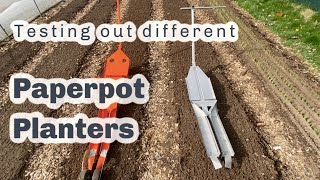
A hands-on comparison and test run of two paper-pot transplanting tools: the Curley’s Planter Pro (an Australian/European alternative) and the traditional Japanese paper pot transplanter. Richard Perkins inspects design differences, usability (weight, handle, trays, wheels, foot/cutter), performance in compost/no-dig beds, and notes likely variation across soil moisture and types; he flags strengths, concerns, and suggests further wet-soil testing.
Chapters
Okay, today we are giving a test run of the Curley's Planter Pro. So this is available Australia and Europe as an alternative to the Japanese paper pot transplanter that you see on the left there. So we'll give it a test. So a few differences with these tools. Now, this paper pot transplant on the front is The Japanese model, 45 years old, designed originally for spring onion transplanting, which is what we're transplanting today. And they make their own drop seeder and their own tray system. And that's true of the Curley's planter as well. It's got a few different features that we'll have a look at, well as its own tray system. So you can see the trays here very similar to the others, except they're open ended. Now, on the Japanese model you have this plate specifically to dig under the seedlings so that they can flow outwards. On the Curley's model, you don't need that. It funnels straight down. And it's not proved an issue yet. But I'm a little concerned about these open ended trays. They're very smart in that they work without that extra step. But my concern is that if a chain starts falling out or is knocked over, it's a lot more vulnerable in this system. These Japanese trays, you can carry them vertically, which means you can comfortably carry two trays out into the field. I tend to not do it like that. I'll tend to carry it at a slight angle like so, just just to keep less likelihood of it falling down. But that's one thing I'm concerned of. Also. We do microgreens in our trays and that would be difficult here without a closed end. So that's one thing that I don't particularly love, but it's also not a major concern. We haven't lost any trays to date. Now, a big obvious difference at the back end is the Japanese model has wheels. Now, we actually got sent a pair to test, but these are not on the production model. The production model just has these flaps for closing, similar to what you see on the Japanese model. The rim here is a bit wider on the Curley's planter and that they suggest to put bricks in here to help keep the back end down. Now we don't have bricks with us, but we've got a couple of weights as heavy as a brick. So we'll try that out then. One thing that I think is missing is a handle here and I think they've said that that's been addressed but this handle really helps for carrying the tool around the farm. One benefit of this tool is that it actually has a pin under here. And this tool folds in half for easy storage in the workshop. That's great. And a little detail I love is this gap here, which lets soil. As you pull out the paper chains, it lets the compost go back into the ground. That's really nice, this model. It gets full up here. There are little holes here, but they're not sufficient to let the compost through. Now, a striking difference. At the front end, the Japanese model has wheels, whereas you'll see on the Curley's model, it's a flat plate. You can set the height at different heights, just like you set the wheel at different depths to control the depth. But look, this is the big difference. So if we just tip over the Japanese model, we see this characteristic cutter that opens up the shaft to let the paper chains through. This model has a different style foot. Now, it comes with quick attachments and it also has a foot like the Japanese model, but it has this furrowing tool which, if we get a different angle on that, you can see it should really open up the space for the chains really well. So that's what we're interested in checking out. See how we like that going through the beds and how well it does closing up the beds again. So we might have to fiddle with the settings, but I think we've got that set at the right height. This has got a really heavy duty build, which I appreciate. And you can offset the handle to the left and right very easily. Whereas the Japanese model has a simple thin handle. We tend to work from the sides of the beds. You can straddle a bed also if you're working on 75 centimeter beds. But I like that touch and I like the heavy duty build. It's a lot thicker metal than the Japanese model and they don't take much abuse anyway. So it's not a tool that needs to be super heavy built. But it's always good for, you know, general moving around and dumping in workshops. And they take some wear over the, over the years. So in setting the tool up, it's a lot easier to get the chains flowing out to the ground. One thing I noticed straight away is it's less stable. I think the wheels and the cutting tool on the Japanese tool help it stand up better. I'm a little concerned that this might fall. Just got to get some pegs to start the row and we'll see how it's like pulling it out. So all of these beds have been prepped in the same way. So it's a fair test against each other. I'm very curious about this funnel opener. I think it could be much better in certain soil conditions and we haven't had enough experience with it to know that, but curious to see how it goes through compost. So you can see it plants them in. Well, one thing that I'm noticing immediately is it's heavier to pull through the ground because you don't have the benefit of a wheel and so you've got some friction there. And it's also you've really got to keep an eye to keep this level. It would be better if this had slightly longer lip because what it's tending to do is dig itself in. I'm not sure if I can do this one handed, but that's also because we're on loose compost. So that's an interesting difference to, you know, if you had a hard soil, I suspect it would run across the surface more easily. You see from the rose, I think it does a totally adequate job. It definitely feels like you're pulling something through the ground more so than this model. And I think a it's because you've got a sharper entry point and wheels really help. And it probably, I imagine it will work better in wetter ground where the Japanese model starts underperforming. Like if the beds are too wet, this becomes much easier to clog up. That compost will catch around here. And so we actually don't use this when it's too wet. I suspect this tool would do better in those conditions and so we would have to test it further throughout the season to see how conditions change. But I think it does a pretty decent job covering up. The only limitation I can see is on the back of the tool. You don't have so many options for maneuvering these. You see how they can clip in. So we could actually do that. We could try moving these in a little tighter, but that's about as close as you want them for the crops that we're planting. But I suspect a little playing around with these might help to close up different crops better. Okay, so the gardeners have been working with the Japanese model planting out a lot of onions so far. So it's curious to hear what their thoughts are immediately. One thing with this tool is it's heavy. That lack of handle and the weights on the back do make it more of an issue for maneuvering. I personally found it better at the end of the beds Where I like to stop the transplanter before we get to the end of the bed, to not drag compost off the end of the bed. But starting a bed in with this one seems harder because it's not easily channeling in until you really get it moving along the bed. So once you keep the level of that frame plate flat, it does cover the transplants up well. However, that requires more physical effort. I would like to see, as I said, a lip on the front of this bar that allows you to. To not have to think about that. That's obviously going to work different in different soil types. Or one big fat wheel. Like if this was one big rubber wheel with rubber all the way across, I think that would be even more useful. So Fabian really likes the way that this closes up after the plants. So part of the reason it's harder to pull through the ground is not only about the front disc and the wheel, but it's also buried them deeper, to be fair. And one issue you do get with the Japanese paper chains is like here, if it doesn't bury them fully, you can have plants that are only superficially planted. Now, that's fine once they get rooting down. And these have big established roots that are down in moist ground. But that can create problems if they're not planted deep enough. You want your soil level obviously up to the base of the plant. So that can be an issue with the Japanese tool is it's not going quite so deep. It's balanced against the easefulness of use. It's definitely more work to pull the heavier model through the ground, but it's putting them deeper into the ground. Now the only issue is when it's not going perfectly straight, it's gouging out big channels that it can't fill back in. But I think it, you know, you would get very different results with this in different soils. And so it's. I would say it's totally adequate for compost, like no dig sort of style like this. I expect it would, you know, it would have different results in heavier soils or in sandy soils that we can't really adequately test it. So we actually originally got sent the same sort of foot as the Japanese model, but we have no idea where that is, to be honest. So we can't do a side by side test in that way. I had really high hopes for this because I think in certain weather conditions this will play out much better. So maybe we'll test it again in wet weather and put up a video about that too. Okay. We'll See how they go against each other. I think this one is quicker. It's my feeling. I don't think you can move at that speed with this tool. Now, it's still much faster than hand transplanting, that's for sure. But I think you have to pay much more attention to that front, front foot. I think having more of a lip would really help that. But I think different soil types will affect that massively too, because there's a lot of friction, it feels like. But it does cover them up really well. It'd be very curious to try this model with a wheel. And certainly a long, fat wheel, I think could do really good. What do you think? I like the way it cover them, but that feel is quite compared to this one, where you don't feel that you don't have so much effort to do this one require much more. Yeah. Takes more effort to pull it through the ground, like straight. But I like the way it feels up, actually. Yeah. Fabian's saying he likes the way that this closes the ground afterwards and it's got a very simple mechanism, so that's good. This one feels much less effort and it wants to stand upright. There's a risk. This one wants to fall down and you definitely feel like you have to keep it in a straight line, whereas the Japanese model wants to travel in a straight line. Now, one limitation of the curly plant is its width. It's about 2 and a half centimeters, 3 centimeters wider than the Japanese model in the critical points. That's here. And it could be at the front, but actually these are the wider bits at the back. Now, that becomes an issue depending on how many rows you're planting with three rows per bed with the onions, like we've been doing, that's no issue at all. We do typically up to four rows, but some people like to do five rows with the transplant on the bed. I think this tool will struggle to do four rows on the bed because of its width. It could probably just make it on our beds, but it would be tight and given its extra handleability, I think it would be a challenge. So slimline is good, although this is built around putting a brick on for ease of having a weight on the back. And I appreciate that element, but that could be a concern to other growers who are trying to get more rows onto their beds with a paper pot system. So I think this tool can definitely work for some. And this was an early test model, so I'm not entirely sure if it's exactly the same as their production models, but it's available in Europe and Australia and it's cheaper than importing your own from Japan. Now, I was selling these for Japan and even with bulk ordering entire kits, you know, in multiples of 50, it's still hard to make the money back because of the shipping, etc. This tool is available, it does the job and I'm sure if we spent, you know, 10 hours with it, we would find perfect ways to use it. I think it's got some great features and I think it will work for many people. It'll be great to see more tests of this in different soil to really get a sense of it, but you can find out more about it in the links below. And all the other innovative tools that Curleys are making, they've made the first BCS powered Broadfork, I believe, and other interesting tools. And it's great to have innovators in this space who are, you know, responding to demands and innovating and making tools for you lot. So we really appreciate that and we look forward to testing this further in different soil conditions. When it's wetter, for example, to see how it fares up, then SA.
More from Richard


A review of short and intensive season on a mixed farm and restaurant/event space in Sweden






Alskade Kyckling Exploring complexities of poultry production in Sweden and what we stand for


