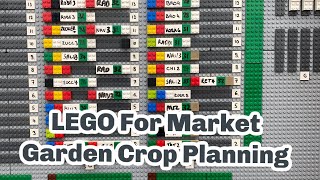
Richard Perkins shows how he uses colored Lego blocks to plan crop rotations on his market garden. Each color represents a crop family, and the blocks sit on a board to map where things go and when. His team can see the whole season at a glance and sync it with Excel for scheduling.
Questions this video answers
Richard Perkins
Washed in a washing machine
Black
Violet
Planted in week 32
Chapters
Main part of the garden is still here. So it's crop planning. And this is super cool. Check this out. Your garden. So this is the. I think this is the neatest crop planning system I've seen. Lego. Yeah. Tell us about this. How does it work? The idea is that every family plant has one color. Like cabbage is wet. So like we on the market garden, we have to do in one year, like, like more cultures on one bed. So and when I'm not here and when we have to improvise something, all my staff can see where was something on during the the year and they can put a new, new culture behind. So normally when we start at this, at the beginning of the season, we will have like one legal block. Sorry, it's not working all the time. So we will have like a block like this and you have a coat on it. We have it also on our young plants already. And you have. And you will have a color on it. But this will be what I do for my team. And then I place it on. On the Lego board, like here. And so the team knows that they have to plant this on that thing. And when they have planted it, they will put this one in front. Nice. And then we have like this one. So it was planted in week 32. And then we put also one behind when the harvest. So vertically can start. And so you can manage your garden very fast and everyone can understand. We also have a to do list. Normally you can have different colors of Legos. So you can put to do lists on it. Like a black one will say you have to put compost on it. Or you have a violet one for have to clean it. All the things you can integrate everything in perfect. And then you can do like. Like we did for each. Each month. Also we take one so you can see the evolution of the garden. And you've got a record of the whole season. So next season you have. You can plan on all these things again. Eva, I reckon so many people are going to copy this. It's so cool. It's fun for me. It's super fun with Lego. Yeah. And so you keep also on the vault, you keep always what family was behind what. So next year we know exactly what we can put in like a standard sort of rotation. Yeah. Yeah. Perfect. Sorry. Because there's also an. I don't know what's in the word, but she really should. So we did all this in axle first. And so you also have a locket accent. This is our culture planning. But we have also the whole garden system in an axle. I don't know where it is. Now here, that's an axle sheet with all the cultures, when they come where, and then you can put it on the table. So my team knows exactly where what has to come when. Awesome. Yeah. And so you can find the same code thing here. So even when we get young plants, this cord is also already on it. And so we can prepare the whole board. Awesome. What a cool system. And to clean it, you put it in the. What is it? The washing machine, and it's clean again. And so you can use it again next year. So. Because one of the things is you can use paper in your greenhouse because it's getting met by water. So this was a quite easy system to have the whole garden and to do it.