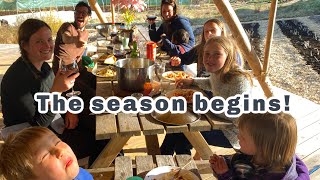
Richard Perkins' YouTube farm vlog ("The Darling Buds of May...") documents spring activities at his 59°N farm: finishing a wall/pond project, plumbing and hot water fixes, moving pigs into agroforestry paddocks, grazing management for cows and sheep, eggmobile/poultry adjustments, garden planting and irrigation setup, sausage-making (forest-raised pork + venison), glamping/campsite preparations, and on-farm trainings and books promoted. The video mixes practical how-to details (materials, voltages, pipe sizes, timelines) with family/community life (seven children, shared parenting, newcomers settling in).
Questions this video answers
~6,000 volts for sheep/cow fence; ~5,500 volts for pig paddock fence.
20 mm and 25 mm pipes.
Chapters
Welcome back to another video, folks. Spring is finally in the air up here at 59 degrees north and life is very different here at the farm. We've got seven children, five adults here and we're homesteading for ourselves, having a lot of fun. It's been the first week with the people getting to know each other, so I wanted to show you around a few things. What's going on right now at the farm. Last break in the wall. Alrighty. So that's the height of the wall. Now I've got to level the ground, take away rocks so we can put insulation here and then it'll be time to put the insulation behind here and fill the void while smoothing out the transition here. Then I'm looking to put probably 40cm of timber on top of the wall after the underlay and liner are in. That will hold back the gravel. Gracie, what's going on here? Okay, so went to turn the heating system, the water system on in kitchen. Wagon pipe has burst so we've been flooding the floor. So pulled out the old copper pipe with a stringy string and now we have to pull another pipe in to get us to the sink. I flooded it this morning because the water heater had blown up. I thought this was all drained out during the winter. Obviously not. But my preferred system has always been to have a big hot water boiler. This thing's not capable of producing very much hot water, not enough to wash up even with a few people. So I'm gonna have a big hot water boiler and a Thai bucket system which is how we've always washed up for big courses. One hot soapy, two cold rinses. Not sure why that looks like that, but that's the mission is get water running by tomorrow so that when people arrive we have all we need. So I just need cold water in here and that's going to be fine. But now we've got the string running through the floor. We're going to see if we can get a 20 mil pipe, 25 mil pipes through. Okay. One chance saloon to pull this through the floor and out. So hopefully when we pull this little blue string, this pipe will go in and then we can connect it back in. Bjorn is taking the trusty Simon bed. Former. This is what we made with the tree beds with. Back when I moved on to the farm, I was using this in combination with the keyline plough. This is a twin roller machine that specifically it's a rotovator with another rotor up under the back that buries the stones. Very impressive. And Perfect for making tree beds in pasture, but also perfect for making very well formed vegetable beds. So Bjorn has taken that where the pigs have been rooting up the ground and tomorrow making nice neat veg rows. We like it. Hello. Alrighty. Nifty new pipe. The bed former rides again. Nice. This is so cool. There's the first adder. I'm just checking the fence for where I might put the pigs. Happy adder. What is going on here? Oh, a Grace and Vilda like taxidermy and they found a dead adder. So they're amazing.
You found a dead adder and told me to taxidermy it.
Look at that beautiful skin. So cool. Good job.
No, I'm going to stretch it out. But first, just to keep it enough that I can stretch it out. I made it. If this is a meat eater, here's some meat. And here's. And it goes to. And it eats the plant eaters. And here's some grass. But when the meat eater dies, it goes to soil. And after some days it will be grass there.
And then the plant eater eats it. Whoa. The cycle of life with Ragnar P. It's a big day. All the piggies are going through the forest. Hello, Little grease. Oh, piggy piggies. Okay. We're moving pigs to the first agroforestry paddock. This is where the pigs first ever moved onto the farm. And it's a very nice paddock that you've probably seen before. And I think these pigs are going to be very, very happy. This is luxury. Glamping Jotun's making luxury. This is going to be one of two compost loos made out of old timber poo with a view. We like it. Oh, yes. We've got no frost forecast for at least a week, so I thought I may as well get the water system on now. We can always drain it. That is far superior to hand watering. Hey, piggies. What are you up to? Sausage making day. Look. This is forest raised piggy fat. We've got beautiful forest raised pork fat. It's lard fat. We're putting in sausage. 30 or so. This is venison from the first deer that I shot. Fallow deer. Forest raised pork. We're going for a little mix. Bit of chorizo style and a bit of kind of lamb spicings. Then we're going to stuff them in sausages. Super nice. Yeah. Ice cream. Yeah. So the cows and sheep are very aware that the grass is growing. I've had to put up sheep fencing inside the perimeter fence. Because the sheep have found a place they can sort of lift the fence up and get under. And once they know, they just keep doing it. That's kept them in for now. But we're not grazing the neighbor's land this year. So I'm basically fencing in this whole area, giving them access still to the old pen. They can still get water and they can still get haylage. But I think once they eat fresh grass, they're not going to be very tempted by that. So this is going to be a bit of a sacrificial patch. It's very early to get them out. Grass has started growing quite quickly. You can see the trees are going into leaf. Hazel's coming on here. But it's very. This time of year is critical. You don't want to impact the grass too heavily. But what I want to do is get them out and still have some time to set up the water line. Because the water lines that go up the edges of our field are not on yet. But if I connect it to the winter paddock, then they'll be able to get water. I'm using standard sheep netting with vertical plastic uprights, which keeps the fence standing up beautifully. This is how we graze the flood when we have cows and sheep together. If we were just doing the cows, we would end up with just a single wire to keep the cows in. But we will be grazing them together this year. As with all nets, to get it tight, you use your foot to push on the bottom to get it taut. And if you're smart, you can walk along without bending over. I just dropped it and it's a very easeful thing. Nets are all coming out of the winter storage. If you store nets properly by rolling the net into the collected posts, they don't get tangled up. And I love working with poultry nets. These kind of nets, it's just secure, fast. Takes no time at all to give them. They're allocated space for the year, so we've got to do our grazing plan. We're a bit behind on that. I wasn't intending to get them out just yet, but I think they can already tell something's going on if you hear from the noise in the background. Okay. Using the Voss 3000 Apollos, this is the only energizer on the market in Europe that I recommend for two poultry nets. It's got three stored jewels and if we have a look, five and a half thousand volts down 150 meters of sheep net. That's ideal. So we'll have lunch and then we'll get all the kids and go through the ceremony of letting the animals out. It's a marrow. It's like a zucchini. Finally, reading from the farm. Black currant juice, potatoes. Forest raised pork. Microgreen salad. Chives from the home garden. Eggs in a mayonnaise. Perfect. Look at that. Asparagus is also coming up. And so we've got a harvest every day now. Look. Beautiful. I'm actually giving these compost. I haven't got around to more than this because these beds haven't had any for ages. Got all these beds made up. We've got onions and garlic. We've just put nets because of the birds. And now we're about to plant potatoes in the rest of that. We've got a few different varieties. Purple ones, yellow ones, white ones. And because of the weather, it might be a little bit of frost coming, but generally it's looking quite nice. Oh, it's all starting to go. Strawberries coming up. Gonna have rhubarb in the next week or two. Make crumbles. Louise has been making ice cream with some of the berries as well as candies with beef gelatine to see Aim in the years to try and homestead and make things for all of our needs with what we got. And because of kids food needs are a little different this year. But finding a way to just make all we need with what we have on the farm, which is awesome. Who's been making blackcarrant candies? Freedom.
Oh, stop. I'm literally gonna get a froggy.
Okay. The rich stone mini. So easeful. We're still working with two 50 meter nets, but we're just moving the eggmobile within the net so much slower around the farm. We're gonna have trouble keeping up with the grass this year because we're. When we had full eggmobiles, they would have quite an impact on the 4 or 500 square meters that they had each day. But Obviously with only 25 hens, they don't make much impact. We're about half production of eggs at this point. That will ramp up over the next days. The thing's really just greening up quite suddenly now. Super nice cows are out in the background, the darling buds of May. So it's good to have the irrigation on. Growth is slow here because it's still pretty cold. It's hot in the daytime, but it's getting cold at night. Still a little bit of pretty much frost first. Radishes just germinating here. Oh, very nice. Been hard to keep these Beds moist. We got carrots that they won't be germinating yet. Take a bit longer. But yeah, having the irrigation system set up is definitely a big bonus as we start to spread out. Got a bunch of beds to transplant in the coming days. So my neighbor Bjorn and I got to the point of finishing the wall, but we're stuck on this project because we're waiting for the insulation that I wanted to install behind the bricks and on the floor before we fill it with soil. They've been delayed and they said end of the month, but now we're into May. It's a bit annoying because I want to get this project going, but I'm also considering forgetting the insulation because the cavity behind here is not that big. And what I want to end up with this soil level to the bricks and a nice dish shape to make the pond. There's going to be 40cm of wood on top of this that holds back gravel that we plant in. So I need to end up with a nice profile. And I'm worried that by the time the insulation's in, I won't be able to move enough soil to make that profile. So we're going to have to see how that goes. I'm going to make that decision soon. Obviously, some areas there's a lot more soil to fill in, but too many things to think about at this time when everything is starting to come to life. So chards, kohlrabbies, more lettuces, first peas, and then we've got broccolis and other things. They have been hardening off here, ready to get transplanted in the next days. Tomatoes are going crazy now and it's a bit of a problem. We've got microgreens that we've been eating to have the first salads. Cucumbers are in, plenty of things on the go, but a few of the tomato plants started flowering, which is not what I want. I'm considering actually putting these out next week, even though it's a bit of a risk because we can have frost till the 6th of June. You can see a bit rambunctious and they're getting leggy in the middle. And normally, as I explained in earlier videos, we would take out every second plant and put these with sticks. But I think now they've grown as they have, I'd rather just try and get them down in whole trays without damaging them and see if we can just get them in the ground next week. Don't really want tomatoes going below 10 degrees, but it's a space issue and we've just got to do it at this point. Got cucumbers coming up. Lovely. Still got Grace's artichokes in here. Want to wait for the frost to go, but they're sort of stagnating, waiting to get out first. Zucchinis over here. They will be transplanted into a bed in a couple of weeks. Probably need pollen on. But keeping this temperature is getting hard now even with their doors open because it's just so warm in the days of late. I think it's the warmest spring I can remember for quite a long time now. So progress on camping. If you remember back to the start of last year, I built with Wilhelm three of these six meter platforms tucked away here for ten teepees. And there's two nine meter platforms for the old yurts that we used to use as classroom and dining room. Now we've got the big teepees, we've put them up here. Got new covers in. Jotun is busy making compost loo number one of two, poo with a view. And so this is going to be camping or glamping something along the lines of people can come live simple, close to nature, but with a nice bed and somewhere to charge a phone or whatever it is. And they can buy food from the farm. We're going to have excess eggs and meats and vegetables, etc. And I'm actually Jotun's employed to run this as an enterprise, so he's kind of in a different role to the rest of the team, but also part of the bigger family for the summer. And we're curious to see how it goes. I have no idea, but I guess we're aiming to get this out in June and have people for the next three months able to come camp on the farm. Okay. Got the tie style washing up system. Reinstall dolls and for the first time ever, we got a washing machine. Fancy living. Looks like wonderful grass fed beef for dinner. So this is the pond that is filled by the stream that is down here, but it's higher in elevation up near the big trees here. So we pipe it in and it overflows out this little hole here back to the stream. I've got a few brown trout that I put in here from when the streams were drying up in the forests. Yet to see them this year, but they usually start hunting on the surface. There's also freshwater mussels in here, but this year I need to get in here and clear out some of the plants to make a bit More room. A lot of life going on in here. We've been seeing a lot of snakes, a lot of frogs. There's tons of frog spawn everywhere. And just now we've primed market garden pump so we siphon water with a footer valve floating about 40 centimeters below the surface. That comes down through this filter and it's pumped up to the market garden. That makes it much easier to irrigate the crops. So that's all set up and running now. So these eggmobiles are just gonna sit as ornaments this year. We're going to take the electronics off these and put them on the Ridgedale Mini. So solar powers and automatic opening of doors, nest boxes and lights in the evening and definitely a lot easier to manage with just a few. These are going to sit up here in nutfield and we'll be grazing around and through them. But it's going to take us a lot longer to get around the farm with the small flock of birds. Cows and sheep are very happy now. There's not much grass in there, but I think at this time of year they're so eager to get out, they'll be happy in there. They've got access to their silage. And we'll be moving pretty quickly around the farm at this point to not over impact the grass. They're right next to the pigs, so that's going to be interesting. Pigs are up here in the first of the agroforestry patches, the most developed one, where the undergrowth has been cleared. So even deep in the summer growth, you can really see through the landscape here. This is a portion of the farm I've documented every year on YouTube because it's been fascinating to see the differences compared to the neighbors land next door that's never had livestock on. And I'm just going down to try and eyeball the pigs. You can see they've been snorting around, but they found themselves a lovely place to camp under the trees here. Now, big animals like cows and sheep are a little bit scared of pigs and quite reactive to them. But I believe the pigs have made a little hollow. It's been so sunny. I think our neighbor Bjorn, that took a couple of the pigs, had trouble with sunburn. But these fellas, they've made themselves a little nest in here in the shade, very nicely tucked away. They're spending a lot of time sleeping at this point. They're pretty happy. Well, well, well. Hello. What do you think about that out on the first grass? So we're not having any lambs or Any calves. These animals are destined for the freezer, so I didn't want to breed them. I want to be free of livestock next winter. Changing plans Life is changing around for me very much, and I want to have a winter totally free of livestock to accommodate some of the changes that I foresee coming. I've been waiting for people to come for months now and working furiously in the last couple of weeks trying to get things ready. So blessed by the weather. At this time of year, it can be minus 10 and raining and miserable, and it's so hard to accommodate people comfortably in the simple setting of the farm. We're often outside all day. We eat outside whenever we can. And this year with kids especially, I was feeling very nervous. But we've just been blessed. The weather's been incredible and it's been so lovely. It's a lot about people management this year compared to farming. I can basically run around and do all of the garden and animal chores myself if I needed to. And the aim of this year is just to really produce our own food and make use of things like making things with the kids, taking care of all the berries, making ice cream with the kids, making candies that are homemade and healthy alternatives, and really giving them the summer of a lifetime, really. And it's been super fun so far. We've just been getting to know each other this week and really nice atmosphere and really nice to have multiple parents sharing kids and putting their different perspectives on the group. And it's so nice. It's been really, really fun week. We've got a bunch of things done. There's always plenty to do at this time of year, but also plenty of time with the kids and they're settling in nicely. There's an older group of kids and a younger age group that are similar to the ages of my kids. And I think I'm feeling really happy with the dynamic. I think we've got a really lovely group of kids and a really lovely group of parents, and we're just getting into the rhythm, getting organized with how we're dealing with cooking, how we're dealing with basic farm chores. I wanted everyone to settle in. So this next week we're going to get structured and organized, but still very leisurely and homely feeling. We've got 6,000 volts going through the sheep and cow fence and five and a half going through the pig paddock fencing. They've been trained to the fence down in the barn. And do look back on old videos if you don't know what I'm talking about. These are areas of land cut at the same time, the only difference being planned grazing and animal impact. You see, our trees are three or four times the size, much more diversity, a lot more grass and forage. There's still brushwood lying underneath this and blueberries, we don't see any of that. And that's just management alone. It's created this incredible agroforestry that's far more valuable than the monoculture spruce like you see up on the hill. That. That's the last little patch of our land. So we had to go through here and really clear out any brash touching the fence. And down in the hollow here we had insulators like these screwed into trees, which is often handy when you're going through wooded terrain. Trouble is, trees grow out quite quickly and start embedding these and then it's impossible to get them out. Ideally, you come and loosen them after a year or two and just keep them coming out as the tree grows. I actually had to snap these off, get the wire out and put in new insulators to avoid them touching the tree and shorting out. Not too concerned about damage to the tree. They're just, you know, one of. There's about five trees in the fence line and, you know, it's no big deal to me. And for the difficult places where it's quite boggy down here, so you wouldn't get a fence post in the ground in a stable way. So that's why I would select trees. But this is a perfect place for the pigs. I think they'll end up possibly staying primarily in this paddock for the whole year because there's only three of them. We aim to butcher them in sort of September, October time. So they're getting grains from local organic farm, but they're getting a lot of veg, scrap and things from the kitchen as well. So I'm yet to make a grazing plan, but the cows and sheep are just being put out and they're going to have. Yeah, I think they're going to complain if I don't extend the paddock for them, but we're going to try and hold them back a bit and then get them marching around the front really fast. Basically, as a rule of thumb, when grass is growing fast, you move fast and when grass is growing slowly, you move slowly to affect the recovery time of all the grass around the farm. But we need to get a grazing plan together and that's something I'll introduce the team to and explain a bit the principles of how we work and why we do what we do. But we're taking it very leisurely this year so no big stresses and doing things right the way they're meant to be. All right, that's a wrap folks. Busy days, but leisurely and very fun being with the kids and the crew. And wanted to let you know if you want to join us for any of the trainings this year. The Pastured Poultry Masterclass is now full, so I'm afraid that's fully booked out and we still have some spots on the no Dig Market Gardening class as well as the Regenerative Agricultural Design training that's our signature on farm training that I've taught to thousands of students around the world. Now you can find about them in the links below as well as if you want to buy our books, that's the best way to support this channel, to support us and the information and knowledge that we've put together into a practical guide, a university style textbook of how to do all this stuff as well as Richdale Farm Builds, how to build low cost Farm Ready infrastructure. And it's like an IKEA manual for building eggmobiles, boiler pans, roller pans, smoke houses, whatever it is you need. You can find all that in the links below. I look forward to updating you as spring really starts now and then we'll have a lot of videos of nice content of all the things going on here throughout the summer. See you in a video soon, folks.
More from Richard


A review of short and intensive season on a mixed farm and restaurant/event space in Sweden






Alskade Kyckling Exploring complexities of poultry production in Sweden and what we stand for


