The first transplants at 59 degrees north. No-dig/no-till growing.
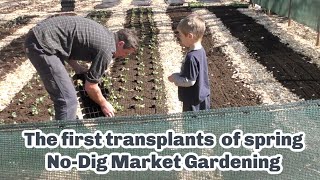
Richard Perkins (Ridgedale Farm) demonstrates first-season transplanting at his high-latitude market garden and explains his no-dig/no-till ‘Ridgedale’ approach. He transplants kales, pak choi, lettuces and spinach, describes bed/path construction with raw spruce wood chips, explains soil-life and water-retention benefits (humus water-holding claim), and covers practicalities: spacing, hardening-off, irrigation timing, use of row covers, and upcoming crop plans (tomatoes, onions, microgreens, crew/ trainings). The video mixes hands-on demo with reflections on scaling no-dig for commercial production.
Questions this video answers
April 22, 2022.
Kale (four beds), plus pak choi, lettuce, and spinach.
Three rows per bed, plants every 30 cm along the row.
15 cm along the row (four rows of spinach in that bed).
About 110 g radish, ~250 g sunflower, ~500 g peas (noting he says it's double when using paper pot trays).
Chapters
Welcome back to another video, folks. It's the first day of planting this spring. I'm super excited. It's a beautiful sunny day. It's still cold at night times. We've got a few days with frost anticipated in the next week. But a lot of the transplants are scheduled to go out now. And because of the fair weather, I figure if I treat them right, they'll do just as good outside. So first seven beds are kales, four beds of kale. Then we've got pak choi lettuce, and a spinach crop. These are quite shady beds behind the oak trees here and behind the windbreak here especially. So I want to put the spinach in there to avoid bolting because it's been pretty hot and dry. You can see I've marked rows here with the bed roller, and that just gives a little bit of surface compaction and gives me a nice straight road to follow. So my process is very simple. I just come along with the dibbler and loosen the transplants. You never want to pull the transplant out by its stem. It's not designed to hold the weight of the soil and its roots. And so I just loosen that up by plonking it and pushing it down on here. And then I lay them out at the spacing that's required with kale. I'm doing three rows and every 30cm, like you can see in this bed here. So we'll get on with that and we'll have some time lapses as we go through this process. Okay, so before we get going, let's just talk about no dig and this approach to no dig market gardening, we can call it the Ridgedale approach of bringing all of the benefits of no dig growing, which for me is the optimal way to manage soil and bringing that to an efficient format for commercial production. I. I was always inspired by people like Charles Dowding, who took off from Ruth Stout's work from a long time ago. And what I've done, what we call the Ridgedale approach, is just make that efficient at scale. So the biggest change is putting in wood chip pathways. And that's so important in this context. Where I'm sitting right now is heavy clay. And it was the former owner's part of the property that belonged to the forestry. And there was big, heavy forestry machinery here. Every single spring when we moved here, before we turned it into market garden, was standing water for weeks and weeks. In the spring, that's gone. And so what I really favor is efficient bed creation and then leveling those raised beds with wood chip. Now I use uncomposted, just raw spruce chip. Now that's because in Sweden nearly all the trees are spruce and it's easy to get hold of. But I like that. I've seen many of my students further south using deciduous trees and that's much better for the soil, but they decompose annually. Mine lasts some years and that's great benefit. No issues with nitrogen robbing or anything like that. The paths and the beds are quite separated, so you can see if you look back at old videos and photos, edge crops on the beds, they show no sign of nutrient deficiency. We're putting down compost and there's plenty of nutrient and soil life unlocking nutrient for plants. So we've never seen any deficits. The benefit of this system is that I can just uncover these beds, rake them over, off we go. In the spring, because they're dark, they warm up quickly because they're covered. Life is busy under there, even when you think it wouldn't be because it's frozen in the landscape around and it stops weed seeds blowing in too. Other benefits of no dig are keeping soil mycorrhizae and soil life happy. And ultimately we've got to be micro farmers at the base of it. If anyone asks me what I do, I'm a microbe farmer. Whether it's holistic management in the pastures, whether it's agroforestry. If we look at how soils function in the habitat we are working with, that will lead us to appropriate actions. So here I'm keeping the soil covered and that's letting life go on all through the winter. And I'm leaving plant roots in the ground. There's a lot of food there for microbes that's being decomposed slowly. So when I put in a kale crop or something, I'll cut it to harvest and then I'll come back and cut it down at ground level and let it decompose and just transplant on top of that. Sometimes if I'm direct seeding and I need a clear bed, I'll either pull crops like a mescaline mix, or I will put a thin layer of compost from the winter bedding in the tunnel on top to give access for the seeder. We save a lot of time in a garden like this with virtually no weeding. One of the biggest videos on this channel is about the weed free market garden. Personally, with 200 beds 10 meters long and two big tunnels, I can go around and keep this squeaky clean in about six hours. A year. And that's mainly keeping the edges of the beds clear because we have creeping grasses coming back in. So I just trim the edges and pull out any creepers that are in here. It remains squeaky clean. And that's more than just aesthetics, it's practical. When we're walking along on the wood chip pathways, you've got dry feet even in heavy rain, and that's a real pleasure. It's also very beautiful. And this is the first thing you see when you come into the farm. So that's the marketing piece in itself. If our vegetable garden is this incredibly beautiful, then everything we produce must be of great quality. That's how it kind of translates the level of care that goes onto it. But we're saving a lot of time with pest, disease and insect pressure, too. A healthy living soil system keeps things in balance. And we don't see nutrient deficiencies because soil life is unlocking nutrients as they're needed by plants that are evolved to to take the nutrients they need. We save a lot of water because this amount of humus is holding so much water. One particle of humus holds four molecules of water. So if I increase my soil organic carbon by 1%, I can store 144,000 liters of water per hectare in the living topsoil where plants want it, I'm increasing it 20%. So I'm literally creating a sponge. And then the wood chips are doing the same. They're soaking up excesses in heavy rainfall and releasing it again to the plant roots when they need it. So this garden stays beautifully clean and beautifully functional and saves a lot of work. Now, it's obviously a lot of work to make no big beds in the beginning, but not so much more work than creating a tilled bed from scratch. But the problems with tilling are multiple. You oxidize carbon into the atmosphere, which is a major problem when we do that across billions of acres around the world, or millions. But we also wake up plant pathogens, which are mostly air rolling and need a lot of oxygen. Like most tillage systems, you're introducing far too much oxygen, and that wakes up pathogens and diseases. So by mimicking nature, building soil from above, and keeping soil covered at all times, it just creates so many benefits. It's been amazing to watch this methodology spread around the globe. I've seen thousands and thousands of farms using this method successfully. After 20 years of growing vegetables, for sure, I can say this is the optimal approach to human scale, small scale vegetable production. And so I'm really proud and Happy to see that all the efforts we've put into documenting this stuff over the years and sharing that has been not in vain. So beds are tucked away asleep under these non woven geotextiles, primed to go. This is beautiful. Now the soil biology keeps active under here. When I peel these off, there's worms active already even though the soil is cold. And then my process is to take a tilther. So I use the Johnny's tilther here, just powered by a battery drill and just give it a light fluffing over or just with a rake. And then I'm using the bed roller to mark out rows. Four rows here for spinach, three rows for lettuces, pak choys and kales. And you can see this is one of the great joys of no dig bed start up. I can come along in spring when we have a very short growing season here. It's just three months without frost here, so it's a very short season and this really helps to get things going quickly to be able to just open up beds when they're needed, rake them over and start transplanting immediately. I'm putting in the first seven beds today. There's plenty more seeding and plenty more planting to come. But this is a homestead year. I've got my crew arriving in two weeks and we're basically planting out the old north here. There's about 80 beds. We'll also be planting the big and small tunnels and that's going to be more than enough veg for us. Now we're opening up the camping in the spruce forest here and so we want to over plant because we don't know how that will go. Maybe there'll be a lot of visitors here over the summer and we also have a few trainings which you can find in the links below. Below we're running our farm scale design training, regenerative agriculture design training. It's an evolution of a pdc, a permaculture design course focused specifically on farm scale production, regenerative agriculture and really distilling all of my experience in the last 25 years into a nine day very intense training course. We've also got a pastry poultry masterclass for Pastor Boylis with a chance to get in the slaughtery and see how to run that part of the process very efficiently as well as all the ins and outs of how to run that business. And we're running a no dig market garden training four day intensive looking at how to do this stuff at scale to make a good living on a very small Acreage square meterage is more.
Apartment so now come sit down. You talk with me now see through your eyes where there is is so much light. We are biding our time for these myths to unwind for these changes we will confront. So please beware with every place that you head and look to your soul for these things Things that you know for the trees that we seek.
Now just working my eye to put these out. You don't need to measure things precisely and you quickly learn how to space things appropriately. The good thing with seeding 10, 20% extra seeds is that you can just select out bad quality plants and anything that's sub optimal. So you end up with a good full bed how you want it. Optimally, you would work in a pair. One putting out plants at the right spacing, the other tucking them in quickly as you go. I'm here alone for the next couple of weeks, so I'm just working alone. But it's a couple of minutes to put them all in so there's no risk of drying out. And we're going to give them a good old soak once they're in.
You know, some people, they just won't understand or just won't understand these things. Thank you for your message, but I don't understand.
So transplanting is a big shock to any plant. We try and rely on transplants because it's such a short season here. So to have a plant that's a few weeks old is optimal and better in the shoulder seasons when it's cold too. So you want to give transplants a really good watering several times even to saturate them before you put them out and then obviously water them in really well. And that's because the bed is often going to suck moisture away from the plants. You don't need to be precious with transplants. As I was learning in my teenage years, I was always told plants are worth nothing until you're harvesting them. And it's true in some way. You don't need to be precious. Certainly if you're working at scale, it's about getting them in the ground. Now, these plants would typically go through hardening off. Hardening off is an important process where you acclimatize plants from the protected nursery to the outside environment. And typically we'll put plants into the polytunnel for a week where they have warm days and cooler nights with no frost. Because there's no frost forecast or certainly no heavy frost for a week. I've decided to skip that step because these are all hardy Crops. And once I put these all in and waddle them, I'm going to put hoops and row covers and that's going to create pretty much a nice situation. Like it would be inside a polytunnel anyway. And so that's just practicalities at this time of year when I'm working alone here and got my children to manage, as well as all the other preparations for the season. But don't underestimate that. The reality is you can knock back crops a couple of weeks if you're not careful. But I think with kales and things, these are definitely ready to be in the ground now and the weather is favorable. Oh, you're a good climber. This guy is so. Good climber. Spider hunting. Nice habitat. This is the kind of spider that bit me. You got bitten by a spider? It was really painful, wasn't it? Yeah. But the thing that was more painful was that the worst feet that we.
Look at, grasshoppers, but they're not grasshoppers. In this sacred land it has seen many hands it has wealth and gold and it is fragile and old enough. The greedy souls just don't care to blow off the changes it will confirm. So speak out loud of the things you are proud of. You love this coast and keep it clean as it rolls. Cause the way that it shines may just dwindle with time.
So in other news, tomatoes are coming on fantastically. My neighbors have been incredibly helpful. They're homesteading just through the trees here and they're looking after the farm when I'm away. Really nice to see the strong growth of these now. Some people start their tomatoes in Sweden a lot earlier, but it's always a risk. We have frost up until often the 6th of June. I don't want these out till sort of 20th, 25th of May, and so I don't want them getting too big. So I found the optimal time for me to get them started. Lots of other stuff coming on. Got peas, lettuces, all the onions to go out very soon. We've got cabbages pretty much ready to go out as well. Now, they're not on the schedule to transplant to next week, but you can see they're ready to go. More spinach, cauliflowers, broccolis, more tomatoes over here. All go at this time of year. I've also got microgreens going because we will not have any fresh greens ready. Maybe some spinach just about. By the time the homestead crew come, I thought I'd start some of the quick growing microgreens. So we've got about 110 grams of radish, about 250 grams of sunflower and about 500 grams of peas. But actually it's double what I just said because I'm putting these in paper pot trays. And so I've worked out the optimal seeding density to put in these trays, which do great for microgreens because they're perforated. That will give us some fresh, super nutrient dense greens for those who want those. We've got five adults, seven kids in a couple of weeks. So it's a lot of hungry mouths to feed.
Thank you for your message, but I don't understand.
These things.
You know, some people, they just won't understand, won't understand these things. Thank you for your message, but I don't understand, won't understand these things.
Sam. All right, down to the last batch. Spinach, four rows and 15cm along the row. Got two trays of this in the smaller one. Four, four trays. Spinach is often direct sun, but I like to transplant it just to get a kickstart up here. Even though it's a cold hardy crop, probably one of the most cold hardy crops, you get better germination in the context controlled growing space of the nursery. And this will be probably one of the first things we'll enjoy with the crew. All right, that's a wrap. Nice couple of hours of work. Everything's got to get watered in. Well, now I haven't got the irrigation system if you're familiar with the farm. We have a pond filled by the stream down at the bottom of the farm. But that pump system is not to be primed and put into use until the frosts are over. So I'll be watering these just with the hose and I've got little rain collection places around here. Give them a good watering in. And then I'll be putting over 4 millimeter wire that I use to keep the row covers up off the crops and I'll tuck them in. I'll probably leave that till this afternoon, but just make sure it's in before tonight. And looking forward very much to watch this garden come to life. I've got a lot of flower bulbs to put in as well as onions and potatoes. It's a bit early for potatoes. I'll do that later in the month, but I'll get the onions in probably tomorrow. Thanks so much for watching as always. Hope you found that useful in some way. To see simple little processes that go to making efficient and effective. No dig. Market gardening work whether it's commercially or on the homestead level. And you can find out a whole bunch more in our books that you can find in the links below. As well as our online offering, there's free free online trainings as well as paid masterclass that you'll find in the links below. I look forward to sharing a lot of things we do this summer. See you in a video soon.
More from Richard


A review of short and intensive season on a mixed farm and restaurant/event space in Sweden






Alskade Kyckling Exploring complexities of poultry production in Sweden and what we stand for


