THE PERMACULTURE FARM (PROFITABLE/ECOLOGICAL/BEAUTIFUL) S4 ● E3
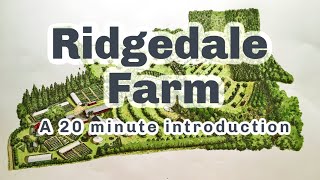
Richard Perkins presents Ridgedale, a 10-hectare regenerative permaculture farm in Sweden at 59°N, describing how the team uses permaculture design, keyline design and holistic management to run tree crops, pastures, market gardens and livestock in a cold climate with ~120 frost-free days. The video emphasizes low-cost, replicable enterprises (egg mobiles, market garden CSA, on-site slaughter, ponds and ram pump irrigation), hands-on education for international students, monitoring and soil/ecosystem regeneration, and community/customer relationships as central to farm resilience and profitability.
Chapters
Welcome to Ridgedale. We're a small, diverse, organic or beyond organic farm at 59 degrees north in Sweden, about the same latitude as Magadan and Russia on the Road of Bones or nearly up at Yukon in Canada. So it's quite an extreme climate for creating a farm. We have about 120 days frost free, give or take up to a month because of the extreme latitude, very low sunlight intensity here and a very long winter which has its bonuses because we get a long rest period if we're able to produce an income in the short growing season. And we really believe it's possible to meet all of our human needs whilst restoring our soils and our ecosystems and our communities. And that's possible anywhere on the planet. I believe we've got all the technologies and knowledge necessary to do that and we've now got all the decision making and planning processes to accomplish that. Whilst accounting for the complex systems that we must work within. We use three main design approaches in the work we do, which is permaculture design and key line design and holistic management. And keyline design gives us ordering framework, an order of priority for scaling up permaculture to the farm level. And holistic management is vital for decision making. It's primarily a decision making framework, but it's also associated with grazing of livestock and economic planning for farms too. So our farm is small. It's 10 hectares, about 25 acres. And it's about half pasture and half either old spruce monoculture forest or cut forest that's regenerating back into native woodland. This is the day we moved into the farm in March 2014. It was owned by an old couple who had been running sort of homestead there for many years, horse drawn wheat, growing and raising their own pigs, etc. So we designed up a farm that's based around perennial crops because these are what we see will be resilient in the future in the face of changing climatic conditions. So it's a tree and berry fruit production over pasture, pastured livestock and we do extensive market gardening and a bunch of other stuff as well. This is what the farm looks like. Three seasons in the windbreaks are establishing and the tree systems are establishing and our pasture is already becoming some of the richest pasture in the village after our intensive impacts with particularly poultry here. And the front yard has become a thriving market garden. It's now scaled up to 100 shares on about 1500 square meters of beds. Our primary purpose here is to regenerate the landscape and the ecosystem processes and the soils and make A profitable demonstration farm of what can be done with regenerative methods. But we're doing that very specifically with replicable and scalable enterprises because we also have a very strong element to our work, which is to educate and empower other people to do the same through holistic management and regenerative enterprise. So we have a lot of people here that we train in the summer and a very busy atmosphere here in the summer, followed by a very long winter where it's just the family at the farm and it looks a bit like this. For six months. We follow this scale of permanence in our educational work. We get people very clear about what they're shooting for in their lives, teach them about holistic management and keyline design and how different climates will affect their approach to design, and then follow through the scale of permanence, looking at mapping and how that informs water management and access around farms, how to put in tree systems, agroforestry setups, ways to develop low cost infrastructure and mobile infrastructure, how to work with animal systems to mimic nature and how to process those products on site, how to deal with fencing to be able to mimic nature in the way animals move in natural systems, build soil and grow annual vegetable crops and build up local food and enterprises in a regenerative manner. So it's very busy. We have a lot of students coming from over 45 countries so far to really get deeply engaged with some of our pioneering education. We run very long term intensive education programs because it's really everything we're dealing with is process based and people need exposure to that working in the field over time to really get a sense of the details that make it all work. Here in Sweden, we've got very good mapping, it's very cheap to get very accurate laser mapping. And we overlay this kind of topography details onto free tools like Google Earth to be able to then plan and get down to numbers and details that allow us to take that design work out onto the landscape. And our primary patterning for our landscape is keyline design for both water distribution in our pastures as well as using this rig for tree planting. And so we teach people how to use digital tools to lay out their design work and then take it out into the field and apply this. And it's a process that we're using to build our pasture alongside plant grazing. So we have a leader follower system with cows and sheep ahead of laying hen flocks and pastured boilers and turkeys and other things that we'll do in the future too. We do a Lot of monitoring at the farm to record both what we started with, but how things are changing over time. We'll be publishing a lot of that in the future as we get more results. But we're radically improving the land with all the nutrient inputs from the animals. To be able to move animals around as they would in natural systems to keep them hygienic and accessing fresh forage. We use simple water network around the entire farm. With these quick release hydrants. We can plug in gas pipe which is very condensed and easily handled on the back of an egg mobile or on a mobile shade tree for the cows, etc. To lead water anywhere on the farm. We want it to be so that we can just keep animals moving in electric fences and bring water to them. Minimizes the work and it's a very efficient way to be able to mimic nature and farm efficiently. We also run a ram pump so we draw water from a mountain stream out onto one of our ridge lines. That drops down into this pump which works on gravity and the force of water falling under gravity. There's no pump, no electric or diesel and that can supply water to the field lines and we also feed that from the well. But then we've also put in a big stream fed and spring fed pond this year that reflects light onto the cold climate vineyard. You see on the left of this photo we have five hardy grape varieties growing up a living trellis of alder. And we put in this pond. It's a GCL lined pond. That's a geosynthetic clay lined pond primarily to supply the market garden. As we've scaled the market garden up, we need a reliable irrigation source and we don't have a that can supply that much water. So we built this pond and that's settling in about six weeks after installation and about eight, nine weeks after installation. It's healed up very nicely. And then our main silver pasture systems are assemblies of apple, pear, plum, cherry and berry fruits with supportive ground covers. And the way we've planted them is by putting in we've deep ripped the ground with our key lime plough, pulling it as a ripper about 60, 70 cm down the ground to decompact the ground under the young trees that they establish quickly. Pulling a bed former, a vegetable bed former over the top of that to create a nice planting service that allowed us to plant by hand and establish a nice cover crop. We're planting the trees directly over those rips so that they can root down incredibly quickly. This was in the first week of moving onto the farm and a few shots here of establishing the tree systems. And tree systems are coming in from fungal dominated soils and we're putting them in the pasture which is a bacterial dominated soil environment. So everything we do in a planning process is to support the rapid establishment of fungi. We're also playing around with some non economic ways of looking at breeding up nut trees for example. It's not an economic element of the farm, but it's a passion of ours that we have the freedom to do here. We're looking at different types of walnut and hazel and chestnut and pecan. See if we can find fruiting varieties that can deal with this northern latitude. And we're planting them up in what we call nutfield, primarily in this savannah. Like planting up at this latitude, if you put about 30% canopy over pasture, you don't reduce your yield of pasture at all. So there's all this scope for putting woody crops into our farms without getting in the way or reducing yields of other crops. That's the tree crops establishing in their first season and they're getting well established now. We're getting very good crops of berries and the fruits are just coming on and that will eventually become a pick your own style enterprise. We have a lot of customers coming here to buy eggs and chickens etc in the summer. This is the windbreak. Put in as 30 centimeter cuttings of Salix of a couple of different varieties. It's up at 7 meters now in places and then inside that is a line of spruce and then a line of alder you see me holding onto there. That's put in as an 80 centimeter width about 16 months ago is now up to 4 meters in places. And that's the angled. It'll be a 10 meter tall windbreak on the back eventually that will ramp wind over the farm. We're also playing around with putting in more nut trees here. We're using the keyline plough as a ripper with the coulters set to allow us to tuck in landscape fabric into those coulter cuts and put in some very low maintenance nut trees. There's some walnuts here and hundreds more chestnuts that we put into what we call top field. And they will eventually one day overtake the other silver pasture lanes. But it'll be several decades before it gets to that point. We're also playing with regenerating our. This is the spruce forest that we own at the back of the farm. It's not very economic. Land use and the clear cutting in Sweden is a major problem for hydrological and diversity aspects. And what we've noticed is whether the forest has been cut. It's species like rowan and ash and oak, lime, great timber trees, much more self seeded. Native species are going to be much more resilient in the changing climate and the strong winds that damage so many of the monoculture plots because of the domino kind of effect. So we run pastured pigs through here and we're working with a local brewer who supplies us all his spent grain as a supplemental feed. And we also grow hops for him for his beer making. And we're trying to balance this enterprise to make it zero input in terms of feed costs. Whilst we're generating the forest. We protect all those tree systems with an exterior fence that's got 10,000 volts running through the top two wires and the bottom wire. Because we have both wolves and lynx here that potential predators for our livestock, but also elk and deer. Elk is what you might call moose in America are a great threat to our silver pasture crops. So we protected all of them with this perimeter fence. And then all of our animals are moving through net and reel systems. And so we can keep animals in the right place for the right time. Within the paddocks. We're also playing around with things like Jean Pain composting, producing mushrooms. There's plenty of other yields to woody agriculture that need to be explored in farms more. Our main enterprise is the pasture boilers. The winter barns that keep the animals in the deep litter system are cleared out. That bedding is put onto our tree crops as a fertilizer. And then new bedding is put in and we bring in new chicks every three weeks in the summer and produce kind of salatin style pastured boilers, although we've adapted that for our climatic setting. And here you see really the beauty of this equidistant layout of a keyline layout is that everything works in that geometry. Fixed width machinery and animal infrastructure and fencing. It's a very graceful way to pattern the use of the landscape. We run our farm just with a simple atv. We only use a tractor for a few hours a year, so it's much better to hire that in. And we're able to extract the value from this enterprise mainly because we've built one of Europe's lowest cost approved slaughteries, which we built out of a wagon that was being scrapped for €200. And we just build up a wonderful little on site slaughter facility that's been approved and we can recycle waste on site. The wastewater goes back on the windbreaks and we compost the wastes and produce really high quality birds. And we've been trying to pre sell everything we produce, which has been a fantastic element of the farm. We produced our own farm currency, the ridge dollar. It's a play on our farm name, but also the original Swedish currency. And customers pay us up front for the year ahead. That really manages the cash flow of the business when all our investments come in early in the year, but also allows us to really know what the demand is. It's a fantastic way to do things with vegetables, eggs and chickens. We've been doing this and it's, you know, it really makes it much more secure and assured what's going to pan out that year. We have our eggmobiles, we've been doing a lot of pasture surveys and we're timing the movement of these behind our herbivores. About 96 hours is optimal for us because the level of fly larvae is at its peak. And the dung beetles, which are very beneficial for bringing organic matter down into the ground, have left the cow manure at that point. So we bring these egg mobiles in about 96 hours behind the livestock and they just spread that manure over every square meter. They eat all the bugs, they benefit from the omega oil rich bugs and give us the best quality eggs. We have people writing to us, sending photos of their dinners with our eggs in because they're in love with our eggs. This build up super cheap. All these low cost enterprises are built up by making stuff out of scrap and they're paying the investment costs in the first year. This is an old car trailer built into an egg mobile over the winter with some rollaway nest boxes. We designed super happy hens and really nice quality eggs. If you want to sell eggs off the farm, you can do that here. But if you want to sell them to shops and restaurants, most of our eggs are sold in flats of 30. But if you want to sell them to shops and restaurants, you need an egg packery, which we've done at super low cost. We found an old scrap wagon and we just built that space up as an egg packery. And then our other main enterprise is our market gardens. We're running a total no dig approach. We're just laying out rotten manure straight on the ground and planting and transplanting into that. We've been doing really well with that so far. We're running a 50 share setup which is scaled up now with the gardens up in the top right there. It's capable of producing 100 shares. Really nice, simple Tools. It's all done by hand. We're laying out compost, quite a lot of compost. It's very intensive in the establishment. And then a bit of compost to maintain it. And then our process is to broadfork the beds, rake them over, use the bed roller that you see on the right there, which marks the crop spacings. And then we seed or transplant. Most of the farm is under row cover at the beginning and the end of the year because it's such a cold season here. We sell all our vegetables in boxes as a CSA for the whole year ahead and we're focused on quite high value crops. We produce about 25 varieties of things and it's been working really well so far. And we do a lot of preserves, both for the family for the winter, to take some of the glut of the summer and put it in the boxes in the end of the year when things are a bit tight, weather wise. And this all started up, you know, super simple, made out of recycled wood to start our plants in the spring. In our living room, which we've now built a very cheap. This is a 1500 Euro lean to greenhouse built out of bulletproof glass from the Stockholm police station and scrap wood, which is kind of how we built most of the infrastructure up at the farm on a low budget. And we're producing really nice quality food and also supporting the soil food web with biochar that we make at the farm, as well as compost teas and other preps like biofertilizers. We capture indigenous microorganisms and make different fermented preparations, etc. And really one of the strong points here is we've done a lot of work cultivating customers and created these drop off points in different towns where we turn up with the veg boxes and eggs and chickens in cool boxes and we just drop off all our product in one go. We got some of our drop offs down to half an hour and we can drop off thousands of euros of product in that time, which is amazing work Johanna's done on customer relations. Something to really prioritize in the beginning. In my mind, a big reason we're doing all this is to secure our own food supply. We're homesteading and then producing for sale to make our living. But we're doing this to raise our kids in a stimulating and incredible environment, eating real food. It's homemade sourdough bread with homemade butter, with homemade cheese from a cow milked without restraint in the paddock, which is a relationship that Takes a lot of work to build homemade vegetables, leek soup here with our pastured boilers and pastured eggs that we've just collected half an hour ago with home cured hams and homemade duck liver pate and pickles on the side. I mean, this is food you can't buy in the shop. It's food to die for. And it's, you know, it's a big part of what we're doing here. To have all our own vegetables and berry crops and meats and dairy and eggs. It's just. Yeah, it's amazing. But it's kind of the wild food here in Sweden. You know, we have the best salmon fishing in Scandinavia close by, and apples and fruits that people will never harvest. Forests full of berries and mushrooms, porcinis, chanterelles and herbs and fish. It's. It kind of makes you feel stupid for farming in the autumn when there's such an abundance and that abundance doesn't stop there. It's really a lot of waste materials that people throw away. Here is how we built the farm up. You know, we spent a couple of hundred thousand euros buying and doing up the farm, which is what people would typically spend on a house here. And we've done it by picking up other people's waste. You know, probably a hundred thousand euros worth of timber that's built up all of our infrastructure. Barns and animal shelters, waste wood chips, yurts. You know, it's incredible what people throw away. And if you got the time to go out looking for these things, it can save a huge amount of money in the establishment phase when there's plenty of things you could be spending money on. These compost reactors. Is €35,000 of compost reactor here being thrown away by the government for a new housing complex redevelopment. And you know, this makes a lot of Compost is about 300 kilo a week capacity from these machines that, you know, it's an incredibly useful resource that's just being thrown away in this society. A wagon we swap for four broilers that can house people or be turned into a sauna free timber that can convert 150 square meter barn for nothing. This is a bunch of timber we picked up for super low cost, just the delivery cost because it was gray at the ends but not rotten at all. And that built a tree house that we can rent out and this wonderful greenhouse that we can do our summer starts in. And at the same time we're doing all this, we're building up a flock of about 40 ewes and we're selling lambs, half and whole lambs. We've been playing with turkeys and ducks and Linda Rood heritage pigs as well as starting microgreens to offer something through the winter. When you can't grow vegetables here, there's no light. And so it's been working really well. And at the same time, we're building soil, we're building community, we're making it work economically, we're managing it holistically, mimicking ecosystem processes as far as possible to localize the inputs and outputs of this farm. There's still work to do on this front, obviously, but these are the things that we need to be looking at into the future. If we want farms to work with low amounts of oil and money invested in technological inputs, we need relationships with customers. Because if we're certified by our customers, then word of mouth becomes our main marketing tool and it's really the basis of food security. When I have a relationship with all my customers and they can come to the farm, look around, see what we do, that's an experience that tantalizes the senses and secures our relationships, secures our community. We're shooting really for multi capital abundance here. It's not just to make a living. We're looking for cultural experience, for social experience, for learning. And we learn so much here. It's such a bountiful lifestyle to live in a place like this and learn about every different field of human knowledge. Really to run a farm like this and everyone benefits. The people coming to learn here have got to be benefiting, our customers have got to be benefiting and we've obviously got to be benefiting to continue with it. And that's been working really well and I hope you would like to find out more. Thanks for your time. You can find out a bit more at the website. We also sell our book Making Small Farms Work and we'll be putting up a lot more videos in the next year, so subscribe to the channel below if you haven't already. Share this video thanks for watching.
More from Richard


A review of short and intensive season on a mixed farm and restaurant/event space in Sweden






Alskade Kyckling Exploring complexities of poultry production in Sweden and what we stand for


