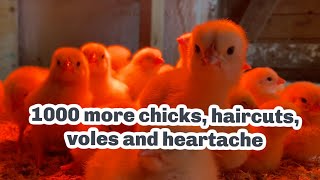
Richard Perkins documents a brutal spring at Ridgedale Farm: voles ring-barked young orchard trees, a water pump needed a new brass connector, and he brought in a thousand meat chicks after a bird-flu feed ban forced changes. He's collapsing vole tunnels, repairing irrigation, and experimenting with nestbox designs.
Chapters
Well, here we are. We have got more chickens on the farm now. Sheep have been sheared. Been fixing up water pumps. Lots going on. Take you around, show you some of what's happening. It. Birds are getting big. Amazing. Every time new chicks come to the Buddha, you realize how much these things have grown. Doing well on peat moss. There's Berlin and it's been quite cold at nights. We've had heat lamps in here until recently. Now we need them back in the brooder for the day. Olds. These little boards have helped with keeping them in smaller clusters so they don't pile on each other. Opened up this back space. All right. Rodinator time. So we have been blowing up a network of tunnels. Bulls have been eating this kale. Popping up under the row cover. It's a very rolly kind of year. We can consolidate these beds and plant something else in this one. But we've had little traps that work with blank capsules, like using a stun gun for killing animals. But definitely one went off. We don't know if it got anything, but you can see it's making a big old mess. With the rodinator. It'll be easy enough to fix up the beds, but what we're trying to do is just collapse the whole network. They're on their way to these nice red curls now. It's looking quite nice, aren't they? Little beauties. No holes in here yet, but there is a hole close by. Some of these holes are from last year. We did rodinate in these beds last year. So you never know if there's more living in there or if it's just part of a wider network. So this is oxygen and propane. You have to set the mixture with these taps, give it a set amount. Turn the gas switch. It's got an arrestor there in case of flashbacks. And then. The sound of a working pump. I have been down here for some hours messing around. This year. Pump wouldn't start. I thought first place to look was the shaft that was free turning. Then I checked the capacitor, thought that might be dud. Found another capacitor. Found out that neither were dud. And then I found out by taking this control box apart that there was one tiny bit of brass that connects down into the circuitry that had a hairline snap that you wouldn't notice unless you'd pulled it out. So I've jerry rigged some wiring together. Pump is on. Sounds like it's got a bit of air in it, so I'm going to bleed that. But that is a Major milestone. It might seem like nothing but this has been a very fiddly job. No spare parts in this country. I'm just filling this pond up which will flood over to the paddy ponds. Nice to see this getting full again. Pump is working. Oh, that's a happy sound. Well, a thousand meat chickens in a tunnel. Never thought I would be doing this but this has been our response to the bird food ban. We've just got the thousand new day old chicks in the brooder. We decided to take them in the end. These birds are doing great. They're growing fast and they seem pretty happy in here. It's still freezing at night and so they have had quite a luxurious time in here. Now they're still, they're growing fast but they're still relatively small. So it feels pretty comfy for them. I'm sure. Have no idea when bands will lift but this place will get very crowded. Now as I said before, it will meet regulation standards. But we all know that those regulations are written for super intensive productions. We've had to bite the bullet. It's a big part of economy. But I am not looking forward to what this will look like in a few weeks time. Hopefully birds will get outside and everything will be well. But we have to have our fingers crossed at this point. Okay. Doesn't look like many birds right now, does it? It's day two for these little chaps. Always. It just shocks you every time how much these birds have grown. If you think about the ones in the tunnel, they're just four weeks older. They're only cute at this point, that's for sure. Guys are doing a great job when managing the space in here. A lot of monitoring of temperature and keeping the bedding. Peaceful. No hair. They look so funny. Nice haircut, mate. Got one at the same time. Bit rough handling but keep, keep the edges clean. Okay, back to basics. We have swapped out the nest box in this one too. Now we are going with simplicity that works. We're going to automate these. We haven't got around to it yet but we've got door and lights obviously automated on this one. Going to automate the nest boxes but just with yeah, too much hassle as full production comes on and this gives us immediate solid results. So after exchanging the previous eggmobile this just felt too good an option. So the metal nests are going to be put for winter use only or building another eggmobile that fits around those nest boxes. But in this space it's just not reliable enough right now. Not any fault of the nest Box Nestbox is totally great. It needs a few improvements that we talked about and we've got them all noted and written down. That's no issue. But for this egg mobile in our type of production, it's not kicking it. We need reliability instantly as egg production goes up. So we'll have to keep you posted on that. We'll be giving all the feedback we've put together to Bruno and I'm sure he'll be able to develop solutions to the things we found. I think we've got enough data out of the RD we've done to make it into a finished product, but it's not really suited to our Eggman wheel design. So we're sticking with what we know and really seeing the benefit of the simplistic, simplistic design that we originally came up with in the first place. Life goes on day by day for the layers. They seem happy enough. They've got used to the nest situation in this segmobile. They definitely laid a few floor eggs where we swapped the nest box over last night. But that's a big shock to the system to have a totally new nest to wake up to. But I'm sure they'll have no problem sorting that out. Interestingly, this is a black tailed hen sticks out. But they seem happy enough. We haven't had to put much bedding down. They mostly pooping under the eggmobiles and that works fine. Hey, we're just looking at your black tail feathers and admiring them. Someone laid an egg in the wrong place too. That's no good. Yeah, they seem happy enough. Definitely the weirdest spring we've had. We started early. We have had broilers this early before and was challenging. It was snowing at the time they came out quite some years ago. We had to wrap them up with the market garden row covers. But we're about a month earlier with the layers this time and it's, you know, there isn't much pasture outside anyway so it's, it's definitely a learning thing. You know, we're basing it, we're basing it on last year's spring but the weather fluctuates so much here that you just can't do that. It's best to get the birds come, you know, later in April so then go straight out onto fresh grass and bird flu bands typically lift then anyway, which has been the case every year so far. So, you know, you live and learn. Shouldn't start so early. But it was decision we wanted to make to have eggs and chickens Back in stock sooner because we'd not had any stock over the winter. Okay, beds back to normal. Just a little bit of raking and we consolidated these kale beds. I feel like we must have had a pretty good effect on their tunnels. It seems like they're coming from the forest originally. There were some in here last year as well as some here, but they've basically got a network all the way to the corners. We must have dislodged most of the tunnel network and I reckon if there's any in there right now, we will have impacted them. I'm thinking leaving the kales uncovered is good so they don't come out under the covers and run around eating from the top. I think that's best, but gotta do what you can do. We set up the traps that have a blank bullet in them and so if there is any tunneling during the night, hopefully that will knock them out and give you a little bit of a peek. So these have a cartridge like you, a blank cartridge like you would use for the stun gun. And basically when anything presses the front of that, it doesn't. It just makes a massive percussive impact, you know, a few centimeters in front of the nose of the trap. So it's not going to harm humans, it's just there for the voles. But let's see, we've got to keep a diligent eye now. It looks quite bare still, doesn't it? But it's still April. There's going to be a lot of stuff going out in the beds soon and things will quickly start getting green again. Well, as if I needed any more news of devastation, some of the young orchard trees in here have been totally ring barked. I don't know if that's voles or mice, but the snow was deep enough this winter that they could climb over this basket tree. But I did find one little tunnel that went straight to the netting which was intact. So could be little mice as well. But basically most of this orchard has been ring barked and I'm. I don't even know what to think at this point. Devastating and not a lot we can do. It's apparently a five year cycle with voles and this is just episodic in a way that I haven't experienced. Don't know what to say. All we can do is try a bit of everything. We've got predator posts. I've seen birds of prey flying over the fields. Cat got a vole morning. We can try ultrasonic things. We can try the castor oil Thing using the rodinator in the field lines too. But it's, you know, it's so challenging because even things like these deterrence with sound ultrasonics, it can take five to eight weeks of constant noise to discourage evolve. And it's such a large area we're dealing with. I like the explosive technique myself. But we've done that twice now across the tree lanes and it's. They still come back. So I think, you know, just seeing the sheer amount of holes in the pasture, not just in taking out the odd apple tree as has been most years, there'll be one or two apple trees. We're just seeing holes everywhere. Everywhere. Like top field is just riddled with them. And I don't know if I think about it anymore. I just burst into tears, I think. So I'm just gonna crack on and we do what we can. Well, the things that haven't been eaten are starting to green up. It's been a long winter, folks. First shades of green. Can't wait to see grass above my kneecaps. Frogs are busy. A little bit of frog spawn appearing now at this end of the pond. It's always fun creeping up here when the frogs are laying because you can, if you're quiet enough, you can stick your head over and you'll see 10 or 20 frogs frolicking around. But up the far end there's a bunch more I've seen. I'm going to get in here with the wetsuit and diving gear this summer, pull out a lot of vegetation because I want to be able to put more brown trout in. And I tried fishing to see if the brown trout survived this winter after a really cold winter. But it's too weedy. Can't really get in there. And it's so full you can't see much yet. But it gets so full in here it starts to interfere with the pump, etc. Have a look at all that frog spawn. Ragnar is getting excited about insects. Seeing a bunch of snakes on the warmer days. It's that time of year where he can just spend hours and hours and hours just searching for creatures. Just clearing the end of the inflow pipe from the little stream. So this is where we are near the forest boundary. And this pipe just runs in the stream down to the pond. Sometimes it gets clogged up. So every now and again I come and pull out whatever gunk is filling it up and that gets a better flow into the pond. At full flow. This is turning water over fully in 48 hours. And that's made a much nicer. That's better. Washing a bit of that mud through, clean the pipes out. That's great. That's really gonna turn over a lot more water now. I'm gonna start to pump a lot more into the gardens now. There's a lot of random little beds in that require hand watering. So it's perfect timing that I got the pump working finally. So if you look across, the landscape definitely starts to look a bit greener, certainly in our fields and in the distance at the neighbours. But when you look down, it's still very young growth. So we've got a few weeks until we will be grazing out on pasture. We don't want to impact the spring grass at this point because that stunts it for the rest of the year. So we might transition with silage haylage on the neighbor's land or in the forest paddocks. And that should hopefully give us just enough silage to be able to get through until we can graze out on the field alone. It's good to give a week, 10 days of transition. That's good for their gut. But I expect we'll do a quick pass in very big paddocks over the neighbour's land because we won't graze that again until it's cut at mid summer. And so one quick grazing really lightly will give us enough time to get our grass established and get out on the grass. Maybe end of May time, probably this. Right now you are finding grubs already. Whoa. Grubs and beetles. We are flooding the paddies. Get them ready for Swedish rice. That's fun, isn't it? It's got to get all the way over to that side and then it'll come out the gray pipe and it'll go down, down and off, out to the ditch. Alright folks, signing out. Just wanted to update folks who have been behind the Kickstarter campaign for the Ridgedale Builds book. I think I've sent the final version to the printer. It's going to be some weeks obviously until we get those back. I'm hoping to get the PDF versions out shortly. I'll be sending out surveys for people to fill in information that are receiving hardcover books. It takes time, these things and getting all the back end of it wrapped up with Kickstarter, etc. But happy to have got the final edit out and the printer. I love working with this printer. They're awesome and look forward to seeing this in a hard copy version. But there'll be more updates on the Kickstarter site as and when I can. And I'll see you in the video soon. Bye for now. It.
More from Richard


A review of short and intensive season on a mixed farm and restaurant/event space in Sweden






Alskade Kyckling Exploring complexities of poultry production in Sweden and what we stand for


