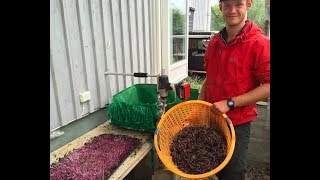
Richard Perkins tests a new Quick Cut Greens harvester on his farm during a busy week of turkey and chicken slaughter. The radish microgreens tray yielded enough to make the tool worth it, and he's planning to CE-certify and sell the harvester through a future tool-supply company.
Questions this video answers
Three slaughter days in a row.
Approximately 60 cm by 37 cm.
About 1 kilogram and a couple of hundred grams (≈1.2–1.3 kg).
12 weeks old; weights around 4.4–5.3 kg.
Chapters
So just finished three days of back to back slaughter of turkeys and chickens and turkeys. And that's it for the turkeys at the farm. We've kept four that are living in the farmyard now with an assortment of other strange birds, which is always amusing. But yeah, we've just been testing out the greens harvester attachment for the first time for microgreens. This is the very first tray of radish and it's just awesome. You're gonna love it. Sam it. So this is how we do gut removal. Truck's coming and we're busy inside doing turkeys. Last slaughter of this week. Three slaughters this week, so pretty busy. Very nice quality birds coming out. They're going through the clean side where record keeping is done and then they're put into the chiller here. So you never know. Now what's inside can be a nasty surprise at this time in the morning. Ah, vegetables. The easy life. So it's 10 o' clock in the morning and and we've pretty much finished clean down of the slaughtery after doing the turkeys. So a really good effort. We've had three slaughter days in a row, so pretty intense for the crew. I don't mind it. I get into a little zone and I really enjoy those sort of manual tasks where you can just work with muscle memory and you don't even need to look or think about what you're doing anymore. And that's time when I can actually think. So for me it's very relaxing because it's one of few times on the farm where I can just zone out into my own thoughts and still manage this process overall without, you know, too much trouble. I'm just up at the site for the turning circle, just checking it out. This is Eric's digger. He's digging the ponds for us in the last couple of years. I see he's got quite a lot of stumps. But here you can see actually if I come back here, you'll get the sense of what we're doing here. These white posts here mark the edge of a turning circle that goes around and mostly on our land you can make out the white pegs there. So it's quite a big old turning circle. But that's what you need to be able to have something coming to collect the timber. They're going to be coming in the big wagon cutters with the big timber cutters and then wagons and leaving it in a pile. You have to have somewhere to stack the timber. But also we get a lot of Big truck deliveries. So it's always a bit of a pain in the driveway. So this will mean we can send them up here and they can just do a big arcing turn back down the road, which is perfect. It feels really good. So I don't know what I can see he's got a ripper bit here I guess to help cut up some of the roots. I think he's just working on getting the biggest stumps out and he's already got a few out from here. I know that they're going to actually take the top surface of the road off and then level the whole pad. And what I've been doing is clearing this. Now we're thinking there's going to be quite a lot of topsoil to put around. But we don't exactly know how much. I kind of wish I'd been here to see the digger pulling out these roots. I imagine it wasn't that big a deal. That's a 14 ton digger. So I mean it's no, no match for something like that. But we're actually. We've extended our fence down and we're basically going to fill this big hole down here and level it off. So this is all turning back to mixed species agroforestry. And some people asked if we're doing that naturally when we take the big trees away. And yes, we are letting succession play out because it's actually the lowest cost way to do mixed forestry is not plant anything. Funnily enough, we've used pigs as an ecosystem trigger and then we're bringing in cows and letting them, and maybe sheep, but letting them put down their pastoral gut flora and we like the species coming back. Here's a beautiful oak. I told the neighbour I'd cut all these trees but I wouldn't cut an oak. Against my principles to cut oak trees in a land that should be covered with oak trees and you barely see any. So I'm leaving them and if they survive, then I'm happy for it. There's a couple here but we've got hundreds on our land and you just don't see them in the landscape because everything's chopped for monoculture spruce and I've had enough of that. That's nonsense. That's not forestry. It's a tragedy. So it's going. Swedish forestry is a mafia run business. You know, it's really big business and influencing politics and big money. People with big land and not so much care for the environment and those kind of things. So I'm not into that kind of thing. It's a bit of a. You know, people come as tourists to Sweden, like, wow, the forest. But these aren't forests like they should have been. You know, mixed forests here would have had a lot more wildlife and a lot more diversity. So it looks like while we've been in the slaughtery, they've just moved the net to bring it down a bit further. I guess they're looking to really fill this corner. I'm curious. I'll get the drone up hopefully this afternoon, see what's going on from above. It'll give you a sense of the scale of the pad, but yeah. Good morning. Happy for lunch soon. So these four are growing on for Christmas, and Mr. P's got some buddies. There's a guinea fowl, too, A puppy, Ragnar. They can have a whole lot of fun. You might remember my little aspelias, I put these in as 80 centimeter whips, about the thickness of these branches in the stem. Two years later, look at these beauties. These are Beauty of Bath is from where I come from. They're really good. Slightly flowery, but that's how they are. Super tasty. We're coming along now, and we're just going to lift up the plastic on these tunnels to redistribute it evenly across the whole structure. Because we've been using the other side mainly, the way we've been working with the plastic, it's crept over to the side over time. So we're just going along now to make sure we get it even across the whole thing so we can close it down in heavy winds, etc. But in those recent storms, no problem at all. Very happy with the tunnels. So Ragnar's on microgreen production at the moment. How's it going, Ragnar? Are they growing okay? Yeah. So this is the quick stand setup for enabling the harvesting of microgreens. So this is the clamp that you get that fixes onto the harvester. So the J clamp hooks around, and this allows you to move the harvester up and down to match the height of your trays. So here we're adjusting the height in relationship to our trays. And you can see that the mount fits nicely behind the pulley here. Go steady on the safety guards, folks. So this is what's left on the tray. So this is test with radish. It's good. So be really careful with that blade pushing it through with the tray. Just keep me. Look at that. Really nicely harvested off the back. These small trays are about 60 cm. Nice by 37. We get a kilo and a couple of hundred grams off one tray like that. It's a really good yield. That looks like a really good harvest. That's awesome. That's really awesome. Very nice. That's literally the first time we tested that. Just look how clean this tray is. So this is one of the products we're going to be selling, the Quick Cut Greens harvester, as well as the clamp attachment and spares kits, etc. I've had some good conversations with farmer's friend in America and this is one product we really believe in and we going to be supporting people to get in the coming weeks. It needs CE certification to make sure it's safe for use in the eu, but that seems to be pretty straightforward. So look forward to be able to get that out to people before the start of the next season, which would be awesome. Well, you know what? Might be time for me to eat my own words. Look at these. Hannes is on turkeys with myself and Nicholas. Beautiful beds. Let's have a little look. Look at these beautiful things. What's the weights like so far? Everything around 4.4, 5.3. Perfect. That's the plan. So these are 12 weeks old. This is the target weight we've been looking for, and Nicholas is capturing data there so we can just track back feed costs and how that went. So this marks the end of the three intensive days with turkeys and boilers and turkeys and then clean this whole space down again, ready for next use. Well, so this is where they've got to today. It's just a couple of hours that Eric had spare. So you can see. Well, you can see partly the real shallow topsoil that we are farming on. This isn't our land, but you get the idea. It's basically sand. This is very similar to what we started farming on. It's amazing to see the difference that livestock, animals on the ground, animals in the ground makes. And it's all about microbes and animals on the land, but it's going to be quite significant. Turning circle and he started to move some of the material over and this is the level. We're gonna level this side up. I think it's gonna be a really nice football pitch or a place, you know, it's like one level spot in an undulating terrain. So excited to see us go up. I'll get some drone footage in the coming days because they weren't gonna start work till tomorrow, but I think the driver had a couple of spare hours. So it's good to see them make a start and really comes to life. How significant and functional this is going to be for us. Well, that's it from Rainy Sweden. It's nice to have the rain back. I'm really enjoying it. I'm really enjoying being watching buzzards and golden eagles even, I think really magical and something I really enjoy. We've got loads of our T shirts back in stock. If you want to buy a T shirt from us, that's one way you can support us as well as buying our book Making Small Farms Work. It's been really well received all around the world. And please, if you're in Europe and you're interested in market gardening or small farms, let me know in the comments below. Sorts of products that you would like us to supply in our tool supply company because it's something I'm considering at the scale which we will grow, the company and the diversity of products that we will run. We're not going to be selling everything. We're going to be selling items that we feel are vital items that we personally stand behind and use every single day at our farm and have expertise in that we can, you know, give really good customer service because we know the details that make it actually work. And yeah, let us know in the comments below. I'm excited here and obviously we need to be careful what we carry to make sure it works out in all ways. But let us know in the comments below and I'll consider it for sure and excited for that to progress and give you updates as that goes. We're in the final stages of working out how we're going to deal with the caterpillar tunnels and then they'll be up online in the coming weeks and that's going to be amazing to be able to get them out to you. So thanks so much for watching folks. Really appreciate the likes and views and please share the video if you enjoy them, find them useful. It really helps to share it on social media and get more people engaged with regenerative, profitable agriculture. Thanks so much. See you in the next video.
More from Richard


A review of short and intensive season on a mixed farm and restaurant/event space in Sweden






Alskade Kyckling Exploring complexities of poultry production in Sweden and what we stand for


