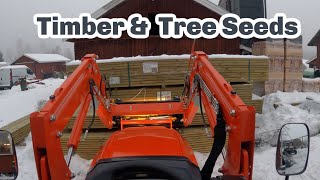
Richard Perkins shows how Vin welded a removable 450 kg counterweight for the compact tractor, then demonstrates moving and splitting timber pallets safely. He walks through seedling propagation setups for nuts, apples, and rice, and explains why he won't be sharing individual plans.
Chapters
So this weight box is no good. It's not actually a weight box, it's a carrying box. It's going to be really useful around the farm for carrying compost, etc. But it just feels really too sketchy to use it as a heavy weight box for the lifting I've got to do. It's just held together with this pin for enabling this to tip. It's not designed to carry more than 250, 300 kilos. This pallet weighs 1.8 tons and I can't lift that, so I'm gonna have to split it in half.
So I've got me a heavy tractor.
Weight and it's a concrete block and our friend Wind is here and he's a master welder. He actually sold us a peacocks originally, Mr. P. And the trouble with this one is it came with bigger size tractor mounts. It's for a front mount for a modern 200 horsepower tractor. So we're gonna stick some 19 mil bolts on to enable us to fit it to our hitch because we've got a. I don't know which category hitch it is, but it's smaller on a compact tractor, obviously. Now, I can lift 12 tonnes on this, but only with small pegs. And I don't trust my welding, but I do trust Vin, so.
It. Sa. It's.
So you can see in his left hand he's got adjustable power control which mainly used for stainless steel, where you've got really thin sheet metal. But it's become second nature to give really precise, accurate welding. Done for 55 now. So that should fit perfectly on there.
But it's getting to the point where to mount this.
The arms are just shy of the.
Wheel, but then once it's on, it'll come back in a bit. But I don't plan to take this.
Off very often because you can have.
A tow ball on the back. And whenever I'm lifting like bales or.
Heavy wood, which is what this machine is for, or using the front bucket to clean out tunnels, etc. I need that counterweight and it gives you much better traction on the back wheels, obviously. So I think I'll try and keep it on there pretty permanently. And. Yeah, nice. Got a lot of timber to move. Nice watching someone professional working. It's only farm welding like the Vinda's normally doing really high precision welding for industry. But I totally trust his joints. Whereas I could have a go, but I wouldn't trust it with this amount of weight. This is 450 kilos. I decided to buy this one, even though you can make your own with a steel drum and concrete, because I can pull off the back of it. It's got a metal frame all the way through. Obviously you've got 10 tons pulling on this thing. So I wanted that versatility and I wanted a compact shape that's low to the ground so I can use the tow ball. And so it's just not sticking too far out in the back. Because like everything on this farm, we've got limited turning spaces. This is the room I've got to pick up pallets. And this is where typically a lorry will always drop heavy loads because of the gravel driveway underneath. So that's what I've gone for. It does seem quite expensive to buy a back weight, but it's no problem. And I think it's, you know, it's a big part of safety to make sure this machine is not tipping when we're picking up heavy loads. And it's just. It's amazing to think how much I used to move around by hand when this machine is just going to make life easy. So Vin not only did he sell us the peacocks originally, everyone that's followed our channel for years will remember Mr. P, who met a tragic end on the electricity lines that are taken down now. But he also welded the steel racks that we put the chickens on. And he's a really skilled stainless steel welder. This job obviously is a bit different, it's just arm welding, but I totally did not feel confident to do this myself. And I thought of Vind when I knew I had to do something to fit this to the machine. It's quite hard to find weights for compact tractors, and as I said before, you can just make your own weights, but there's less functionality in that, in that I needed the steel structure to be able to mount a tow bar because that's going to be something that's very useful. I'll be able to load up heavy loads of timber onto a trailer, tow it in the forest, and I don't want to have to be taking this on and off to be able to pull that. Now, I could use the Rhino, but it's going to have trouble getting through some of the forest land, whereas this will have no problem at all. So I think that's a super nice job and well worth the investment in a proper weight system here. We've got enough tyre clearance to do the job, so gonna give it a test, lift some pallets.
It's.
So question is where to put it. What I'm trying to do is get the 3.6s. There's three, four and a half there. I'm trying to get the decking timbers. This is the decking. I'm trying to get this out of the way so I've got access to 4 and a half, 3 and a half. Then the only other base timber is down here. But I'll have got rid of a bunch of decking up to the forest by then. I'll be able to reach these, which are going for the big yurts, big teepees over here. So all this process is just basically about being able to move wood. Now I've had to split these pallets in half to move them safely. Obviously, with a narrow wheel gauge tractor, if I'm not perfectly centered when I start turning, that's when it gets really sketchy and can tip over. But I'm still impressed with the machine. I mean, picking up that much timber and being able to move it is a massive bonus compared to doing things by hand. There's no way on earth it can pick up these big pellets, but it can pick them up half at a time. And what I'm doing is just squeezing the forks in between gently. Now it's very hard. If you've got like a front loader that's designed for front end work, obviously what you can do is come in much more parallel. But with the tractor, with forks, every time you're going up and down a slope at the back that's affecting the forks. So it's very hard to be super accurate with them. And so what's happening is it's scratching up the wood a little bit in places, but that's no worries because I can just turn the decking over to reveal the other side. So I've got that degree of flexibility. This is what the floor of the earth is going to look like. It's going to have a 2 mil gap between the boards. There's going to be a nice flat floor with hidden screws. It's going to be really nice. What you can see is all these boards are actually frozen together and it makes splitting them up with the faults quite easy because they sort of come off in a chunk together. And now I've got. I'm set up basically for starting to cut. That's all I needed to do now.
Mission accomplished for now. Didn't have much time before it got dark. But I also went up in the forest today and I managed to get one of the screw fittings into the ground. For attaching the uprights that will support all the platforms. So with an iron bar to get through the top bit of the ice, it seems like the snow has been insulating enough as well as the canopy cover from the forest that I can actually get to work now. So I've got a really big job cutting down all the pieces. I'm going to be using the guide out of the Ridgedale builds book that Moritz has been putting together through cad and that's super helpful for cutting these down really quick. And then what I'll do is take all the sub platforms one by one with the tractor and dump them up in the forest in the right place. Shouldn't have any weight issues on the bumpy road there because it's just going to be less weight for the actual subframe. And then I'll take the cladding up in two or three goes. But this is great. This is where I've been wanting to get to for a while now is get all the timber accessible. So I've got my 4.5, my 3.6s and another stack there. So that's all I need for cutting everything that will go up into the forest. And I only need the longer planks when we get round to the yurts in the back here. And I've got to take down those, yeah, platforms before. So that's great. Very happy with the machine. As I said, I think the machine is capable of lifting a lot more, but especially with a wide load and a narrow gauge tractor and not having more than 450 kilos on the back, I certainly don't want to push it. It's hard to stack neatly because I'm not so skilled. I'm learning how to use a machine, but it's also just because everything is frozen together that it's sticking and slid. And working with a tractor with forks on bumpy ground is never the same as something like a forklift truck, etc. But we got where we needed to and that's fantastic. Okay. As we get ready for the season, I've got some big tidy ups to do in here because it gets a bit of a mess in the winter and it's just me and I'm mapping around with different projects, but I'm thinking of getting some better racking in this corner to really organize things and better racking for all screws and fittings etc that we use over time, obviously we get more tools and got some different metal gear, climbing gear, painting gear, things to work out and deal with. So we'll Have a good old tidy up before the team arrive and get this place as it should be in order. When I was at the dump recently, I picked up all these old root trainers. These would have been used for spruce trees for forestry planting. And they walk along with a poddy putty and have a few of these on a rack system so they can plant thousand trees very fast. So I thought I'm going to grow out some seedling Bittenfelder and Antonovka apples and then pot them on in bigger root trainers after they've germinated in here. I've got quite a few, enough for huge amount of new seedling trees, some of which will go down to Clipper, some of which will stay on this farm. So every year I like to stratify some nut seeds and different tree seeds as well, do some grafting and things. But look, Ragnar, we have got from Sheffield Seeds, they do a good supply of nuts over in America and they tell you where they were harvested from specifically climate wise, the purity, germination, etc. We've got more black walnuts. They've been doing so well for us. So I've already got hundreds here, but I'd like some more. We've got some Illinois pecan, pecan nuts, we've got some butternuts, Juglan's Cyneria, and we've got some Juglan's Regia normal sort of walnuts we call English walnut, I suspect everyone calls their walnut. And then loads of loads of Bittenfelder, which is an apple that you can grow from its own seed, as well as Antonovka, which is a common root stock, but also can be grown from seed. And so you can buy for $10 you can buy thousands of these and have your own rootstocks or leave them to grow as sort of wild apples, good for juicing, ciders, et cetera, etcetera. Super nice. So these will get soaked. We'll change the water maybe two days, changing the water in between. Then we'll put them in damp compost in the root cellar. I'm filming Ragnar's filming me filming you filming everyone. I've always got a bunch of different perennials and interesting things. I'm going to try rice again this year. This is. Hi, Ayuki. This is rice. We actually got to set seed here at 59 degrees north. I imagine that's probably the most northern rice that's ever set seed outdoors. It didn't firm up because our season is so short. Rice is photosensitive, so it needs dark in the middle of our summer, so we actually used night blankets on it when it had gone to flower. I'm going to try more of this rice. I've also got some other dry land rices here. This one is from 2,200 meters altitude in Nepal that was given by Chris Evans over in the uk and so I'm interested to try that because that's an interesting environment, obviously quite different from ours. Lots of perennial seeds. I've got boxes and boxes of different trees. This is robinia, then locust, all kinds of things. So I'm going to do a bunch of nursery stock this year, which I'm excited about. Now, a lot of that is mainly just for fun and my own pleasure and to have diversity and just do things that are interesting for me, which I'm excited for. I just want to end the video by saying thanks for all your support from all over the world. Those of you that follow our social media and comment and like and share etc. I really appreciate it. I just want to say about the Ridgedale Builds book that we're working on in the background. We're working really hard to get that together for you. And please, I want to say, don't email me asking me for specific plans. I'm not releasing any plans of anything. I'm releasing a book when it's done. I'm sorry if that's frustrating because we're in the spring ramp up and people want to get building with eggmobiles or boiler pens, whatever it is. But it's just, it's too much to ask for someone who's trying to put a book together for everyone. I'm not really interested in answering those emails, so don't find it rude if I don't answer your emails. I get hundreds emails every day and I just can't keep up with it. And I'm making a book for you, so please respect that and you can buy the book and it'll be of extremely good value. Just making any one of the structures will save the cost of the book in materials and time for sure. So please be patient. We're working on it very hard in the background, trying to get most of it done before the season really ramps up and our team arrives and we start our productions, which I'm also very happy and excited to share with you again this year. As always.
That was my toy. See here. Toy, toy, toy, toy, toy, toy, toy, toys, toys. So what do you think about that? So should I. Mom talk. Show your mom talk. So. So, Mama.
Oh, wow.
Can I talk?
How do I do? Hi, I'm Ragnar's mama. All right, that's it from us. Thanks for your help, Ragna, and look forward to sharing another video with you soon. We'll start building the yurt platform soon and probably get down to Cleta, get things ready for the rental of one of the houses there this summer. So thanks so much as always for watching, folks. Hope you have a great weekend. See you in a video soon.
More from Richard


A review of short and intensive season on a mixed farm and restaurant/event space in Sweden






Alskade Kyckling Exploring complexities of poultry production in Sweden and what we stand for


