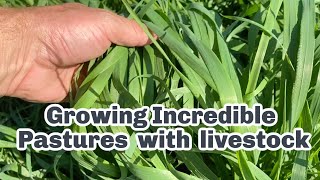
Richard Perkins shows how trampling grass with livestock builds soil carbon and organic matter rather than wasting it. After 30 days of rotational grazing, paddocks recover with abundant worm castings and insects. Tight-cell grazing leaves structural plant diversity that deepens roots and strengthens soil microbiology.
Questions this video answers
August 8, 2020
About 30 days
About 59 degrees
Keep grazing on his land through end of October to enable grazing through Christmas on neighbour's land
Initially €120,000, reduced to €100,000; presenter suggests an offer around €70,000 as possibility
Chapters
Welcome back to another episode folks. Today I want to just talk quickly about why trampling down grass when we're grazing with mixed livestock is not a waste of resources, it's actually investing into the future, into the carbon bank of the farm and it's what formulates the bottom line next year and beyond. Quick aerial flyover as we're approaching the middle of August. The gardens are abundant, kicking out wonderful crops. A bit weedier than it's ever been this year. There's a lot of perennial weeds that have popped up on top of the beds this year and we'll be doing a quick go through to keep on top of that. No serious weed pressure and you can see it looks pretty clean. Anyway, grass is in recovery. We've got the cows and sheep, they've been up in the forest paddocks now, which they thoroughly enjoyed, but the forage is quite thin up there. So we've left K1, the first of the neighbour's fields, which we're now back onto with the cows and sheep. And we're leaving K2 and 3, the bigger paddocks, which are bigger than our farm, to stockpile for winter grazing. That's the plan so far at least. If we can keep grazing the animals on our land through to end of October, we'll be able to graze through till Christmas on the neighbour's land and that will be ideal. Tomatoes in the greenhouse here. Finally catching up. It's always a bit slow up here at this latitude. Pretty beautiful day. We've had a bunch of rain after the long droughty season and now we're getting the odd summery like day, but it's not so warm. But that's the way it is farming up here at 59 degrees. I'm up here in Topfield and we were last grazing through here about six weeks ago now. And you remember if you've been following our channel, the grass was over the back of the cows. Grass is over the cows backs. Hello, Winston. Right now it's had about 30 days recovery and it's up at knee height and what we did when we came through before is really trampled a lot of material on the ground. Now a lot of people would see that as waste, but there is no waste in nature. And by laying this thick organic mulch down on the ground we are making sure we capture every drop of rain that does land after that dry spell. And I don't know if you'll make it out in the video here, but the soil surface remains moist even in the driest of weathers. And there's beautiful worm castings covering the entire surface of the soil. Everywhere you look, just pure worm castings. Lots of insect life, eggs of insects. And this is beautiful to see. So we'll be grazing back through here in a week or two's time, I think, coming through with the cows and sheep. But there is no waste in nature. By laying that material down, we're just investing in the next swathe of grass and the future of the carbon bank of our farm. And it's glorious to see beautiful growth. If you go up to the neighbor's farm now, that grass that's had no animals on it, it's rank, and it just cannot perform anything in the rest of the year. We've got beautiful, luscious growth. Let's take one of these grass plants out, see what it looks like down from the base. So we've got 1, 2, 3, 4, 5 true leaves. Hello, Ragnar. He came walking up in the field. Look, hold that one up so we can see. We've got five or six true leaves and they're yellowing off at the bottom. So this grass is safe to graze. And the cows will absolutely love this stuff. It's beautiful. Just look at the thickness of the leaves. Yeah, look. It's amazing. This is grass that's performing nothing like it did when we moved here. And so we're just going to keep repeating this process, trampling a lot of the material, letting the animals selectively graze what they want to graze in tight cells, moving daily and putting the rest of it back on the ground as manure and urine, leaving some grass standing. You can see some old tufts if we just jump up here. Ragnarok want to just show this? If you get down, especially in the evening, you see some of the older grasses left standing. And this is cocksfoot. But you see the new cocksfoot coming up from the stem here. But maybe I can catch it on film here. It's best to do this early in the morning or late in the evening where you can really see, but see all the insect life, spiders, webs here, going all the way across the field. This is habitat creation. Different age groups, different age classes of grasses, tall woody material, new vegetative growth, baby plants coming up underneath at all stages of development. This is beautiful stuff. And this is what we want. We want 3D Edge because that creates the habitat for a diversity of creatures that create balance in our habitat. Anyone can do this, folks. There's no magic here. I think it's mostly the power of chicken with the nutrient they're putting down on the ground in their manures. But always managing our grazing so that we're not over grazing. And specifically allowing grass to express its physiology. Because when you allow grass to express its physiology, it's going to be rooting as deep as possible, as long as possible in the year, pumping short chain carbohydrates into the ground. Feeding soil microbiology. And that's what we're doing. We're microbe farmers. So we're ensuring that no grass plant on the farm is overgrazed. That microbial life is respected, treated with care, and the output is healthy cows, healthy sheep and a healthy ecosystem that's attracting wild species all the way up to the predator species that we take as the reflection of the work that we've done. But it's such a beautiful thing to be in August now with such beautiful growth and such nutritious big leaf grass. It's a wonderful place to be in. And we feel more and more resilience every year that we do this. We really noticed it back in 2018 in the Great drought. We also had grass up to our shoulders. And that was a time when the neighbors had already gone yellow and people were selling off half their beef herds because they knew there'd be a winter short shortage of feed. It's become amply evident that this stuff works, folks. It's easy. Anyone can do it. It's about observation, timing and a bit of planning and replanning whenever necessary. Having the animals in the right place at the right time for the right reason, as it were. But it's pretty simple to do. We train people up in a few days how to do this. And many of our past students are doing a wonderful job too. It doesn't take many years to turn around damaged grassland soil. Bottom of the scale of permanence. Quickest thing to damage, but the quickest thing to build. Look at all those stuff. There's so few more. And that is the very coolest deck. First leaks coming out. We are off to visit a property in the village. Could turn into a restaurant or a dance hall. Never know. But we're just scoping out a bargain. This is silly. Gordon, which is a really nice little cafe down on the lake here. And it's next door to this. So we're gonna go and just see. It's the old camping place that gave us a lot of bikes the first year we were here. Why do they give you so many bikes? I think so, need them. I want the closest I can to being here. This is a quite a big old building that's been for 16 camper wagons. Not very much land, but could have potential. It's a bit run down but we're just curious to have a good look around. So this place was actually turned into a sobriety society because there were two guys looking after the railway which is just up the hill. One of them got squished by a train because he was drunk. So the other made a sobriety society. It's been used for camping. There's quite a few double bedrooms in the property and camping outside. We would be more interested in farm to fork pop up restaurant and event space for courses in the winter. It's got the commercial kitchen and a campers kitchen. It was going for €120,000. It went down to €100,000 and they want to sell it. It's got a shower block out here as well as two shower blocks inside and a laundry room commercial kitchen here. But basically I don't think many people would buy a place like this because it's so uniquely. You know, it needs a lot of maintenance to keep this up. It needs a lot of renovation. But I reckon you could probably get an offer in for €70,000 or something. Which in that case would make this. You know. I could return the money from running a couple of trainings and give us a winterized space for doing things. Needs totally re skinning on the outside. Comes with half a hectare. It's got a field here and another one at the top for camping. But the lake is just behind here. You can't see through. There's a beautiful river down here. And it's the couple that used to run the village shop that closed down some years ago. I can see a lot of potential here. But there would be a lot of work and a lot managed. On top of what we already do. You have a big boiler room downstairs. Campers can come in. At the bottom we have more showers and toilets. This is a big boiler room. You can't really see wood powered Boile making bird houses. Super cool. Ragnar. Banging nails, sawing bits of wood. Time to paint. Ragnar. What have you made? A birdhouse. Nice job. So in sieving compost recently, Grace discovered some grass snake eggs. She relocated them in this box. There are plenty grass snakes. Couple hatching but we'll leave it there today. Folks. Hope you enjoyed just seeing our beautiful grass. I'm very happy about it. So is Ragnar. And we'll catch you in a video soon. Bye for now. Hi. Hi. Hi. Hi. It.
More from Richard


A review of short and intensive season on a mixed farm and restaurant/event space in Sweden






Alskade Kyckling Exploring complexities of poultry production in Sweden and what we stand for


