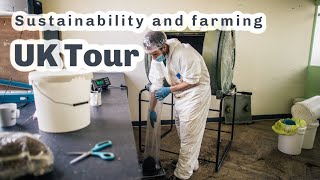
Episode 1 of 'UK Sustainability Tour' (YouTube) follows Richard Perkins around the UK visiting community-led sustainability projects: Incredible Edible Todmorden (town-wide food growing, school programmes, Every Egg Matters), K Mabon Retreat (storytelling), Lammas Project in Pembrokeshire (One Planet low-impact planning, affordable straw-bale/straw-insulated homes), Martin Crawford's forest garden (agroforestry/perennial systems), a mushroom social enterprise turning coffee waste into oyster mushrooms, a Bristol community eco-housing self-build, a permaculture wet wastewater treatment system in Hampshire, and agroforestry alley-cropping on a Suffolk farm. The episode emphasises community resilience, low-cost/low-impact building, relocalised food production, and practical permaculture and agroforestry techniques.
Questions this video answers
Roughly about 300 tons a week ("about the weight of 22 double decker London buses").
One Planet planning policy (referred to as "One Planet Policy 52").
Took a year to build and cost about £12,000 (speaker describing their dwelling).
Everyone spent between £2,000 and £20,000 building homes (reported by narrator).
Chapters
Our first stop is at Incredible Edible Todmorden, a Pennine border town in the north of England, where a group of highly motivated individuals have engaged community, local public bodies to start growing food and vegetables all throughout the town, integrating business and education to create a really thriving model of community resilience. We've come to meet Estelle Brown who tells us it all got started when Pam Warhurst gave a talk to the local community.
Pam approached the newspaper to put a shout in the newspaper to see if anyone else would be interested in starting something and called a meeting which was held in the bear Cafe. About 50 people turned up. Pam spoke to them and Pam was bom, bom, bom, bom bom. What we've got to do, somebody's got to do something. Governments aren't doing anything. It was absolute silence. Pam stopped speaking. Still absolute silence. And then suddenly the room erupted and everyone wanted to go and do it there and then we must dig now. We must dig now. What can we do? Where can we find land? What can we dig up? What can we plant? And so the whole thing just took off. The town has lost all its industry. We were mining wool and Cottontown, all.
Of that is gone.
There is no economy, there is no industry here. We need to build a food industry to keep the young people of Toggleden in Toleden. The time is right now. When people tried to do this in the 70s, everybody had too much. They were doing it because they wanted to do it. Now people are doing it because they need to do it because of the economic situation. There's 1 in 10 unemployed in this area now. So growing their own food makes economic sense. We have seven schools in Tomborden. All seven schools are involved. All seven schools are growing. Three schools have chickens. The high school is going to have a food hub. It's going to have land based studies, they're going to have apprentice schemes. They're already going to our Incredible Edible Growing Limited at Wallsden, which is a market garden training centre.
We bring students to this site because they're on a BTEC agriculture course and.
We help to teach them the practical aspects of that.
And it's not just the great work at schools that inspires us about Incredible Edible. They're working with local bodies to create orchards and vegetable growing spaces in disused parts of the town as well as engage the community with creative campaigns like Every Egg Matters, where they're putting local producers in touch with consumers to relocalise the food system.
Got to the point where even though I'm treasurer of Incredible Edible and ought to be somewhere in the centre of all that.
I don't know what's happening anymore.
And that's great. There's an edge of chaos, but there's also an edge of isn't this fantastic that people are just getting on with it and not asking me if we.
Can create businesses or business ideas for them to create their own businesses in the town. The whole economy of the town will come up and the Toptenden pound will stay in Toppedon, the young people will stay in Topidon, and instead of becoming a dormitory for somewhere else, we will be a thriving community again. We will have a thriving market. Like Carl the Cheese. He was the IT guy that suddenly became the cheeseman because a relative of his had an organic dairy farm and he started off with one cheese and he's on five different varieties of cheese now. I think he can't make enough cheese for the people that are asking for it. He can't supply enough.
And it's really a reflection of what inspires us most about Incredible Edible in this town. Nearly everybody's heard about it, if they're not even involved. And this style reflects that. There's been no vandalism problems. People are really taking back responsibility and pride in their public spaces. It's testimony to effective communication and inclusion. So here, the local schools are working with local bodies and also local businesses to create a model that's really thriving now. What a fitting first stop on our adventures. And we're inspired to find out this model spread to many other towns in the UK as well as abroad.
Now.
Reflecting on effective communication, we head west to the beautiful Snowdonia national park, home of Eric Madden, whose passion is for storytelling at the beautiful K Mabon Retreat Centre.
Well, of course, storytelling is a, you know, is a. Is an ancient art. Perhaps the oldest of them all, in a way. Well, perhaps along with dance and singing and so on. But, you know, I like to believe that as we learnt to speak, as humanity learned to speak, we also were telling stories. So storytelling is what they like to say, hardwired into the brain. It's like we. You could say it was our native tongue. People are still hungry for stories like they've always been. But nowadays mostly we get our stories from the media and there are stories everywhere. I mean, the media themselves, you know, like, what is the top story of the day? You know, they're always kind of on the hump for the story. How do we know? How do we change the world so that it becomes more sustainable and convivial.
And.
Soulful, if you like. Long ago it's said that the young Merlin made a great prophecy in the mountains of Snedonia. And it seems that the last part of that prophecy applies to our time now. It goes like this. Though the goddess be forgotten, the soil will become fruitful beyond man's need. The fatted boar will proffer food and drink. The hedgehog will hide his apples in London. Underground passages will be built beneath the city. Stones will speak, the sea to France will shrin, and the secrets of the deep will be revealed. But beware the ass of complacency. Swift against goldsmiths, slow against ravenous wolves. Oak trees shall burn, and acorns grow on lime trees. The Severn river will flow out through seven mouths. Fish will die in the heat, and from them serpents will be born. And the health giving water at Bath shall breed death. Then root and branch will change places and the newness of the thing shall seem a miracle. The healing maiden will return, her footsteps bursting into flame. She will weep tears of compassion for the people of the land, dry up polluted rivers with her breath, carry the city in her right hand, the forest in her left, and nourish the creatures of the deep. With her blessing, man will become like God, waking as if from a dream, heart open, filled with light. Radiant face glowing like the rising sun. Shining eyes like twin silver moons. Radiant ears shimmering with song. Shining lips that dance over words, Words of magic that burst into the air, becoming swallows. The soul shall walk out, the mind of fire shall burn, and in the twinkling of an eye the dust of the ancients shall be restored. You know, we've had innumerable amazing evenings in the roundhouse around the fire, with candles and lanterns and tales being told. Not just me, but lots of people come and tell stories here. These are things that. They're almost a mark of our humanity, something that we've done since the very beginning. We shared food, we told stories. And if we could only continue to do that today and into the future, then, you know, then there'll be something. Then our humanity will be assured and that sort of convivial togetherness will be. Will be an important part of who we are and who we become, standing on the shoulders of the ones who came before us. Remember our ancestors.
It's been a really beautiful stay here at Caimabon. And with spring just around the corner, the SAP's rising in the birch trees, so we get to enjoy this rare but really refreshing treat that comes just in two weeks at the start of spring. It's been really great to stay here immersed in this fairy tale landscape, considering story and the power it has to frame our reference for the world we live in, particularly as young parents. But also at the beginning of this long and epic journey we're embarking upon, we head south to Tira Gaffel, the Lammas Project's first eco village in Pembrokeshire in the south of Wales. The dedicated efforts to obtain planning permission over the last five or six years have led to an amazing new development One Planet Policy 52 legislation which makes it much easier for anyone wishing to live a low impact life to establish themselves in Wales.
Well, what I would say is that having established Lammas, we've kind of set the precedent here in Wales and we've.
Kind of opened the way for other projects.
Now, fortunately here we've got a very supportive government, It's a very new government, the Welsh assembly and it's very forward looking. And so, yeah, just, just the opportunities here, whether you're just a single family or a group of 10 families or.
A group of 100 families, if you.
Want to come and live on the land and pioneer sustainability, then the opportunities are here. Yeah, come do it.
Don't make the mistake that it's easy because it isn't. It's hard graft, but it's the most satisfying thing that I've ever done.
So this is where we're living at the moment. It took us a year to build, cost about 12,000 pounds to build and.
Now we can live in that and.
That'S going to be our base for.
About three to four years while we.
Get the rest of the holding up and running. Our house, house is going to go there and it's going to be a straw bale, timber frame, funky, really organic thing. But we want to be able to take our time on it. We want to be able to just come at it at a leisurely pace and not rush it. So, you know, we're still working on the designs for that.
What we've tried to do here at Lammas is take the best of the.
Alternative world and marry it with the best of mainstream, because essentially we're all in this together. You know, there is one environment, it is in crisis, therefore we all need to act in unison. So in order to appeal to people living in mainstream lifestyles, you need to provide legal security, financial security. Social freedom needs to be attractive, affordable, you know, it needs to tick lots of boxes.
This is, this is the first building that we built here at the Lammas Project. It's the third Home that we've made for our family over the last 10 years. Moved here in the summer, built the house through the autumn, which is now two years ago, took us about two months. We've built using stone that we've excavated from the land here. When we levelled out the site for the house, we're also using clay that came from the same place. We're using trees which come from the woodland one field away from here. We use quite a lot of scrap for wiring and for plumbing and so on. Scrap glazing all round. We've got an old greenhouse on the front here which we dismantled from old botanical gardens who are moving, which gives us growing space which is attached to the house, which is also living space and gives passive solar heating to heat the house whilst the house keeps the greenhouse warm. Our design is very much informed by permaculture principles, so there's an example of one element serving many functions. And we try to incorporate all those sorts of principles throughout our design of the house and the land. And spent. Ended up spending 1200 pound on the roof liner there, about 600 pound on. On straw bales which we use for insulation in the walls and roof, little bits on things like lime and sand for rendering and odd plumbing fittings and things to make things join up. And a landscaping bill of about 800 pounds, I think it was.
It's a familiar story at Lammas with nine families living here. Everyone spent between two and twenty thousand pounds building beautiful, affordable and functional homes for their families.
So all around the world, people are now, and have been for most of history, building their own homes. And they've been doing it not entirely on their own. They've been doing it with help from their communities. They've been doing it informed by local vernaculars and traditions of building and using those patterns encoded in the way they build to ensure that they do it well and make buildings which serve them well. Our modern construction industry in this country is something quite different to that now. And I feel I'm really fortunate to have come to building not as a builder, not as a carpenter, but just as layman, if you like, who is looking to provide shelter for his family. It leads us to that short route between what's our needs, what are our resources, how do we match those two? That's not what drives the construction industry. That's driven by. It's an industry. It's there to make money. In some ways, the more convoluted the process can become and the more complicated, the more opportunities there are for profit. Along the way. And so that's the natural direction in which it travels. If we are going to make some kind of transition to a low carbon future, if you like, ways of doing things which are not more positive for the planet as well as socially, we need to look amongst everything, we need to look at the way we build. Since its inception, Lammas has been really involved in talking to the regulatory authorities, particularly in our case to the Welsh assembly, particularly. And you know, there has been this development of planning policies for this type of development, which is great, you know, with low impact planning policy, the one planet planning policy. Despite having these policies, there is still an immensely onerous amount of paperwork associated with them, which is proving to be a restriction on the people who are actually going to take it up for us as occupational. Maybe 50% of the time that we've been working on this land has just been about reporting it and monitoring it and making sure that we are doing what it was that we set out to do. Like a lot of the issues of our modern society, there's a big element of what is not quantified. What do you not measure? When you measure things, what is it that you're not measuring? That's the important thing. By virtue of identifying a sphere of concern, there's also things which lie outside that sphere of concern. And the more we focus on those things inside the sphere, the more we load impact. So the need for ventilation in the building goes as far as assessing how much air changes is required to move body odour of people so that I protect me against the hazard of smelling my wife's body odour or something. You know, the cost of that is possibly in some cases the installation of ducting and fans and so on which are coming. They're produced with fossil fuel energy, they're using minerals from other countries. The consequences of those things are not considered. You know, there are externalized health and safety risks and consequences there which are not considered. So I think what we're trying to do with this is not that we're trying to ignore our own health and safety. Confirmed in a. Because of course I don't want to kill my children, I want to make a good healthy living environment. But also I want to acknowledge all of those externalities and to do that in a quantifiable way would be nigh impossible. For starters, I can't compare carbon to toxic pollution because they're not equitable things in any way.
It's amazing what's happened in such a short space of time here, both within the community and the effect it's managed to have on the wider planning policy throughout Wales. It's a really effective model offering truly affordable and creative solutions for housing people in a low impact way where they can take back control of meeting their own needs on the land. Feeling really inspired, we're headed south back into England to Devon Totnes, where Martin Crawford, an agroforestry and edible food forest expert, is going to show us around his garden.
A forest garden is one type of agroforestry. So agroforestry is basically integrating trees and.
Other forms of agriculture together.
In 1994, when I started, this was just a field of grass, nothing else here at all, surrounded by some, some woodland on some of the sides. I spent many months making a plan of the main trees and shrubs in the tallest layers. And that's pretty critical. Of course, you want to get those planted at the right kind of spacings. You know, nothing in forest gardening is absolutely critical, but you don't want the stuff planted too densely, otherwise you'll have too little light to work with beneath the trees or shrubs when they're grown. The oldest forms of agriculture which have been discovered are forest gardens of about 12 to 14,000 years old in the south of Asia. Probably they came around by people modifying.
The forests around them.
A forest garden is kind of an intensive form of agroforestry where you've got a deliberately designed system of trees, shrubs, mostly perennial plants underneath, designed very carefully to kind of maximize all the positive interactions that plants can have and minimize negative interactions. They're intensive systems. It's not like farming. Well, it's not really like gardening either, I have to say. The idea is to mimic the natural type of ecosystem that you get in this kind of area, which is a forest. You know, annual based. Horticulture is the most energy intensive and most, least sustainable in the very long term without oil. So a forest garden is a response to the need really for a sustainable system, a low input system, but also a response to climate change, climate extremes, which is what's going to actually affect agriculture and horticulture. It's not the gradual increasing temperatures or whatever that's really going to have a major effect. It's the increase in extreme. I think we have to look at many more perennials in our growing systems than in our diet. And that's quite a challenge. Socially that's quite a challenge because most people are quite conservative about what they eat. Most perennials have a lot more nutrients in them than annuals. For example, these Below me here are Turkish Rocket, which is a perennial Brassica. It's very deep rooted, has a permanent root system exploiting a wider volume of space than most annual vegetables, so it can actually access more soil and more nutrients. The real argument to be made that eating perennials is much healthier than eating mostly annuals. Probably the most challenging thing in terms of moving away from annuals is perennial grains. Moving people away from that is not going to be easy. I have no doubts about that. The trouble is that all the agricultural research is funded by big companies who want to produce annual wheat or annual. You know, there's hardly any money going into, and certainly no official money going into breeding perennial wheat and perennial rye. The thing with mixing plants together is you have to think carefully. You don't want them competing too much in terms of root space, ideally, and aerial space as well. So it's a question of thinking in. Well, I describe it as thinking in four dimensions. You have to think in three dimensions and the time dimension as well, and how the season goes. So, for example, over there, there's a patch of perennial leeks beneath those trees over there, growing underneath them is a ground cover raspberry. It's a rubus species that grows very low to evergreen. And so you've got one plant at this kind of height and another plant at this kind of height. So in terms of aerial space, there's very little root competition, very little aerial competition. And the root competition is similar. The rubus is quite shallowly rooted and the leeks go down to a bulb quite deep down. So this soil is permanently protected from drought, the effects of hot sun or heavy rain and so on. And because the soil structure is good and the organic matter is high, then nutrients don't leach out. Nutrients tend to be recycled in the system, making it more self sustaining in many ways. In most forest gardens in the world, there's at least 200 different species. They're not necessarily all used all the time. Some of them may be medicinal species that are only used if somebody's ill. So maybe very rarely in this forest garden, there's actually more like 500, because I'm experimenting with a lot of different things. That diversity gives a lot of niches for wildlife and a lot of different habitats. A couple of years ago, somebody, an MSc student, did an invertebrate diversity study and compared diversity of invertebrates in the forest garden in different areas, comparing it with that in a native woodland of a similar age. And invertebrate diversity was much higher. You know, a lot of these Plants are non native. You know, this is non native, which.
I'm standing in now.
That's a really interesting finding and indicates that probably diversity is more important than just nativeness. You know, nativeness can be important as well, of course, for particularly for some wildlife, but diversity can be at least as important.
So by their very nature, these systems are too diverse for commercial cropping, but it's a really effective solution at relocalised community embedded food production. Nearby, also on the Dartington Estate, our old friends Adam and Jess have a social enterprise that's turning commercial waste into edible mushrooms.
Roughly about 300 tons a week of coffee grounds are produced by the large branded cafes, like the high street cafes that you'd see regularly, about the weight of 22 double decker London buses. So it's a, it's a large amount of coffee waste from that you could produce a hundred tons of oyster mushrooms a week to take, you know, this massively damaging process and produce a hundred tons a week of a healthy, protein rich, nutrient rich, delicious food. I see as a massive opportunity. I think got quite inspired by the whole idea of a model for business of social enterprise and not just kind of producing something for sale, but to have a kind of a wider environmental or social benefit as well. So I've set fungi futures up as a social enterprise and I suppose the main aim initially is just to facilitate recycling a lot more coffee waste into food instead. But a longer term kind of idea or vision is to kind of widen that into also a kind of a social benefit by being able to help other businesses set up in every city in the uk. So you could almost have sort of regional centres collecting coffee waste from within that city and using it to grow mushrooms for sale in the local area. There's many forms of urban waste in particular which are kind of not really utilized at the moment. Like breweries, for example, produce tonnes of spent grain and hops, which again is still full of nutrient and mushrooms can grow off that. So we're in the, the grow room here, this is the incubation room and it's generally kept sort of 20, 22 degrees, quite nice and warm, dry, got fresh filtered air that comes in at the back there, just filters out spores from any other moulds or bacteria and it's basically a place to propagate the mycelium, which to produce a mushroom you need a big bulk of mycelium and from that it will produce mushroom. All the white there is the mushroom spawn having grown across the coffee grounds and it's now fully Colonized its food source. And when you cut a hole in there, it will then switch into mushroom production and begin to produce mushrooms. Originally, it starts as a small piece of mycelium in a test tube. This is a master culture. And you take a very small amount, maybe half a fingernail's worth, and put that on a petri dish plate like you used to have in school almost. And from that small piece of material there, it will grow outwards across the whole of the petri dish, Takes around about a week, week or so. And you then cut small pieces of that petri dish out and add it into a jar of grain, and it will then grow outwards and across the jar of grain. So you're effectively just taking a small amount of my son and expanding up and getting more and more of it. One of these dishes, for example, you can make three or four jars of grain From. And from the jar of grain, you add it into a bag of grain. Each jar of grain can do three or four bags of grain. And so the whole process, you just kind of exponentially expand from the grain spawn. You then add that into a bag of waste sawdust. And this comes from a local timber frame company that have tons of wood shavings. And I just pick that up, and it's a perfect medium for the spawn to grow on. So you produce bags and bags of spawn. Each one of these can make 15 bags of sawdust spawn. And then from your 15 bags of sawdust spawn, you then mix that in with the waste coffee grounds and some shredded cardboard. Here's one that's about a week or so after having been mixed up and incubated, you can start to see the bits of white growing across the coffee waste beginning to sort of fully colonize its food. And that takes roughly about three weeks or so till it's fully colonized like that. And at that point, it's now ready to fruit the mushrooms. So in the space of about eight weeks or so, we go from a piece of mycelium the size of your fingernail, you can have around about a thousand bags ready to fruit mushrooms, Each one producing about half a kilo of mushrooms. This is where we do the cultivation of the spawn itself, which is probably the. The trickiest part of the mushroom production is the early stages where you're producing the spawn. And everything has to be done under very sterile conditions. So we kind of work in front of this air filter. This is a very thick HEPA air filter. It's about that thick. And inside there, it filters out all the spores of any other fungi or bacteria that would be present in the air, most people don't realize, but in the air they breathe, or their hair, their breath, there are hundreds of thousands of spores of other species that we try to compete with the mushroom spawn. And so really the process of cultivating the spawn is to try and eliminate as many of those other spores as possible and instead to kind of create a condition favorable to the mushrooms species that you want to cultivate. Scalpel over a flame, just to kind of heat sterilize the tip of the blade. Wash my hands and arms down with alcohol. And that just kills anything that may be on dead skin or in my hands at all. And you tend to work from this side. So you be behind the petrol dish and basically sort of take a piece of the petri dish, you add it into a sterile jar of grain, close the lid up quickly, and then it will go into the incubation room where it would be nice and warm and it will start to grow. These are probably one of the most significant investments I had to make and setting up, whether it's a stack of fresh petri dishes or a jar of grain before you've added the spawn to it, or bags of sawdust before you've added the spawn, they'd all basically go inside, inside brush cooker thing, whether it's six bags or 12 jars or hundreds of petri dishes, you basically would use this as your vessel to sterilize them. So you add them in there, add the lid on, turn the heat up and bring it up to sits around about 120° degrees or so. And at that temperature is known to kill all living species. That will then cool down overnight. And the next morning you'll bring that now sterile substrate in front of the sterile airflow and add your spawn to it. And then basically your spawn has got a free run on its food source without having to compete with other fungi or bacteria. This is basically the centerpiece, I suppose, of the whole operation. Without this, you're not going to cultivate mushroom spawn. You're just going to cultivate green blue.
Mould.
And various different types of bacteria. So it's kind of fundamental really, in terms of the running of the business. I had to invest around about £12,000 in equipment, and that was for the pressure cookers, for building a laboratory. The shipping containers, which is what the grow rooms are made up, retrofitted inside, and a whole host of sort of lab equipment and various other things I needed just to go from nothing into business but the running Costs actually week on week can be fairly low because your raw materials are fairly cheap. Most of them are waste to most people, whether it's sawdust or whether it's coffee. So as a model, I suppose it's quite nice from that point of view. You haven't got lots of large costs to run every week. Probably your labour is the main cost. It's probably one of the biggest benefits, I guess of being self employed or starting your own company is just the opportunity to learn is something that you can decide on now. You can drive forward what you want to learn about and how you want to learn it.
This model of turning a problem into a solution has really inspired us and we're headed north to Bristol to see how this. The same thinking has been applied to creating affordable and attractive housing in the centre of the city.
The existing community found out that this site was coming up for sale. It was a scaffold yard and they didn't want a kind of conventional new housing development to go up here and so they wondered how they could stop that and then they decided that they would just take it on themselves and let something happen that they wanted to support. So they formed an organization and they put up flyers in the local community to ask people who would like to join in to build an eco friendly house as part of the community. So this area, it's in the colony or been very active politically. So starting with in the 80s, we set up a city farm and also the, the allotment is on the other side that were going to be sold off and people can paint to protect them. So they are protected for I think 99 years now. There were 40 houses, flats, each of them built by the people living in them. Everybody wanted to build an eco friendly house and in the middle we've got a communal garden which is actually for us I think, because I have three children. The best bit about it, to be able to live in the city and the kids can go out the back and play and they won't come in and they just mingle around the houses. So we sometimes have none and we sometimes have 10. It's very interesting when you look at this house, you think, oh, this is something for rich people. But actually many of us were on low income. One of the things that helped us here, we turned an obstacle into an opportunity in that as it was a scaffold yard, there was. The whole site was concreted over and that made the site quite unattractive because conventionally you would have just dug that out and massive work. But what we did, we just bent on top of the slab and used it as our foundations. And you can't see it now, but underneath the gardens, if you dig down a meter, there is still the concrete. We then had to use lightweight houses and that was really good because we wanted to to use sustainable timber, it's the most sustainable building material and minimize the use of concrete. So foundation is very minimal, so hardly any extra concrete. The houses are large because the concrete slab had to take them, so they were timber frame. So we bought the whole site for 600,000. So that was about 35,000 per plan each. So we each put that together, we each got our plot and then it was for us 80,000 to move the house. As a group, we kind of really thought a lot about how can we be eco friendly but also build the houses, you know, on a low budget. And so with so many people looking at how to do this at Boat Wieners, we came up with some quite creative solutions. Bright Green Futures is a vehicle to enable safe build eco community housing. Looking just to focus on this development until that's finished, which is probably another year and a half. But we'd like to move from development to development so that, yeah, I mean, this kind of really nice way of living, it would become more realistic for more people.
It's a really clear example of how a community acting together can create huge change very quickly. Our journey now heads east towards Hampshire, where we've come to meet Maddie Harland of Permaculture magazine and hear about their amazing wet system.
This site was taken over by the Navy because Portsmouth was being bombed and they were worried about losing their communication base. And the Navy built conventional sewage system which was for up to 3,000 personnel. And that is over yonder. And when we came here, it had been decommissioned and we didn't particularly want to fire it up again. We wanted to do something more creative. So in the last 11 months, we, with Biologic Design and Jay Abrahams have built this system. And this is a waste ecological treatment system. It's a beautiful piece of permaculture design. It's a series of ponds, it's all on the contour, which are designed like swales. But instead of trapping the water and then releasing it into the landscape, we hold the water in the swales with a synthetic geoclay textile which lines the ponds because we're on chalk here, which is very porous. Around all of the banks are three and a half thousand willows, which we've just coppiced, so not very spectacular. At the moment, but within months they'll be way high. And then in the actual ponds are about 3200 marginal and aquatic plants. What happens is the black and grey water is filtered in a tank up there and it drip, irrigates into this pond system and slowly moves through the pond. So the top pond over in that corner is going to have the highest nutrient level and as it comes down, the roots of the aquatic and sub marginal plants and the willow suck up those nutrients. So at the end of the system is the bottom pond and by that time the plants have cleaned the water and then the water goes back into the landscape, ultimately ending up in Portsmouth Cities aquifer. So it's very, very important that one, the system works properly. And to build a system like this you do have to do biodiversity survey first to make sure you're not destroying anything of value in the environment and you have to have planning. And because this was the first wet system in the south of England that took some negotiation because they had no experience of it before. So it's very multifunctional. It's a nature reserve, it's a place where we produce a lot of biomass. It may be in time that we might divide the aquatic plants and sell them and have an aquatic nursery. And of course it deals with all of our blackwater and all of our grey water. And. And someone asked me recently, they said, well, why didn't you build a reed bed system? Which is a great question. And the reason for that is reed bed systems work really well on a fairly stable continuous load. The Sustainability Centre is a place that on May 13th this year, we're running the South Downs green Fair and 3,000 people will come to the site and leave their nitrogen with us. So that's like an enormous sort of influx of flush toilets, bluntly. And a reed bed system would struggle with that. This is a really biologically robust system. And then at other times of the year, like in mid winter, it's really quiet on this hill. And so this system can cope with extremes of human activity on the site. And that's why we chose it. So the whole system is fed by gravity. Now when we have a conventional sewage system, it's aerated, the black water's churned, it's put through arms that pull oxygen into the system and that's all done mechanically. This system is completely run by nature, so gravity and plants. The beauty of this is that it doesn't rely on human technology, it doesn't rely on fossil fuels, nothing. All we have to do is coppice the willow and in years to come, perhaps harvest some of the aquatic plants so that it doesn't turn into marsh. But it really is perfect permaculture design because we are literally working with nature and getting multifunctional yields as well.
It's a fantastic system that's scalable and replicable from a household to an industrial level. After getting stuck for a day because of the panic buying of fuel, that really revealed the fragility of our supply lines, we managed to head north through the Dartford Tunnel. For our last stop in the uk, a visit to Professor Martin Wolf, who's an agroforestry expert in Suffolk.
The systems that we've got here, all alley cropping systems, in other words, lines of trees separated mostly by about 12 meters of crop, alley crop land, all orientated north, south to minimize shading. That's the basic structure. Within that basic structure, we've got two coppice systems, one one with hazel, one with willow. So most of that material we use for chipping to be used in our wood chip boiler to provide central heating and hot water. In each case, it's a double row of hazel, what we call production hedge. Well, it was all cut by circular saw on the back of a tractor. We have a power takeoff driven chipper goes on the back of the tractor so that we can chip hazel willow, blow it into a trailer, carry it back to the farm into a large hopper where it's fed automatically into an Austrian wood chip. Then there are the two hardwood systems, alley cropping again, exactly the same kind of layout as before, but this time we're using hardwood trees rather than the rather softer coppice material. It's a mixture of essentially seven different tree species. So oak ash, wild cherry, sycamore, Italian alder, small leaf lime. Why do we have this mixture, this range? Well, we don't know when we plant trees like this, what's going to be popular in 50 years time when they mature. By having the trees in this kind of arrangement, what we're doing, in essence is if you like growing woodland edge, if you ask ecologists where the action is in the countryside, then it's woodland edge. The wood forest or woodland, is trying to spread outwards and whatever's outside is trying to spread inwards. Then there's lots of activity and interaction going on. Birds like barn owls, tawny owls and so on, are very happy living on this land. It provides all that they need. We've got a really complex ecosystem or set of ecosystems building up here. So although we're only 60 acres or thereabouts, the bird list is something of the order of 50, 55, surrounded by big broad acres, monoculture, where there are relatively few birds. The crop rotation that we got on this farm is not a commercial one. The reason being that we have quite a lot of EU project work on cereals, where we're trying to develop cereal. The sorts of crops we're trying to develop, every single plant is different from every other genetically. Our wheat crops are hugely heterogeneous. So what we need to think about is how do we get that land back to some kind of uniformity. So for that reason, after the cereals we have a two year lay, then a year with potatoes, then after the potatoes we have another two years lay and then we go back to cereals. So that by that time, things, from experience, things are pretty uniform again. You can see from these white canes, they mark the ends of plots. So there's about roughly 60 small plots in here. So it's a replicated trial to look at wheat bean mixtures. We've had experience before. Wheat bean mixture is a very reliable crop. You can't necessarily predict whether you're going to get more wheat or more beans. That depends on the season, but it is reliable. One of the things that really concerns us here is, is that in a ridiculous kind of way, in this country we grow quite a large area of beans for human consumption. And all those beans are exported. They're exported to Egypt, North Africa, Japan, all over the place.
We import a lot of green beans from Africa, don't we?
Yeah, yeah, yeah, yeah. We think we need to be finding ways of really supporting and pushing production and use of these sorts of beans in the country itself, while animals are grazing grass on hillsides or using up waste food or whatever it is, that's fine. But as soon as you start committing the production of cereals as a crop to feed animals, then it becomes very inefficient. It was a stab in the dark going for the 12 meter size.
But.
In fact, I think it was a rather good stab, actually. My feeling very strongly is that 12 meter alleys give you a very intensive interaction between trees and crop. As soon as you go wider than that, that interaction drops off quite markedly. I think probably 24, 28 meters would be the maximum you really need or want to have. An important point Cheshire didn't underline, really about this farm is that since we converted it fully to organic at the end of the 90s, we have brought no inputs onto the farm at all? Absolutely nothing. The yields tend to be slightly higher than average, but they're consistent, whereas many individual monoculture varieties go up and down yo yos between seasons, depending on if it's a dry season or a wet season. So it is a way of mitigating climate change to some extent. The trees in the system as well. What we're doing here really is capturing carbon and storing it and provided the root system is understood and ground, then that's a huge carbon gain which isn't in the atmosphere and if the timber is used for building furniture, no more permanent sorts of products, then carbon stays captured.
We're really inspired by Martin's work and how easily this model could be fitted into so many current agriculture situations with multiple outcomes and benefits for fairly low inputs. We've had a great time in the UK and seen and met some amazing people and projects. We're excited now to move on to the continent and joined by our friend Muriel, we head across the Channel into bounds.
More from Richard


A review of short and intensive season on a mixed farm and restaurant/event space in Sweden






Alskade Kyckling Exploring complexities of poultry production in Sweden and what we stand for


