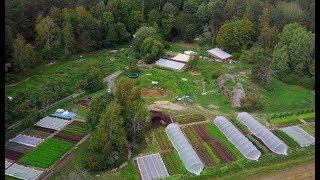
Richard Perkins visits a Swedish farm growing food on 1.8 hectares and selling 500,000 SEK annually through a farm stall and local distribution. They discuss earth-sheltered greenhouses, compost sourcing, Azolla ponds, and how to keep costs down with reclaimed equipment and low-tech infrastructure.
Questions this video answers
1.8 hectares
Approximately 1,300 square meters of beds
About 500,000 SEK (≈ €50,000) over ~6–7 months
Wednesdays, 14:00–18:00
24 boxes per season
Chapters
So I'm in Karlstadt just picking up chickens for a one off drop to Stockholm for collaboration with minfarm. It's a local distribution company that does food boxes from about 40 farms around Stockholm to consumers in Jerry. We're doing a special one off drop off of chickens for one of their boxes partly in collaboration with Elin who was our chef in the first year. Amazing young woman who's just powerhouse and involved in Min Farm working on their recipes, etc. But I thought I'd take the opportunity to go and drop in on some old friends under Talana, under the pines. Well, it's -28 in here and I didn't bring a jacket but luckily I'm just picking up this pallet here. You can see this is where we stockpile a bunch of turkeys, beautiful turkeys here. As well as chickens for sale throughout the winter. Now we've just been in contact with a group of Americans who are living here in Sweden and obviously Thanksgiving is a big thing for them and so.
We'Re going to explore the possibility of supplying them all with good turkeys because.
You can't get good turkeys here in Sweden. But basically I'm going to transfer these boxes onto kanger boxes and I'm on my way to Stockholm. I'm going to get out of here now. Okay. Frozen chicken delivered Kangar boxes did good. I'm off to see my buddies.
Here.
In Yana with Robin and Ozzy and these two are brothers and we met in 2012. Apparently these guys have an awesome little place, very social enterprise with beautiful veg production and a whole bunch of other stuff going on including this earth sunken greenhouse. So we're going to catch coffee and have a look around, see how it's going for them. So we're sitting in this beautiful. This is like. What would you call it? It's not a wallopini, it's a sunken in greenhouse. Earth shelter.
Greenhouse.
Solar. Solar greenhouse.
I don't know. Yeah, like this is basically a brick wall stuck into the earth, right? Yeah. And then is that.
That's an insulated roof?
No, it's just the roof.
Just the roof.
And we're facing south that way.
Yeah.
And this was actually your seating room, wasn't it? But then it's turned into a social space as well.
Yeah, it could be. It's designed to be both a social room. We could have a party in here or a din or we have parties and dinners and meetings and like events.
I see you got a sound system, but is this where you would do all your spring start before the season gets going in February. January.
Okay.
So pretty early. You're in a similar climate zone to us, but that's an early start.
Yeah, but it's also starting with microgreens. Right.
So your micros are going more in the spring to restaurants.
Yeah.
And you just run them in on these racks in the back there in multi layers.
Yeah.
And you were doing like fava bean.
And stuff like that, weren't you?
Yeah. When the main and ravishes, like, what.
Did you start out with? Because you started up and your focus was you both. You're a chef by trade and you're a veg grower from training at Kuilibah. So what was your mission when you set out?
Yeah, to glue them together. Yeah, yeah. To like. I felt like the. The restaurant world, the gardens in Sweden was so far away from each other, understanding for each other. And our family has, like, farming background. And that's my interest for starting to cook came from, like, in a way, glue them together.
So it's getting people into contact. It's a big social element too. Right. So it's getting people into contact with food and then how to process that food and how that food is part of the center of social things and.
Yeah, get to know solely and get to know there.
So how's it developed? Has it developed how you imagined or has it gone off in directions that you didn't anticipate?
It's the boat. It's mainly on track, so the vision is still intact. But it's been many side missions.
Maybe you can just tell the viewers say, what does undutilana mean? And what's the story of this place? Like, a lot of people won't be speaking Swedish.
No.
So undetalana is meaning under the pine trees. And the pine trees, biologically, was the first tree after the Ice Age to Sweden. The first big trees. And it's really. Yeah. Making rock to soil through a strong micro.
They're kind of growing in little lenses on rock, aren't they? Basically, when you see trees coming down in the forest, they're growing on nothing.
So they're really making soil. It's always pioneers who break new soil, and we want to pay respect to all those pioneers. That makes it possible for us.
And you're pioneering too, so it's got its meanings. So you guys have been here since like 5, 6 years, same time as we've been running Alpha, pretty much. And so you got three. How big is the site?
1.8 hectares.
1.8 hectares and the gardens. Do you know how many square meters of beds you run?
1300.
1300 square meters. And you guys are doing really good now. We're about how far away from Stockholm? Like half an hour drive from Stockholm. And this is like the cultural center of the Biodynamic association, you could say.
Yeah, not really this place, but.
No, not this little farm in particular.
But this area has got a lot.
Of alternative people and good food and people seeking alternatives on the way out in Stockholm.
70 years of organic farming.
Yeah, it's an area of cultural importance. I'd say. It's where we actually lived when we first came to Sweden. We lived in Gnester, which is very close by. And so there's a whole group of people engaged in like social things and food things. But can you tell us a little bit more? Like how does it work out economically for you? That's a pretty small area that you're working on, but you're making a really good turnover from it.
Yeah, getting better and better and it's a long learning curve and also adjusting to. It looks really good. From the market garden.
You're doing about half a million crowns. Yeah, that's about €50,000 of sales from 1300 square meters in six, seven months, basically. And what's the model? You have CSA, kind of, but self service CSA. So down in the packing station, you can see here all the vegetables. Vegetables are laid out and this is open 2 till 6 o'.
Clock.
And that happens every.
Every Wednesday?
Just Wednesday?
Yeah.
So that's happening every Wednesday. And customers come and you see on the chalkboard they can just select the vegetables they allotted that season and they've obviously paid up front for the season, which is what, 20 boxes or 24? 24. They're eating the season out here. What is this thing?
Germination chamber.
What's the idea then?
To really stabilize the germination of all.
The seeds so you can control the temperature.
And also during the summer when it gets really hot in here, it stays stable on 25 degrees. So then we have a stable germination still because when it's 30 degrees it's not.
Not ideal. What temperature does this keep in the winter? Like, do you notice any retention of heat?
Like if we don't heat it, it just stay around zero or a bit under.
Even when it's minus. Whatever.
I've been here when it's been like 15 minus outside and I walk in and it's like zero.
That's awesome. Yeah, that's really awesome.
And we have this pipe underneath the soil like 35 meter. It brings in air all the time and it gets a bit heated in the winter and in the summer it comes cooler. But we need to get some shade cloth in the summer.
Yeah, yeah.
To put over the fence.
You build it out of a lot.
Of recycled material also not.
Like half a year, like over the winter.
I remember.
I think when I was last here it was a hole in the ground and you were putting massive boulders on the back wall. So you did a lot of work on that. And you would just put shade cloth over the top of that in summer to keep it cool. And then you could still use it for seeding and. Yeah. That's awes. So these guys have made up their own caterpillar towns. They look awesome. Now you've done that on the super cheap.
No.
So you bent your own hoops. Yeah. And then what have you done for all the pieces like that you would typically get from farmer's friend or whatever.
Yeah.
This one, that's what you hold up the plastics. Super simple. Yeah. And just little hook brackets. But that's sweet. Nice.
It's just galvanized bracket, like €1 thing and this S hook.
So it's like a 20 meter tunnel. That costs you what, €7,700. Yeah.
Yeah.
Perfect. And you've had no trouble with the storms or winds. Perfect. They're so stable, aren't they? In strong winds.
But this only came in 6 meters. So they become a bit. They're a bit low.
Right.
The ones you have.
I see. Because. Yeah. And ours are really nice because they have a vertical end so you really get a lot of volume.
That would cost like a lot to make that.
Right. This is standard length.
Yeah, this is standard length.
Yeah. But they're good enough. No.
Yeah. And we can source that local.
Yeah. So you guys are working on 75 centimeter beds. Yeah. And lots of compost. No dig style. Yeah. And you had to tell us you had some big problems with compost supply. You actually used the same supplier we did. But it turns out they have different recipes.
So this is the bad compost.
What was in there? But it was not good enough. So you had to. You put down like a lot of compost and then had to rip it up again. No. And now you've got some good stuff from local farms.
Double spring work.
That looks. That looks more like the ticket.
We have really clay soil, heavy soil here. Yeah.
This part of Sweden is just. It's homogenous clay. Now it's all the farms around here go bone dry in the summer. I imagine all the pastures stop growing now and.
Yeah, it's been a tough summer.
Tough summer. Yeah. But that almost looks really nice. Is that from the cow farm? Yeah, yeah.
And I start to work with them is like the best thing.
Yeah.
You could wish for.
But they've now 90 head of cows or something.
Yeah, yeah.
It's perfect.
Now it's just getting them get the whole compost heated so we get less weeds in the compost.
So you're gonna start working with them to manage the compost being made properly?
Yeah, we start talking about.
Yeah, that's awesome.
Yeah. And what to put in the. In the stables. Yeah. What materials to.
Can you get Torv really cheap?
This is Milton Torv.
Yeah. That's what we've got this year. And we. Mixing our chicken and cow. We've kept them separated like cow and Torv and chicken. And. And I thought it didn't look so great, but I've just been looking under the microscope and it's. It looks great. And I'm gonna mix them together now. But it's. It looks like this stuff is really nice. Torv is such a good place. But that mix up with your compost this year, that set you back a bit in your productions. Yeah. Yeah. How's that impacted you economically and will it cut your revenue this year, do you think, with the drought as well?
Yeah, but we didn't aim that high, so I think we, like, maybe get above what we wish for.
Okay.
Even though the drought and the setback. But it's mostly like. It was tough for us.
Yeah.
All the hours. It's got a hold water a lot better and also have a better start.
Are you doing, like, totally no dig.
Yeah.
Is that your. Can we have a look at some of the beds and should we just show first?
Look where we turned over the most times.
Yeah. So they're short little beds. Have you cropping all the.
Yeah, we can crop the whole bed out in one week.
So it's planned for weekly harvest. Yeah. Awesome. You say all your beds are the same size?
We went to the local blacksmith and they made like 10 more and we've been selling them to friends who started gardens.
It's good for clay.
Sorry.
Yeah, it looks heavy duty with that extra side tine giving it strength like that. Yeah, I like it. And this cart is how you move stuff around.
Yeah. We can fill this one and it goes.
It goes over the beds. Like, that's how you get compost down efficiently.
Yeah. Perfect.
Pretty Simple. Super simple. Yeah. I bet that saved you a ton of work now. Love it. This is the old cow manure with peat moss bedding. It's beautiful stuff. Look at that. It smells like forest floor. It's got a good structure already. Even it's a lot of worms coming in here. Very nice.
Yeah.
So this is sort of thing that.
We end up with.
It's hard to find in Sweden. Very hard for us to find good compost here.
So this is perfect so that if we want people to work no dig, then we need to show people how to make good compost.
Yeah, I've been trying to get. I've been telling people there's a good business for someone who makes big scale good compost.
Hopefully yoga gets to it.
Yeah.
And also the, the, the bigger farmers, I think.
Yeah.
Has it been used for you guys for insects this year? What are your typical insect strategies?
Just insects netting. We don't use the. Nothing else, can we.
Do you want to show us how you do with your. Some of your beds? Okay, so you got multi span insect nets.
It's less work.
Yeah.
So here's arugula.
Look. Rock it without a single flea beetle.
Beautiful.
We're coming there.
So you're getting the covers on as soon as you seed over all the beds. And you're seeding all this block at once, basically.
Or we just move. We have this five block netting and we see two and just put the net out. When the next bed is empty, we see that and we move.
Just keep moving the net outwards. Yeah, yeah.
So and then we can. When this is hard, we can move it.
What's this down here? How's this set up?
We had have this, what do you call it?
Like this header pipe is coming. Is that a gravity? Oh, it's from the pond. Yeah. So the pond is just over here and that's fed by water coming out of the forest basically and down the gully.
Yeah.
So then how do you get it around the garden?
We have a main line through like the garden and we have like this outlets every 10 meters so we can hand water the whole area with this guy.
So is everything hand watered?
Kind of. We have some sprinklers, but because we have kind of this clay soil, we don't need to water that heavily. The whole garden we can like. Okay. Now we planted these beds.
You water stuff in and then just leave it alone.
Yeah. And then we take like a third of the. The garden with the more heavy water for one day. But that take like half an Hour or I don't know.
That's awesome.
So it's not a big deal.
It's not a big part of your day.
And it's a high pressure pump.
So this, it's putting water down, putting.
Out lots of water.
Yeah. That's awesome. So watering is really not that big of a deal for you. What sort of crops are you growing for the csa? Like what have you found? Customers are wanting with more carrots, more.
Beets, more turnips, more radishes, salads, simple, nice crops that people really enjoy.
I've seen like maybe 25 varieties, that sort of thing.
Yeah.
Or more maybe.
Yeah.
But.
Before we tried to grow everything all the time, like. But now we're like, okay, we don't grow this for the summer, we grow it for the autumn, like the season. So it's easier.
Now you originally you had, when I was here, years ago, you had your market gardens on this side over here. And they've never, they've migrated over here. What was the main reason for that?
Because it was really heavy clay over there and it was also where we wanted to do this. Easy to make. Yeah.
Logistics maybe like the layout and orientation of it. And we wanted to work with the forest edge and put in a perennial garden.
So we worked naturally fits on the.
Next to the landscape to extend the forest edge.
Yeah.
Something I see here that I see at our own garden is all these fungi and that's something you get with no dig that you don't get in a tillage based system because fungi are the first thing to go when you till where you select for bacteria. So this is the. This is what used to irrigate. It's filling off the channel that comes down from the forest. There's basically bare rock you can see around the site on the drone footage. It's all just bare rock around here. So a lot of flow coming down the hill that's directed here. And then you guys are growing a Zola as a. I bet that's really.
Helping stop the evaporation in some clay pond. We have a liner or something.
So I was actually here in. When was it you dug it? I was here when it was being constructed. Yeah.
2013.
And there's one more pond up at the top there, isn't it? This beautiful homogeneous clay they have here around Stockholm, which has its pros and cons, but it's good for building ponds like this. But I love this Azola. So this is not living through the winter here. So you've kept it alive just a Small amount in a fish tank in the back of the greenhouse. And then that mould applies up to this throughout the summer.
Yeah, it's epic.
Yeah. Someone was asking about the evaporation in our pond and I showed you in the pond that we never pumped from, we got about, I'd say 25 centimeters of evaporation over the summer. But with a covering like this, you not only get zero evaporation, but you also get clean water, living water, and you get a lot of food that could be fed to chickens or ducks, etc. So this is the guy that gave you the Azola. He was at the Stockholm University.
Yeah, he's an artist and works.
So he was looking into whether you could use the Zolla to make food.
Yeah.
And. Yeah. Discovering it in different ways and studying it.
Cool.
That's a.
Like a book and Mikkel's book here.
Yeah.
So Mikkel wrote a book about natural forestry. So the Lubeck based forestry here in Sweden. It's in Swedish, but it's a good book. Check it out if you're Swedish. You guys are really into recycling. This is a bit of a cow barn. They found all this amazing, like cookers and fridges and sinks and it's awesome.
And.
Yeah.
Working on a low budget.
Yeah. But it's also a really good restaurant level.
That's what you need, Chef. No. Yeah. So what's the. It's a bit like this is. I can imagine you have events at night times and this is like a really nice dance area.
Yeah, yeah, yeah. We had a big party with 400 people.
400?
Yeah, two weeks ago.
These guys are normally speaking Swedish all the time. I know it's tough to. You know, I think people will really appreciate the effort to speak in English and try and translate some of your thoughts into English. That's really cool. But you. So you have like people that connect to this place that are interested in veg production, farming and then you have people connected to the social element and.
Yeah, and to food to like culinary.
Do you feel like it really is obvious to people when they come here? Like the connection you're able to draw between both is that like an emphasis.
Emphasis on the. The event.
So to really show people where the food is coming from and as it were.
Yeah, I think the place has the aura of it and I think we had storytelling around this during the years, but could be even better. So we're trying to. Yeah. The soil as the bottom layer of everything we do. So that needs to be.
Yeah.
In the aura in anything. So even if it's a men's group thingy, it's about what's. What planet are we some kind of. Even if we here to dance, it needs to taste it and feel where it all begins. Yeah.
How many people come through here in a year, do you reckon?
We talk. It's hard to buy 4,5000 people, I think.
Keeps you busy now.
Keeps a busy.
What do your summer hours look like? Like how many hours do you reckon you guys work a week?
We spend our days here. We walk between those.
But it's kind of work some way.
It gets less and less work because we get more and more like focused on what we're doing and it gets like, we can go home on a Friday and feel like we can leave the job here. That's cool.
But then you just have to come back on Saturday and do an event.
Yeah.
Or open the greenhouse and go and swim or work a whole day. So it's.
You work a full week to get the sort of veg production that you're doing. But it sounds like. Yeah, that thing where work and rest and play, they actually just become so entwined that you don't, you can't really separate them at all.
This is the part of life that we love.
And so what would you say to like other people that are thinking of starting out, like, particularly with market gardening, but also with like social things and events like, like Sweden's a particularly hard place to make economies work and you guys are doing it and enjoying it and obviously like totally committed to what you're doing. Like, have you got any advice for.
People that are starting out or want to start out with that?
Yeah, the gold. Go nuts.
There's all the harvesting. Look at my beautiful clear water under there. So you're saying it multiplies, double itself every week?
Basically, yeah.
That's awesome. These guys have got these big commercial chillers just for €50 each if it's seven of the great crates up.
But look at these beautiful Hakari.
They've been serving them up flea beetle free, serving them like little Japanese candies and talking about Ozin as a chef. So he's talking about putting them up with some sweet syrup from some herbs like basil. Could be like a delicacy for dessert.
Well, you know me, I'm into low.
Cost solutions and these guys are rocking it with their bubblers and their secondhand fridges that they're getting from around the area. Got a little drying rack here and taking some of the work out with the self service and that works really well around here. Really nice people in this area and who are really appreciative of the sort of the quality produce. These guys got a nice big blue handle for their watering and veg. This is something we'll be stocking in our store. Nice heavy duty rubberized handle with adjustable spray which is perfect for wash down. So we'll be serving that too. And nice little simple setup for wash down.
They've got a drain in the old.
Barn floor here and so this is a work in progress there.
Have this barn that comes with the property and they're just slowly doing it up.
But a lot of space up here to do all kinds of stuff with as well. So speaking with Robin, he's hoping to be able to buy this place. It's leased for a peppercorn lease at the moment, but they're looking to buy this place one day and I think they deserve to. They do an amazing job. So basically the farm stall is open two to six, but it's self service. So people come as a gentleman with his child on a bike and they just come and self serve. So I just bumped into Simone who's a very important part of this place too. I was just on my way out, but I wonder if you want to say anything a bit about your role.
Here, growing vegetables and a Nutella, that sort of bling. But I also want to work with this platform next year. We really want to invite people. We really want people to see where your food is grown. We want people to have a place where we can talk about these questions because there is no places in.
You're not taking money off those people, you're hosting them for social cohesion, etc. So the EU funding would give you a salary for running those projects basically.
Yeah.
So that would then make this place more complete financially.
Yeah, yeah.
So.
But it's sad that you need to go that way.
Well, unless you grow a lot more vegetables. Yeah.
And that's. I mean I really want to work with these questions more than I want to grow.
Just grow vegetables.
Yeah, yeah, yeah. It's a good situation.
Yeah.
They're coming to.
Well, it was really good to just.
Meet Simone before I left because she.
Was expressing a bit of frustration around it being challenging to make a living as a farmer. And whilst they're doing really well economically here, it's not enough for their three salaries. So having to take another vegetable growing job on outside to pay the bills is really tough. Now there's a few things to think about that and I Think it's important.
To share this kind of thing.
One is that, you know, when you start to farm commercially, you're competing in a globalised food market, albeit, you know, we're in a niche market where we can out compete conventional farms on freshness, locality and quality. Potentially. It is tough because people have become used to going to the supermarket and getting all kinds of deals and subsidized.
Foodstuffs often run by ag school, like.
Some of the veg growing productions in England, for example. You know, the ag school students are doing 16 hour days cutting celery and you got to be able to cut and pack like four or five celery every minute for 16 hours, you know, so you're competing against this kind of operation. And I think it's an interesting thing to consider what their options are in that way, because they are right outside Stockholm. The marketplace is there, there's no doubt about that. So I would consider a few things and I mentioned a few of them, but I think I would like to go back over the winter and offer my time to support them and help if I can, which I've extended to.
Them and we'll see.
But basically I think they should shave off some of their crops and grow things that are profitable for them. They can definitely scale up greens now. They don't want to just be growing greens and microgreens or whatever, but the reality is if they need more economy, they do need to specialize and cut some of the crops out that aren't working well for them. And then the other thing is to consider winter growing things like microgreens. And they can sell microgreens. At times they're selling micros for double the price we can sell out here. And they have a massive marketplace on their doorstep. So I think there's scope for actually turning over a lot more sales without increasing beds.
Now.
They've got 1300 square meters now. I would not anticipate that being enough for more than one person's salary in Sweden, like, or a family salary, you could say. But it's certainly not going to pay out three full salaries. It's only seven months of the year for a start, maybe eight months. They're pushing it there. They're in slightly warmer climate zone, but basically I think they would need to double their bed space if they wanted to all get a salary out. Plus this EU leader funding for the social work they do. And that's really, you know, they are doing amazing work bringing a lot of people together on that site. It's really busy place I've been there when it's like, full of people coming through. But maybe they need to pull the reins on some of that to constrict where people can and can't come in. Because it takes up so much time to host people and they do a really good job. They're really social and they're really amazing people. And it does take up masses of time when you have unexpected visitors all the time. Now, I think they're always going to get that at that place. It's that kind of feeling in the community around there. But I think they could find a better way to get the economy out of that, too. Now, you know, it's a lot of work to host and care for a space that is not bringing you money, and that is what the EU funding will do. But I think there could be a way to capitalize on all that. They're bringing people on top of that, too. I think it's a really great project. They're doing really good. It's been a very challenging year, and yet they're still up in their sails, which I haven't managed to do. We've dropped sales from the drought, but I think that a little bit more tweaking of their crops and maybe considering some different tools so that they could increase the bed sizes without actually having to do loads more work. It was smart the way they do their insect nets, but I think better seeding tools and you know, considering, like, how to be able to plant twice as much in the same time.
Thanks so much for showing us around, guys. That's super cool. I hope you folks enjoyed that. Where can people follow you if they want to see more?
Yeah, the garden is Instagram the Talama.
And you're on Facebook also. Yeah. So we'll stick the links in below. Thanks so much for watching, folks, and thanks for you guys for sharing.
Thank you.
And we'll see you next time.
More from Richard


A review of short and intensive season on a mixed farm and restaurant/event space in Sweden






Alskade Kyckling Exploring complexities of poultry production in Sweden and what we stand for


