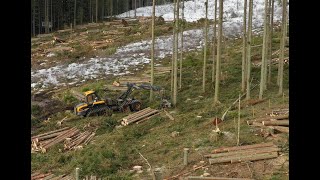
YouTube video (Richard Perkins) reflecting on a winter forestry harvest on his Swedish farm: he documents heavy-machine logging operations, damage to fences, soil compaction and ecosystem impacts, the economic tradeoffs of timber sales, and plans for repair and agroforestry recovery. The tone is mixed — practical, regretful, and hopeful about ecological recovery.
Questions this video answers
July 8, 2019
€7,000
€20,000
About €10,000
About one tree every 40 seconds (losing money at ~60 seconds in Sweden)
Chapters
Well, it's high summer now and I still never made a video about the forestry. And we've just been finishing up fixing up most of the forest paddocks, the fencing that was smashed up during the operation. So I thought we'd do a little throwback to the winter when we were cutting and what was happening in that process and some of the mess that it made on the farm and what I think about that. So this is the machine that does the damage, as it were. They're very impressive machines, but highly destructive in terms of massive compaction and the rate at which they can just take down trees. I mean, this thing has to be cutting down a big tree every 40 seconds to be making money. Here in Sweden, if it goes to like 60 seconds a tree, then they're losing money. And where the ground is all frozen up, it's okay. But it's starting to thaw out now. And they've trashed my strawberry patch, which they haven't. You know, they haven't brought in the logging truck yet. And that will be doing much more damage as it brings up super heavy loads of timber. But should be a couple of days to go and then there won't be this Skyline anymore. So I've been asked to move a little bit of the corner fencing here just to make it easier to get through. You can see it's very wide track drill vehicle. And once they're pulling timber out, it's going to be too wide. It's making a bit of a mess, but the ground is holding up okay. But I think taking the logs out is going to really impact it, so we'll see how it goes. So we're here on the neighbor's land. They haven't started our patch yet, but this is what it looks like when they come through. I'm out of breath because of the deep snow in the forest. The ground seems to be holding up okay, which is reassuring. But it is looking like warm weather for the next day. So it's hard to tell. They're going to be working through confined spaces when they get up to our line over here. And they've assured us that they won't totally trash the fence, but. Well, we'll see what happens. It's going to look pretty bare after this is gone, but the new forest is coming up here on the neighbour's land. Well, here's our fence line. We've done a pretty good job staying off that. It's going to need some tightening up afterwards. Oh, it's going to be very different Watching the ecology. This point in, if we just hop over the fence here, this is where the pigs have been digging it up all year. And a lot of light is going to come onto the ground. Now. You can see they're resting for the weekend. So there's the machine over here by the eggmobile. But I expect to see a flurry of raspberry and forbs and grasses and then hazel and willows and poplar and birch and eventually some oak, etc. Quite a lot of fallen trees on the other side of the electricity line that's kept open there. But they reckon we can get full price for that timber. Timber shouldn't lie too long because you get beetles that are boring underneath the bark and damage the wood quality, but also breed and then infest other parts of the forest. So we just have to see. Now, I think it'll take a few days for them to get through and clear, and then we'll come up and see what it looks like up here. But it's. It's going to be quite drastically different, I think. So. This is down at the business end, and you can see there's a chainsaw blade there, and that is kicking out. These grabbers are holding the tree. It's cutting it, tilting it to get a direction of fall. And then it's all computerized, and it spits through a log, taking off all the side branches and cutting it into exact lengths. And that is all recorded on an onboard computer. So there's live data streaming of just how much material is being put through. Well, Ragnar and I are just coming up to have a look at what's been taking place. But as you can see, there's a very different landscape around here now, and it's making quite a bit of a mess in there. Wowza. And it's a few days now of bringing the material down. You can see up on the hill, the wagon has started that job. So I'm up here at the turning circle. That's the view. It's going to be very different. A very different amount of light coming onto the ground there now. And so it's going to be interesting to see what grows up this year. There's a lot of fencing to repair because of the tree work, but all that's been left is a few of the taller birch you can see up there. Pretty drastic. So the tree house is on the edge of a clearing. Now. There's also twiggies. They have not cut magnets. They have cut a lot of trees, but they've left us some so that we can build another house one day. Let's go see the tree house. So we're up at the treehouse and this is the view. The machine is starting the long job of picking up the wood and also talked. You want to tell us to talk on the camera? What do you want to say? Doing the trees. The machine is taking the trees. The trees is gone. So there. So there. Well, they have made quite a mess. They've trashed a lot of the fencing. We're gonna have to speak with them about it because they're responsible to fix any of the. The damage they make. But they, they've taken out a huge amount of our fencing that was not in the. Well, this is what they've done to our field and they've hardly taken any of the timber out yet. There's been quite a lot of double lorry loads leaving. But as you can see up on the hill it's still all there. But they have made a horrible mess. They're in their contract, they have to fix this. But it's wow. Much to say, pretty catastrophic. This is very nice soil we've been carefully building over the years. But I dare say it'll cover back nicely once I get the place flattened out again. It's hard to get the scale of this but it's 40, 50 centimeters up in the air here and it's. I want to go up and see what's happened to my forest fencing, see how much damage there is to fix up there. This is a meter deep hole. Now one thing they made me do is take down the corner of the pig paddock here which seems a little bit stupid. They crushed it now but they're not even using it as a pathway. This is our neighbor's land. Oy yoyo. It's just a bomb site here. It's gonna take a while to cover up again. So this is the old back line of the forest and the fence is in remarkably good condition considering. You can see some of the wires here are fine, but it's. They've trashed the wire but not the post. Generally there's a couple of smash posts and a couple of corner assemblies that have been damaged. But it's actually not as bad as it seems. Here for example, it's fine. And because we're not going to have pigs in here for some years now as this recovers, I might be. I will analyze it once they've cleared all the wood out. But it may be that I just restring it as a two or three Line fence if I can. I'll just replace it with what's there and just have to put a bunch of new insulators on. But essentially I can see a bunch of smashed insulators. But if I can get the original wiring back then I may as well. They've left a few sad lonely birches. Quite a drastic view. You can see the tree house over here. It's going to be quite some getting used to. Well, it's 6 o' clock in the morning and they've started work moving wood but we still got no power, which means no one here has got any power down the valley. But they were here late last night but they went again so I guess it might be a bigger problem than they could deal with. But we need some power. So the electric just came back on. It's now 8:30 in the morning. It's apparently been off all the way to the main road which is 7km away. So a lot of houses without power. Update is they've taken all our timber out but the drivers are unhappy. They're having to pile timber between our tree lanes now and they're very aware that they shouldn't damage the trees. But it's making a real mess. We'll go down there and have a look. But power's just come on. I don't know if it's temporary but they're talking about having to reroute the cable which means digging up even more of our field. And it's, to be honest, it's such a mess in there that not happy about it. It's been a bit of a nightmare to be honest. And a lot of people here rely on electric for their heating because they've got those modern ground source heat pumps so they haven't had heating for the last 20 hours and it's minus degrees so. Well, that's why we want a hot water system with wood because wood's reliable. At the end of the day you can always put more wood in. So. But yeah, we'll go and look at the damage in a minute when I've had a cup of tea. And they must have cut the electric line that comes under here somewhere and so they reckon there's only a day left to get the timber out. So he's piling it here, he's trying not to destroy our trees. But they reckon they can be done with getting the timber out today. But the electric's back on which is good. But I don't know, I feel so mixed. I think this is, you know, it's gonna take. It's gonna heal up, but it's gonna take the whole year just to get this back to some kind of order. I mean, that machine just rips up the ground, and I think the drivers are pretty unhappy. It's like the whole job seems to have been badly organized. But this is. Well, this is what you get for bad timing. The weather's. You know, the winters are not as cold as they used to be. If the ground had been frozen up a month ago, this would not have happened. And I think there was a bit of a lack of due diligence, checking the electric line, you know, especially when they knew they were digging this deep under the ground. But, well, it's happened now. Pretty full on. That's a crazy machine. This driver is really cool. He's really aware that we're trying not to damage our tree crops. And so they're being as careful as they can. But obviously, when you have a machine like that. Getting out the way, It's maybe coming to say hello. Bad feeling in my heart. Yeah, but it's the. It's the planning of the whole. The whole thing here is so bad. I know you've been doing a very careful job trying to not hit our trees. And we have a lot. Put a lot of y. That creek and. Yeah, but what happened last week, we didn't know that the cable is coming through here. That Oscar has. He should have checked that now. Yeah. Because it. I think when they originally came the first time, we told them it is buried under the ground here. Okay. So forestry guys, checking forestry. The electric guys are concerned because they need to get. They basically have to dig up this cable and avoid my little chestnuts here. And they have to get a new cable in here. But they're concerned that the digger won't be able to drive over these tracks. They want to just drive through the field. And I said, look, I'm sorry, but you guys have already made a massive mess. And even if it's a pain in the ass, you're gonna have to flatten this and drive on this, because I can't have more machines trashing my trees. I mean, it looks way worse than it is, in a sense. Like, yes, we've spent years building this soil, but this is a roadway. This is a track that is a access to the neighbor's forest, and it's a right of way for him. So it's always been used as the track that we access the other bits of land. But, you know, I want them to stay on that and not come into my tree crops, which to them probably seems really insignificant and pointless because they've got a job to do and it's a big industry, A big sawmill that's out of power. Everyone else has got power now because they've rented, rooted the power, but there's a big industry that shut down. But it's like, well, you know, it's your problem. Actually, it's not my problem that this happened. You didn't do due diligence in the planning. And the drivers, I mean, they're being really polite, but the drivers are really pissed because they just feel bad about the job they've had to do. But I feel, you know, yeah, like right now it's a big mess, but it's fixable. Like, you know, it'll take the rest of the year to fix, but it is fixable. But if they start driving anywhere else through the fields, then I'm not going to be a happy bunny. And so I think we'll just be up here, make sure. They need to start fixing the cable now. But I want to make sure that they're not going out of what we've said because, yeah, I'm just not up for that. So I was just talking with the forester guy and he was saying they want to come in May and flatten off the pastures for us. But I said, look, I need that done in late March, really, because we got to start moving eggmobiles around the place. And I want it, you know, as soon as grass can start growing, I want it seeded and ready to go because it's going to be hard to get eggmobiles across those big tracks because they're going to sink in the ground. So we're going to have to wait and see. So it's all drama. He has to come along and put this cable under the. Under the track that this machine has been making bigger. And this guy's just got a few loads of timber to get out now. Quite the mess, I think. You know, for those of you watching this, you're probably gonna find is so drastic. And it is really drastic. But, you know, I don't. I also don't want to be that guy that's like just a pain in the ass, like telling them they gotta do things differently. But it's important to monitor work being done on the land because, like, you know, I totally understand. These machines are super heavy and the ground is in really, you know, it's not ideal when the ground is not frozen. But they're doing. They are doing the Best they can to not destroy our land. And whilst it looks really gnarly here, it will. It will be sorted out and it will recover. That's the beauty of nature. But I told them, like, they wanted to come back and take Brashwood in the summer because you can't leave deadwood lying on the ground because the beetles. But I'm sure there's another small, like burning it or something, because once this is fixed, I do not want another machine coming in here. There's no timber to be harvested out of here for another 80, 90 years and I don't intend to be employing a machine like this ever again. It's all a bit hectic up here. We've got wood coming out, wood being taken away and a new 50,000 volt cable to go underneath the field whilst he's still taking the timber. Oh, it's crazy days. Make a video. Because I make a video. I took a lot of drone photos of film when you're coming and taking a walk as well. It's not something that happens very often. So. This is what the road over the bridge looks like. Somehow it stayed in one piece. Whoa. Up to my edges. Wow. Well, let's talk about the economy of this. This timber is basically. They were trying to give us a fixed contract for €7,000 for LA timber. Luckily, we took it on a per measurement basis, so we'll get around €20,000. Now, if you take that out after tax, that's about €10,000, which doesn't feel like a huge amount of money in the context of things that's, you know, nearly two hectares. That's taken 70, 80 years to grow. It's a bunch of money, you know, white money. After tax, it will pay for a new hot water heating system around our house and a glycol loop through the greenhouse and a beautiful masonry stove. But, you know, the timber company are making the money on it. You know, there's nothing more profitable than turning lumber into plank timber and they make a killing on it. And it just goes to show, you know, what it's like at the raw end of the industry. It's, you know, it's causing major ecosystem damage and a lot of mess to fix up afterwards. But I'll be glad when this is all done and spring comes and we can start seeing it repair. But there's a bunch of fixing up to do and I'm not looking forward to it, really, but that's what you get. You know, we're. We're using big industrial machinery for a small farm. So it's, you know, that's the way it goes. There are the low tech ways of taking timber out but it wouldn't be economic at all. You know, we would certainly not have made any money. And it felt important to capture a bit of that money because, you know, that's helping us renovate our home. And yeah, I feel so mixed. It's quite emotional because there's a lot of beautiful topsoil that we've been building that's been damaged and we can build it again. But it's, yeah, it's, it's just an interesting experience all around. Okay, so these guys are now found the cable and then we. They've got to basically dig a new cable under this road which means forestry machine can't come back in. So they are actually now bringing in the heavy transporter to take the forestry machine away. They're going to have to come back up here to take these logs back down. And then it's deciding whether to take the few remaining loads out the front of the hill, which is a good kilometer that way, or there's forest tracks about a kilometer up north in the forest. But it's turned into a ripe palaver. And so far the driver's been doing a really great job trying to avoid hitting our trees. But it's. These are my little baby walnuts from seed that I don't really want getting trashed after several years. They're trashing a bit at the end of this row here, but that's the way it goes. Crazy mess. Well, I guess that's the end of this episode. The machine's out and it's got to come in a different way. But there's no way to close this story until the spring when we cover up the ground and start all the repair work. And hopefully if I get this book done in the next weeks I'll be up fixing the forest paddocks. I want to get the cows up off the pastures. Everything starts to thaw out so they don't impact the pasture too heavily and can be up in the forest patches. But I'll keep you posted. I think, you know, it's going to be an ongoing thing to reflect on throughout the summer now as we start to see different species popping up and the cows will helpfully bring some of their flora and fauna up into the forest. But yeah, crazy days. I, you know, I don't know what words I can say in the face of all this. It's pretty drastic and I hope there's something insightful or Useful in that and just makes me really dread the day that they take this forestry. All of our north beds are on our neighbor's land and they just kindly let us use that for free. But at some point they're going to have to cut all that timber and it's a good volume of timber. It might be that we move this wagon, which is becoming an outdoor kitchen this year, and so we can stack up logs there. But I want to try and avoid them trashing the market gardens that will have spent 10 years or so you know, building no dig beds on. So I'll be willing to invest in a way to avoid them doing that. But we'll cross that bridge when we get to it. But yeah, sad days. This is. It just feels intense but interesting and I don't know what else to say. So this is what it looks like now. It's greening up, but it's very dry period. And this is heavily compacted subsoil. So you see the grass that is in here is totally stunted and you can see these expansive clays that we have in the topsail here cracking away. So it's going to be some years until this is recovered. Over on our neighbor's land, it's basically very little regrowth at all because they've not seeded at all. So we put some seed down just using old remnants of what we got. But it's. Yeah, you can see patches of it are pretty terrible. It's only now that we've been able to come through, bringing the eggmobiles over. Been getting a lot of strawberries out this lanes here and soon back up to nutfield. But we've been putting a thick litter on the ground, really trying to armour the soil a bit as far as we can in our grazing plan. So our last bit of fencing down here is the borderline of our property and we making a corner post here, then stretching the wire here. So this is the larch plantation and the paddock in there. And this is the long thin plantation that you'll have seen pigs in if you've been following our videos a bunch of times. So that's the last bit of fencing to fix, which is great. And as I said, the benefit that they've left, the one benefit is that we now have a bridge that's accessible with an egg mobile, potentially to get down this steep slope into our neighbour's land that we can graze. Now, it's got a lot of brash sticking out of it, but this is really raised up from the river compared to what was here before. And it's taking, you know, massive diggers over the top of it. So it's very strong. No problem for eggmobiles. And that's one good thing that's come out of this, is that we could actually definitely change the way we improve our neighbour's land, which hasn't been improved, and we're basically using his land to cut hay or haylage. And so there's no reason why we couldn't scale up hens again and improve the ground like that. So this is all soil erosion that you can see at the base of this tree. There's 40, 50 centimeters of soil that's washed down out of here. This is all new soil sitting on top of the surface. This is not the soil type that was there. This was dug over by the pigs before, but this is actually mud that's cascaded downhill from the tracks of the machines. Now. It's dried up a lot recently after a sort of wet spring. But you can see the cascade coming through here really damages the hydrological cycle when they come up. Now, this is what it looks like now in July, having crossed the midpoint in the season. And we've now actually finished all the paddocks. So you can just make out the tree house in the background. So we have one thin paddock here, then the thin paddock that the telegraph or the electric line runs through. And we fixed up this paddock to the fence line. You can just make out on the hill here. So our paddocks are operational again, and that's fantastic. But it's going to be a long time till this gets sorted out. Now we've got the fences up, we can actually bring the cows and sheep in here and we will possibly winter graze up here so that we can put down a lot of seed. And it's a shame, in a way, not to have pigs like the pigs do a fantastic job of cleaning up this mulch. The forest paddock, where the ram is right now is beautiful. If you get down low, you can really see across the landscape. And when you compare it to the neighbour's land, you don't get any of this brash. And you get much different species assemblies just from having the pig set through once the trees were gone. Also because the. Actually the machine has left a bigger mess than the pigs would. They've come through with a digger and leveled the pathway, sort of. It's not so level. And you can see when you're up here, it looks very different to. It probably comes out on camera but, you know, give it four or five years, it will look like the second step here. Not. Not this level, this level. And this is what it looks like after maybe six, seven years. So it's going to change. But I want to bring animals in here to disturb the landscape and start bringing in pastoral species through the cows and sheep again. So it's great having sheep back at the farm. That will help with clearing the undergrowth. And we'll be transitioning this all to agroforestry with a lot more focus on grazing. And that's, you know, this is what's had to happen to get that whole thing started. Was it worth it? Well, once. Now the fencing's up, you know, I can really see as summers kicked in and all the landscapes regreening again, it's, you know, it's a matter of time till it's becoming beautiful and dense again. But it caused a lot of stress and heartache and I think for the money we get out, compared to what the company would make on a job like this, you know, is it worth it? I don't know, but that's it. I just thought I'd share a bit of the old snaps for you. For those that have been following our channel for a while, I never put out a video about this and I think it was just because I was feeling so heartbroken about the whole thing and feeling a little hard done by. Whilst it's a lump of money we got in, it's a small amount of money in the great scheme of things, in terms of the money passing through a farm like this and so, you know, it's from the mess that's made, I wish in some way I just kept the forest in place and. Yeah, well, that's the way it goes. We've explained why we had to cut in and that's the way it is. So, yeah. Hope you found that interesting in some way. Don't forget to click, subscribe, share the video if you enjoy our content and we'll see you soon in the next video. Bye for now.
More from Richard


A review of short and intensive season on a mixed farm and restaurant/event space in Sweden






Alskade Kyckling Exploring complexities of poultry production in Sweden and what we stand for


