Water fast, making bacon and pruning tomatos
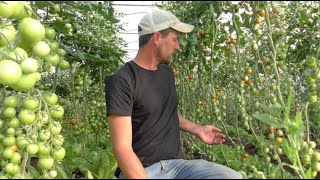
Richard Perkins cures sow belly into streaky bacon with salt and sugar, then hot-smokes it. He explains his water fasting practice and keto diet, while pruning tomatoes and cucumbers to ripen before frost hits.
Questions this video answers
13 kilos
About 2% (≈260 grams for the 13 kg of meat).
About 1.5%.
About five to six days, with daily turning and re-rubbing of the brine.
48 hours (two days).
Chapters
So in today's video we are making bacon, clearing out the tomatoes and I'm on a waterfall, so I haven't eaten anything for 48 hours now, so forgive me if I'm a little bit dizzy. But let's have a look at what's going on at the farm right now. So we've made videos about this before. But essentially what I want to do is make bacon out of this sow. This is belly from a sow raised in the forest here. And what I'm going to do is just trim the meat up and then we're going to rub it with salt and sugar which takes. It's a process that takes about a week before we'll put it in the smoker, which is the process with hot smoking. So that cooks it as well. I'm gonna chop this down a little bit to make it easier to handle. So I'm gonna chop it firstly. Just. That's going to be streaky bacon with a lot of fat which is very characteristic of the Linderud pig. And personally I'm quite interested in a kind of keto like diet. Lots of meat and animal fats and protein and trying to reduce the amount of carbs. You can see the ribs taken out here now, 6% by weight. These two cuts weigh 13 kilos together. So it's about 2% of salt I like to put in, which is about 260 grams in this case. And you want about 1.5% of sugar and lots of black pepper. So I have measured that out here very accurately and you've got to get this right because it's very important that the bacon isn't too salty or, you know, too lightly salted. I like to add a lot of black pepper and I will rub this all over the surface of the meat in equal proportions and we will be putting it in a chiller and turning it every day and re rubbing the liquid, the brine that comes out the liquid that's drawn out the meat for about five, six days before we smoke this. So again with the second cut, I'm just going to cut through just to make it smaller, easier to handle and leave us with the correct sort of size chunks that tend to fry up for breakfast. You can see that's a beautiful looking cut. Same on the other side here. That's beautiful. So now I'm just going to equally distribute the salt and sugar mixture onto the one side and it's good to cover the meat very fully, but it doesn't matter too much because you're Going to be moving it around on a day to day basis. But you do want to rub salt into the entire surface, including the edges. But it will start to really soak through the meat as we go. So I'm going to pop these into their containers, making sure I've salted the ends and then I'll do the other side. Once it's down in the container, It gives you a sense of how that's looking. Then for these I just rub it into the sides myself. Okay, now I'm going to keep them in this container into the fridge and it works quite well because it will really allow the brine to soak up. Now because they're lying on top of each other, what I want to do is just cover up the fatty top side before placing this halted side back on top there. And now I just need to really put this all over the remaining surfaces. Very simple process. And what we will do is put this into the fridge and it will start to pull out juices from the meat. And so you would expect to find a watery brine in the bottom of this in a couple of days time. So then on a day to day basis we'll turn the meat around and really rub the mixture back into the flesh and make sure we change the order. So the ones at the bottom are back on the top, ones at the top are on the bottom. And then we will wash this down thoroughly when we come to cook it and smoke it because you want to wash all that excess salt off the surface of the bacon and then you hang it to dry once it's washed down. You would hang this in the smoker to develop what's called a pellicle, which is a tacky dry skin surface that helps the smoker deer really well. And then we will smoke it, which hopefully we'll see in a video soon. So why fasting? Well, I've been practicing water fasts a lot in the past. I used to do a day a week and then up to a week a couple of times a year and it's really rejuvenating for body and mind as well. And I've been noticing my brain is just slower than it normally is and I am pretty fatigued generally. But I feel like it's good to reset the system through long water fast. Just now with the PDC and an intern group coming again, I feel like I need to be on top form and get my brain in gear. So it's a good way to just take some time inward as it were, and just really relax into feeling full of emptiness. I've been two days without food. Just pure water now, nothing else. And fasting is very different from cleanses and things that people do where they're taking juices and things like that, but that doesn't shut down your digestion. So part of the aim is to eliminate toxins, things like that. And part of it is just to give your body and your digestive system a rest so that your body can heal up other things. I've had this ongoing problem with my lower back, which has been giving me issues in the last couple of weeks. And so I'm looking to just totally clean and reset myself. And it's something I've done a lot of more so in the past. Here we're surrounded by amazing food, like a whole human diet. We produce dairy and eggs and meats of different kinds and smoked meats and vegetables, and we eat whole organic foods the rest of the time. So we eat a very wholesome, balanced diet. I've always had a kind of aversion to sitting down, having three meals a day. I've never actually done that. I typically eat one or two meals a day, so I have intermittent fasting in my life generally, which has just been a natural process I've done. I think I did that since I left home, really, partly out of laziness and partly out of just feeling like I only want to eat when I'm actually hungry and not just eating because it's a formality or something and I let my body guide itself on what I want to eat. I tend to eat quite a lot of fats and some proteins and vegetables. I've been eating too many carbs though. Like, I really love bread, good sourdough bread and, you know, whole grains and things. But it's. I feel like that's always been too much of the Western diet. And I'm interested in exploring more of the keto diet and giving up toast. Oh, I don't know if I'll be able to do that, but. But it's funny. Yeah, we'll see how it goes. I don't think I can fast for a week fully now because it's just not practical when you're doing physical work. Also, I'm having a little bit of downtime in this next period before people come and just doing jobs around that don't take huge amount of physical exertion. But if you're doing an extended five, seven day water fast, you should really be resting, taking a lot of bedtime, relaxing, meditating, whatever you do. And not be physically exerting yourself. Now I've done it a lot, so I'm pretty experienced with fasting that I'm not bothered by taking five days or something whilst doing mediocre exercise. But you should never do really long water fasts if you don't have experience or, you know, have health conditions, etc. And it's something, as I said, I've done a lot of in the past. The longest fire server did was a month that I did alongside with a friend. And we were ingesting bentonite clay. That's the material that I've talked about on this channel for building and sealing the ponds. And it swells up eight times its thickness in between these geosynthetic textiles. And that's what allows it to become such a great sealer for the ponds. But it's mined out of the banks of rivers by elephants, macaws, monkeys. They'll travel hundreds of kilometers to go and get it because it's sucking heavy metals and toxins out of your bloodstream. At least that's how they promote it anyway. So we had a month on water just ingesting bentonite, clay and water. Interestingly, I think a lot of people are fearful of fasting because of the hunger, cravings, etc. That come. But they typically come from my memory in the first three, three days or so. I've now had two days without food and I haven't felt hunger at all. And I'm not very food motivated. I eat very little compared to most people. I always observe like my plate's half the size of most people and that doesn't limit me in any way physically or mentally. And I think people generally overeat. I think that's fair to say. You know, we eat far more calories than typically we actually need and often of the wrong balance of stuff due to the wonky guidelines that the government's put into all of our minds since, you know, being a child. I just remember things at school of food pyramids and just how, you know, outdated all that stuff is. Yet it's so much in our brains in some way still today as a cultural perspective. And I know many people will have experienced and experimented with many different diets. And I'm not here to talk about diets and, you know, people need to find out for themselves, but. But I do. Yeah, I really find value in fasting for speed of mind and clarity of thought and clarity of memory and just to give the body a refreshment. And yeah, that 30 day fast was really interesting because the first few days I was extremely hungry and then after about four or five days, your body just becomes. The only way I could describe it is full of emptiness. And you're not hungry anymore and you're not thinking about food, you're not craving food. And I've never had a high sugar diet in my life. So, you know, I grew up with homemade food and wholesome organic sort of food, which I didn't like at the time. But I, you know, value that highly now and the way that that's allowed my body and brain to develop. And it's, it's very obvious that, you know, what good food does to children, particularly, particularly in the formative years of their lives. But that last week of that month long fast was incredible because I actually was working part time selling organic fruit and vegetables. And in the evening I was kidding up a big Mercedes campervan and in the mornings I was doing an intensive driving course. I hadn't had a driving license before, so I did a week long driving course where you go for two or three hours of lessons every day and then the last day of the week is your test. And so I'd done that after three weeks, no eating, which is perhaps a little crazy. But I would go and do my driving lessons, then go to work and sell organic juices and whole foods and then I would come back in the evening and I would be fixing up this van and putting in, you know, turning into a mobile home essentially. And I passed my driving test with no minors and went off after that in a completed van and went to a festival for some days. And I felt extremely energized. And your body starts burning fat, obviously when you're not eating, and particularly not eating carbohydrates, you start producing ketones and things and your body's got plenty of energy to survive for extended periods. People have done water fasts for very long periods of time and I don't know if there's any major benefit and certainly it's not practical in my lifestyle, but it's nice to have some days just not eating and just really observing the body and mind. And then I think to break that fast, I'll probably, I'll probably take some. Right now I'm craving green cabbage, maybe with some lemon juice on top. And I'll probably take that as a purgative just to get the systems going again. It's really important that you drink a lot of water, obviously, and that you don't just break that fast by eating something ridiculous or Something sugary because you get some craving, but the cravings typically go away. And so it's a nice mellow period of just eating light foods, really nutritious foods. I'll probably be taking a lot of broths and things, and I might experiment with the keto diet. It's typically shared is like eating 70% fat, like good fats, animal fats and 25% proteins and 5% vegetables, so not so much fruit or very little fruits, very little carbohydrates. And that's the big shift for me, is eliminating things like bread. And that's going to be tough for me because I really love good sourdough bread. I was always influenced by Sally Fallon's work and there's a lot to be said for she studied how all cultures around the world fermented their grains before they ate them. And we didn't use. Used to have gluten intolerance, all these things. Now, I'm sure some of the viewers are far more knowledgeable about diet and nutrition than I am, and as I said, I'm quite guided by my body. I don't really subscribe to any particular thought. I always take the perspective of, like, what would our ancestors have done? You know, and the body is remarkably resilient. Obviously, if you're eating eggs, you would have found a whole clutch of eggs, you would have gorged the whole lot and you wouldn't have found eggs again until the next year. And likewise, if you brought down a big animal in a hunt, you would have obviously eaten a lot of meat and fat at that time. And, yeah, I don't know, it's blase to just talk about these things in such a simple, quick way, but I think I've always been guided by, you know, what makes sense, and cutting out any sugars and processed food and all that stuff obviously makes a lot of sense, but trying to cut out carbs is going to be a big one for me and we'll see. I'm not sure if I'm definitely going to do that, but. But that's what I've been thinking about in the last weeks, just to try and test that out for myself and see how that goes, but I'll check in over time as we go. It's two days so far, and I'm not sure how long I'll keep this up, but maybe up till the weekend. So, peas coming up. These four beds cleared and we've got a lot of peas, so they're all disappearing now. They've been cropping for Seven or eight weeks I believe. But clearing the beds over for the last turnover of crops now as the weather starts to get colder. Well, things have got a little bit out of hand this week. Just a bit too much to get on top of all these plants. It's time to take the tops off the tomatoes now and get some higher pruning going on to fill, to let more light through to get the rest of the lettuces transplanted out here. So I'm leaving the idlis, that's the really rambunctious flower sets that you see here. I'm taking the tops off all these plants now. That's just basically taking off the growing tip. So you see a bit behind with suckers. Here's a sucker, that's what you want to be taking off. And I'm using these Japanese two handed scissors, another sucker there, little suckers here. And then we'll be taking off the growing tip about there. And the reason being is that we've got to get all this fruit that's lower down ripened up now. And it's mid August. We could be having frost in a month from now. So some hard pruning here and then we'll be taking out the lower stems, which I've been doing in this row. You can see it really lets a lot more light through. You can really see the abundance of tomatoes. We've got to ripen up now. It's looking pretty amazing in here. And we take the lower branches off up to about my waist once the fruit's really set. You can see there's some incredibly highly loaded trusses on here. And now is the time to get a bit more light to the ground for the salads and get these ripening up. And the way we sell these is at the Rico in bags. So we actually harvest tomatoes that are ripe or just before ripe. So they'll ripen up as they're stored for a couple of days before they go out, which is is typically Wednesdays and Thursdays. But we wanted to get a bunch more light down into the ground here, but also importantly cut off the tops of the plants. So as you can see, I've cut the growing tip off these plants and some of these plants were growing much bigger. And so I've just been making decisions which flowers to leave on and where to top off the plant. You can see a truss like this is barely going to have time to set fruit. So we'll get three or four trusses off a plant now that's what we have to do. Because of the short growing season here. Just have a look at some of these rows. We'll have a walk along. You can see on some varieties there's still a lot of flower clusters up here. And I don't have super high hopes for them because we've got frost coming in potentially a month's time. Some really cold autumn season already. It could get hot again, who knows? But at some point you've got to decide when the cola plants here in such a short growing season. We've been doing that at the end of August, but we've been ending up with a lot of green tomatoes that we use for chutneys and things which are delicious and we can sell them over the winter or store them also for our consumption. But we've decided to cull them a little early. So taking off the tops of the plants and then taking out any suckers still. Here's a sucker here growing up between the main stem and the branch. I would typically cut them off just pulling that off because I don't have the scissors with me. But you've got to keep an eye on them too. And you also get suckers at the end of the fruit branches. So I'll take them off too. Just pinch them off. So we really allow these time to ripen up. This is idli, the variety I've told you about many times. You can just see one of the six trusses on this plant. These are yellow cherry. Once they ripen up, I haven't been through and pruned these. Just been waiting for pollination to be complete and fruits form up. But I will do the same. I will come through here and clean up around the plants. But we're going to have an incredible abundance of these. One of my favorite tomatoes. You can just see the mass of fruit you get on the single cluster there. And we have a lot of flowers still in, but they will keep forming heads and so we'll keep these going. I'll take the tops off these in the next week or two. But just a sheer mass of flowers. An incredible tomato variety here, for example. That's looking good in here. So all the cucumber plants still relatively small, just about seven foot or two and a bit meters, but they're pumping out good cucumbers. You can see an example here. We typically run the cucumbers until they are diseased out or just give up and it gets too cold. We've got a month left. We've been pulling out a hundreds of kilos of cucumbers out of Here, and I would have expected the plants to be higher. They'll reach the top of this frame and start trailing back down again, hopefully, if we have decent weather. But we kind of leave them to it. We prune them to a central leader, just like the indeterminate tomatoes that we grow and cut off any side shooting. But other than that, they're pretty straightforward and easy to manage compared to tomatoes. There's a lot more work goes into raising tomatoes. So is it a good idea to grow a salad crop underneath? I think so. We've been growing up to a thousand lettuce heads in here under the rows you can see, especially as you prune them up high, there's plenty of light getting down. They've been a bit shaded out in the last few weeks because we missed the time to come in and prune, which we typically do once a week. We'll come through once a week, string the plants up and take out the suckers. And now that we've cleared the plants more substantially, there's plenty of light. So we're getting some of the last successions of salad in. Once winter really kicks in here, it's just too dark to grow anything in the winter. And so we will clear this out and make room for hens because you. You get heat in this tunnel, but you just don't have enough light to grow things. Things can overwinter just about, but even then it's not like for some of you in southerly climates. But it's been fantastic. We have two lines of drip that service both sides of the plant, and you can see that more closely here. So that services both sides of the tomatoes. But also we're working with drippers about 30 centimeter intervals, which is similar to the plants, forgive me there. I think they're 25 centimeters. We put 20 tomatoes at about 22 and a half centimeters apart. So pretty close and intensive. But that allows us to put in lettuce intensively and it gets watered in by hand the first couple of waterings, and then it's good to go on the drip. Okay, so that's it for today, folks. I've been taking a little bit easy, doing more simple, less laborious jobs and just really connecting into having no food and being surrounded by such amazing food. But it's interesting. I'm not feeling like snacking on anything right now. I hope you found that interesting in some way. Don't forget you can hit subscribe if you haven't already. Share the video Give it a like if you enjoy the content here, and I've been working in the background a little bit on Regenerative Agriculture, the book, and just got it back from the editors doing some of the digital formatting. But now I've got to go through doing some more substantial copy editing. And then it'll be time to build the index and work on a few tweaks before we can announce when that will be released. But it's likely to be winter time, early winter. I hope I can bring that to you. I'm super excited for it.
More from Richard


A review of short and intensive season on a mixed farm and restaurant/event space in Sweden






Alskade Kyckling Exploring complexities of poultry production in Sweden and what we stand for


