WEED FREE MARKET GARDENING (Our no dig approach)
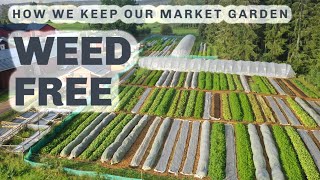
Richard Perkins presents a practical walkthrough of his no-dig market garden, explaining how thick surface layers of compost (and sometimes cardboard) and wood-chip paths produce a tidy, low-weeding vegetable system. He contrasts no-dig with conventional tillage (which wakes weed seeds and plant pathogens), describes bed creation options (direct no-dig on pasture or tilled then covered), outlines minimal weeding frequency and simple hand tools used, and highlights benefits including reduced washing, water retention, lower disease/pest pressure, better marketability, and modest running costs. He emphasizes the initial investment in compost (10–15 cm initial depth commonly described), timing (prefer autumn application and winter settling), and recommends insect nets and aesthetic/path-edge management. The video closes with promotion of his training resources and a call to subscribe.
Chapters
We pride ourselves on having one of the tidiest market gardens I've ever seen. But it's not luck. It's down to careful planning and correct management of our no dig system. So I want to talk about the weed free market garden today. So I've made a lot of videos talking about no dig in the past, the benefits and looking at drawbacks of conventional tillage system. Personally, I don't have many friends left that actually till the ground to grow vegetables because I think it's totally unnecessary and that's only necessary for broad acre crops. And there's alternatives for that too, which other people focus on on large scale farms. On a small scale we can grow vegetables much more intensively by layering compost on the ground. You see, we have this beautiful rich fertility that we're putting on the surface which eliminates weeds. Now this was pasture. This is full of buttercup, horsetail and creeping grasses such as quickroot and pretty, you know, nasty perennial weeds. Now first thing I should point out is we do some weeding. We just don't do very much. Now we've made beds in various ways. The first beds made at the farm over on the east and west and south, we didn't dig at all. We had 50 year old lawn that we basically laid down manure, rotten horse manure straight on top of. And we actually put cardboard under the wood chip pathways. Now using cardboard and putting down a thick layer, 10-15 cm of proper compost should eliminate most weeds, especially if you do that in the autumn before winter and leave it covered over the winter and plant in spring. Those beds, we actually made them in the spring and planted them out that year. And they've been the least weedy beds of all the beds in the. This is what we call the old north. And then we have the new north in the block behind the 30 meter caterpillar tunnel in the distance there they were actually tilled first and then covered immediately and put into a no dig system. We used cardboard in some parts underneath the compost on top of the tilled ground and in other places we just put the compost. And to be honest, we haven't seen really any difference. Now we do do some weeding. There are annuals that come in, particularly young tree seeds. The pioneer trees like birch we see this year and we get the old dandelion and things coming through. But to be honest, I can weed the entire market garden space, including all the paths around, which is made up of wood chip. I can weed the entire thing in about six hours. And I need do that three times in a year. And that is the extent of the weeding we need pretty much. So I've just come out of the chiller room where it's a nice cool 4 degrees, 46 degrees on the stern look on a black car, 68 degrees. I think we should have a climate strike 48 degrees on a white car. It is way too hot and it's only 2 o'. Clock. Well, it's kind of the hottest time of the day, so we're going swimming. This is not a day for farming. It's 40 degrees on the road down here. I'm gonna look at the grass over here. 33, 32. Not a good day to be a lettuce. I guess. As you see on the aerial footage here, it's really pleasing environment to walk in. The wood chip is serving the function to soak up excess water. That means we're never working in the dirt. And because the beds are made of compost, there's very little washing to do. We eliminate all washing of vegetables necessary. Now. We will wash carrots and the roots of spring onions and beets and things like that. But we basically eliminated the need to wash salad mixes. As long as we harvest them early in the morning and make sure the crops are free of any insects through using insect nets or whatever that we basically don't have to wash any crops like that. And that's fantastic. Another beautiful thing about no digs, just so easy to pull crops out the ground. If I have a crop of carrots like this, carrots come out clean and beautiful and this barely needs washing. You can see that's just utterly prime condition. Now some of you will remember we had a lot of issues in the start of the year with unbalanced compost on the beds that we didn't apply evenly using two different types of compost. We've worked hard to fix that over this season and it's actually looking pretty good around the garden. We're going to have a walk around the garden and just look at the state of the beds and see if we find many weeds. It's basically looking really fresh and clean. And that's an important strategy. This is the first thing that you see when you come onto our farm and it's a marketing piece in itself. I've been to so many market gardens that just look scrappy and they don't look good. You know, if I show a photo of this beautiful, well kept garden, it translates in the customer's mind as high quality produce and a level of care that you don't find in a scrappy, messy farm. So for me that's really important. But it's also just a natural consequence or corollary of doing no dig properly. Probably the biggest mistake people make is not putting down their material thick enough in the beginning. Now, we don't put that much compost down on a yearly basis. You'll remember if you follow our channel, we put down about 10cm at the start of this year. But that was a wood based compost with very low fertility. And that was after five years of just applying small amounts each year after the initial 10, 15 centimeters that was put down. So you're making that big investment in the beginning a to increase fertility and put life onto the ground. This was a compacted grass field that had forestry machines and big tractors parked on it. Mainly we used to use as a football pitch. And we decided to till initially just as a temporary decompaction mechanical kickstart to then convert this totally to no dig. And I don't know which way I would recommend. I think it can be helpful to decompact really heavily compacted clays before you start, but it's also not necessary. And we've made no dig gardens for. Well, I've made them for nearly half my life and I've not had problems doing totally no dig. We made that decision here just because we'd seen the impact of our keyline plough in the pastures as a mechanical kickstart ahead of grazing animals holistically in the radical soil building that I've documented in other videos and in our book there. So we decided to do that and I don't regret doing that. I have noticed more weeds in this section, but we're also right next to the forest that's just outside the caterpillar tunnel here. So we do get young tree seedlings coming in. I just found a weed here. There's one. And you see the beauty of no dig is very easy to pull anything like that out. But you see it remains remarkably clean in here and we just don't need to put the effort in that. A lot of people do. You can see some yellow sticky traps here. Just monitoring the type of bugs. We like to place them about a foot above the crops. Lots of onions out the back here. One area where you could do things differently is along the edges. That's typically where creeping grass is. You might just be able to see some of the couch grass coming in to the edge there. You could deal with that with landscape Fabric along the very outsides of the garden. Like you might remember at Jake Oxton's in Oxton's Organics. In the video I made last year, I avoid that. Just I don't like the use of plastic. There's far too much plastic used in small farming as it is. And basically once a year I come and cut the roots back with a spade and just weed through there. But it's just for aesthetical reasons, those creeping grasses never make it to the beds. Well, things are starting to get going in here. So last year we had a thousand tomatoes in here. This year we've been growing a lot of salad anytime. A couple of thousand euros of salad underneath. Multiple different varieties pruned high. Now the food is setting different cherries of different colours as well as idli, my favourite over there. But just look at the bumpy yields on these. Looking fantastic. Just look at the size of this cucumber. So I'm as tall as you, Ragnar. Look at the size of it. Amazing. So things looking great in here. Looking forward to pinching out the tops of the plants relatively soon. Italy is still putting food on. You can see the lower trusses here. Gives you a sense of this sort of amount. You get on each truss and they're still putting out new trusses. They get to about this size and it's a bit slow compared to the others, but pollination seems to have done okay. We will see. But a lot of flowers still out. It's just insane, these idlis. But this has worked really well. It's been very weed free. We get weeds around the edge. We just never bothered pulling because we'll have chickens in here. So many vegetables. So many vegetables. Ragnar. Yeah, cherry tomatoes coming. But it's. It's a pretty easy space. We do clean out everything underneath once the chickens have come in over the winter. And we're back on the starting pad every year. But then we just bring some of the composted bedding in. There's very little weeding to do in here. Huge amount of salad coming out. And that's really made a bonus because this salad was not in our plan. We got remains, frilly lettuces, butter lettuces. So lots of great beets, carrots, chard, more beets coming up there with parsley. And there's a lot of autumn crops here. Got some beautiful spring onions. We've been multi sowing these using the paper pot transplanter early in the year. That's what you want because you can just basically harvest an entire bunch in one pull, put a band around it. Off you go. Now, here you can see a couple of weeds, but you can also see there's no concern whatsoever having dense plantings, closing canopy really quickly really helps with keeping weeds down. I think with no dig, there's a couple of things going on. One is that we're just smothering out the weeds. And so the only weeds we'd expect to come into this are things that are seeding into it. And the second is that we are sort of tricking the system forward in ecology. So what are weeds? You know, weeds are earth repair mechanisms. They're all these annual and perennial pioneering plants who have typically wind dispersed seeds that are very small. They have many of them and they remain viable for a very long time. They colonize every inch of the planet. And their job is to fix soils together, start pumping carbon and nutrients around to cheer on succession. We see in nature, every single organism is patterned by default to look after its own needs very carefully and robustly in the service of the whole. And whole systems all function like this. We can see examples of this across all ecosystems all over the planet. And we can see it in our own diagram experience as humans too. We also have that same patterning, of course, And so these organisms only function in the ecosystem is to get liquid nutrient pathways and water cycling and soil holding together so that they can lead forward succession back to whatever state it's meant to be in in your particular environment. Here in these humid climates, this would be forested land if it was left alone totally. But we're copying a forest system. We're putting down organic matter on the ground, and that helps to trick the system into a higher order of succession where those weeds are not necessarily stimulated. I come from England, where we say one year is digging, seven years weeding. When you till the soil, you're causing multiple problems, but one of them being you waking up the weeds, as some people like to call them, and telling them, hey, you know, here's some damaged soil. It's your turn to wake up and fix this problem. Not only are you making this problem, you're exposing organic matter to the atmosphere, and carbon bonds with oxygen, flies off as CO2. You make the surface compact by allowing clay particles. When raindrops hit bare, soil particles splash up in the air. And it's clay particles, flat platelets that are the lightest of all soil particles that land back on the surface and can cap the surface and stop water penetrating and thus sinking into the groundwater. To recharge groundwater. You also wake up nearly all plant pathogens. Nearly every single plant pathogen in the garden is aerobic and it needs lots of oxygen because nearly all natural death happens in the open air, not actually in the soil. It's happening with massive amount of oxygen. And so that's nature's recycling system to turn things that aren't useful anymore back into liquid water soluble nutrients that can be uptaken into the surrounding environment very quickly. All of our diseases and pathogens are incredible recycling systems designed to turn something that's not very useful anymore back into something beneficial to the whole. Now, we have a very strange relationship to life and death. And we like to keep things alive that want to die and we like to kill things that want to live. And that's not a way to farm, but it's not a way to live either. You think about most of our westernized societies, we have a very strange relationship to life and death and we don't mimic natural systems. Now, it can be hard to grasp or take that if you're dying of some terminal disease. But that is nature's way of saying you're not robust anymore and you're going to get turned back into soil and humus too, for the benefit of other plants. Now, I don't wish to hurt anyone's feelings or be offensive with that, but I'm talking about natural patterns that we can see in all ecosystems all around us all the time. So this is the extent of the weeding tools we use. And we have a couple of precision hoes from Glacier and a couple of oscillating hoes, but to be honest, they have not been used yet this year. Except Joe just told me that he used this to take out the mescaline mix. That's one downside I've seen to no dig is that we have to actually take out the mescaline mix because we don't till it in. But that's not really a big deal. And so he was testing if it's quicker to pull it out by hand or use this and seems like it's quicker by hand. I will weed by hand because it's quicker. I can straddle beds and these are superficial weeds that are sprouting in compost, so they're just easy to pull out. I'll use a Korean hoe to pull out things like dandelions growing in the pathway or digging out quick root the accuch grass as it spreads into the wood chip. And I really like this tool. It's a very effective, precise tool. Other than that, we don't need weeding tools. It's why I never put tools for weeding in our farm shop. We don't use weeding tools. And if you're spending a lot of your time weeding, we had some people here on the market garden training who said they were spending 80% of their time weeding. That's crazy business. And I know a lot of market gardeners are weeding a lot of their time. But if you do this right, it saves you so much time, it keeps you very motivated, it uses less water because this organic matter is just holding water like a sponge. And you get much better crops with really low instances of diseases. The only disease we've seen here is rust spots on beet leaves which aren't even a problem at all. We have some insect problems, but at no greater rate than you would typically have in any garden in Sweden with flea beetle and cabbage butterflies, which can be alleviated using insect nets. But it really is a very much simpler and more beautiful way to garden. Oh, one of my favorites. Look at these. Hakari. Beautiful. Lot of flea beetle problems, but beautiful roots. I've basically decided to stop growing other types of turnips. Maybe purple top turnip will be good, but pretty disappointing with turnips in general as a vegetable. But I do like hakarai very much. So why is it more people aren't doing no dig? Well, to be honest, I really don't know. I've done a lot of work over the years promoting no dig. I've been making no dig gardens for half my life now. It is a lot of work in the beginning putting down the amount of material, but really it's not so much more work than making beds from scratch in any method with a two wheel tractor or doing it by hand or whatever. And the benefits just are huge. You know, I'm always super proud when I go off to other market gardens. I always come back feeling like, wow, we have the most beautiful market garden I've been to and just the least stress and problems to manage. And it's interesting. It's like when we go out for dinner. Johanna and I have stopped going out for dinner dinner because we're just always disappointed because we get a whole farm diet here and you can't buy food of this quality in any restaurant or shop. So it's a bit like that, you know. I'm very proud of our gardens and I think it's strange to me that there aren't more people really doing no dig and doing it full on. Like this whole trend of Low and minimal tillage is all great, but people are putting the same amount of compost down that we do just tilling it in. But they're waking up their weed seeds and plant pathogens and it shows. You know, in most photos you see the gardens have a lot of weeds to deal with and it's. And maybe that's fine. You know, I'm not trying to bash anyone. I just, I'm trying to work out why not so many people are doing it. But many of our students have gone away and set up no dig market guns very successfully. And the key, as I said before, is putting, putting enough material down and typically making beds at the right time of year. And I would do it in the autumn and put enough material. I love using wood chips in the path. It doesn't rob nitrogen. That's an urban myth from people that haven't tested that in their own experience. I'm using spruce wood chip and I see no loss of nutrient anywhere. It soaks up excess water, it keeps your feet clean. The crops are clean, Everything is tidy and clean. There's very little watering and weeding to do comparatively in a dig system. And disease is minimized. And when you have healthy plants, you get less insect problems because healthy plants resist insect attack. And you know, that's the way we like to do. And it's a way that I really recommend anyone to do if you have the resources at hand. Now, pretty much everywhere I've been in the world, you can get your hands on enough compost to get started effectively knowing that you do not need as much in the future. We now have enough material coming out our winter bedding for our hens and our cows to be totally self sufficient. But there's no big problem buying in a few thousand euros of compost if you're growing €40,50,000 of vegetables. It's not a big deal. It's a very small running cost. So you've got to factor that into your planning. And I say that because we have much more profitable enterprises on our farm. Things like pastured broilers, pastured layers that I've made many videos about. They're much more profitable in terms of time inputs. But nearly half of that revenue is going to feed costs, maybe 40%. In a market garden, you know, of a similar magnitude, the running costs are tiny. It's maybe a thousand euros on seeds, a few thousand on compost, and then replacing row nets, etc. When you need them. It's very low running cost for, for the magnitude of vegetables we grow, so don't skimp on it. It's the lifeblood of a market garden. It's compost and organic matter and soil food web that is driving this whole system. So you better put your investment there at the right order of magnitude. So we're bringing back the paper pots because we're very happy with the new garden crew. They're doing an excellent job and much more organized and on the ball. So we're feeling background finally we can relax a little bit. It's been quite stressful at the start of this year, just with the problems we've had with management, etc. But things are coming back together now and we've got some beautiful crops to carry us through for the rest of the season. And the gardens look magnificent again. We've got some beautiful beets that we're putting out weekly and lots of very nice crops developing. Really enjoy growing the paddy pans. These have just been harvested, all ready for delivery this week. So it's just small ones left on the plants. And we've got many beds of paddy pam which we prefer to courgette just because courgette is such an overgrown crop, as it were. But I think you'll agree the garden's looking fantastic. It's looking beautiful here in our east beds. I put this down to asparagus and edible and beautiful flowers. I want to do some flower bouquets this this week to see if we can sell bouquets because it's something I would love to go into further, but we are in a very rural location where I don't expect to be able to sell that many bouquets. We add these to salads as well as sell them to chefs, etc. At the same time. But it's a joyful thing to have a beautiful array of gorgeous flowers in the gardens. But thanks so much for watching our videos folks. Don't forget to hit subscribe if you haven't already. You can share and like the videos and you can leave comments and questions below which I try and weave into future videos. You can find out a lot more in our online training in the links below. It's by far the most varied and diverse and in depth look at regenerative agriculture and farm design and enterprise planning you'll find on the web. It's very low cost, available on a month to month subscription where you decide how long you stay. So if you want a lot more information and structured learning in a focused educational program covering all aspects of what we do and farm design, et cetera, then that's the place to go for that. You can see it in the links below. Thanks so much folks. See you in a video soon.
More from Richard


A review of short and intensive season on a mixed farm and restaurant/event space in Sweden






Alskade Kyckling Exploring complexities of poultry production in Sweden and what we stand for


