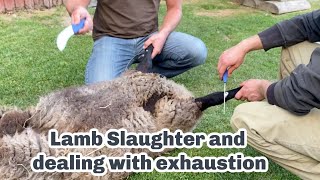
Richard Perkins' YouTube video 'Winners, Lamb Dinners and Time out' combines a host update (announcing competition winners, book giveaway and promotion) with an extended, practical lamb butchery demonstration. The transcript includes multiple speakers—Richard, an experienced butcher (Speaker B), and Gracie—who walk through incisions, skinning, organ removal, and preparing the carcass for chilling, interspersed with family/farm asides and sensory reactions.
Chapters
Welcome back to another episode, folks. Super nice, Glassy Lake behind me. I'm taking some time out just before our last chicken slaughter and I've been a bit absent. We've had a busy training here. Lots to tell you about, a few videos that I never got to put up and talk a bit about what's going on at the moment. So we had the competition and you could make me laugh. I sent you a book and to be honest, I wasn't expecting 600 odd jokes to appear on the page. Someone made me laugh and to be honest, I just got left behind with the busy course and slaughter of chickens. So I just, yeah, I feel a bit overwhelmed by the whole thing. And so I've used your help to help me decide winners for that. And there's lots of, you know, I wasn't necessarily expecting jokes. I was thinking of witty, snappy comments, etc. But some of them are great. So you've also upvoted some of them. So the winners of that are the people that go under the YouTube names of Moto R Sportnej, Timothy O', Flaherty, Flahly. Don't know if I'm pronouncing that right. And FBL Bosnia and Andre Compton. If you want to send me a personal message on the Ridgedale Facebook page. And then there's also a special winner, Matt Swarbrick, for this wonderful picture he put up that defin made me laugh and that was a fantastic effort. If you guys want a book, contact me on the Ridgedale Facebook page and send me a private message there with your name, your address and your contact number and I will ship out a copy of Regenerative Agriculture to you. We're doing monthly giveaways on home site RichardPerkins Co so you can be in to win there. And if you want to, just buy the book to support us and to have an awesome manual of how to build a farm from scratch designed to do good for the land, for yourself and for your customers. Then you can buy that at regenerative agriculture book.com so thanks everyone for chipping in with that and yeah, good effort for showing up and appreciate the comments, etc.
Sam, we're coming back to our farm.
It's good grass.
Accidents happen sometimes.
Salad bar beef. Look.
Time for a feast. So we took one of the ram lambs. So first thing we've done is nicking the front legs above the knuckle. And then what I'm going to do is take a line down towards the neck here and then if you Want to take a line just in a V to my joint. But we'll do it one at a time because otherwise it will putting tension on. So you take that line. Her hair is quite thick, so you can hold it in your knee like this and take that line all the way down. And you want to connect yours to.
Where they've been shown, because where do the candle.
So you want to come to like there.
You can be.
You can just push. Yeah, the knife will guide itself. And you want to just make sure you've got split to the. To a V so we can pull it off the bristle. Because this is where there's a lot of connective tissue to the breastbone. Then you've got to free up this joint. So you hold it in your knee again. And with your knife you can start fairing it away from the knuckle bone. And then you can go under, watching your fingers. And I'll cut the skin away there. And that allows me to get it up on the joist. Gracie's on filmmaking. Good job, Gracie. Then what we're going to do is take the brisket because this is really heavily attached to the breastbone. So you just want to put your foot on the neck and try and rip it off the brisket here. And then you got to get your hand in there, separate it to the end of the rib. So we try a bit more pulling. It helps to twist the fur here so you really get some grippage. I need my foot, not your hands. That's it. Now you can get your hand in there or fist and punch to there and just leave a sack there. That will help us later. Can help to have wet hands. If you wet your hands, you might need a whole fist at this point, just at the end of the rib there. Okay. So this is the brisket. We're punching the skin away from that to the end of the breastbone so.
That we've got a free pocket when.
We want to cut back up here. So that's separated. You really use your fist now? Yeah, yeah. The middle is still there. That's good enough. Okay, let me change. Back leg and the back leg, we do the same. Make a nick. You hear it sort of click. And this time just going down in front of the balls. Wait, I went a bit too deep. So can hold it like that if you need to and just come up in front. So straight line that. Rather than chopping, try pushing and letting the meat guide your blade. And this one we can actually break the leg off.
How many times have you slaughtered a.
Sheep quite a few. So what you can do here is kind of crack the knuckle, actually break the leg, not all the way off, but just to separate it a bit.
If that was alive, I think that would have hurt a lot.
Yeah, that's a leg break. And I've split that brisket hair. And that's going to help us pull the skin off. You see there? All right. So at this point, we either lift her pin or we do it on the ground. So it's up to you.
I think it'll be obvious.
You could hoist him and skin him easier so it. It makes it a little bit more. You're not using gravity anymore, but that's no big deal. Like, you can do it like this, no problem. So we could cut down into that joint just to separate the leg.
Why is it slightly blue?
It's not blue.
Looks. It looks like it's got a hint of blue.
You can really separate this side.
That looks delicious. Oh, so it's quite easy to make sheepskins, isn't it?
Well, no, the actual making of the skin is a bit more complicated.
I know, but, like, the shape of.
It, it's quite simple. All right, so now we're just separating. And this whole bit pulls. You just pull it off. And then it's the legs that you have to work it. You had a lot when you were leaving. Just a little bit on. Let's roll her off. See, I've got through to the back here. So you want to work at separating that.
I suppose this is the other way of knowing sheep as dinner or lunch or breakfast.
It's a little bit more labor doing it this way, but it's not actually much fun than hanging it.
That looks like it's going to be very good. Yeah, definitely. You can see the lines in the meat.
Okay, perfect. Get that out of the way. And we'll just take. So under the tail. That's the tailbone there. Under there, I need to poke in. I'm trying to separate the connective tissue without splitting up the guts. And so I want to cut all around the butthole so we can pull it out the other end. It's much easier when you're hanging. So, Akos, you want to. I'm making a little hole, and it's like a chicken. There's fat, and under that is guts. That knife helps you. You want to rip down a straight line to the brisket that here. And then we will get a saw.
That's like it's in a fat belly.
Fat.
So much. Look at that go. That is like. That's so much that you can't eat.
This is where gravity really obviously helps.
Don't eat that.
That's its intestines. That's its stomach full of grass. See how much grass it's eaten today.
Oh, look, it's got grey intestines.
Now it's two levels because you're going to get to the diaphragm and then you've got your kidneys stuck to that. That's one you've got in your hand. But you should pull it, not cut it. I don't know.
It's not gonna work.
Can I go strong enough? You? Where are we? Put the butthole out. Yeah. That's your line of separation. Leave that for now. Let's go for the gut. Wow.
So you're going to come across the.
Diaphragm and then below that's your lungs and your heart. And they'll need a bit of cutting to get through the diaphragm.
Look, the rain forgot.
Whoa.
That's like a huge intestine sack.
Yeah.
You see how the kidneys sit on the back there in the leaf fat. Look at the back of the animal. You've got leaf fat. That's the nicest fat in the animal. And your livers are tucked in. Maybe give it a little tuck with a knife to get through the connective tissue. You're getting to your kidneys now. So now you've just got to pull, physically pull all that is going to come out. Just yanking it.
Oh, I'm getting the smell now. That's quite a big liver this is getting.
Yeah. So now we need to cut a bit through this.
That smells like roast lamb.
And let go of that. My fingers.
Smell that. That is an amazing n.
All right.
Now look, here's his voice box. So we're going to take that out. So don't need. Okay, so now that's his diaphragm. That's what helps push his lungs up. Here's his heart. You see the heart here.
Can you eat the heart?
Of course you can.
Are we going to eat the heart?
That's his heart.
Like that. It's a bit like the size of Grace's heart. It's a bit bigger than Grace's heart. A bit smaller than my heart. That's what pushes all your blood. That's some old blood that dried up.
How long ago do you think it dried up?
When we killed it. Alright, so then this can all pull out now with a bit of separation on the diaphragm.
You know the worst thing about filming this is you have to be really close so you get all the smells.
That's a very strong muscle. That's what if you play didgeridoo and you breathe with your stomach to make the second breathing. That's what is doing that. Here's your kidneys popping the leaf fat so we can look at them to see if they're healthy. It looks like a healthy liver. Sorry, kidney.
Is there a difference between a liver and a kidney?
Yeah, yeah, yeah.
In my mind they're kind of the same thing for some reason.
Here, Ragnar, look at this. This is lungs.
They're all flat.
Can't see how lung work.
Oh my God.
A non smoker. That's how you breathe. And this is like marshmallow. If you want to touch it. It's like a marshmallow texture. Trying to see.
I don't really want to touch it.
It's exactly like marshmallows that you cook on the fire. It's made up of teeny holes. Press it and feel how it feels. It's squishy, isn't it?
I don't want. Oh yeah, that does taste like. That does feel not taste like marshmallow. I bet they'd be quite yummy.
Well, look, we've got some other goody bits here. This is a liver and that's just like a chicken. Here's the gallbladder.
What's a gallbladder?
That's what makes bile, so you can digest fat. Okay, so we have to take that one off.
What colour is it?
Inside it's green liquid. Chop that one. Let's have a look. It looks like a healthy liver, but we'll see inside. Very healthy liver. So that's going to be tasty.
Why is there holes in it?
Just for blood vessels. That's its spleen. The spleen is for your. When you get cold and your fingers and toes get numb, that's where all the blood goes. It goes in here to keep your heart and other vital organs active. This is beautiful fashion. Look at this. This is what you wrap sausages and meat puddings with. Beautiful strong stuff.
Oh, it stinks in there.
Yeah, it's because I burst this one a bit. Maybe we won't keep it for now because we've got too much going on.
I kind of want to cut open the organs thing and see what's inside there. That would stink.
The guts here.
Yeah, but that would stink.
It will stink. But this is what he's been eating. Today.
Why is it furry on the inside?
Essentially surfaces area. Ragnar, do you want to see what his stomach looks like?
Actually doesn't smell that bad. Doesn't smell really.
Ragnar, look. That's his stomach. See how it's all scaly like a fish. And he's been eating loads of grass. So much grass. All this is grass.
Me and mummy saw like the like scaly part of a deer's stomach in New Jersey because it was hunting time. And what is that?
This is the intestines. So look, these are long pipes.
Can we cut open the intestine?
This will just be poo inside. This is all intestines. It takes the grass and it goes all the way through here. And the food goes into the body. See all this is intestine.
Can we see the big fat part? That part? Can we see that part inside there?
It's more digestive grass. So the grass is fresh. Then it's a bit more mushed down. And by the time it gets here, you see it poo. Now. So the body's taking all the good food out and then the waste is taken away. So now we want to get it in the chiller, which means we should probably have a fresh bit of plastic to put on the chiller shelf. I'll turn the chiller. I'll be turning on when we get in there. The digging bee. Look, don't touch him. Let him do his thing. He's digging his hole. He's digging all his tracks out. So they close it up when it's hot and then they open it up when they come home. What a cool bee. Galactic space Pitchcock. That looks incredible. Gracie, what is that on your head?
What? Grasshopper.
The insect collector. Ragnar, who have you got today? Whoa. He just.
So fazello here. When I eat sugar, I get. I get really hyper and then I get really tired. I just get quite chatty.
Wow.
Sometimes good to take time out and just look at a beautiful place I live in. And I really wanted a year out this year. That's partly why I took the tour. Now, I guess that wouldn't constitute most people's ideas of a year out for rest. It would have been extremely high paced schedule to go around filming. I've had an exceptional time running the farm like a hero experience doing remote interviews. And I think a lot of benefits come out from having long form conversations rather than looking around at farms. And of course that would have been beautiful. But I've got a lot out of it. And I know many of you have too. So join us over@farmlikeahero.com if you want to take part in the discussions that are happening and the questions and answers, as well as all the long form interviews with some of the best young regenerative farmers in Europe. I've just been blown away by people's stories and how people are doing, but I think, yeah, I can share that. I don't feel rested after the year. I feel pretty burnt out. We just had a big disappointment for me was Joel Salatin couldn't make it to the farm. We looked forward to that all year and thought that there might be problems with him coming into Europe. So we supplied all kinds of documentation that met the embassy guidelines for exceptional travel from America. But Joel wasn't even able to get on board the plane. In the States, they had all kinds of new regulation that seems to be changing day to day. They said that they were working under special information to protect Americans from getting stranded abroad. And we found out at midnight before people were arriving for the course the next day. Obviously we were gutted. We thought we had everything in place according to the embassy websites and guidelines. And so we emailed everyone late at night and everyone came in amazing spirits. There's a couple of people that didn't show up, but everyone else turned up and we ran the training anyway. I ran that alone and we had a great time and got a lot of value out of that. We ate exceptional food. Chef Elim was back cooking up a storm as always. She's just an amazing chef. I guess if you spend time in Portugal, you've seen them do with the secreters. It's really great to have so many great farmers here and for them to meet, share stories as well as just refresh and get insight into all the pieces that we fit together in regenerative agriculture. But it's left me pretty exhausted. We did line up getting Joel on zoom for the last day, but we just had a nightmare. We had poor connection. We kept cutting off every few minutes. And then when we did get a good connection at his end, we had this intense tropical thunderstorm and it just. You couldn't hear a word going on because of the noise on the roof. And then we had a lightning strike a few hundred meters from the yurt that took out our electrics. And so we gave up in the end and had a big feast. And I think everyone was really understanding of the circumstances, but my heart really sank. You know, it's something I look forward to for a very long time and felt like almost like a Pinnacle of what we've been doing here and being able to offer to people. So bit heartbroken and feeling like, you know, a little bit dented to not be able to offer people what we've been saying that we were offering. But we gave everyone refunds and I think everyone was happy in the end. But yeah, it was a big disappointment and yeah, it feels still quite emotional for me and part of this year for me was to take space away from the farm to get perspective on where to put my energy. I run a pretty full on farm normally. This year I've stepped back from that but I also run a business that's quite a lot larger than the farm. Single handedly from my office in the evenings and mornings and it's. Yeah, my recovery time is getting longer. I'm pretty exhausted and I'm not sure where best to put my energy yet. We've created an amazing thing here and I know it's rippled out across the world and has set new trends and helped many people start or refine their businesses and I feel a lot of responsibility for that. But I'm also more and more starting to look at my needs, our family's needs more and there's a lot that needs time inputted there. So I'm not sure what to share other than that. Yeah, I'm feeling right now like I need a year out and to take space to rekindle things that are most important and dear to me and get perspective on how to best manage our resource base moving forward into the future. It feels like these, you know, this year has been a real eye opener for a lot of people and a shock for a lot of people and we'll have long lasting consequences. And there are many pieces to the jigsaw that we manage. We're not just a farm producing food. We're also responsible for starting up hundreds of new farms and influencing the way small scale farming is done. And I feel a weight on my shoulders with that and a duty to that as well. And that's what my passion has been burning up towards is why I've worked the hard long hours that I have. But I'm not able to do that in the same way anymore. And yeah, don't know where I'm going with that other than to share that. You know, I'm feeling pretty fragile right now and hoping to use the space this year to take a bit of time out and get some reflection and go into a restful winter. We're going to get rid of our hens this winter to really just totally relax out what needs to be done on the farm to give time and space to really reflect, redefine our context and think about next steps where the best use our energy for the benefit the most people that doesn't consume us in our family and private life in the way that it has over the last years. And yeah, that's where I feel about that. So not so many updates for me. There's been a few videos I've made that I haven't been able to post due to time, but we've got our last chicken slaughter tomorrow and then I'm thinking to take a little time out from the farm and maybe do a bit of exploring. And the team here more than capable of keeping up things on the farm, which affords me a space that I rarely have had. But I'll make some updates for the remaining part of the season, but maybe a bit less frequently. The Farm like a Hero experience is rolling on and there will be constant updates from that. And so I hope more of you join us over there. But that's it for now and I thank you for watching our videos and for, yeah, supporting us and caring what's going on for us too. And I know a lot of you feel deeply connected to this place, so I felt I wanted to share a bit where I'm at right now. I look forward to seeing you in a video soon.
More from Richard


A review of short and intensive season on a mixed farm and restaurant/event space in Sweden






Alskade Kyckling Exploring complexities of poultry production in Sweden and what we stand for


