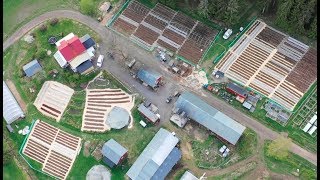
A vlog-style farm update by Richard Perkins describing recent work over the past week: covering beds with about 500 L of new compost, spreading woodchip, frost protection measures (row covers, fleece) and early-season seedling/transplanting. He discusses the economics and benefits of a no-till, heavy-compost/woodchip approach versus conventional tilling, updates on livestock and pasture management (cows, pigs, eggmobiles—two eggmobiles planned), and experiments with nut and avenue tree plantings (Nutfield) suited to a northern climate. The video mixes practical tasks, observations about microclimates and soil health, and decisions about breed choices and farm layout.
Chapters
So it's Friday again. The weeks are rolling by. We've had two amazing weeks of weather, and today we had a frost and snow again, and it looks like even colder tonight. We've done an immense amount with a very small team. We've covered all the beds with about 500 liters of new compost. We've put wood chips on half the gardens and still got a bunch to do. We've been taking cuttings, rooting things, seeding things, fixing spaces, clearing up around the farm. We've done an immense amount. Still got a kitchen to build, get the yurts up to be ready to host people in a couple of weeks, as well as all the layers and the first broilers and turkeys coming. So things are hotting up around here. It's been beautiful weather and it's just dipped down again. But a little snapshot of what's been going on recently. Well, the frost came. Looks like we have another colder night tomorrow. We've got some extra fleece on and drained all the water lines. Peas got a double net, one on top of them and one arching over. So let's have a look, see how they did. Okay. Here in the south. We left kales and onions uncovered and spinach, it's going to go to minus two tonight. Things seem okay. Just made sure the peas and beans were covered. The beans are the most susceptible. Spinach is fine. So beans being the most susceptible, they seem okay. I certainly got a nice sunny day to pick up again, so I think we've done all right. Got some very spindly fennel in. That seems fine, Mr. P. Looking beautiful. We've taken these raised beds away. We used to do cuttings and things in here, but we've got a lot of stuff in the bottle. The bottom of this tunnel now, there's a lot of grapes, cuttings of grapes. I'm gonna do suckers of strawberries in there. Gonna put this area just back to lawn just to have a bit of open space, because we're just running out of open space. So all the beds are done now, and everything survived the frost and the beans are fine. They were the. The biggest risk. We'd put this double fleece on the peas just because they were so tender and they've been hardening off in 20 degrees. And then, yeah, we only put a single one on the beans in the end because we were just running late. But everything survived the frost, which is great. Looks beautiful here. I'm going to get the drone out so we can see some aerial shots of Basically a week's work moving wood chip and compost. So some people ask about the cost of putting down wood chip, putting down compost. The compost we're putting down this year is very cheap. It's essentially made of winter bedding. And we've bought in this wood based compost which is basically you're paying for delivery and we wanted that for water retention because of the drought last year and the limited water supply we have. But basically over the last five years we've spent less on wood chip and compost than the average market gardener would spend on a BCS two wheel tractor. So not only are we not spending all that money on a machine that needs oil and maintenance all the time, we've basically invested it in soil building and weed free. You know, we just, we've got a guy here from Holland today who's just come to help for the day, was passing by and he runs 5,000 square meters in Holland and says he spends 80% of his time weeding. And it's mind blowing. I mean I know that's what all market gardeners at Till are doing, but it's, we literally spend a few hours a year weeding and that's just around the edges to keep it neat on the sides of the path. So for me, very happy with that investment. And I've talked about this in the past, like it's a much better investment for me because most of the people tilling are spending 10 grand on a machine like that and then spending as much on compost as we do anyway and just tilling it in. But you wake up all your weeds, you wake up all your pathogens and you burn off carbon. All these problems that come from tillage and we have such an ingrained habitual idea that you must till soil but you don't need to till soil. And I will never grow vegetables until soil again. It's just not the way forward. And we have found a tiltha useful issue just for smashing up little like straw in the compost. But we're not tilling the soil. We don't want to ever till soil. This beautiful amelanchea is just coming into blossom here behind me. Very nice. And it's really greening up in the landscape now. You'll see on the drone footage. But yeah, keeping the gardens clean. You know, there's many reasons to keep the garden spotless. A, it's just very efficient, it's beautiful to work in. B, it's an advertising ticket. The market garden is the first thing people see when they come onto the farm and if you see this level of care going into a vegetable garden, that translates to all our other products. We obviously care and work hard in all that we do. And I think that's a great marketing piece in itself. So snow and hail coming down now. We had 0 degrees, minus 1 maybe and then it's looking like it's going to be minus one or two tonight. So keeping them row covers on. Now. This is the bizarreness of farming in Sweden. Irrigating in the snow. Only in sweden. So I had a haircut in between. I have a hairdresser in our local towns from Ayatrea and he doesn't speak English and he basically does a one cut job. Whatever you want, he'll do the same thing and I love it and I always like seeing him. But yeah, starting next week we are having Eric who dug our ponds, the big ponds I've made videos about in the past. He's coming to clean up all this mess. I don't know yet when they're coming to take the timber out of here, but as you can see, the pasture is looking pretty bad. And basically it's at the point where we can't possibly pull an eggmobile through here even if we wanted to. And it goes all the way up through our neighbor's land. And that's where we start the turkeys. Things are growing well out here. It's a little bit hard to get through, actually. When they were doing the forestry work, these trenches were so deep that they cut through the main power supply to the entire village and cut it off for 24 hours. It was like industry out of business. And it was over a meter deep that they dug this down. I've asked that they can bring in topsoil. Obviously when they have mashed it up this badly, it's just subsoil up on the surface and I need it level that we can get eggmobiles down. But you can see the grass is growing pretty good. And soon we'll get the cows back on pasture. We're going to have a look at them. Strawberries are coming up and right now what I'm going to do this weekend is plant a few nut trees that I've got and I'm going to come through and weed the strawberries and take away any suckers and pot them up. And I'm looking for about a thousand suckers to pot up because when we put in these strawberry patches we never actually finished them. There's still two and a half, I believe, rows up here. In top field, I'm just jumping across these big ditches. But do you remember if you've been watching us closely, we put in this plastic to essentially have more nut trees. These are black walnuts and we have a lot of chestnuts. These are from seed and because we had black plastic, these are such a long term crop, we didn't really want to put any effort into looking after them. Some of them are doing fantastic actually. But we thought once we had this plastic in line, it basically. Up in top field Here we have 18 meter tree lanes on keyline patterning. And so by putting this in, it just basically halves the lines, which first is totally fine. Nine meters being multiples of three, which is what the boiler pens are. And so we just felt we'd come along and put strawberry in to make use of that plastic. And obviously they're sending off suckers all the time and it's quite easy to extract suckers and pot them on. And these are all really good varieties. So I'll be basically pulling out a little sucker like that, potting it up later in the year, coming back and finishing. There's two or three rows down the bottom here that never got strawberries. So that's the job for the weekend. I am having weekends off, which is fantastic. But this weekend I want to just catch up with plant stuff before the season really kicks in. There's the odd hole sometimes where voles have come in so we can refill them. But nut trees are coming up great. Really excited to see more of these popping up around the farm. So a little bit of weeding for the strawberries. But this makes moving broilers and layers a real pleasure. And it's not hard to come along and just spot weed this. Get a bit of couch grass coming through, but it's. It's maybe once or twice a year we'll come through and deal with that. So the cows are up here. This is the paddock near the turning circle where we always start the pigs rotation in the year. So here's Clovermay. This has been dug over completely two or three times by pigs and now it's been grazed real short. We're basically keeping the cows here to keep them off the pasture until we want to start grazing. They've still got a little bit of haylage, but they're obviously much more interested in scoping out the grass. So they're essentially over grazing in here. Over grazing being a function of time. Basically. Once the head is nipped off a grass plant, it goes into shock for two or three days and then it starts growing again. So overgrazing is purely a function of times how long you stay in one place, that is no more than three days and how long until you return. But because of the tree cover in here and because this is, you know, in a transition period to silver pasture, I'm not concerned about that. And I'm mainly interested in looking after our pastures because they're getting radically improved through the poultry, etc. So it's, you know, this is technically over grazing, but I don't mind because we're keeping if. Basically the idea to keep them off the field right now is that if you start grazing too early in the year, you stunt the grass basically. And so I'd rather prioritize the paddocks than the little forest patch here. So we're in the process now of deciding what bull to get in to serve these girls. We only have four cows left now because we sold some for beef and they make remarkable beef. So this is Fjell Ku cows, native Swedish heirloom cow. It's a very small cow. It's a dairy cow that would have been used for dual purpose originally. They only eat half as much as a modern dairy cow and their milk is much higher in fat and protein. They're really well adapted to this climatic condition. They like to be outside all year round, except for September when it's raining it seems. And we've been thinking about breeding a Hereford bull with them to get a little bit more of the beef quality and scaling up the grass fed beef as a little enterprise, you know, sideline enterprise for us because we have access to our neighbor's land who lets us use that land for free because we get more, you know, he gets more subsidies if we actually use the land. So it's a win win situation. It means we don't have to pay rent and that seems secure for the, you know, sort of short, medium term. So we're considering doing that now. However, something that's been playing on my mind is that there's only a few hundred breeding pairs of Fyoku or there certainly was when we got hold of these. And yeah, part of me is really feeling like we should keep to the heirloom breed. They actually, it was something like a 17 year old FYLKU bull won the best beef in Sweden award. And yeah, there's something to be said for keeping, you know, the land race going and I value that they're much smaller and slower growing animals but I really love the nature of these cows. They're really beautiful cows. And the dog's gotten here so the. The cows are chasing him away. Actually, Saku is not quite. Look, see? Not happy about the intrusion. That's quite fun. Yeah. But I really love these cows and I think it's quite probable that I might want to keep them straight. Fioku because it's ultimately, it's a sideline enterprise for us and the money is important but not critical that, you know, I'm not in it for fine line margins that a typical beef producer would be. There you go. Was that dog a little upsetting? Hey, I'm okay. I'm not gonna scare you. Yeah. So just for comparison, this is the neighbor's land next to us. And this is something I like to keep referring back to because this is what our land looked like mostly when we bought the farm. And you can see here a shot of the comparison with what our grass looks like. This has just had no livestock on it, but it's had no other treatment. You can see it's thick with thatch, but it's very stunted grass here. It doesn't really grow or express itself above about 12 inches, 30 centimeters tall all year. And our grass, you'll remember when we went into drought, everyone had gone yellow in June and we had Timothy in coxfoot up to my eye level, which really showed us the impact of the work we've been doing building soil since we came here. So it'll be interesting. I'll keep referring back to this patch because it's the best way for us to sort of see how our land is progressing. It's the most similar to what our land looked like, although some of our land was in a lot worse heart than this when we first moved here. Particularly at the top of top field, which is the closest part to this land geographically. And in our field it's just silt, so very low in fertility. And it was covered in moss. We've actually eliminated all moss from the farm, whereas there isn't so much moss in here. You get a little bit but very stunted grass. The lack of animals on landscapes. Grasses co evolved with animals, lots of them moving, putting their fertility and developing the nutrient cycle. So that's a big part of what we've been doing at our farm. So we typically have 1st of May as the starting of growth on our grazing plants. Things got off to a good start this year and it seems like we've got a bit of rain coming, which is fantastic. So it won't be long. This is for scale, but we're going to come in here and start grazing in a couple of weeks just before the hens arrive. And we're just running two eggmobiles this year. And so I'm looking forward to see how the ground responds this year after the heavy drought. But nice to see the grass coming flushing in just at early May. Now these are some of the avenue trees. This is a wonderful oak planted from a little 40 centimeter whip. As an avenue tree, you can see hazel interspersed with oaks behind. We have a couple of hundred oak trees down the road as well as some chestnut, which are kind of an inheritance planting. These are marginal areas of a farm that would never get used typically. And there's no reason that, you know, grandkids couldn't have 200 straight, beautifully pruned oak trees that could rebuild a beautiful home. I haven't actually. I keep meaning to start pruning the laterals, but basically you want to prune the laterals before they get to sort of 15cm girth to allow that to heal up to get a really beautiful saw log. And you're basically pruned for the central leader. I would take this one as the leader and start shaping this. And you want to leave 40 to 60% on the crown to make sure you're not taking away too much of the photosynthetic capacity of the tree. But I haven't got around to that this winter because I was so busy writing. But I'm going to get to it next winter instead. But nice to see these popping up. It's still amazing to think there's just so few oaks in the surrounding landscape. We have two outside our house that you'll remember if you're a regular viewer. And we've got a few hundred both on the sides of our roads and coming up in the pig paddocks that are regenerating. There's a beautiful one here actually right near the fence. But we have a couple of hundred on our property and you just don't see them anywhere else. It's very strange. Here's a beautiful 56 year old oak, must be 4 meters tall, but yeah, I'm really. More oaks, more nuts. I'm going to show you a couple of special nut trees that I've got sent here for Nutfield. So Nutfield is a savanna planting. These are wide space trees that when they're fully grown will not represent more than 30% shade over the pasture, which will result in no loss of pasture yield. And we've put in pecan, which is doing great, and chestnut and walnut and they're based on sort of zigzag pattern but they're basically giving us 10 meter rows east to west which is how we graze. We typically always graze top to bottom of the fields to allow gravity to help with the egg mobiles. A bunch of these trees are doing great and what I've done is I've actually bought some large English walnut based on a neighbor who put in some older English walnut and had great success. There's now a 25 year old tree not far from here that's giving, you know, edible nuts that are self seeding themselves and doing fine. And I think because of our climatic conditions putting in some older established trees is a good strategy for our climate. So I've got a bunch of older walnut species that I'll be putting in. So we're here in the barn. This is Mars, Jupiter and Saturn. These are Czech walnuts and I've got a few older chestnuts just to see if putting older trees in is useful as a strategy too. Nutfield is a big experiment for me because it's not an economic part of the farm. It's just my little thing of seeing if we can find nuts that do well in this extreme northernly climate. There are no, you know, nut growers anywhere near this level of latitude. I never wanted to plant English walnut because I just felt like it would never do well in, in our climate at all. But this is from the, the walnut company in the uk, it's a breeder there and, and I just thought it's worth giving it a try. I don't know how it will go. You know, nut feels an experiment and we'll just see. They, they got lost in the post for several weeks and basically these were sticking out the top of the package. So they've obviously had enough light to sort of green up but I'm not sure how well they're going to deal with the sudden shock of being out here. We'll see. It's an interesting thing and I'll let you know as I get them planted up and what I think of it throughout the season. But an interesting strategy to try and get older nuts in the ground here when we have such harsh and such variable winters that can easily wipe out young nut seedlings, that maybe an older tree will be more robust, who knows. So first lettuces in here and giant red mustard popping up. These were the ones first transplanted with the paper pot. Mizuna's gone off, start harvesting their first salad soon along with microgreens Beautiful weather. Just got insect netting to help mitigate the flea beetles. Here's all the pollen that shows up at this time of year. This is the yurt platform. A lot of pollen fills the lakes, fills your car, fills your nose, everywhere. Well, microclimates are very easy to observe at this time of year. Not only do we melt off quite a few weeks and a few hundred meters away down near the lake, you see here, just on the south facing wooden wall, how much quicker the blossom comes out against this wall. Just timber. But timber can reflect and soak up a bit of heat. So you get blossoms here two or three weeks before the blossom actually comes into flower down the bottom of the tree. Interesting time to observe. Just down here, 200, 300 meters. The ice is melted about eight weeks before it melts down here in the herb garden. Saundson weekend's here. Okay, that's it for now, folks. I've got a weekend off now. I hope you have a great weekend. Thanks so much for watching. Don't forget to click subscribe, share the video if you benefit from it, and we'll see you in the next video.
More from Richard


A review of short and intensive season on a mixed farm and restaurant/event space in Sweden






Alskade Kyckling Exploring complexities of poultry production in Sweden and what we stand for


