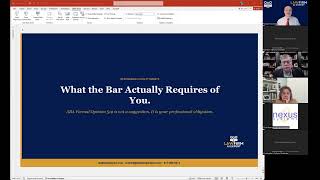
How Small Law Firms Can Use AI Safely, Ethically, and Without the Overwhelm Webinar

In this one‑hour webinar, Richard Schreiber – founder of Law Firm AI Expert, author of Law Partner in Heels, and autism‑advocacy chair – walks owners of small‑to‑medium law firms (especially women‑led) through a practical, low‑risk path to adopt artificial intelligence. He first names three core pain points: (1) the time‑squeeze that forces partners to work endless hours, (2) the legal risk of AI‑generated hallucinated citations (citing Stanford data that 1 in 6 AI‑produced citations are invalid, with over 1,500 falsified citations in three years), and (3) the ethical/compliance risk introduced by the American Bar Association’s Rule 512 (effective July 2024) and emerging state AI‑audit laws. Schreiber clarifies what AI is and isn’t – it is a tool, not a judgment substitute, and prompt engineering alone is insufficient; robust context and human‑in‑the‑loop checks are mandatory. He then outlines five ABA‑mandated guardrails (know the rule, human‑check every output, verify every citation, log AI use, protect client data) and shows how his company builds every solution around them. He describes a six‑month adoption journey: month 1 – initial tools go live; month 3 – multiple AI agents streamline work; month 6 – firm operates with a suite of bespoke agents and a competitive edge. The first six tools he recommends are: Smart Client Review (case‑worth scoring), AI‑drafted documents with source‑cited lines, automated client updates, rule‑automation “autopilot,” early‑warning alerts, and a Know‑How Library that captures senior lawyers’ expertise in a private LLM. All tools integrate inside existing Microsoft 365 or Google environments without new sign‑ins. Schreiber then showcases three flagship products: Trial Lift (trial‑prep dashboard, citation validator using open‑source databases, guardrails that block unverified sources), Cognify Solutions (AI‑governance engine that logs usage, enforces compliance), and Secure Justice AI (end‑to‑end cybersecurity and AI‑governance umbrella). He cites industry risk statistics – 43 % of SMBs are hacked, average cost $200 k, 69 % of law‑firm staff use AI daily but only 9 % have an AI policy – to stress the urgency of a governance framework. Finally, he offers a paid 2‑hour discovery session ($849) that delivers a custom AI roadmap, task‑prioritization, risk/ethics assessment, and a free AI assessment workbook plus the first four chapters of his book. He limits the offer to five firms, provides a sign‑up link, and ends with a personal call to reclaim time for family and life outside the firm.
Chapters
Welcome everyone. Glad you're here today. My name is Richard Schreiber. I'm the founder of Law Firm AI Expert. This webinar is for a different kind of people, several kinds really. The woman or man running a small to medium-sized law firm who is great at law, but maybe worn out by everything else in the practice of law and in their business. In the next hour, I'm going to show you a clear path. This isn't theory or hype, but a real path. So let's get into it. A little bit about me. I've helped law firms for over 25 years in the legal tech space, not through demos and real systems, but real money, real firms, and real systems. I helped many of the AM Law top 200 law firms in my past over the years with business process outsourcing, technology and equipment. I've saved my clients 15 to 20% or more to use the GEICO line. I also wrote a book called Law Partner in Heels. It was designed and directed towards and paying homage to women-led law firms, small and medium-sized law firms. And these leaders just carry so much, not just the business of law, but the practice of law. And in many cases, extensive home duties. I also chair a foundation on autism. My daughter was born with it and it inspired me to create this whole important mission to help the world understand people with autism better. That work has shaped how I think about building tools that help people to carry less and be less burden in their businesses and life. I didn't come into this from the classroom. I came into it from life. And everything that I build is from that perspective. Quick note on Law Partner in Heels, my book, Billie Belair's Beautiful Life. Before I get into AI, I just wanted to mention that I wrote it for the woman who is excellent in law, but still worn out from the day-to-day responsibilities of running his or her firm. It's not a motivational book. It's a practical case for Building your firm on systems so that you don't have to do everything yourself. This afternoon is the live version of that argument. So we're going to talk about how to make it real. So quick review of our agenda today, where— what we're going to be covering. First, we name the real problem. What's draining your time? And wearing you out in the business of law. Then we'll talk about safe AI for lawyers, what the ABA or Bar Association rules really say and what you need to know about them. Then I show you the tools: Law Firm AI Expert, Trial Lift, Cognify Solutions, and Secure Justice AI. So we put a wrapper around all of the elements of protecting your data and creating good AI and safe solutions to optimize your business. And then we'll wrap it up with a clear next step and see if this fits your firm working together. So a little bit of teaching first for about first half hour, then some Q&A, and we'll take a quick break and then decide if it makes sense to proceed and go forward. So this is where we start, with the truth. Your firm should not need you to be worn out to keep it going. But for most women-led and many men-led firms as well in the small to medium-sized legal space, that is exactly what's happening. Before we talk about any solution, we need to name what's really going on. Let's be honest about what it costs. When the firm depends on you. If you're in this room, you're not lazy. Of course not. You're doing too much. You are the partner, the dealmaker, the closer, the editor, the bottleneck, and the one who holds everything together in your firm. You've looked at AI. You've stepped back. Not because you are slow, but because you are careful. Because one bad result or data leak can cost you big time. We'll talk about that in a little bit. So you wait. That makes sense, but it can't go on. You need to look seriously at AI adoption because your competition is, and if you don't, you run the risk of falling behind. So if you're tired of being the whole system, you're in the right place. Let me show you what can happen when you kind of take a look at what the other side looks like. So 6 months from now, you're working fewer hours and still growing, increasing your revenues. Systems keep things going instead of you doing it all. You have better security of your data and knowledge of how to use AI effectively and securely. You have a steady income that's growing, great clients, and no panic. You're there for school and dinners and trips with your family. You're a strong leader who owns his or her time. That's what we're building today. Now, there are 3 problems I see in most small to medium-sized law firms. Let me name them fast. Problem 1 is the time problem. You want to bill more hours, but the only way you know how to do that is to work more. You're already maxed out. Problem number 2, AI risk. Stanford University found that AI legal tools make up about 1 out of every 6 invalidated citations. Your insurer doesn't care that AI wrote it, whether it's errors in commission. Your name is on the brief. You are ultimately responsible. In the last 3 years, there have been over 1,500 falsified citations that found their way into the courtroom, resulting in fines of over now $100,000, license suspensions, case dismissals, and other reprimands. And the number of these falsified citations, these hallucinated citations making their way into court. Is tripling every year. It's an epidemic. Problem number 3, the ethics problem, which stems from problem number 2. The American Bar Association Rule 512 is here. In fact, it's been here since July of 2024. Using generic AI with no records or tracking of those exchanges isn't just risky. In some states and jurisdictions, it's already a legal problem. So your firm either keeps running where you step away or it does not. There's no middle ground. So let's talk about how to fix all three. Before we go any further, let's set the expectations about AI, what it is and what it isn't. AI is not a stand-in ever for your judgment. Or your decision-making. It is not a fact check, check database. Only a database can fact check. A large language model is just this big, huge repository of information that the LLM is going through and trying to synthesize into a generalized result, which is why hallucinations can happen. It's a tool that clearly doesn't get it right every time. One-line prompts give you weak results. Prompt engineering is a total fallacy. Good AI needs full context. Context is a conversation you have with the AI that leads towards you and it jointly determining what your prompt needs to be in order to get the desired outcome. See, reverse engineer it. You start with your outcome in mind. And then have a conversation with the AI to help the AI build the prompt to get your desired outcome. That is what we build when we build our solutions, and it's what separates serious tools from dangerous ones. So let's talk about what the American Bar Association now requires of you. You know, ABA Rule 512 isn't the choice. It is the law of your job. It sets the guidelines and the requirements on how you practice law and utilize AI within that space. It isn't new. As I said, the law was passed in July of 2024, but a lot of firms are still acting like it doesn't apply to them. It does. And at some point in the near future, it's going to become much more enforceable. You've already seen the Bar Association, obviously with the hallucinations. Decree all kinds of fines, suspensions, and revokes of people's law to practice. Everything we build at Law Firm AI Expert is designed to keep you on the right side of this rule. We build guardrails and protections into all of our solutions. Let me walk you through what that looks like in practice. So here are 5 rules that we build every tool around. That are in alignment with the ABA 512 statutes. No exceptions. Number 1, know before you rule, you use. Rule 1.1 of the ABA 512 statute says you must understand your rules. Not knowing is not an excuse if things go sideways. That's no accountability. Number 2, check every result. AI is a tool, not a lawyer. You must check every result before it gets in front of a client. There's a human in the loop. We build dashboard user interfaces to enable that for you. Number 3, check every case citation. AI makes up facts. 1 in 6 legal queries we know results in a fake citation if you're using it for legal research. Even with a RAG. You will— it will still hallucinate. Your name is on that brief. There are no exceptions, no margin for error. Number 4, keep a record of your AI use for client work product. No record means no defense. Write it all down. Always. Auditing of AI uses will become commonplace state to state in the near future. Number 5. Keep client data safe. Most AI tools are not safe for client data, especially if learning is turned on. Public large language models, unless you turn it off, will learn from your data. Using them the wrong way may break ABA Rule 512.1.6. These are not extra. This is the base. Now I mentioned individual states. Are passing laws that will soon require audit trails and audit reports on AI use. That's client-related work product. California, Texas, Illinois, Colorado, and other states are passing laws or have already passed laws that impact legal, financial, healthcare, real estate, any place that's using personal information client-related information, or HIPAA. Failure to meet these audit requirements when the state auditor comes a-calling can result in fines and suspensions. Let me tell you a little about our company, Law Firm AI Expert, and what we actually build. Law Firm AI Expert creates custom tools built around your firm. Not off-the-shelf software, not a one-size-fits-all platform. We build tools that are built around how you work, your clients, and your team. The Brits have a wonderful term for this. It's called bespoke. So our solutions are built always with safety and security from the ground up. AI governance and guardrails. Let me walk you through what that looks like. So here is the journey. It can take about 6 months. Today, you're probably too busy, too reactive, and carrying way too much risk. In 1 month, the first tools are in. If we work together, you start saving time, fewer mistakes. By the 3rd month, with now multiple agents in place, things are running smoother. You take on more clients. Clients get better care. In 6 months, you lead and you grow with at least half a dozen agents within your environment and your working space. Now you're out in front of the rest, the competition. That's the arc. So let me show you what makes it happen. We always start with what saves the most time and effort the fastest first. Smart Client Review scores new cases against past wins. So you know if a case is worth your time before you spend an hour on it. Writing helps you with AI-written first drafts from records and case files. High quality. Every line cites its source. We will use small private language models, not public GenAI large language models, which will offer better security and accuracy and no hallucinations. Smart client updates go out the right time for each client. Instead of the client having to chase you, they get information updated on their case as it happens without you ever having to pick up the phone. And nothing leaves without your say-so. Your rules on autopilot means your way of doing things run 24/7 without you. Case early warnings give you alerts before a requirement or a characteristic in a case become a problem. And your know-how library saves your 20 years of wisdom into a small private language model. So it stays there when people leave. These 6 tools are where we start. We're not limited to them, of course, and they— some may or may not apply to you, but we'll discover other ones together and build those use cases together. So here's one of the biggest concerns that I hear. I don't want to change anything or everything. You don't have to. We build inside what you already use. If you're a Microsoft 365 user or a Google user, we'll deploy our solutions within those, within inside your firewall and within those models. There are no new sign-ins, no moving files. We keep things simple. And every tool that comes in with safety built in, it records, checks, writes to log files. And we provide dashboards to keep the human in the loop. You get new capability without disruption and full accountability. Let's talk a little bit about Trial Lift, a product that we built to help trial lawyers prepare for court, streamlining that somewhat burdensome process and giving them a little predictive analysis on how to try the case. Trial Lift is the only AI trial tool built that also keeps you safe in court, which is where the rubber meets the road for trial law and litigation firms, which again leverages our AI guardrails to protect against hallucinations and exposure of your critical data. So let me show you what it does real quickly. This is the Trial Lift case dashboard. This is your control room. Trial Lift tracks your hours saved. Quick prompts let you get hours of work done in one simple click, and you can self-build new prompts. And it watches for things for like judges' patterns. If Judge Harrison, for example, rules for the plaintiff 78% of the time, you know that walking in. Trial Lift is always watching so that you don't have to. And Trial of Citation Validator. This is one of our centerpieces. So if you're using one of the GenAI products through our platform, the Citation Validator makes sure that the hallucinations are tracked and quarantined, or that you're not even allowed to submit PI or client-related data in your prompting. All of that is redacted and stripped out. We use only open source databases for our validation, PACER, CourtListener, and Fastcase. No Westlaw, no LexisNexis, no Bloomberg, no expensive subscription services, but databases, which is the only true way that you can validate a citation. You cannot validate a citation through a large language model. That's like asking the hawk to watch the chicken coop. Remember, your name is always on the brief. Trial Lift makes sure that what it is that you're showing and reporting is real. And again, our system, Trial Lift, is built around its intensive guardrail system. The guardrail system is what makes Trial Lift differ from any other AI tool. Again, it protects you against guesswork. And if something is guessed by whatever large language model you may be using for research, it gets guess detected and blocked and redacted. No source, if that's the case, means no output. Full stop. No non-certified or non-citation-provided research data at all. If a source cannot be traced, It is blocked, not just flagged, blocked. Every tool is built to follow those ABA 512 statute standards and rules. You don't use, you don't just use AI, you use AI that you can defend. Let's talk a little bit now about Cognify Solutions, our sister company that actually provides the AI governance engine. Our team of professionals embed those AI governance components within any solution that we provide and extracts information about usage patterns by the users using our tools to make sure that they're in compliance. Cognify is the safety layer that makes everything that you use and do in AI defensible and reliable. Think of it as a governance engine that sits underneath everything else. Let me show you why that matters. Here's the real problem most firms face. They're not stuck because they know too little. They're stuck because they have too many tools and no clear path on where to start. Too many tools can cause you to freeze before you ever get started. Without clear goals, teams stay busy testing, but never build anything that saves time. When you deploy without a plan, risk and friction can go up at the same time. What most firms need is not another idea. They need a clear path forward. That is why Cognify provides through its AI governance and guardrails, on your behalf. Now let's talk about another one of our initiatives called Secure Justice AI. Secure Justice AI is our end-to-end solution for infosec, cybersecurity, and AI governance and guardrails. Safety, clean habits, and cyber defense all built into together into one umbrella because they have to be looked at from an end-to-end perspective. Everything we just covered about governance, risk, and cyber threats now, this is where it all lives, under SecureJustice. And you can visit our website, securejustice.com, to learn more. Myself and my partner, Chris Feenster, just recently spoke at New York City Tech Week on AI governance and cyber risk. So let me ask you something, or to ponder something. How many of us have life insurance or health insurance or car insurance? How about home or apartment insurance? Most of us, if not all of us, do. Why? To stave off the possibility of catastrophic, catastrophic events. Such as a hospitalization or, God forbid, a car accident, or something happening to our home through a hurricane or some other natural disaster. But how many of us work at a firm that has both a cybersecurity and an AI governance framework in place? Most small to medium-sized firms do not. Law firms and other industries are included in that mix. Here's a stat that should really make us all pay attention, and that is 43% of small to medium-sized businesses will get hacked, and the average cost is $200,000. And that's, as we have a saying in New York, that isn't chump change. To a small and medium-sized business, the cost of $200,000 to remediate or resolve a cyberattack, within 60— within 1 year, 60% of those businesses will close. And here's the interesting fact. People that run a business have to monitor and deal with risk Assessment. Okay. So we don't have a problem buying homeowner's insurance, but here's the thing. The odds of a tree falling on your house are 1 in 200, but the odds of you and your small to medium-sized business experiencing a cyber risk is almost even money, 43%. And most firms are naked. The point is you cannot go on thinking, oh, it's not going to happen to me. I'll deal with it if it does happen. If you wait that long and you do deal with it after it happens, guess what? You could be headed towards being out of business. So here's the governance gap that we see. 69% of all staff at law firms, probably similar numbers at other industries, use AI at work routinely. That's already inside your daily operations. But only 9% of those who said they use AI at work state that their firm actually has an AI policy or governance or rules or even standard operating procedures. That gap is where lawsuits live. Strong tools with no concrete tools creates big risk. I'm sorry, I meant strong tools that don't have rules on use create big risk. The question is not if something will go wrong, it's when. That is why governance is not optional. It is the foundation of secure AI use. So the threat landscape has also changed, and most firms don't know it yet. Old malware was easy to spot, known patterns, but AI-powered attacks are faster, smarter, harder to catch, and harder to trace. And this is happening now. We've seen an uptick of cyberattacks that combine autonomous rogue agents and traditional spyware, malware, virusware, and ransomware, which is a very powerful combination, unfortunately. Your firm holds client files, medical records, and private messages. This makes you a target. Having a safety plan in place that encompasses InfoSec, cyber, and AI governance is not a choice. It is a requirement. And the amount of malware attacks has increased 1,200% since 2024 because of AI agents. Rogue agents working in concert with traditional cyber security attackers. And worse, practically a third of all malware, virus, or ransomware attacks cannot be prevented by traditional cyber software because the companies can't keep up with the speed of the new threats. That's a number that comes right out of the cyber security industry. Scary. So how do we get started? We offer a 2-hour review and AI plan together. In those 2 hours, we will look at where your firm is now, look at your business processes, and we will find where AI can help the most. And then we map your best path forward. We give you a roadmap on how you can deploy AI successfully in your environment. To really level up and resolve those manual processes, those time-sucking processes. This isn't a lecture. It's a real working session. You leave with this plan, a roadmap built for your firm and your team and how you really work. The goal is not to add more tools. It is to make the right moves in the right order. This is the fastest way. From confused to confident. So I know there are probably lots of questions, and before we close, let me just answer a couple of them that I always seem to hear. But let's work in a small firm without making things complex. Yes, that is exactly what we build for. We're not here to intervene in the way you're practicing your business or law. What if my team is already overwhelmed? We start small. We move at your pace. We do it without being intrusive. How do we do this without breaking ethics rules? Every tool is built around the 5 rules I showed you from the ABA. Built with governance and controls from the ground up. How do we know where to start? That is exactly what the 2-hour session answers. AI matters. The question is how to use it safely. So here's our offer. Here's exactly what you walk away with from our 2-hour session. First, a clear look at where AI can help your firm the most and where it should not be used just yet. Second, a clear view of the tasks that eat your time and energy. Third, a list of all the best places to use AI in your firm matched to how you work. Fourth, a look at ethics, risks, and rules that matter the most, and a step-by-step plan how to address them. You're leaving knowing what to do first, what to wait on, and where to focus. We're taking 5 new clients right now at this special offer price. Here's the investment: $849. That's it. For 2 hours of our time together, a custom AI plan will be produced for your firm, a roadmap and an executive summary. The goal is simple. Help your firm change for the better in 6 months or less. And give you back hours every week. A clear plan always beats rushing to try new things. We limit the number of clients so that we can take each firm and apply our full focus. We're not about doing more. We're about doing the right thing next. And there's only 5 at this price. So here's your call to action. Click the link that we'll put in the chat right now and book your 2-hour session. Get your custom AI plan. Your firm should not run on stress and long hours. It should run on a clear path and tools that you can trust. I look forward to working with you and thank you for being here today. And if you book today, you're going to get a free assessment tool, an AI assessment tool. A workbook for our session together, and will include the first 4 chapters of my book, Billable Hours, Beautiful Life, Law Partner in Heels. And the link to sign up for our $849, 2-hour assessment session together is info.lawfirmaiexpert.com. .com/paid-discovery-session. That's info.lawfirmaiexpert.com/paid-discovery-session. It's been an honor and a privilege today to speak with you. And we look forward to working with you. And my contact information is on this last slide. Please feel free to reach out, book a call, and let's get you started on your journey to optimizing your business and getting your valuable time back so you can go to that volleyball match with your daughter or go out to dinner with family and go on that vacation. And sleep well knowing that you have systems in place that are taking care of business while you're off enjoying some valuable free time. Have a blessed day. Hi, I see somebody joined the P7WL6. Might you have any questions about the presentation or our offer? And thank you for joining us. I put the link in the chat to sign up for our 2-hour session.