David Dault - Talking Back To The Mavel Universe: Choosing Politics Over Narrative
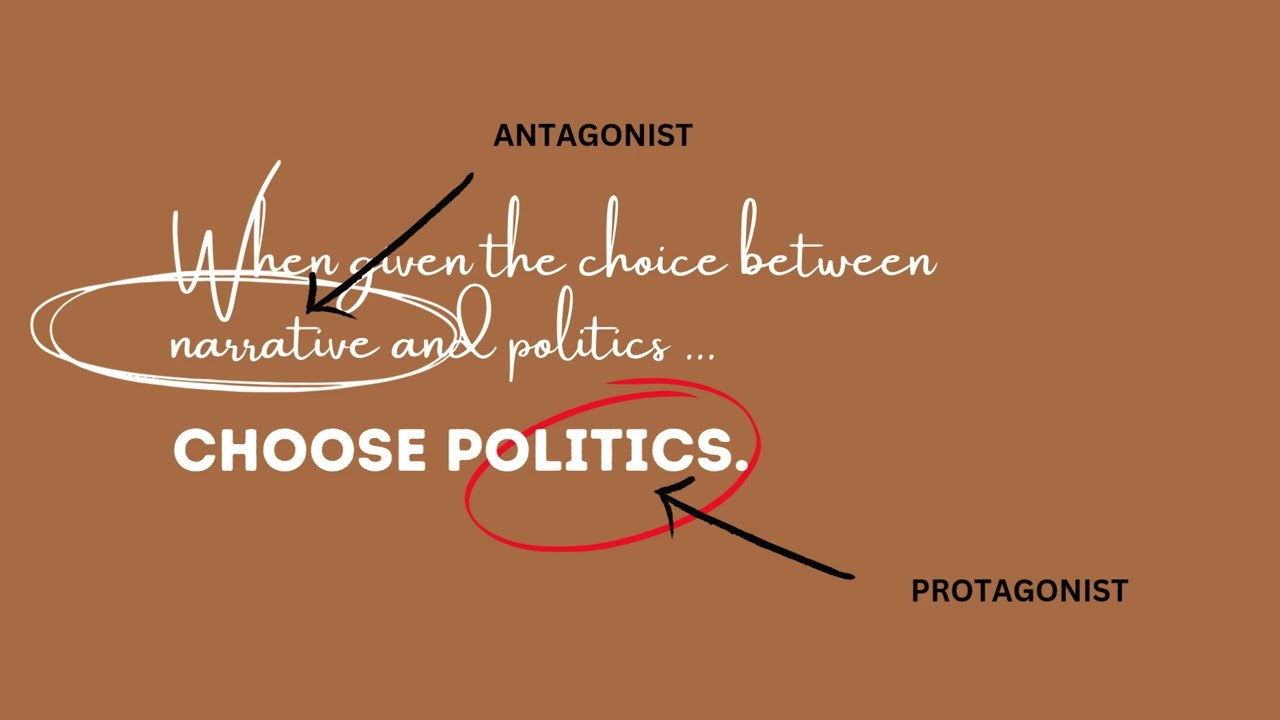
David Dault argues that Hollywood's three-act hero's journey, perfected by Marvel, creates politically passive audiences by treating narrative as a profit formula. He traces this from Joseph Campbell's monomyth through Peter Watkins's "monoform" concept, then proposes counter-strategies like détournement and participatory theater to reclaim storytelling for genuine politics and audience agency.
Chapters
I want to thank Midwest AAR President Jenny Kaplan for the kind invitation to speak to you today, and I also want to thank Philippa Koch and Vadim Putso and all the folks that have worked to welcome me and to support my presentation today. I'm truly grateful. Also, thank you, Associate Dean Jolly. Yes, good, very nice to meet you. Alright, as was mentioned in those kind words of introduction, I have a long career parallel to my academic career working in various types of media. In that capacity, the best description of my work might be as a professional storyteller. I've helped to bring stories to the television screen, to radio, to podcasts, and to print. And to get a shape of the narratives as well as the material structures that produce, distribute, evaluate, and reward or punish those narratives. And so in many ways, in addition to being an academic and a teacher, I am a storyteller and a student of storytellers. And it's in that capacity that I'm coming to speak with you today. A couple of years ago, I was invited by Princeton University's Center for Culture, Society, and Religion to come and talk to their graduate students about storytelling as a viable mechanism to bring their scholarship into the public sphere. In those remarks, and in the conversation that followed, I presented a very positive view of a very formulaic type of narrative. What we might call the basic conflict narrative or the three-act structure. And I suggested that this structure can and should be leveraged by scholars when they are trying to get the attention put onto their work in the public sphere, because the public at large is primed to respond to this particular type of storytelling and to stories that are presented in this way. So if you're unfamiliar with what I mean by the three-act structure, let me offer a somewhat dated example. A classic conflict or three-act structure goes like this: boy meets girl, boy loses girl, boy gets girl back again. Or if I may use language familiar to some here in the audience, another version of the three-act structure goes like this: Christ has died, Christ has risen, Christ will come again. Now, in many ways, the talk I'm gonna give you this afternoon is the flip side to that talk at Princeton. There, I talked about the positive aspects of storytelling. Today, I'm going to warn you about the more malign aspects, the more shadowy aspects, if you will. In those earlier remarks, I discussed the practical benefits of harnessing a certain type of storytelling because the audience is primed to respond to certain structural triggers in certain predictable ways. Today, I wanna speak instead of the public dangers and the possible political costs that arise because an audience is primed to respond to certain structural triggers in certain predictable ways. Now, what do I mean by primed to respond? Well, I've got a couple of teenagers in high school, and one of the units that they do in PE every year is health. Last year, our older kid came home after one of these health classes and they said to me, Papa, did you know that food companies have laboratories and they spend millions of dollars every year fine-tuning the the fat and the salt and the sugar in our foods so that when we start eating their products, it's very hard to stop eating them? And that sometimes we get so hooked on the food that, that we get so hooked on foods that aren't so good for us because of that? And I looked at my child and I said, yes, I do. Nutritionists tell us that humans have evolved to have a particular positive response to the basic building block ingredients of our diet, such as sugar, fat, and salt. Food production companies have now taken these biological preferences and weaponized them against us. Well, I want to suggest that in a similar fashion, humans over the millennia have evolved also to respond to stories just as they have evolved to respond to nutritional prompts, communities across the globe have found reasons to gather and to tell stories together as a way of explaining and understanding the world, yes, and explaining and understanding themselves. But just like we are now experiencing a nutritional narrowing and weaponization, we are also experiencing a narrowing and weaponization of our narratives. Our healthy desire for good stories has been weaponized against us, and we now find ourselves not only craving a certain very stylized kind of narrative, but we find ourselves in the unique position of being unable to imagine any other kind of narrative than the structures which currently hold us in thrall. It's as if we have been trapped in a narrative food desert. As William S. Burroughs once put it, we are the products now. And as a product, speaking to my fellow products, I want to offer this afternoon both what I hope will be some clarifying analysis as well as perhaps some first steps in a way out of this addictive weaponized trap. So if I were to boil down my remarks today into one thesis statement, it would be this: when you're given the choice between narrative and politics, you should choose politics. And in these remarks that follow, I'm going to explain what I mean by that and why. Now, even as we are making that statement that given the choice between narrative and politics, you should choose politics, You will notice that I've already fallen into a kind of narrative trap because in that statement we now have a protagonist, politics, and we have an antagonist, narrative. And in what follows, a possible structure for my talk would be simply to line out a kind of journey where we discover the conflict between politics and narrative. We explore it. And that would— we explore what would delight and frustrate us. And then eventually I would bring us to a tidy resolution at the end where either we have the romance of politics winning or we have the tragedy of the triumph of the antagonist, where the narrator, the narration, the narrative reigns supreme. So I wanna highlight already that even as we begin to examine narrative, we kind of fall into the trap of narrative. We fall into the clutches of narrative. And so I'm going to proceed with that in mind, and I'm gonna do what I can along the way to highlight those moments when narrative is pulling us into its clutches. And I'm gonna try and frustrate those reflexive tendencies where I can. So it would be good, I think, to define some terms. I've already talked about protagonist and antagonist within what we have come to understand as a typical story. The protagonist is the agent around whom the story turns, the one who has the most possibility for action, but also in good stories, the protagonist is the one who has the most possibility for growth and change. The antagonist, on the other hand, is a character or a set of forces or the object that interrupts and tries to thwart the realization of growth and action and agency on the part of the protagonist. And so as we think about this dyad of protagonists and antagonists, we see almost a Hegelian struggle of self-overcoming and self-realization through negation. It's an interesting mechanism, one that's worth pondering at length. I'm not gonna ponder it here. I should take a moment to say some words as well about the other term that I have been using both in the title and also in some of my remarks up to this point, and that term is politics. Throughout my remarks today, I'm gonna use this term politics in a rather technical way as opposed to an everyday and common way. When we think about politics in regular language, we often think about voting and a kind of dialogical argument and the kind of back and forth that we see and that we observe on the television. But that's not the way that I'm intending to use it today. Instead, I'm going to be borrowing and drawing from the work of Hannah Arendt. Now, she wrote a lot about politics, and her thought developed and shifted from work to work. So she doesn't offer us one set definition of what politics is in her thinking. But genealogically, we can gather some key themes from Arendt. First of all, for Arendt, politics exists when you have difference without violence. Persons with different backgrounds and different needs reasoning together about how to build a common life together. That is at the heart of Arendt's ideas about politics. Similarly, for Arendt, politics describes these moments when we are able to speak openly and honestly about our wants and our needs without resorting to manipulation or trying to instrumentalize the other person in the conversation. Politics is communication without coercion. But probably the most important way of understanding politics in Arendt's developing thinking is that it describes a project aimed towards an unknown future, a future that is fundamentally out of our individual and collective control. And so for Arendt, politics is deeply tied to another concept that was central to her thinking, the concept of natality. Natality means for Arendt that every moment we have the possibility of creating something new together. It points towards generativity and birth and new life. The unexpected future we create together is not some distant horizon out there waiting for us, but it is anchored in the anarchic genius of this very moment when something new and unexpected might be birthed by our common communicative, non-coercive, nonviolent existence across our differences together. I had to practice that phrase. Arendt thought about politics in parallel with this concept of natality, but she also thought about politics in tension with some other concepts. For Arendt, the opposite of politics is economics. We can think of economics as the mechanism for reaching a known, predicted, predictable future. A helpful image for understanding Arendt's notion of economics here might be that of a factory. You put in raw materials at the front, and then you put in a certain amount of labor over a set period of time, and you should expect that on the other end, the factory will yield a certain amount of product. This amount of material will yield a definite number of widgets at some future point in time, or else something has gone wrong. And the predictability of that kind of future is the axle around which the wheel of economics turns. In Arendt's thinking. This preoccupation with being able to say, at this point in the future, we will get this number of widgets. We have tied this ability to anticipate certain futures up in the mechanism of profit, and thus economics is really the mechanism around which most of our agency is preoccupied these days. In Arendt's analysis, these economic structures have pretty much become the only game in town, the only story that we tell. And thus, for Arendt, our political sphere, where we work together across difference towards unknown futures, has been wholly captured by this economic sphere, where we compete to eliminate difference in the name of greater and greater productive efficiency. Economics has captured the whole of our imaginations in service to this idea of yielding the predictable, planned, dependable future. Now, as an aside, I want to give a shout out to Christian Balzer's paper from earlier today on colorblind conservatism, where she explored some similar structures of predictable futures in the work of the American Prosperity Gospel Movement. I hadn't thought about those connections before today, but I'm gonna be following up thinking about them now that I'm alerted to their existence. Thank you for that. So I hope that these remarks, with these remarks, you're starting to see some of the lay lines of what's gonna follow in my talk today. I wanted to just put in play Arendt's particular ideas about politics because they interrupt some of our traditional expectations. In this sense, even mentioning natality invites natality. I needed to say all this in order to turn now to what I want to say about narrative. But I want to remind you that I have also already told you that I think that narrative is playing the role of the antagonist, the villain, if you will, here. So you see, even as I tell you that this is where I'm heading, I'm already following the stock structure of a script. Even in my attempt to caution us against the seductions of narrative, I'm falling prey to the narrative, the economic structures of storytelling. So let me now turn to an analysis of this economic structure of narrative, economic both in the fiscal sense, but also in Arendt's sense, narrative in the service of fatality. The yielding up of the planned and predictable future. This philosophical connection between narrative and economics that I just suggested is not accidental. And so now let us begin to turn to fleshing out this mechanism of narrative, why it is that it has a deep and profound— well, one might even say physiological connection to the idea of planned and controlled futures. And why I hope we may be able to imagine something different in our storytelling and in our interactions with one another that would approach what Arendt calls politics. So as a way of critically analyzing what I have here been calling weaponized attention or weaponized narrative or addictive narrative, I'm going to quickly introduce 3 figures and 3 key terms that I'm gonna be using in a complimentary and critical fashion. So the three key figures are Joseph Campbell, Peter Watkins, and Sigmund Freud. And the three key terms are monomyth, monoform, and master plot. And if you've never encountered these terms before, that is okay. They're coming from a kind of abstract place, but I hope that I'll be able to present them in a tangible and accessible manner in the next few minutes so that you can begin to spot the occurrence and activity of these, these three forces as you navigate your own media landscapes. So if I had a bit more time, this would be a much longer section talking about Freud and the master plot, and it would come later in the talk instead of right here. But because of time, I decided that I would move it up and I would just say a couple of remarks about it. This concept, Freud's master plot, comes from the title of an essay by Peter Brooks, and really I cannot recommend this essay highly enough. In it, Brooks offers a close reading of Freud's book Beyond the Pleasure Principle in an attempt to answer the question, why do we have stories in the first place? Because we can't just say, once upon a time, two people lived happily ever after. If we say that— yeah, you like that, right? If we say it that way, we get very, very frustrated. Wait, what happens in the middle? Exactly. And so Peter Brooks is trying to lean into that frustration. We seem to want the frustrating, distracting middle of the story where everything goes wrong, and we don't feel satisfied by the happily ever after conclusion unless we get some frustration before it. So Brooks, rereading Freud, offers an answer to the question, why do stories have middles? And Brooks's answer, drawing from Freud's work with shell-shocked World War I veterans, is Trauma. We tell and retell stories as a kind of therapy to safely process the traumas of the past, and in order to make our terms with the ultimate traumatic removal of agency, death itself, which is ahead of us. Okay, so there's a lot more to say about Brooks and Freud's master plot. I recommend that you read the essay. It's wonderful, and I'm happy to return to it in the questions. But for now, I just need to put a pin in Freud here and move on. Okay. So let's talk about Joseph Campbell and the monomyth. The monomyth comes to us from the work of Joseph Campbell, and another name for the monomyth is the hero's journey. As a screenwriter and author Christopher Vogler has put it, quote, the hero's journey was Campbell's all-embracing metaphor for the deep inner journey of transformation that heroes in every time and place seem to share. A path that leads them through great movements of separation, descent, ordeal, and return. And in his book, The Politics of Myth, Robert Ellwood observes that in the wake of Campbell's writings, the monomyth becomes a kind of toolbox for our collective political imagination, in that it seeks to be a, quote, cohesive story about who a people are, what they can accomplish, and what their deep-level values are, unquote. I wanna linger on that language in these two quotations for just a moment because it's important. Vogler says Campbell thought the monomyth described a pattern of heroes in every time and place. Ellsworth said that Campbell wanted the monomyth to be a key to describing the limits of human experience, who people are, and what they can accomplish. And in that sense, Joseph Campbell was not unlike many academics that we may have known through the years, someone who is convinced that their theory is exhaustive and that it describes everything. Now, Campbell and his theories might well have just remained in academic obscurity had it not been for a young filmmaker who happened upon his writings, an ambitious director by the name of George Lucas. In the mid-1970s, Lucas was working on what he referred to as a space opera, inspired by the low-budget serials like Flash Gordon that he watched as a child. So Lucas had read Campbell's work and decided to use these ideas about the hero's journey to give structure to the movie that he was working on. The working title of that project was The Journal of the Whills. We now know it as Star Wars. The combination of science fiction and monomyth became an immediate sensation. As Robert Ellwood has noted, quote, perhaps Campbell's greatest triumph of all, though an indirect one, was the overwhelmingly successful series of Star Wars movies. These films have created out of science fiction what seems to be the dominant living imaginative mythology of our time. "Comparable to the role of Arthurian fantasy in Victorian England or Wagner's heroes in Wilhelmian Germany," unquote. It's possible that some of you in this room have no idea what the media world was like prior to Star Wars, but it was a singular event. It became the highest-grossing film of all time to date when it was released, Adjusted for inflation, the original film is the second highest-grossing North American film after Gone with the Wind, and it is the fourth highest-grossing film in the world overall. When it was released, nobody, including George Lucas, thought it would be a success. And after it became not only a blockbuster, but the blockbuster, everyone across Hollywood stood up and took notice. Suddenly, every studio wanted to figure out how to repeat the success of Star Wars. And success here did not necessarily mean telling a great story. No, success meant finding out how to turn small to moderate capital investments into astronomical profits, pun intended. Moreover, with Campbell's monomyth, the studios now seemed to have a formula that guaranteed success. After all, if it worked for a movie as weird as Star Wars, it will work for anything. Thus began the process of reshaping the media production apparatus such that, that the success of Star Wars could be replicated again and again and again. To return for a moment to Hannah Arendt's concept of the economic, the people who ran Hollywood wanted a predictable future. They wanted a predictable future that not only would render them steady profits, but a predictable future that would allow them to say with assurance that the profits would be of a certain magnitude. To do that, more and more studios began to rely on what they decided were predictable stories, or I should say, stories created using one very predictable story structure. In the nearly 50 years since Star Wars first hit the theaters, a symbolic feedback loop has developed in Hollywood. Studios increasingly sought projects that fit the narrow confines of the mono-mythic formula,. And as a result, a parallel industry arose, a series of experts who wrote books and offered classes designed to help you sell your script in Hollywood. Over time, the pressures coalesced. All the major books that teach you scriptwriting utilize some variant of the monomyth. I've got some of them up here. And since 1977, it has become increasingly difficult, if not impossible, for movies to get made in Hollywood that don't follow the monomythic structure. If you remember Martin Scorsese talking about the Marvel Cinematic Universe and how bad he thought it was, this is part of the dynamic that he's trying to condemn. I don't have to— I didn't have time to bring that into my remarks, but I just wanted to mention it here. Everyone wanted to replicate Star Wars, even if they were telling very non-Star Wars-like stories. Now, all of this, remember, is driven by economics. Not artistry. Nobody wants to invest time in writing a script unless they think it has a good chance of selling, and increasingly nobody at the studios wanted to put capital into a film project unless they could predict a certain magnitude of return on their investment. In the wake of the triumph of Campbell's monomyth, Hollywood filmmaking becomes completely financialized. Risk will no longer be tolerated, The structure is universalized, and endless contortions of content are produced to fill the same repetitions of hero's journey and three-act conflict structure. And this brings us to the monoform. This is a term coined by the avant-garde Marxist filmmaker Peter Watkins in the late 1970s. It describes, quote, the standardization of the audiovisual form resulting in the creation of an increasingly hierarchical and manipulative relationship with the audience, unquote. As Watkins developed his critique over a series of lectures and essays, he noted that it was not just the rigidity of storytelling structure, as was the case with the monomyth, that was the whole of the problem. Rather, Watkins noted the entire material process of filmmaking, from scripting to editing, has been engineered and refined to create a certain type of politically passive audience. As Watkins put it in his essay, Notes on the Media Crisis, quote, this monoform is designed to entrap, to catch and hold the attention of the public ever— the public over prolonged periods of time, It is organized to create predetermined responses, which means that before the audience sees any monoform film or television program, its producers already know how they, the audience, will react, or at least such is the intention. No allowance is made for any reaction from the audience which might be different to the anticipated and created one. Unquote. As more and more money gets tied up in producing stories that are simply reconfigurations of earlier stories, all other types of storytelling and storytelling structure begins to be crowded out of the production process and in the media. So this monoform is present now, not only in cinematic structure, but also television structure, mass market fiction, and other types of media storytelling. It is a way of shaping the attention of the audience towards an economic end. And I mean that both in the financial sense and in our sense. In Watkins' analysis, the monoform is not simply an economic engine, but it is explicitly anti-political. It is designed to interrupt the possibility of audiences reflecting, pausing, and talking back to the media that they were experiencing. They're not supposed to critically engage with it. Rather, they are supposed to simply consume it, enjoy it, and ask for more, like a bag of potato chips. And this is not just true at the level of consumers of media. The pressures to adhere to the monoform are also at play with the producers of media themselves. In 2015, in an interview with Charlie Rose, George Lucas said, quote, "One of the reasons I retired is I could then make the movies that aren't popular." Because in the world we live in, in the system we've created for ourselves, in terms of— it's a big industry. You cannot lose money. So the point is that you have to, you're forced to make a particular kind of movie. And I used to say this all the time when people, you know, "Back when Russia was the Union of Soviet Socialist Republics, and they'd say, 'Oh, but aren't you glad that you're in America?' I said, 'Well, I know a lot of Russian filmmakers. They have a lot more freedom than I have. All they have to do is be careful about criticizing the government. Otherwise, they can do anything.' And so what do you have to do? You have to adhere to a very narrow line of commercialism," unquote. Think about that for a moment, though. George Lucas, arguably the co-author of the very machine that we're now discussing, who took the monomyth and monetized it, building a golden on-ramp to the monoform— George Lucas said that he had to retire from the industry in order to make the kinds of films that he wants. All his money, all his power, all his influence did not give him the one thing that he truly wanted. Agency. Now, if you've been following the pieces I've been laying out so far, your ears may have just perked up because we have circled back to the observations made earlier by Hannah Arendt and the diverging paths of fatality and natality, the economic and the political. On the one hand, we have the triumph of Campbell's monomyth through Star Wars, resulting in the financialization of storytelling and the handing over of Hollywood to a pure and unbridled economic intent. But now we have Watkins taking the analysis even further. The financialization of the monomyth did not stop with storytelling, but through the advent of the monoform, this new weaponized form of storytelling has been used to evacuate our politics as well, with the result that we are no longer a public, but a fractured series of fandoms. The special effects budget in Star Wars meant that audiences became hungry for more and more types of visual spectacles, which meant that the economic outlay to produce these kinds of films increased, and as the economic outlay increased, producers and financial backers wanted more and more of an assurance that they would get a return on their investment, which meant that they wanted to buy into projects that were more or less guaranteed success. What that meant was that even as innovative as Star Wars was at the time, as soon as it became the blockbuster, it began to eclipse the possibilities of other projects having the same kind of radical innovation in terms of storytelling and risk-taking. Instead, it began to narrow its focus. Even as the technology of visual storytelling increased, the variety and possibility of the story structures themselves began to increasingly narrow. Probably the best early example of this was the movie Alien, which played off of two of the previous successful blockbusters. When it was getting pitched, the creators of Alien described it as Jaws in space. Those of you who are familiar with Mark Fisher and his idea of capitalist realism have heard this song and dance before. Somewhere in the late 20th century, right around the time that the monoform came to power, we lost the ability to make new things. Instead, we seem more and more only able to reboot, reshoot, or retell the stories that have already been successful. The Lion King is a beloved movie? Let's turn it into a franchise. Let's make a video game. Let's adapt it into a stage play. Finally, let's re-release the story, but this time, instead of being an animated cartoon, will have all the parts played by CGI live animals. And it makes money hand over fist. Mark Fisher said that capitalist realism involves an inability to move on, to be trapped in an ever-repeating nostalgia, to be trapped, as he said, watching 1970s sitcoms on increasingly higher-definition televisions. And it should be clear all this is happening not because we somehow ran out of fresh ideas. This is happening because the constant regurgitation of old content into the monoform renders two very valuable economic outcomes: very high, reliable profit margins and political passivity. And now we have all the pieces in place. In order to be able to talk about, and I hope to be able to talk back to, the Marvel Cinematic Universe. Now, for better or for worse, the monoform has reached a state of perfection, and it is here that we can frame the Marvel Cinematic Universe as the height of repetitive storytelling that is galvanized for maximum controlled effect and maximum controlled Affect. Every single one of these movies is a tightly controlled monomyth, and each forms a part of a larger monomythic structure. The franchise not only has a decidedly economic purpose— it is the case that most of these movies each made over a billion dollars at the box office— but as I will argue, it also has an expressly political purpose in our landscape. It's about policing, The Marvel Cinematic Universe is about genocide. It's about making us think about having others do the fighting for us. It is about a certain type of catharsis and dealing with a certain type of trauma. But let's start with the fiscal and financial aspects. The MCU formally began in 2008. That's not even 20 years ago at this point, and in that time it has generated profits of close to $34 $50 billion. Just for comparison, the total profits of the Star Wars franchise, which began 30 years before the MCU in 1977, has just reached $47 billion. And the Star Wars franchise is a finely tuned money-making machine, make no mistake about that. So it should give us some idea of just how turbocharged the MCU is about generating returns on its investments. Films in the MCU that generate 3 or 4-fold returns on production costs are considered flops. They really want every single one of these properties to hit at least $1 billion in revenue. That doesn't give filmmakers a lot of room to take risks. Think again about what George Lucas said: "It's a big industry. You cannot lose money. You have to adhere to a very narrow line of commercialism." So, it's very clear that there is an extreme fiscal conservatism at work in the storytelling. But let's not lose sight of Peter Watkins's idea here of the monoform. There's a radical social conservatism in operation here as well. The turbocharged monoform of the Marvel Cinematic Universe is interested not only in creating a certain streamlined set of media properties, but also creating a streamlined set of audiences. James McIntosh made a video essay back in 2023 called "The Politics of Superheroes: Defenders of the Status Quo," and he observes that the MCU is, quote, "a universe where very little social progress can ever really be made. While the heroes do usually manage to roll back the various apocalypses," they don't use their superpowers to help build a better world. So rather than focusing on innovative ways to transform society for the better, we mostly just see superheroes reacting whenever the status quo is threatened. In Age of Ultron, Tony and Bruce's plan to use AI technology to bring about peace in our time— peace in our time is framed as the height of hubris and something that endangers all of humanity. Ultimately, the Avengers learned that it's a mistake to try and reshape the world. They must instead wait around for external threats to materialize, and then and only then can they leap into action, unquote. And here McIntosh's analysis really parallels that of Peter Watkins's critique of the monoform. As McIntosh notes, in the MCU, quote, there is no public to speak of. There are only innocent victims, unruly mobs, and of course, godlike superbeings who monopolize power. And if the public does not exist, what we might call constituent power also cannot exist. We are then left with a situation where a small group of powerful, unelected supermen and a very few superwomen hold all the cards. In this way, the public is stripped of any power and reduced to a passive fandom. And that means that there's simply no way to achieve the kind of fundamental transformation that's necessary to turn the planet into an equitable or sustainable place to live, unquote. All right, so I need to pause here and say I am a fan of the MCU. My family and I have watched the Infinity Saga multiple times, and I'm moved to tears every single time that Tony does that damn snap. And again, I want to stress that I make my living in part as a professional storyteller and as a consultant to storytellers, so I have preached the gospel of the monomyth and the monoform. They are incredibly effective, and moreover, they are trustworthy. Back when I used to produce television documentaries, I would sometimes say to my staff that we were in the emotional manipulation game. So what I'm saying today is not that Marvel is bad, bad, bad, and that you should never enjoy these movies. But just like if we only lived on a diet of processed foods like potato chips, we would harm our physical health. The gravity of the perfected monoform, as expressed especially by the conservative social forces of the MCU, can prove harmful to our political health. As Ruha Benjamin has put it, we can become endangered when our imagination becomes limited to futures where only violence, eugenics, or totalitarian control seem like viable options. And as I have tried to demonstrate today, there's a, there's a danger that this is the sort of imaginative logics, and these are the sort of imaginative logics embedded in the monoformic structures of the Marvel Cinematic Universe. And so what can we do? How might we begin to talk back to the Marvel Cinematic Universe or to the next monoform that is deployed against us to turn us from natal publics into fatal fandoms? Well, in my last few minutes, I want to sketch out a couple of options. One option, inspired by the Situationists back in the 1960s, is détournement. Uh, that's a fancy word for the process of appropriating the images that are forced on us by large media and advertising firms and rearranging them or remixing them to form new subversive messaging. This was practiced in the 1980s in the music industry, both by fringe bands like the Bay Area's Negative Land, as well as rap and hip-hop artists with the rise of sampling and remix culture. In these cases, artists are taking what is offered by the monoform and repurposing it, it in fresh and often liberative ways. At least that is until the, the new forms are themselves reabsorbed by the monoform, but that's the subject of a different keynote. Please do invite me back. But parallel to remix culture has been a movement in print culture known as subvertizing, again, rearranging well-known advertising imagery and creating subversive, pro-human, and pro-ecological messaging. Perhaps the best-known practitioners of this have been Canada's Adbusters Collective with their magazine of the same name. So the last slide and this slide are examples of the practice of subvertizing. What you'll notice is they take for granted the existence of the monoform. They expect you to know the context and reference of these images. And this shared knowledge in some ways becomes the motor power for the subversion. But, and this is a loving but pointed critique, they only work if we assume that the monoform remains in full effect. If the monoform were to collapse, these particular types of art subversions would also collapse. So these are interesting examples and provocative for sure, but they are not, for me at least, the most compelling possibilities here. Instead, I am interested in those thinkers and those avenues that reject the premise that the monomyth is the universal form of storytelling, and which offer a different metric for successful storytelling than the monoform. I'd like to conclude with two examples. The first example comes to us from Ursula K. Le Guin. It's from a short essay of hers called "The Carrier Bag Theory of Fiction." Don't let the brevity fool you, however. What Le Guin offers us here is a powerful antidote to both the monomyth and the monoform. Where the monomyth is about individualism and conquest, the carrier bag approach is about community and sustenance. Her critique goes like this, quote, so long as culture was explained as originating from and elaborating upon the use of long, hard objects for sticking, bashing, and killing, I never thought that I had or wanted any particular share in it. The society, the civilization they were talking about, these theoreticians, or we might add these practitioners of media production using the monoform, this society was evidently theirs. They owned it. They liked it. They were human, fully human, bashing, sticking, thrusting, killing, 'Wanting to be human too, I sought for evidence that I was. But if that's what it took to make a weapon and kill with it, then evidently I was extremely defective as a human being, or not a human at all,' unquote. I hope in that extended quotation we can hear in Le Guin's critique an echo of the criticism offered by comics writer Alan Moore creator of the legendary series The Watchmen, when he says, quote, most of the pressing issues facing our society today cannot be solved by finding a few bad individuals and punching them in the face, as cathartic as that fantasy might be, unquote. And thus, with Le Guin and Moore, we return to Hannah Arendt's notion of politics: difference without nonviolence, communication without coercion, and the openness to natality, the birth of something new here and now between us that opens us to an unknown future, an uncontrolled future. As Ursula Le Guin puts it in the Carrier Bag essay, embodying this kind of politics means turning away from the killer story toward the life story. As Le Guin puts it, a life story, quote, full of beginnings without ends, of initiations, of losses, of transformations and translations, and far more tricks than conflicts, far fewer triumphs than snares and delusions. A life story redefines technology and science as primarily a cultural carrier bag rather than a weapon of domination, unquote. Or to put it into the language of the monomyth, the life story is, quote, a fundamentally unheroic type of story, unquote. But how do we create space for this life story when all around us are hemmed in by the monoform of the killer story? How do we talk back to the Marvel Cinematic Universe in practice? So the final image I want to leave you with today comes from the work of Brazilian theater director Augusto Boal in his book "Theater of the Oppressed." In it, he writes that when theater began, it was an event that incorporated everyone, as Pope Francis might put it, todos, todos, todos, everyone, everyone, everyone. Boal says, quote, theater was the people singing freely in the open air. The theatrical performance was created by and for the people. Then came the aristocracy and established divisions. Some persons will go to the stage and only they will be able to act. The rest will remain seated, receptive, passive. These will be the spectators, the masses, the people. And in order that the spectacles may effectively reflect the dominant ideology, the aristocracy established another division. Some actors will be protagonists. They will be aristocrats. They will be heroes. And the rest of us will be the chorus. Symbolizing in one way or another the mass, the audience, or in the language we have established in this keynote today, the fandom, unquote. Boal goes on to challenge us to reclaim the true heart of the theater, and in his challenge, I hope that you will hear echoes of Le Guin's life story and Arendt's curious notions about politics. "The barrier between actors and spectators must be dissolved," Boal says. "All must act. All must be protagonists in the necessary transformation of society." And Boal has put this into practice again and again, inviting ordinary everyday folks into the theatrical moment. They run a scene together, often taken right from the headlines of that day's newspaper, And then they see where things go wrong. And then someone either on the stage or from the audience calls out, stop! And they discuss what went wrong. And then they run the scene again differently until it fails again differently. And someone calls out, stop! And they discuss it and they run the scene again. And they run the scene again until they figure out together how to make the moment right. As Boal once put it, "It may be that theater itself is not revolutionary, but have no doubt, it is a rehearsal for the revolution." The change we need will not come to us from Hollywood. The change we need will not come from a better story about a better hero, because in the end, as well as in the beginning, the hero only knows how to tell and live one kind of story: the killing story. But we may not be able to afford too many more of these killing stories, and we may not be able to afford too many more heroes. It is up to us, you and me, to assume the role of protagonists, to cease being an enthralled fandom and return to being an engaged public, practicing the ancient and natal arts of the life story together. Difference without violence, communication without coercion, and the openness to the birth of something new here and now between us that opens us to an unknown and uncontrolled future. Thank you for your kind attention, and I look forward to your questions.
More from Rick

Voices in My Head (The Rick Lee James Podcast) Episode 628: Truth, Justice, and the Way


Rick Lee James feat. Phil Keaggy - Heaven Is Full of Criminals (Official Lyric Video)







Heaven is full of criminals — bold opening and musician story #substack #shorts
