Episode 580 - Sean McGowan - The Holistic Guitarist - Voices In My Head (The Rick Lee James Podcast)
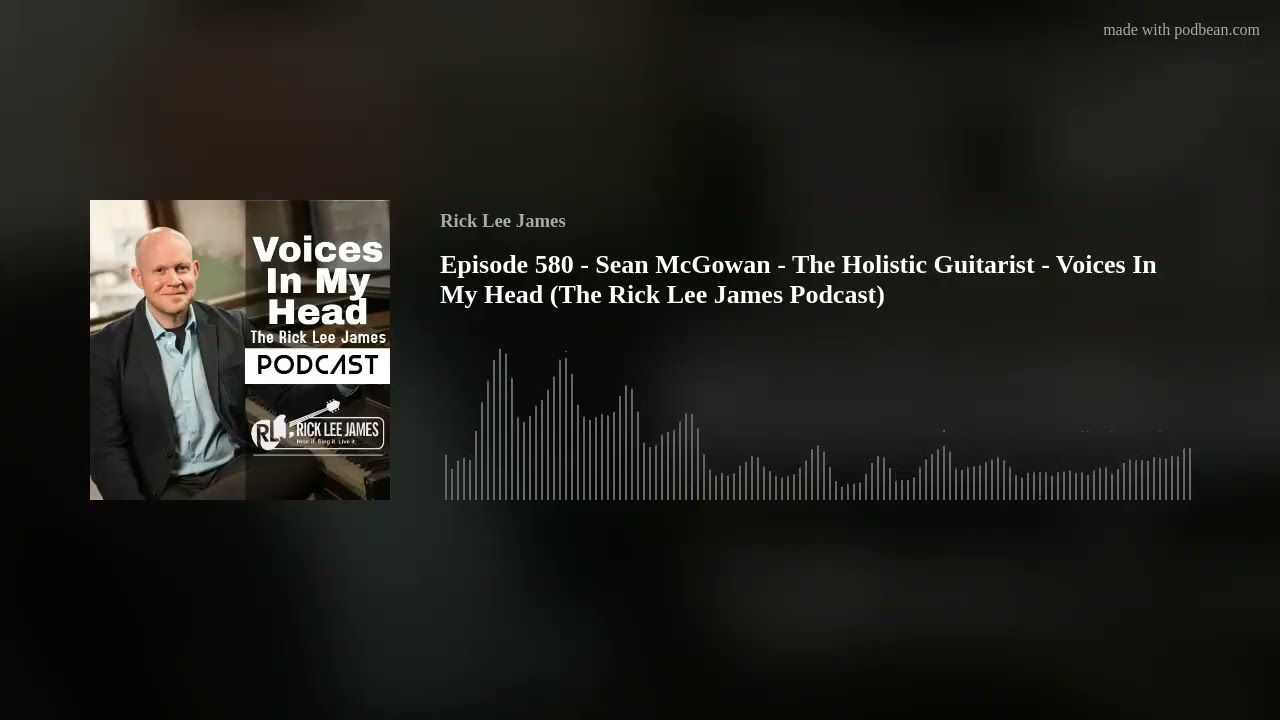
Sean McGowan, a fingerstyle jazz guitarist and University of Colorado Denver professor, discusses his book The Holistic Guitarist, which treats guitar playing as integrated physical health, mental wellness, and creative development. The book includes testimonials from Alex DeGrassi and Eric Johnson, a companion video series on stretches and posture, and chapters on performance anxiety, visualization, and technique.
Chapters
Well, welcome back to Voices in My Head. As always, I am your host, Rick Lee James, and I am so glad for all of you who are listening, and thank you for joining me here once again. I am particularly excited about this episode this week just because of the topic. My guest this week is Sean McGowan, and he is a renowned fingerstyle jazz guitarist, a composer, and an educator, and he has innovative techniques and diverse musical influences that have set him apart really in the world of guitar. And he has a great new book that's about to come out called The Holistic Guitarist: A Complete Guide to Musical Well-Being. And the book isn't just about mastering guitar, it's about nurturing the musician as a whole, physically, mentally, and emotionally. And Sean's holistic approach, I think, can help guitarists of all levels to cultivate a sustainable and fulfilling musical journey. So without any further introduction of the book, we're going to get right into it tonight. So Sean, welcome to Voices in My Head. So glad to have you here.
Hi, Rick. It's so nice to be here. Thanks for inviting me to be on your show.
Well, um, this is the first time that we actually had a chance to meet tonight. I've seen some of your books in the past, and you're just an amazing musician. I wonder if, as we start, you could just tell our listeners a little bit about yourself.
Sure, um, I've been playing guitar for quite a long time, I think 40 years now maybe, and professionally, all genres, all types of gigs you can imagine over the years. But in addition to playing, um, I've, I've been teaching for quite a while. I started actually teaching informally, you know, just informal private lessons when I was in high school. And, um, over the decades since, I've taught in music stores and private music academies, um, in public school, and, and I've been in ed for about 23 years now, which is, which is what I love doing. So I'm currently a full professor of music at the University of Colorado at Denver. I'm from Maine originally, and while I was there, taught at Bowdoin College and University of Maine. But I've been teaching full-time here at CU Denver for about 18 years now. And along the way, I've, I've, I have courses through TrueFire.com, which is a really wonderful online platform for all styles of guitar playing, as well as artist workshops Works, which is now a sister company to TrueFire. And I've been working with Acoustic Guitar since, um, since 2004 actually. We, we sort of just celebrated our 20th anniversary, um, working with them as a contributing lesson provider and educator and consultant. And so this will be my 5th book published with Acoustic Guitar and Hal Leonard, and I'm very excited about it because it literally has been about a 25-year project in the making for me anyway.
Wow, that's terrific. And that's actually where I saw the ad first, was an email that Acoustic Guitar sent out, and I saw the book and I thought, oh my goodness, this sounds right up my alley. I like guitar playing and holistic lifestyle things, so this is a great opportunity. Now, that being said, I haven't had a chance to see the book yet because it's not come out yet, so it's going to be kind of a surprise to all of our listeners whenever we get it. But I have had a chance to see some of the preview pages, and the art is really neat in the book and the things that you've written in there. So I'd love to just kind of pick your brain about, for you, what does it mean to be a holistic guitarist, which is really what the book is based around?
Yeah, I think, you know, it can mean a lot of things, but to me personally, I think you set it up beautifully in your introduction. Holistic in the sense that The journey— all of our journeys in music and guitar is a lot more than just, you know, practicing repertoire or learning scales or even playing gigs. It's holistic in the sense that it takes your entire, you know, commitment emotionally, mentally, spiritually, physically, and to get the most enjoyment out of it and therefore, you know, cultivate enjoyment within so that you can spread that joy and communicate through music, whether it's through teaching or performance or recordings, any of those outlets. And I think that that is such an important human characteristic, and it's a gift, and it's, it's more important— it's as important now as it's ever been. And so, so to zoom in a little bit from that, specifically the first couple of chapters— well, I divided the book into 3 overall sections. Physical maintenance or physical wellness, mental and emotional wellness, and then creativity. So the first part of the book was really born out of— this is where I mentioned, you know, 25 years in the making. Many years ago when I was a student myself in college, I just noticed this kind of unspoken thing that was happening, which was musicians constantly getting injured but also not talking about it. So it was a little bit of an elephant in the room. And, and, you know, a lot of musicians, all musicians in all genres, especially classical musicians, orchestral musicians, there's a stigma around getting injured, you know, because then people worry about not being able to, you know, play or perform or do a tour or function. So it was just something that wasn't talked about ever when I was a student. And then it kind of dawned on me that it was never a part of traditional pedagogy, at least none that I have experienced up until that point. You know, I never had a guitar teacher talk about the mechanics of playing, um, how your back is supposed to feel, how your, you know, posture is like. Um, it was just strictly, you know, music in the sense of learning scales, learning chords, learning music theory, learning history, learning repertoire, those kinds of things. But it wasn't holistic in the sense of how do you take care of yourself physically, how do you take care of yourself emotionally. So the first couple of chapters in the book explain the most common idiosyncratic injuries that afflict guitar players. And that's followed up by, um, wellness resources, preventative strategies, as well as lots of testimonials from musicians, both who have recovered fully from injuries, all styles of guitar playing, and those who have had quite long careers. I've, I was really fortunate to get people like Alex DeGrassi and Grant Gordy and Eric Johnson, people from different styles who have been doing this for a long time offer and share their thoughts on how they've stayed healthy over the years.
Well, that's terrific. And I love sometimes when I warm up— now, not that I play it nearly as well as he does, but Cliffs of Dover by Eric Johnson. You know, it's one of those kind of go-tos with the little riffs that are in there.
So, oh yeah, it's iconic.
Yeah, it's just, it's amazing. It's just a beautiful piece of music. So I'm really excited. And there's a whole other layer of why I'm excited too. This past year, just a couple months ago actually, I went to to the Grammys because I— first time ever, probably last time ever, I played on an album that got nominated this year. Very cool. And it was, it was like, oh, this is probably never going to happen again, you know. I mean, I don't know for sure. Uh, just before I went, I cut the tip of my finger so bad, like I, I nearly cut the, the end of it off, like, and, and, and I still haven't quite recovered from it in my playing. Um, so when I saw what your book was about, you know, kind of taking care through injuries and different things, I'm kind of building back, uh, from from where I was, where the, the wound is healed, but there's still a lot of pain that goes along with it. So I'm grateful that you even thought about this, because as you said, um, we don't think about it a lot when we're, you know, learning guitar from people. Usually it's just scales and techniques and different things, but to actually think about what it means to be recovering in the midst of that, because we wear a lot of our identity, I think, too, on our instrument sometimes. So yeah, absolutely. Almost feels like when, when we get broken where we can't play, uh, it's like that part of us dies a little bit, you know. So it really hurts to do that. So, uh, so bravo, first of all, for, for— I feel like doing the job of a servant in many ways to other people, for helping that kind of instruction that can help people in the recovery process. But the other layer of that that I wanted to say, and I mentioned this in the email, my day job is I work as a chaplain in a hospital. So a lot of what I do is, is I visit with people. Most people don't realize is that what we do as chaplains is based around emotional health. And so whenever we come into people, they're dealing with great anxieties. And I will go into a room sometimes with people if I discover that music is very important to them, and I will play music on the guitar, or I might wheel a keyboard in or something like that. And there's something very core there where people find meaning and value and purpose and connection. And I've played everything from Amazing Grace to Freebird in rooms with patients. You know, it just depends on what that, uh, person meets. So, um, I'm really interested— all that is to say, um, in this approach that you have in the book, and I'm grateful. So because I have not had a chance to read it yet, I'm looking forward to it. Tell me a little bit about some of the artists you mentioned before, how you have interviews and different tips and techniques. Um, is it the kind of thing where, uh, you wrote most of the book and then had them write little sections, or do they have like chapters, uh, of themselves, or how is it structured in if you don't mind going just a little bit deeper.
Of course. So I kind of, you know, it changed directions quite a bit over the past year where I was physically writing the book and trying to organize everything, and it all kind of fell into place in a beautiful way. And, you know, of course everybody's busy, everybody's running around, people are touring. So, you know, things were coming in at different times in terms of testimonials and stories and advice and all of those things. So the way I ended up structuring it was I thought that it would be a great, almost kind of an epilogue to the book. So chapter 9, there's 9 chapters in the book, and chapter 9 is just titled Good Medicine: Advice for the Long Haul. And I had such great advice and testimonials. There's testimonials and very real-life anecdotes which are funny, but also profound and poignant throughout the book. But I got so much great information from Eric, from Alex, from Grant Gordy, from a great flamenco guitarist Juanito Pascual, Lawrence Juber, great acoustic fingerstyle guitarist, played with Wings, um, Clive Carroll, a beautiful English player. You know, lots of, lots of people from different styles. They were so generous with their information and their experiences that they wanted to share to help anybody, um, you know, um keep, you know, keep a vibrant musical practice consistent. Uh, Vicky Genfand was another one, uh, and they've also had experience touring and recording in quite a bit. And, and they basically had, um, so much to offer that we just decided to dedicate an entire chapter. So the way that that last chapter is, it's kind of a culminating chapter. So it's all of those people and more that I mentioned on developing technique in a way that you won't hurt yourself, how to stay healthy when you're traveling on the road, how to stay inspired, you know, how to develop a meaningful relationship with yourself through your instrument, with your audience through your music and live performances and recordings. And they all had some very beautiful things to contribute. You know, the last section of the book is just called Advice to a New Student. And everything that they said is like a little treasure. It's like a little gold nugget of wisdom. And so I was very humbled and grateful that they were willing to contribute in that way. And then leading up to that last culminating chapter, um, so as I mentioned, the first couple of chapters are all about physical wellness, injury prevention. There's lots of— I should mention there's an accompanying video. Um, I haven't seen the video yet, but there's several hours of accompanying video where, um, I walk people through all of the stretches and postural elements. So it's, it's more than just what's on the page. You can actually see me do it, and it's That's a nice thing. And then chapter, uh, chapter 4 is all dedicated to mental and emotional wellness. And that's anything from, you know, people that maybe suffer from performance anxiety to just developing better concentration techniques, memorizing music, visualization practice— whether you're visualizing a new scale pattern or a new melody on the fretboard, or visualizing a chord progression, maybe visualizing something in an alternate tuning if that's new for you, or even visualizing yourself on stage, like really being optimistic about a gig or a performance. And it's an opportunity to visualize yourself, visualize your sound, and to get really, you know, do a deep dive, you know, try to get in on a deeper level beyond just the notes on the page, so to speak. And then Chapter 6 is a giant 30-page chapter on technique. There's lots of etudes, there's lots of musical excerpts in different styles. And, um, and then the 7 and 8 chapters are all about how to creatively practice, how to practice in a way that stimulates creativity, that's enjoyable, and that, um, is, is optimal for growth and, and advancement in whatever it is your goal might be.
Well, that sounds amazing, and, and, um, really looking forward to reading it for myself. Um, and I wanna, I wanna ask you, because we're talking about this and you were mentioning some of the ways that musicians connect with their instrument or connect with their audience. And I feel like it would be foolish if I don't ask you, as a musician yourself, as the writer of this book, can you tell us a little bit about your connection to your instrument and to your audience and all that playing? And I— if that makes sense as a question, because I, I really feel like everybody has a little bit of a different relationship with why they do music and why guitar instead of, you know, uh, Why not dobro, steel guitar, piano? I mean, whatever it is. And all of those instruments, a lot of us are multi-instrumentalists and we have a different relationship with each instrument. So I just love to hear some of the connection that you feel you have and where you have that connection.
Yeah, sure. Well, you know, I've always played guitar, you know, first and foremost. And I just, I just love it. Like, I just love guitar. And, and I think that in terms of my own relationship, that's, that's cultivated through my teaching and learning and studying and composing and performing is just to really like connect, connect with my instrument and also connect with anybody that's listening in a way that is just really all about a joyful experience, you know, or maybe, you know, an emotional experience. It doesn't always have to be, you know, joy— it's joyful in this, in the practice, and in the sense of like, let's experience something beautiful together, whether it's a song that may be sad in content or, you know, more uplifting or whatever it is. I think music has always served throughout history that function, whether it's used in, in, you know, spiritual practice or religious ceremonies or in, you know, just, just in everyday life through ritual and family events. And for, you know, I mean, if you think about it, everything that we have right now music through our phones or even CD players, that's all so relatively recent. So, you know, for eons, music was communicated orally and in person, and I think that there's still a real need for that. So for me, being an instrumentalist— I don't sing at all— I've thought about that a lot, like, how can I connect to an audience without actually singing words? And, um, you know, and of course I had lots of incredible experiences seeing some of my favorite instrumental musicians do that And they all had this ability to just connect through sound. It's just, it's something that's almost ineffable, but you can feel it. I remember when I was young, I got to see B.B. King, and it was incredible. I mean, it was transformative in a way. Like, he was such a great singer and a personality, but just his guitar playing just gave you chills through your entire body. So, you know, I think that the audience is is on the side of the musician, you know. Of course, they want to be there to suspend their reality. Of course, they're not— they don't want to be there to criticize, or, or they don't want anybody to fail. And this is something that we talk about with dealing with performance anxiety, for example, which is very normal and everybody deals with it to some extent. But we can't let it be debilitating or prevent us from doing what we love, because the audience wants that. The audience wants you to go up there and play well. They want to experience something that's really beautiful and joyful through sound. And, and that's kind of the ineffable part. But I know you know what I'm talking about when you've experienced something that was just beautiful, whether it was a symphony or a rock concert or what— a solo classical guitar. I just saw David Russell a few weeks ago, and it was amazing just the way that he could communicate through his instrument. So I've had lots of experiences where I've got to experience that as a listener, and I do everything I can to try to cultivate that so that I can communicate it as a performer.
Yeah, well, and I love too, just speaking— thank you very much for sharing that, by the way, that was very insightful. Um, but just speaking for myself too, on the other— from my experience, one thing I love about it is when I hear a song that for whatever reason it connects with me in, in a powerful way, and then it's like, oh, I need to learn how to be a part of that. So like, for me, playing then becomes like, oh, I get to kind of be a part of this song, you know, like in some ways, because you're learning the notes. And there was, especially when I was young and just learning, you know, around 15 years old, there was such a feeling of accomplishment and such a feeling of, you know, like really like accomplishing this victory of like, oh my goodness, I'm playing this note for note just like the song that I love so much. And I'm a part of this bigger thing. And I don't know.
Yeah, I mean, isn't that the coolest feeling in the world?
Yeah, for sure, for sure. And then you're helping audiences too to begin to feel that way, and then some of them may go home and try to learn it as well. You're just kind of sharing this thing together, and I love that. So yeah, me too.
And I would just say real quick, you know, like there's things, you know, unfortunately right now we're in a time where things are so divisive, um, through media and politics or all of these other things, and music like food is a connector, you know. Music brings people together, and just like food, it's a great way to learn new things and experience new things. And I've always felt that way about music. So just to be a participant in that process is, I think, fundamentally sacred, and it's something that I take— I do not take for granted. And actually, throughout the book, there's quite a bit of information on keeping a journal and also meditation and visualization, but also a practice of gratitude, which I feel is a really— again, this is something that none of my teachers ever talked about, but through other study and reading of other things, I think it's absolutely, you know, pertinent and applicable to contemporary musicians to really feel honored at the privilege of being able to participate in something so wonderful and expansive and far-reaching as music. Not, not only geographically far-reaching, but historically, like you said, You know, if you play a classical— a piece written for classical guitar that was composed in the 1800s, you're really— you're literally connecting to, you know, over 100 years ago or 150 years ago with that composer and with the times. And it's, it's really special. It's very cool.
Well, I very much agree with you on that. So, well, I can't wait to read the new book when it comes out. And just as we're closing up our time together today, uh, is there anything that we didn't anything we didn't talk about that you would like to kind of highlight? Or is there anything that you're just kind of excited about right now musically? Or it doesn't even have to be music. Maybe there's a book or a TV show.
I don't know.
Yeah, I always like to just find out what's, what's really giving you life right now.
Yeah, well, certainly this is because it's so new and there's so much energy going into it. So I would just share that, you know, I'm very reachable via my website, which is seanmcgowan-guitar.com. And, um, and if, if, if people want to visit the acousticguitar.com website, there's links to pre-order the book, um, if anybody is interested. I think one thing overall I would just say about the book is that it truly is written for everybody, any guitar player, regardless of what genre or style they play, or, you know, what level, um, they're— whether they're beginner, intermediate. This is all information that is applicable and available for all guitar players. And that was a big thing, you know. In the past, I've written books that were specifically about fingerstyle guitar. I have a book about, you know, just specifically hymns and Christmas music, and then another book just on jazz, like a jazz method. This book, which I'm very excited about, is literally for everybody, for anybody that plays guitar that wants to take a deeper dive. And it's a book— I wanted to write it like a cookbook that It was beautiful and you could just kind of come and go. It's not a method book. It's meant to be a reference manual to support people on their journey.
Well, that is terrific. Well, I know that a lot of people listening to this are going to be very excited about it too. And I will make sure to put links in the show notes to your website and to the new book. So, uh, The Holistic Guitarist, and it comes out again on which date? Uh, I should have written it down, but I didn't.
I've been told in the next 6 weeks. So there's no specific date, but certainly before, um, summer starts. Start. So I'm hoping by the end of May.
Very good. And you can pre-order it now, so that's the important part. And we'll make sure again to put links, and if everything works well in internet world like it's supposed to, from where you're listening to this podcast, you should be able to just go to the notes and click on it and be able to go right there to pre-order it. So, well, Sean, thank you so much for just being so generous to come on and talk about your new book. And, and I'm honored to find out that this is the first thing that you've done really promotion-wise as far as podcasts and things. So I'm grateful to be able to kind of premiere this, uh, whenever we release it. And it's actually going to be tomorrow from the time that we're recording this. So, wow, you work fast. I do, I do. I try to work fast for sure. So, um, well, thank you again. I appreciate it. And as I say to my guests every week when they're on this show, thank you for being one of the voices in my head this week. And as we close out today, I just want to thank all of you who are listening once again. And make sure to go to the links that we're going to have in the show notes and please feel free to check out rickleejames.com, and there's some pretty fun and interesting things on my website too that hopefully you have not seen everything on it yet, and we're planning on bringing out some more new things in the future. So have a great night, God bless you everyone, and thank you for listening to Voices in My Head.
More from Rick

Voices in My Head (The Rick Lee James Podcast) Episode 628: Truth, Justice, and the Way


Rick Lee James feat. Phil Keaggy - Heaven Is Full of Criminals (Official Lyric Video)







Heaven is full of criminals — bold opening and musician story #substack #shorts
