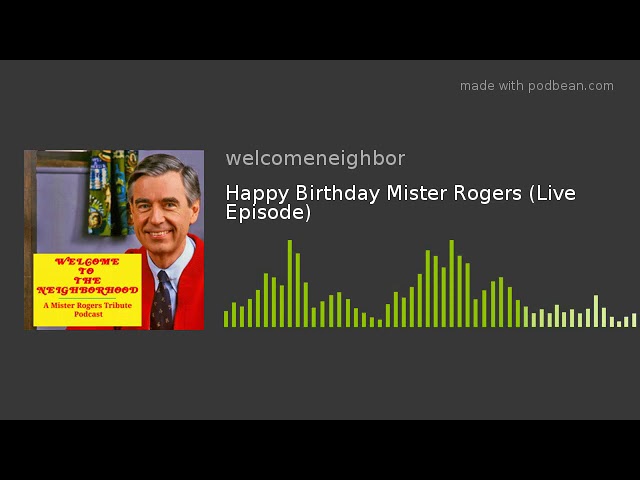
In this live, solo podcast episode recorded on March 22, 2020, host Rick Lee James welcomes listeners to a Mr. Rogers tribute titled “The Neighborhood.” He frames the show within the early COVID‑19 pandemic, noting his limited live‑show experience, a funeral memorial he is attending, and the broader societal changes caused by the virus. The episode serves as a birthday celebration of Fred Rogers’ 92nd birthday and a comprehensive tribute to Rogers’ life, career, and philosophy. James provides a concise biography—covering Rogers’ birth in 1928, education in music composition, early disdain for television, entry into TV production, creation of The Children’s Corner, the Canadian precursor to Mister Rogers’ Neighborhood, his ordination as a minister, and the launch of the iconic PBS series in 1968. He highlights Rogers’ creative output (over 200 songs, including “Won’t You Be My Neighbor?”), notable guests, awards (four Daytime Emmys, a Lifetime Achievement Award, the Presidential Medal of Freedom, Television Hall of Fame induction), and his role as a child‑development advisor to the White House. Throughout, James intersperses a series of Rogers’ quotes from The World According to Mr. Rogers, focusing on imagination, the link between wishes and effort, discipline, handling anger, and the transformative power of disappointment. He connects these ideas to the present crisis, urging listeners to practice kindness, discipline, and community support—mask‑making, grocery drops, phone calls, and other low‑contact assistance. James also acknowledges the supportive @MrRogersSay Twitter community, encourages sharing of helpful resources, and shares his personal disappointment about canceled spring‑break plans and a wedding anniversary, using Rogers’ teachings to reframe the situation. The episode closes with a final discipline anecdote about swimming, a reminder to keep promises, and a thank‑you, directing listeners to his personal Twitter (@RickLeeJames), website, and his other podcast, Voices in My Head.
Chapters
Welcome to The Neighborhood, a Mr. Rogers tribute podcast. I am your host, Rick Lee James of rickleejames.com, and I run the Mr. Rogers Quotes Twitter account found at @MrRogersSay. As we walk again into this live podcast neighborhood. We want you to know that no matter where you are from, you are welcome here. I'm glad to be your neighbor. Every daughter, every son, every tribe, and every tongue, in the spirit of Fred Rogers and the life of welcome that he lived, welcome to the neighborhood. This week at the neighborhood, I'm trying a live show again for the second time here on Podbean and hoping it goes well. I don't have, uh, a lot of experience doing live shows like this one, but I really am a little bit pressed for time this week just because, as all of you know, these are unique days for us as a nation with the virus that's going around. And in fact, this morning I am a part of a, a funeral memorial, and we're trying to do some different things for a family here and finding ways to care for them that are safe and, and will be good for them. But we'll, uh, we'll see how the day goes. So I hope that you will enjoy this tribute this morning that I've prepared for Fred Rogers' 92nd birthday. This is a day that is a very special day in many ways because I really feel like he did a lot to change the world for the better. A lot of times we don't want people to change the world. We often say that like it's a good thing, but really, as we can see this week The world has changed. All of us are trapped inside of our homes in many places, and we're trying not to go out any more than we have to because for the sake of others, we don't want to spread something that is going to cause others to become sick or something that they could maybe even die from. So in many ways this week, the world has changed. And so often when we talk about the world changing, it's not always for the good. But as we can see in Fred Rogers' life, sometimes you can change things in the world, and you can change them for the better. I think that the legacy that he left is something that is so unique, and so I just wanted to take a few moments today to pay tribute to him and, and to thank also the Twitter community @MrRogersSay, because you guys are a way that Every day you help to brighten my day. Just the kind comments, the way that you spread kindness, and even during this crisis, many of you have been finding ways to help, and some of you are making masks, and some of you are finding ways to offer yourselves and do food deliveries, and, and we've been trying to work together by retweeting and sharing different ways where you can get help if you need it. So please continue to share those types of things today. But for a few minutes today, we're gonna share and celebrate the life of Fred Rogers. So who was Fred Rogers? Well, of course he was a puppeteer and he was an ordained minister who became a host of a television show that we watched, most of us growing up, called Mr. Rogers' Neighborhood. He had a degree in music composition and he wrote over 200 songs for the show, including the theme, "Won't You Be My Neighbor," which is probably his most famous song. In his lifetime, was honored with numerous awards and accolades for his dedication to children via television. Well, he was a longtime beloved host of the show Mister Rogers' Neighborhood, and he was born on this day, March 20th, 1928, in Latrobe, Pennsylvania. He was an only child until the age of 11 when his parents, James and Nancy, adopted a baby girl. Well, after graduating from Latrobe High School, Fred Rogers enrolled at Dartmouth College where he studied for a year before he transferred to Rollins College in Winter Park, Florida. Fred Rogers, who'd begun to play the piano at a very young age, graduated magna cum laude in 1951 with a degree in music composition. Now, during his senior year of college, he visited his parents and was awed by the family's household addition. A television set. He could see a fantastic future for the medium, and as he later recalled, he immediately decided he wanted to be a part of it. But the irony of this is that he didn't like television. He actually hated television very much. He saw what I believe now, looking back, was an episode of the Three Stooges where they were hitting each other with pies and demeaning each other. And he said, "If there's one thing that really makes me angry, it's one person demeaning another. That just really makes me mad." So he wanted to do something different with children's television. So his first job in television came when he worked as an assistant and floor manager on the music programs for NBC in New York City. In 1953, he was hired to work in programming by WQED in in Pittsburgh. It was a recently launched community TV station, and it was the first of its kind in the country. Well, by the following year, he was co-producing a new program, The Children's Corner, and this allowed him to share his love of puppetry and to introduce some of his favorite puppets from his home to a young audience. In the early 1960s, he made his first appearance as Mr. Rogers on a Canadian Broadcasting Corporation show called Mr. Rogers. Now interesting, if you look at the spelling of it, there's no space. It's just M-I-S-T-E-R-O-G-E-R-S. And the program helped to lay the groundwork in its look and its approach for the later Mister Rogers' Neighborhood television show. Well, as he gained experience, so did his aspirations, and he earned his divinity degree in 1962. And at his ordination, the Presbyterian Church asked him to serve children and families through television. I always find it fascinating that Fred Rogers was our first televangelist, and I think he was probably the best still to this day. However, Canada is not where they stayed, and he and his wife Joanne ended up moving eventually. They were back in Pittsburgh where the— where Mr. Rogers created Mr. Rogers' Neighborhood in the year 1966. Well, 2 years later, Mr. Rogers' Neighborhood aired on PBS stations throughout much of the country. Well, over the course of its decades-long run, his show varied very little. He approached his young audience with respect. He talked with them directly about issues that faced not only children but also issues that faced adults, and they were issues that were rarely touched on by other television shows. Things like war, assassination, death, and divorce were things that children's television would really not dive into until Mr. Rogers' Neighborhood. On the show, you would see some of the most enduring characters on television, on children's television. Characters like Mr. McFeely, who was named after Fred Rogers' grandfather, the Owl. Then there was Queen Sarah Saturday and King Friday. And actually, he was King Friday the 13th because he wanted Friday the 13th not to be a scary time for children but to be a time where they could celebrate and have fun. So King Friday the 13th was born. At the center of the show, though, was Fred Rogers himself. He was on the screen who he was off the screen. In fact, some people said that he was even more Mr. Rogers off the screen than he was on. Well, as you all know, he was an amazing man., and I find that he is incredibly inspirational. His show attracted a number of guests over the years, amazing musicians like Yo-Yo Ma and Wynton Marsalis. Rogers also earned several awards for the program over the years and many honors, including 4 Daytime Emmys. In 1997, he received a Lifetime Achievement Award from the National Academy of Television Arts and Sciences. In sciences— not scientists, sorry, live show, can't correct it. And in 2002, he received the Presidential Medal of Freedom. Well, in 1999, he was inducted into the Television Hall of Fame. Well, Fred Rogers was committed to children, and it wasn't just limited to the TV set. In 1968, he served as chairman of a White House forum for child development in the mass media, and he was often consulted as an expert or witness on those issues. Those of us in broadcasting have a special calling to give whatever we feel is the most nourishing that we can for our audience, Mr. Rogers said. We are servants of those who watch and listen. Well, a lot of this biography today came from biography.com. And I inserted some information of my own. And we know a lot about Fred Rogers and the way that he so uniquely entered our lives and spoke to us on such a way on the television set that made us feel like not only we were listening to him, but he had a beautiful way of communicating that also made it seem like he was listening to us. Well, today on his 92nd birthday, as we are missing him in a world that desperately could use some of his kindness and wisdom, I'm just going to share some Mr. Rogers quotes to close out this podcast today. These are from the book The World According to Mr. Rogers: Important Things to Remember. Imagining something may be the first step in making it happen, but it takes the real time and real efforts of real people to learn things, make things, turn thoughts into deeds or visions into inventions. Here's another one: What makes the difference between wishing and realizing our wishes? Lots of things, of course, but the main one, I think, is whether we link our wishes to our active work. It may take months or years, but it's far more likely to happen when we care so much that we'll work as hard as we can to make it happen. And when we're working toward the realization of our wishes, some of our greatest strengths come from the encouragement of people who care about us. Or how about this quote on discipline? Discipline is a teaching-learning kind of relationship, as the similarity of the word discipline suggests. By helping our children learn to be self-disciplined, we are also helping them learn how to become independent of us. Sooner or later they must, and we are helping them learn how to be loving parents to children of their own. And this great song, which I think could benefit us a lot right now, the lyrics to 'What Do You Do With the Mad That You Feel?' There's a lot of frustration right now going on, and I think that this song could be very appropriate. What do you do with the mad that you feel? When you feel so mad you could bite? When the whole wide world seems oh so wrong and nothing you do seems very right? What do you do? Do you punch a bag? Do you pound some clay or some dough? Do you round up friends for a game of tag or see how fast you go? It's great to be able to stop when you've planned a thing that's wrong. And be able to do something else instead and think this song. I can stop when I want to, can stop when I wish, can stop, stop, stop anytime. And what a good feeling to feel like this and know that the feeling is really mine. Know that there's something deep inside that helps us become what we can. For a girl "Can someday be a woman, and a boy can someday be a man." Just a couple more quotes before I close out the episode today. "How great it is when we come to know that times of disappointment can be followed by times of fulfillment, that sorrow can be followed by joy, that guilt over falling short of our ideals can be replaced by pride in doing all that we can, and that anger can be channeled into creative achievements and into dreams that we can make come true. I think of that quote specifically today, by the way, because I know that right now there's a lot of disappointment. Many of us can't leave our homes in the way that we would like to. I know that this next week was going to be spring break as well as my and my wife's wedding anniversary, and we had planned to get away and now we can't. There's some disappointment there that comes with that, but hopefully we can know and remember that we will get through this, won't we? That times of disappointment can be followed by times of fulfillment, and that sorrow can be followed by joy. In the long run, we will come through this. We'll come through it together, we'll help each other. And even though right now as we're going through it together, it's hard because we're going through it apart in many ways, aren't we? We can't see people the way we would like to. But I still want to encourage you to reach out to your neighbors, to your friends, to your loved ones in any way that you can in this time. Even if it's a phone call, a text message, an email. Maybe you could find out if there's anybody around you that needs groceries and if you're not a person who's at extreme risk, Maybe you could drop off groceries at their door. You don't even have to necessarily make contact with them face to face or make any physical contact. Maybe you could just find out what they need and bring it to them and drop it off. There are many ways to say I love you, as Fred Rogers would remind us again and again. And it's good for us to keep our commitments. I think I'll close with this final one about discipline that Fred Rogers talks about swimming. He, he says this. He says, "I like to swim, but there are some days I don't feel much like doing it, but I do it anyway. I know it's good for me, and I promised myself I'd do it every day, and I like to keep my promises. That's one of my disciplines, and it's a good feeling after you've tried and done something well. Inside you think, 'I've kept at this and I've really learned it.'" not by magic, but by my own work. Well, friends, let's be disciplined enough to keep our commitments in this time. Let's take care of each other and love each other well. And I think we would find that if Fred Rogers was with us today, he would say, "I'm proud of you." Well, I'm Rick Lee James, and I want to thank you for being here with us today for this second live episode that we've done all in one week. Uh, hopefully we're getting better at this and We'll be learning more about adding more new music and things like that to the episode in the days to come. But thank you. You can follow me on my personal Twitter account if you like, @RickLeeJames, and my website is rickleejames.com. My other podcast is called Voices in My Head: The Rick Lee James Podcast, and I look forward to being with you again next time. But until then, you make each day a special day. You know how? By just your being you. There's only one person in this whole world like you, and people can like you exactly as you are.